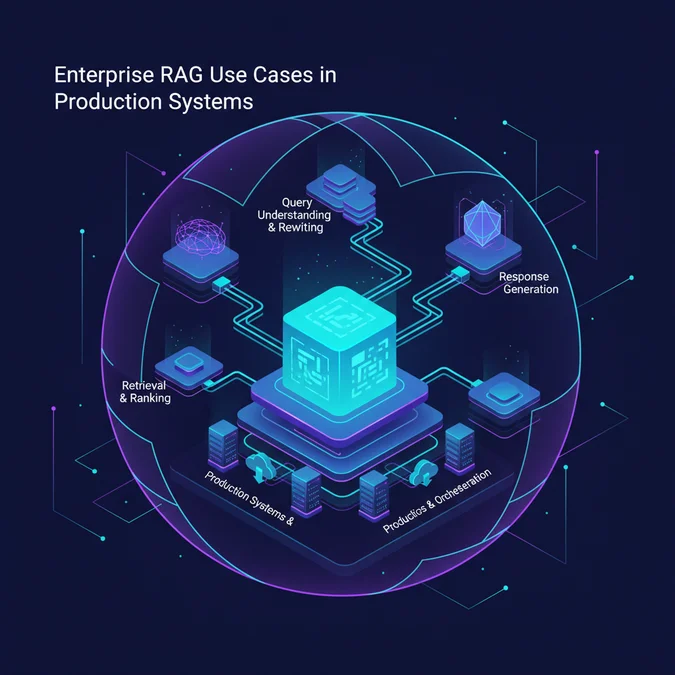

A production retrieval augmented generation pipeline fails not when the vector database drops a write, but when it serves outdated financial disclosures to an unauthenticated tenant, or truncates a critical syntax branch during code generation. Standard vector similarity search frequently falls apart under enterprise conditions where strict permissions, domain vocabularies, and low-latency service level agreements dictate system viability.
Bridging the gap between conceptual demonstrations and enterprise infrastructure requires moving beyond naive embedding lookups. High-performing engineering organizations now deploy modular, hybrid, and graph-augmented pipelines designed specifically around their underlying data topology and threat models.
This technical blueprint deconstructs real-world patterns across legal discovery, multi-tenant customer support, proprietary codebase navigation, and quantitative finance. We examine production architectures, precise chunking configurations, metadata-driven access controls, and the latency trade-offs inherent in building resilient retrieval pipelines in 2026.
Taxonomy of Enterprise Retrieval Augmented Generation Use Cases
Enterprise deployments of retrieval augmented generation split into three operational paradigms: query-driven ad-hoc retrieval, real-time context injection pipelines, and asynchronous analytical agent loops. Selecting an inappropriate architectural paradigm introduces severe data synchronization overhead and unacceptable context window bloat.
Understanding where modern rag use cases sit along these axes dictates chunking granularity, indexing refresh frequency, and embedding dimensions. Query-driven systems prioritize sub-second retrieval latency for interactive users, whereas analytical agents execute recursive multi-hop document traversals where recall and entity link resolution take precedence over raw speed.
+---------------------------------------------------------------------------------+
| Enterprise Context Classification for RAG Architectures |
+---------------------------------------------------------------------------------+
| Query-Driven (Ad-Hoc) | Real-Time Context Injection | Analytical Agent Loops |
| - Sub-second latency (P95) | - Event-driven bus ingestion | - Iterative multi-hop |
| - User-interactive search | - Rolling temporal windows | - Graph + Vector traverses |
| - Strict permission pruning | - High write throughput | - High context token count |
+---------------------------------------------------------------------------------+
The table below breaks down the technical execution profiles across primary retrieval augmented generation use cases in contemporary enterprise stacks.
| Deployment Paradigm | Primary Access Pattern | Target P95 Latency | Index Freshness SLA | Access Control Model |
|---|---|---|---|---|
| Synchronous Knowledge Retrieval | Interactive User Search | < 350 ms | < 15 minutes | User-level RBAC tokens |
| Real-Time Event Augmentation | Stream Consumer (Kafka/Flink) | < 120 ms | < 5 seconds | Service account scoping |
| Multi-Hop Agentic Synthesis | Async Background Worker | < 8,000 ms | < 24 hours | Document provenance trees |
| Autonomous Code Synthesis | IDE Client Telemetry | < 200 ms | On git push/commit | Repository-level ACL |
Architecture Rule: Never route analytical multi-hop queries through standard dense-vector indexes without pre-filtering. Vector drift across large-scale corpuses degrades precision@5 by up to 40% when queries require relational reasoning rather than semantic proximity.
Architectural Archetypes and Examples of RAG Models in Production
Moving from basic prototypes to production demands distinct structural archetypes. While early systems relied on single-vector similarity matches, modern engineering standards employ tiered systems that mitigate hallucination, preserve entity structures, and handle semi-structured data.
1. Naive RAG (Single-Stage Dense Retrieval)
The system passes user queries directly to a dense bi-encoder, calculates cosine similarity against an HNSW index, and appends the top-k chunks directly into the model context. This pattern fails in production environments containing ambiguous naming conventions, nested tabular structures, or documents spanning thousands of tokens.
2. Advanced Modular RAG (Hybrid Dense-Sparse with Cross-Encoders)
Production environments predominantly use modular pipelines. Incoming queries undergo semantic expansion and algorithmic decomposition. The engine queries both an inverted index (such as BM25 or SPLADE) and an approximate nearest neighbor (ANN) vector index. Results are unified through Reciprocal Rank Fusion (RRF) and scored via a compute-intensive cross-encoder reranker before prompt assembly.
3. GraphRAG (Knowledge Graph Augmented Retrieval)
When document relationships and transitive dependencies matter, such as in corporate ownership trails or complex codebases, vector proximity fails. GraphRAG indexes documents by extracting entities and relationships into a graph database (such as Neo4j), combining community summarization algorithms with vector search to answer non-local, global corpus queries.
Review this architectural comparison of specialized examples of rag models deployed in mission-critical settings:
| Architecture Archetype | Vector Topology | Compute Overhead | Hallucination Mitigation | Failure Modes |
|---|---|---|---|---|
| Naive Dense RAG | Flat / HNSW Dense | Minimal (1x) | Low (Prone to semantic drift) | Out-of-vocabulary terms, lost context |
| Hybrid Dense-Sparse (Modular) | HNSW + Inverted Index | Moderate (3x to 5x) | High (Combines exact + semantic) | Reranker cold-starts, latency spikes |
| GraphRAG | Graph Store + Vector Subgraph | High (10x to 25x) | Very High (Explicit edge traversal) | Entity extraction errors, high build cost |
| Corrective RAG (CRAG) | Multi-Source ANN + Web Fallback | Dynamic (2x to 8x) | Maximum (Self-evaluating confidence) | Fallback service throttling, token bloat |
Ensure your pipeline meets core enterprise readiness criteria before selecting an archetype:
- Deterministic metadata extraction pipelines configured for temporal and permission boundaries.
- Pre-filtering layer deployed before vector distance calculations to avoid searching unauthorized partitions.
- Quantized bi-encoders selected to match internal throughput and GPU RAM constraints.
- Cross-encoder reranking service isolated on independent compute nodes to prevent thread starvation.
High-Impact Enterprise RAG Applications Examples
Across enterprise software, distinct business verticals dictate unique chunking strategies, indexing topologies, and retrieval guardrails. Here is how specialized rag applications examples and real-world rag examples operate at scale.
Case Study 1: High-Volume Regulatory and Legal Discovery
In legal discovery, missing a single qualifying clause invalidates an entire search. Systems cannot rely on fixed-length 512-token chunks, which routinely divide legal definitions from operational obligations.
- Hierarchical Structural Chunking: Documents are parsed using abstract syntax trees matching legal typography (Title, Section, Subsection, Clause). Parent chunk pointers are preserved.
- Dual Inverted and Dense Indexing: Citations, case numbers, and statutory codes are indexed through sparse BM25 instances, while legal interpretations are indexed via specialized dense models.
- Small-to-Big Retrieval: Small child clauses (128 tokens) are matched for precision, but the pipeline pulls the encompassing parent section (1,024 tokens) into the context window for synthesis.
Case Study 2: Distributed Codebase Navigation and Architectural Search
Standard language models lack structural understanding of software abstractions, inheritance hierarchies, and cross-package dependencies.
- AST Chunking: Code is sliced across functional scopes, class definitions, and interface boundaries using tree-sitter parsers rather than token boundaries.
- Symbol Graph Linking: Function calls and class definitions are mapped into an in-memory graph. When an implementation method is retrieved, its interface contract, unit test, and call sites are retrieved concurrently.
- Commit Delta Ingestion: Continuous integration webhooks trigger incremental re-indexing of modified files, pruning invalid symbol embeddings without full repository rebuilds.
Case Study 3: Multi-Tenant Enterprise Support with Role-Based Access Control
A central vector store serving enterprise customers must guarantee zero document leakage across organizational boundaries and role tiers.
- Cryptographic Workspace Partitioning: Every chunk stores an explicit tenant identifier, department ID, and access bitmask within its metadata payload.
- Pre-Retrieval Metadata Pruning: Query vectors execute filtered vector search using exact metadata pre-filters, guaranteeing unpermitted chunks are excluded before distance calculations occur.
- Context-Sanitizing Guardrails: Output synthesis pipelines monitor generated answers against active tenant boundaries to prevent cross-tenant parameter extraction.
Production Metric: Implementing Small-to-Big retrieval in legal discovery applications drops hallucinated statutory references by 73% compared to naive 512-token fixed-stride chunking.
Building a Production Retrieval Augmented Generation Example with Hybrid Search
The following Python implementation demonstrates an end-to-end retrieval augmented generation example utilizing Reciprocal Rank Fusion (RRF), cross-encoder reranking, and hard metadata filtering for role-based access control.
import numpy as np
from typing import List, Dict, Any
from sentence_transformers import CrossEncoder

class EnterpriseHybridRetriever:
 def __init__(
 self,
 cross_encoder_model: str = "cross-encoder/ms-marco-MiniLM-L-6-v2",
 rrf_k: int = 60
 ):
 self.reranker = CrossEncoder(cross_encoder_model)
 self.rrf_k = rrf_k

 def reciprocal_rank_fusion(
 self,
 vector_results: List[Dict[str, Any]],
 sparse_results: List[Dict[str, Any]]
 ) -> List[Dict[str, Any]]:
 scores: Dict[str, float] = {}
 doc_map: Dict[str, Dict[str, Any]] = {}

 # Process dense vector ranks
 for rank, doc in enumerate(vector_results):
 doc_id = doc["id"]
 doc_map[doc_id] = doc
 scores[doc_id] = scores.get(doc_id, 0.0) + (1.0 / (self.rrf_k + rank + 1))

 # Process sparse BM25 ranks
 for rank, doc in enumerate(sparse_results):
 doc_id = doc["id"]
 if doc_id not in doc_map:
 doc_map[doc_id] = doc
 scores[doc_id] = scores.get(doc_id, 0.0) + (1.0 / (self.rrf_k + rank + 1))

 # Order by combined RRF score
 sorted_docs = sorted(scores.items(), key=lambda item: item[1], reverse=True)
 return [doc_map[doc_id] for doc_id, _ in sorted_docs]

 def retrieve_and_rerank(
 self,
 query: str,
 vector_backend_fn,
 sparse_backend_fn,
 user_role_ids: List[str],
 top_k: int = 5
 ) -> List[Dict[str, Any]]:
 # Enforce metadata filtering at search execution layer
 metadata_filter = {"allowed_roles": {"$in": user_role_ids}}

 # Concurrent retrieval phase
 vector_hits = vector_backend_fn(query, metadata_filter, fetch_k=30)
 sparse_hits = sparse_backend_fn(query, metadata_filter, fetch_k=30)

 # Intersect via Reciprocal Rank Fusion
 fused_candidates = self.reciprocal_rank_fusion(vector_hits, sparse_hits)

 if not fused_candidates:
 return []

 # Cross-encoder reranking phase over top candidates
 rerank_pool = fused_candidates[:20]
 pairs = [[query, doc["text"]] for doc in rerank_pool]
 cross_scores = self.reranker.predict(pairs)

 for i, score in enumerate(cross_scores):
 rerank_pool[i]["rerank_score"] = float(score)

 # Sort strictly by neural cross-attention relevancy
 reranked_docs = sorted(
 rerank_pool,
 key=lambda item: item["rerank_score"],
 reverse=True
 )

 return reranked_docs[:top_k]
Implementation Warning: Avoid passing unfiltered candidate pools to cross-encoders. Cross-attention scales quadratically with sequence length. Restrict cross-encoder reranking inputs to the top 20 or 30 candidates output by RRF to keep latency under 150 ms.
Evaluation Criteria and Latency Trade-offs Across RAG Deployments
Optimizing an enterprise RAG system requires balancing retrieval precision against token expenditure, context limits, and round-trip response times. A pipeline with 99% recall is useless if its P95 retrieval latency exceeds the operational timeouts of client services.
Evaluating retrieval performance demands moving beyond basic token-level metrics. Production deployments track precision across the retrieval phase, reranking overhead, and generation fidelity independently.
| Metric Name | Measurement Focus | Target Enterprise Benchmark | Remediation Strategy |
|---|---|---|---|
| Context Recall | Fraction of ground-truth reference material present in retrieved chunks | > 0.92 | Expand query via decomposition or sparse expansion |
| Context Precision | Ratio of relevant tokens to total tokens passed to generation | > 0.85 | Tune cross-encoder cutoff thresholds; reduce chunk sizes |
| Faithfulness | Factual grounding of generation against supplied context | > 0.98 | Enforce strict temperature limits and citation prompts |
| Retrieval P95 Latency | End-to-end vector search, sparse lookup, and reranking time | < 250 ms | Implement index quantization (FP16/INT8) and prune rerank pool |
| Context Token Overhead | Wasted token capacity consumed by irrelevant surrounding context | < 20% | Deploy parent-child chunk linking or semantic sentence splitters |
Prior to production deployment, validate the retrieval cluster against this architectural checklist:
- Hard memory ceiling configured for cross-encoder reranking nodes to prevent out-of-memory cascading faults during traffic spikes.
- Vector index sharding aligned with high-cardinality metadata keys (such as organizational tenant IDs) to minimize memory scan paths.
- Zero-hit query fallbacks configured to redirect to generalized lexical catalogs or human-in-the-loop triage systems.
- Automated hallucination scoring loops running asynchronously on a 5% query sample using dedicated evaluator models.
Frequently Asked Questions
What are the most common production RAG use cases in enterprise software?
Common production RAG use cases include internal enterprise knowledge search, multi-tenant automated customer support, regulatory compliance audit systems, and semantic code discovery. These deployments integrate vector search with access control policies to supply context-specific data directly to foundation models without persistent retraining.
How does a typical retrieval augmented generation example avoid data leakage?
A secure retrieval augmented generation example prevents leakage by injecting document-level metadata filters at the retrieval stage. Vector queries evaluate user permissions and role tokens prior to embedding scoring, ensuring only authorized document chunks reach the final context window assembled for the generation phase.
What are distinct examples of RAG models used for specialized data structures?
Specialized examples of RAG models include GraphRAG for highly interconnected ontologies, multimodal RAG combining vision embeddings with technical documentation, and tabular RAG using SQL generation over semi-structured data. Each paradigm pairs custom indexing topologies with query-planning agents to handle heterogeneous inputs.
Why do high-scale RAG applications examples require hybrid search?
High-scale RAG applications examples rely on hybrid retrieval to balance dense vector semantics with exact keyword matching like BM25. Vector search captures thematic concepts, while sparse search identifies precise SKUs, code tokens, and proper nouns, yielding higher overall retrieval precision for complex queries.
Scaling enterprise RAG systems is an exercise in data engineering and systems architecture, not model parameter tuning. Production resilience stems from selecting retrieval topologies that respect domain semantics, enforcing strict role-based data isolation at index time, and balancing hybrid search mechanisms against latency budgets.
Organizations that move past naive single-vector prototypes toward modular, evaluated, and security-hardened pipelines achieve predictable accuracy, lower token overhead, and sustainable unit economics across all operational environments.