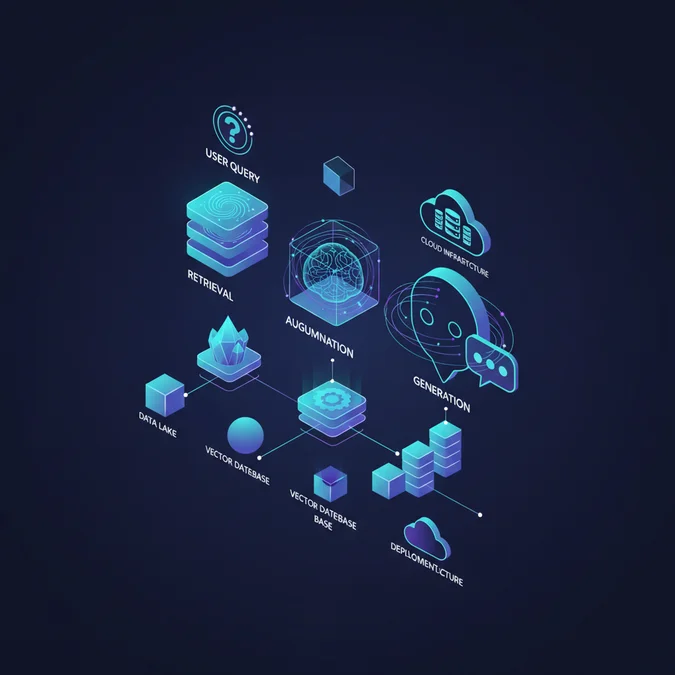

Naive RAG implementations often falter when faced with complex, multi-hop queries or massive, heterogeneous document stores. In 2026, the transition toward advanced RAG architecture is no longer optional for production-grade AI applications. Engineering teams must move beyond simple cosine similarity on flat text chunks to build resilient, context-aware pipelines that prioritize precision over raw recall.
This article examines the modular components of modern retrieval systems, providing a technical taxonomy of techniques that balance latency, cost, and accuracy. By moving from monolithic retrieval to a staged, multi-step execution path, you can eliminate common bottlenecks and significantly reduce hallucination rates in your LLM-driven services.
Evolution of Advanced RAG Architecture
The evolution of retrieval systems has moved from simple index-then-retrieve flows to sophisticated, multi-stage advanced RAG systems. Naive implementations typically suffer from low precision, as they treat all document chunks as equally relevant. Advanced RAG architecture addresses this through query transformation, metadata-aware filtering, and multi-vector representations.
Production-grade retrieval requires a decoupling of the retrieval stage from the generation stage, allowing for modular optimization of each component.
Modern pipelines now incorporate document pre-processing (semantic chunking), retrieval optimization (hybrid search), and post-retrieval refinement (reranking). This layered approach ensures that the context window is populated only with high-signal, relevant data.
Taxonomy of Modern RAG Retrieval Methods
Selecting the right approach depends on your data structure and query complexity. The following table summarizes the primary rag retrieval methods and their trade-offs in production environments.
| Method | Latency | Accuracy | Best For |
|---|---|---|---|
| Vector Search | Very Low | Moderate | Semantic similarity on unstructured text |
| Hybrid Search | Low | High | Keyword-heavy technical documentation |
| GraphRAG | High | Very High | Complex relationships and cross-document reasoning |
| Reranking | Moderate | High | Filtering top-k results for precision |
These rag techniques are not mutually exclusive. High-performance systems typically utilize a cascading retrieval strategy, where initial broad retrieval is narrowed down through successive layers of filtering and ranking.
Implementing an Efficient Advanced RAG Pipeline
Constructing an advanced RAG pipeline requires a robust orchestration logic that handles query expansion and result merging. Follow these steps to implement a production-ready flow:
- Query Rewriting: Use a lightweight LLM call to transform the user input into a canonical search query.
- Hybrid Retrieval: Execute concurrent calls to your vector store and BM25 index.
- Reciprocal Rank Fusion: Merge the results from both indices to normalize rankings.
- Reranking: Pass the combined result set through a cross-encoder to refine top-k selection.
[Query] -> [Rewriter] -> [Hybrid Search] -> [RRF] -> [Reranker] -> [LLM Response]The following Python pattern illustrates a modular approach to retrieval:
def retrieve_context(query, vector_db, bm25_index): rewritten_query = llm.rewrite(query); vector_results = vector_db.search(rewritten_query); keyword_results = bm25_index.search(rewritten_query); return reranker.rank(vector_results + keyword_results)
Scaling Efficient Retrieval Algorithms in RAG Technology
Maintaining sub-100ms latency while scaling necessitates the use of efficient retrieval algorithms in RAG technology. As your index grows, brute-force search is replaced by HNSW (Hierarchical Navigable Small World) graphs and quantization techniques.
- Approximate Nearest Neighbor (ANN): Utilize HNSW for logarithmic search complexity.
- Semantic Caching: Store previous query-result pairs in Redis to avoid redundant computation.
- Quantization: Use product quantization (PQ) to reduce the memory footprint of large embedding indices.
| Optimization | Latency Impact | Cost Impact |
|---|---|---|
| HNSW Indexing | Significant Reduction | Low |
| Semantic Caching | Near-Zero Latency | Minimal |
| Selective Reranking | Moderate Reduction | High Cost Savings |
Frequently Asked Questions
What defines an advanced RAG system versus a basic implementation?
Advanced RAG systems integrate multi-stage processes such as query rewriting, hybrid search, reranking, and graph-based indexing. Unlike naive RAG, which relies on simple vector similarity, advanced architectures prioritize context precision and noise reduction to significantly lower hallucination rates in complex production environments.
Which RAG retrieval methods offer the best balance of latency and accuracy?
Hybrid search remains the gold standard for balancing latency and accuracy. By combining keyword-based BM25 with dense vector embeddings, systems capture both specific terminology and semantic intent, providing superior retrieval results without the extreme computational overhead required by full GraphRAG implementations.
How do I optimize an advanced RAG pipeline for cost?
Optimize your RAG pipeline by implementing semantic caching and selective reranking. Only trigger expensive reranking models for queries where initial retrieval scores are ambiguous. Additionally, cache frequently requested context chunks to reduce embedding API costs and minimize redundant vector database lookups.
What are the most efficient retrieval algorithms in RAG technology today?
Current state of the art includes HNSW for fast approximate nearest neighbor search, paired with Reciprocal Rank Fusion (RRF) for merging multi-source retrieval results. These algorithms, combined with metadata filtering and graph-traversal techniques, allow for highly efficient retrieval even across massive, heterogeneous document datasets.
Successful production deployment of advanced RAG systems hinges on the iterative refinement of your retrieval path. By prioritizing hybrid search, selective reranking, and cache-heavy architectures, you can maintain high performance while keeping costs predictable.
Review your retrieval latency and accuracy metrics regularly to identify where your pipeline requires tuning. As your data volume grows, ensure that your chosen algorithms for indexing and retrieval scale horizontally to prevent bottlenecks during peak usage.