
Standard retrieval-augmented generation pipelines fail predictably when user intent spans disparate domains, retrieval indices return noisy chunks, or queries require multi-hop reasoning. In a deterministic retrieve-then-read pipeline, an unhelpful top-k vector match directly poisons the generation context, leaving the large language model with no mechanism to self-correct.
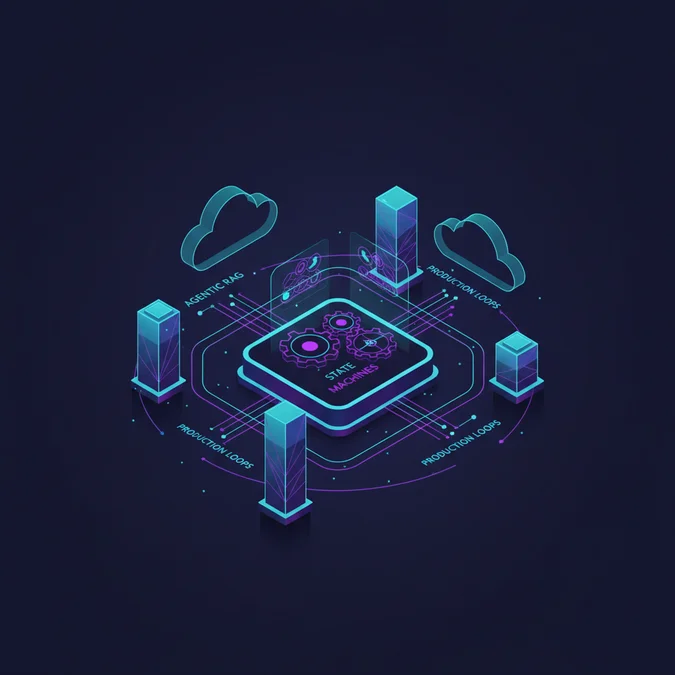
Agentic RAG replaces this linear dataflow with an autonomous, state-driven control loop. By wrapping information retrieval inside an agentic framework, the system treats vector databases, search indices, and structured SQL stores as callable tools. It evaluates context quality before synthesis, reformulates queries dynamically, and navigates branching execution paths when initial searches miss the mark.
This architectural guide provides an end-to-end blueprint for engineering agentic retrieval systems in production environments. We analyze state machine mechanics, benchmark latency and cost trade-offs against traditional pipelines, and explore code implementations featuring deterministic termination, semantic caching, and continuous evaluation.
Defining Agentic Retrieval Augmented Generation and Autonomous Retrieval
Agentic retrieval augmented generation shifts knowledge integration from static search to dynamic decision-making. In a standard pipeline, a user prompt passes through an embedding model, retrieves vector matches from an index, and appends those matches to the prompt context. If the retrieval step pulls irrelevant fragments, the generation layer inherits the failure.
Agentic retrieval transforms the retrieval step from a static pipeline phase into an iterative, tool-assisted reasoning cycle governed by explicit validation gates.
With an agentic rag architecture, the language model functions as an orchestrator. It does not blindly trust the first search result. Instead, it inspects the user objective, decides if retrieval is necessary, queries one or more knowledge stores, and systematically grades the returned context before constructing a response. This paradigm relies on three non-negotiable operational mechanics:
- Autonomous Query Reformulation: The system decomposes ambiguous or compound questions into targeted sub-queries, translating human prompts into focused vector, keyword, or structured database queries.
- Dynamic Context Grading: Retrieved document chunks pass through an automated evaluation node. Documents that fail threshold relevance checks are discarded before entering generation memory, cutting context window bloat and eliminating hallucinations.
- Corrective Retrieval Routing: When an initial index yields low-relevance results, the agent recalculates its strategy. It can alter semantic search parameters, cross-reference external web tools, or ask the user clarifying questions.
By treating knowledge bases as interactive environments rather than static references, agentic retrieval systems isolate and resolve data gaps dynamically. This dynamic control loop transforms weak or ambiguous queries into dependable enterprise workflows.
Structural Taxonomy: RAG vs Agentic RAG, AI Agents, and Hybrid Workflows
Choosing between naive RAG, advanced hybrid pipelines, and fully autonomous systems requires understanding their architectural trade-offs. The debates surrounding rag vs agentic rag, rag vs agent, and rag vs agentic ai often blur the line between simple tool invocation and unbounded reasoning.
Naive RAG uses single-turn, deterministic semantic search with no feedback loops. Advanced RAG improves retrieval using pre-search techniques (query expansion, hypothetical document embeddings) and post-search mechanisms (re-ranking, chunk compression), yet remains a feed-forward DAG. Conversely, an agentic system runs on a directed cyclic graph (DCG) with branching logic, tool use, and self-correction steps.
| Metric / Capability | Naive RAG | Advanced RAG | Agentic RAG | Pure AI Agents |
|---|---|---|---|---|
| Execution Topology | Linear Pipeline | Directed Acyclic Graph (DAG) | Directed Cyclic Graph (DCG) | Unbounded ReAct Loop |
| p95 Latency | 300ms to 800ms | 800ms to 2.2s | 2.5s to 8.5s | 5.0s to 30.0s+ |
| Average Token Overhead | 1x (baseline) | 1.3x to 1.8x | 3.0x to 6.5x | 8.0x to 25.0x |
| Hallucination Risk | High (context poisoning) | Moderate (mitigated by re-rank) | Low (automated context grading) | High (unanchored reasoning) |
| Retrieval Quality Control | None | Deterministic (Cross-encoder) | Dynamic (LLM Evaluator / Critic) | Heuristic / Tool feedback |
| Failure Mode | Irrelevant context injection | Stale rank thresholds | Infinite loops, token exhaustion | Goal drift, tool misuse |
When comparing rag vs agent implementations, pure generative agents struggle to anchor factual claims without an underlying retrieval architecture. In contrast, pairing autonomous routing with deterministic retrieval pipelines gives engineering teams the best of both worlds: flexible multi-step reasoning backed by verifiable enterprise records.
Core Agentic RAG Architecture and Multi-Agent Orchestration Patterns
Building resilient agentic rag systems requires modularizing retrieval, reasoning, and grading into isolated components. Rather than relying on a single monolithic prompt, enterprise agentic rag architecture divides system responsibilities across dedicated routing, execution, and evaluation services.
+-----------------------------------------------------------------------------------+ ║ Agentic RAG Execution Engine ║ +-----------------------------------------------------------------------------------+ | v +---------------+ | Router Agent | +---------------+ / \ Semantic Search / \ Structured Query (SQL) v v +--------------------+ +--------------------+ | Dense Vector Index | | Enterprise DB / OLAP| +--------------------+ +--------------------+ \ / \ / v v +----------------------------------+ | Document Relevance Grader (Critic)| +----------------------------------+ | |---> [Irrelevant] ---> [Query Rewriter Node] ---+ | | v [Context Confirmed Relevant] | +----------------------------------+ | | Synthesis & Grounded Generator | | +----------------------------------+ | | | v | +----------------------------------+ | | Hallucination / Faithfulness Gate|<-------------------------------+ +----------------------------------+ | v [Final Answer]Complex production implementations typically employ specialized rag ai agents arranged in supervisor-worker or hierarchical patterns. A supervisor routes the initial question across specialized agents, such as an internal compliance retriever, an API lookup agent, or a code-analysis engine. Below is a production state machine interface using LangGraph to establish these deterministic controls:
from typing import Annotated, Sequence, TypedDict, Literal import operator from langchain_core.messages import BaseMessage from langgraph.graph import StateGraph, END class AgentState(TypedDict): messages: Annotated[Sequence[BaseMessage], operator.add] documents: list[str] iteration_count: int query: str is_grounded: bool def route_query(state: AgentState) -> Literal["vector_search", "sql_query", "direct_llm"]: query = state["query"].lower() if any(term in query for term in ["revenue", "inventory", "sales", "metrics"]): return "sql_query" elif any(term in query for term in ["policy", "handbook", "clause", "guidelines"]): return "vector_search" return "direct_llm" def grade_retrieval(state: AgentState) -> Literal["synthesize", "rewrite_query", "terminate"]: if state.get("iteration_count", 0) >= 3: return "terminate" docs = state.get("documents", []) if not docs: return "rewrite_query" # In production, route to a light evaluator model (e.g. GPT-4o-mini, Claude 3.5 Haiku) return "synthesize"Production Implementation Checklist
- State Graph Recursion Safeguards: Set a strict upper limit for graph traversals (such as
recursion_limit=5) to avoid infinite loops and unexpected token usage. - Isolated Evaluation Nodes: Keep synthesis models separate from grading models. Use small, fine-tuned classification models to verify context and assess faithfulness quickly without adding excessive latency.
- Tool Isolation and Security: Sandbox dynamic tool runners, such as code interpreters or dynamic SQL query generators, with read-only database connections and tight connection pool limits.
- Fallback Circuit Breakers: Make sure the state machine falls back gracefully to standard search results or prompts the user directly if multiple retrieval and rewrite attempts fail.
Deconstructing the Cyclic Agentic RAG Workflow: Routing, Grading, and Self-Correction
The agentic rag workflow differs from standard retrieval pipelines by introducing explicit self-correction loops. Instead of returning whatever chunks semantic search pulls up first, the system assesses and adjusts its findings before answering.
- Intent Parsing and Tool Routing: The system receives a user request and determines which tools to call. If the request involves multiple steps, the agent breaks it down into sub-queries targeted at specific vector spaces or relational databases.
- Context Retrieval Execution: The selected tools query their respective data sources. Dense vector search, sparse BM25 indices, and structured relational filters run concurrently to minimize pipeline latency.
- Algorithmic Document Grading: A dedicated evaluator inspects the retrieved document chunks against the original request. The system scores relevance, strips out noise, and determines if the retrieved context is sufficient to answer the prompt.
- Iterative Self-Correction: If the retrieved context fails the grading step, the agent rewrites the query to emphasize missing semantic details and triggers another retrieval run.
- Grounded Synthesis and Verification: Once the system confirms the context is relevant, it synthesizes an answer and passes it through a final verification gate to confirm every claim is grounded in the retrieved sources.
The following example demonstrates an automated grading and self-correction node using Pydantic validation to detect hallucinations before finalizing output:
from pydantic import BaseModel, Field from langchain_core.prompts import ChatPromptTemplate from langchain_openai import ChatOpenAI class ContextGrade(BaseModel): is_relevant: bool = Field( description="Determines if the document chunks contain sufficient information to answer the query." ) confidence_score: float = Field( description="Normalized confidence score between 0.0 and 1.0 indicating retrieval alignment." ) identified_knowledge_gaps: list[str] = Field( default_factory=list, description="Explicit list of missing concepts required to address the prompt fully." ) def evaluate_retrieved_context(query: str, retrieved_chunks: list[str]) -> ContextGrade: llm = ChatOpenAI(model="gpt-4o-mini", temperature=0.0) grader_prompt = ChatPromptTemplate.from_messages([ ("system", """You are an impartial evaluation critic. Analyze the retrieved context strictly against the user query. Flag whether the context contains adequate, relevant data without extrapolation."""), ("human", "User Query: {query}\n\nRetrieved Chunks:\n{context}") ]) pipeline = grader_prompt | llm.with_structured_output(ContextGrade) try: result = pipeline.invoke({ "query": query, "context": "\n---\n".join(retrieved_chunks) }) return result except Exception as err: # Fail securely: mark as irrelevant to force query rewrite or safe fallback return ContextGrade(is_relevant=False, confidence_score=0.0, identified_knowledge_gaps=[str(err)])Implementing this multi-step validation layer prevents irrelevant context from reaching the final synthesis step, which significantly reduces the risk of hallucinations in production.
Production Engineering Trade-offs: Latency Budgets, Token Costs, and Termination Safeguards
While agentic RAG systems improve retrieval accuracy, they introduce real challenges around latency, token usage, and overall cost. Running multiple reasoning passes, tool invocations, and grading nodes can cause response times to jump from milliseconds to several seconds. Designing these systems for scale requires balancing answer quality against resource constraints.
Without guardrails, an agentic loop can fall into repetitive, non-converging retries, burning token budgets and spiking p99 latencies without improving the answer.
| Optimization Layer | Implementation Strategy | Observed Latency Reduction | Token Cost Impact |
|---|---|---|---|
| Semantic Caching | Store prompt-context-generation embeddings in Redis; set similarity thresholds >= 0.93 | 65% to 85% on cache hits | Drops to zero tokens for hit queries |
| Parallel Retrieval | Run hybrid vector search, BM25 indices, and API tools concurrently with asyncio.gather |
35% to 50% across retrieval steps | Neutral (same tool tokens consumed) |
| Tiered Model Routing | Use smaller models (Haiku, mini) for grading and routing; reserve frontier models for synthesis | 40% to 60% on evaluation steps | 60% to 75% drop in eval token spend |
| Hard Loop Termination | Enforce a 3-loop cap, set execution timeouts, and track token usage directly in the state machine | Prevents runaway p99 spikes | Caps worst-case token spend per query |
To safely deploy agentic retrieval systems in production, balance performance and cost using these core engineering patterns:
- Define Concrete Latency Budgets: Establish clear timeout budgets for each stage of execution (e.g. 300ms for routing, 600ms for retrieval, 500ms for grading). If an operation exceeds its budget, exit the loop early and fall back to top-k hybrid search.
- Instrument Continuous Evaluation: Track system performance using frameworks like Ragas or TruLens, measuring three key metrics: Context Precision (relevance of retrieved chunks), Faithfulness (absence of hallucinations), and Answer Relevance (alignment with user intent). Set alerts to catch drops in retrieval precision when vector indices change.
- Enforce Safe Degradation: If an agent cannot confirm context validity after two iterations, return a grounded response built from the highest-ranking search chunks, accompanied by an explicit confidence warning. This prevents broken workflows while keeping users informed.
Frequently Asked Questions
What is the primary difference between standard RAG and agentic RAG?
Standard RAG executes a deterministic, single-step retrieve-then-read pipeline. Agentic RAG introduces autonomous reasoning loops, allowing an LLM to evaluate retrieval quality, reformulate search queries, query multiple data sources sequentially, and self-correct hallucinations before producing a final response.
How do agentic rag systems handle context relevance grading?
Agentic RAG systems employ automated grading nodes that inspect retrieved document chunks against the user query. If semantic similarity falls below a confidence threshold, the agent rejects the context, rewrites the search query, or falls back to web retrieval.
What causes excessive latency in an agentic rag workflow?
Latency spikes in agentic workflows stem from sequential LLM reflection calls, multi-turn tool invocations, and repeated vector queries. Implementing parallel retrieval execution, fast classifier models for routing, and strict recursion limits reduces overhead substantially in production.
When should teams use RAG AI agents instead of pure generative agents?
Teams should deploy RAG AI agents when tasks require grounding in proprietary, rapidly changing, or strictly partitioned enterprise documents. Pure generative agents risk catastrophic hallucinations on factual queries, whereas RAG agents enforce deterministic grounding with dynamic reasoning capability.
Agentic RAG represents a natural evolution in AI system design, moving beyond static, one-way retrieval pipelines toward resilient, self-correcting architectures. By combining autonomous query routing, algorithmic document grading, and controlled feedback loops, these systems overcome the common context poisoning and hallucination issues that affect naive retrieval-augmented generation.
Deploying agentic retrieval in production requires careful engineering trade-offs. Teams must balance the benefits of dynamic reasoning against higher latency, increased token consumption, and complex state management. Establishing hard termination limits, using semantic caching, and setting up rigorous evaluation frameworks like Ragas helps ensure your systems deliver high-quality, grounded responses while staying within strict enterprise performance budgets.
Benchmarking Architecture Trade-offs?
Discuss real-world performance characteristics and production considerations for your specific workload.