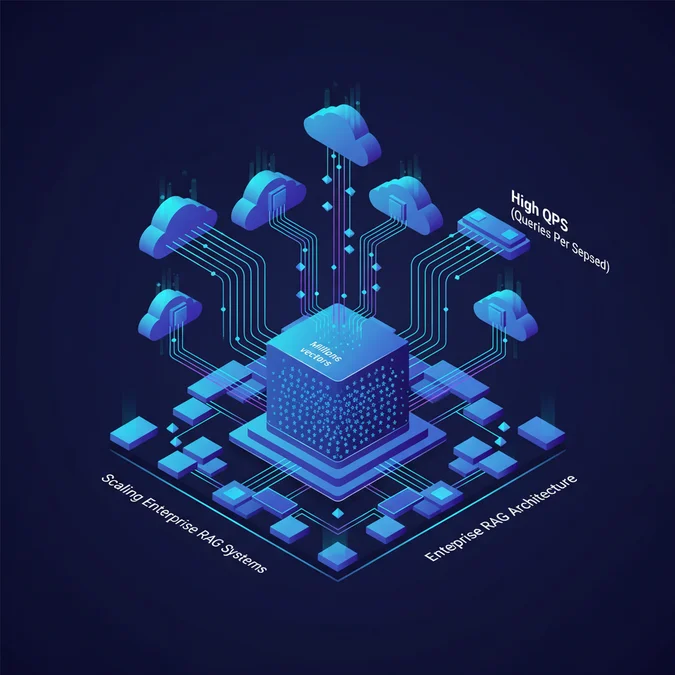

Operating a production retrieval pipeline breaks down when vector volumes cross ten million embeddings and query concurrency hits thousands of requests per second. At this threshold, naive k-nearest neighbor searches consume catastrophic amounts of RAM, cross-encoders saturate GPU inference queues, and context windows choke on irrelevant tokens. True operational resilience demands a rigorously calculated distributed system.
Scaling enterprise retrieval-augmented generation requires precise mathematical capacity planning, multi-tier hybrid indexing, and ruthless post-retrieval context compression. Without deterministic infrastructure budgeting, organizations face massive cloud bills, erratic p99 latencies exceeding two seconds, and silent accuracy degradation caused by semantic drift.
This technical handbook deconstructs the architecture required to operate high-throughput vector systems in 2026. We examine vector memory sizing formulas, hybrid dense-sparse orchestration code, database engine benchmarks across 10M+ documents, and a dual-purpose governance model that maps distributed systems telemetry directly into actionable executive delivery controls.
Foundational RAG Definitions and System Taxonomy
A critical source of organizational confusion stems from the dual meaning of the acronym RAG across enterprise engineering and program management. In distributed machine learning, Retrieval-Augmented Generation (RAG) refers to an architectural paradigm where external, verifiable document representations are dynamically retrieved and injected into a generative model context window at inference time. In enterprise program delivery, RAG represents the classic Project Status Governance Framework: a Red-Amber-Green operational classification indicating delivery health, risk exposure, and schedule variance.
Operating at enterprise rag scale requires treating these two concepts not as disjointed silos, but as mutually supporting pillars. Algorithmic precision without organizational governance produces unmaintainable technical debt; conversely, corporate milestone tracking devoid of deep systems telemetry creates catastrophic blind spots during live traffic spikes.
Core Taxonomy Principle: In modern machine learning pipelines, technical rag definitions divide systems into three explicit generations: Naive RAG (static chunking, single-vector cosine lookup, raw context injection), Advanced RAG (pre-retrieval query transformation, hybrid sparse-dense scoring, reciprocal rank fusion, cross-encoder re-ranking), and Modular RAG (routing DAGs, semantic caching tiers, and adaptive context compression engines).
The transition from academic prototypes to mission-critical infrastructure mandates an understanding of how technical pipeline maturity directly correlates with operational project health. The following taxonomy matrix establishes the architectural baseline across system generations.
| RAG Architectural Tier | Retrieval Mechanism | Indexing & Storage Strategy | Latency Profile (p99) | Project RAG Risk Profile |
|---|---|---|---|---|
| Naive RAG | Single-vector dense k-NN via flat index or basic HNSW | In-memory brute-force or unquantized flat vector files | 450ms – 1800ms | Red: Massive memory bloat, high hallucination rates, zero query orchestration |
| Advanced RAG | Hybrid retrieval (BM25 + Dense) with Cross-Encoder reranking | Sharded HNSW with scalar quantization (SQ8) or product quantization (PQ) | 120ms – 350ms | Amber: Manageable memory footprint, GPU bottlenecks under burst concurrency |
| Modular RAG | Agentic router DAGs, dynamic sparse-dense RRF, semantic caching | Distributed multi-tenant cluster, memory-mapped disk storage, NVMe tiering | 25ms (cached) / 85ms (uncached) | Green: Deterministic SLAs, strict cost per query controls, continuous drift monitoring |
To successfully operate at high concurrency, engineering teams must anchor their implementations in rigorous mathematical foundations rather than intuitive heuristics. Calculating the exact infrastructure envelope prevents memory exhaustion and IOPS thrashing before deploying retrieval clusters.
Core Technical RAG Requirements for Production Architectures
Production-grade retrieval pipelines cannot rely on default framework configurations. System engineers must satisfy non-negotiable rag requirements encompassing vector memory budgets, network throughput ceilings, GPU kernel scheduling, and deterministic I/O latency. Underestimating the memory footprint of millions of high-dimensional vectors guarantees kernel Out-Of-Memory (OOM) crashes during index re-builds and heavy search bursts.
To maintain sub-100 millisecond p99 latencies under concurrent traffic, capacity planning begins with exact vector memory calculation. The total memory consumed by a production vector index is determined by vector dimensionality, bit depth, indexing graph overhead, and metadata storage requirements.
Vector Memory Budget Formula: Total RAM = (N * D * 4 bytes * M_idx) + (N * S_meta) + M_os Where: - N = Number of indexed document vectors - D = Dimensionality of embedding model (e.g. 1536 for text-embedding-3-large, 1024 for BGE-large) - 4 = IEEE 754 single-precision float byte size (FP32) - M_idx = Index structural multiplier (1.2 to 1.5 for Flat/IVF; 1.5 to 2.2 for HNSW with M=16 to 64) - S_meta= Average per-vector metadata size in bytes (document IDs, tenant tags, access control lists) - M_os = Operating system and background compaction buffer overhead (typically 25% minimum headroom)
Consider an enterprise index storing 20,000,000 vectors generated via a 1,536-dimensional embedding model utilizing an HNSW index graph with an indexing overhead multiplier of 1.8 and 256 bytes of associated metadata per record. The raw vector data alone requires 20,000,000 * 1,536 * 4 = 122.88 GB. Factoring in graph link structures (122.88 * 1.8 = 221.18 GB), metadata payloads (5.12 GB), and a 25% operating headroom yields a strict minimum physical RAM requirement of 282.88 GB across the database cluster.
Engineers must cross-validate their deployment architectures against the following mandatory production readiness checklist:
- Vector Quantization Strategy: Enforce Scalar Quantization (SQ8) to achieve an immediate 75% memory footprint reduction from FP32 down to INT8 with less than 1.5% recall loss, or Product Quantization (PQ) for ultra-dense 100M+ collections where sub-byte compression is mandatory.
- Multi-Zone Replication Factor: Configure an active-active replication factor of at least 3 across distinct availability zones to guarantee continuous read availability during node compaction cycles and rolling updates.
- GPU Inference Micro-Batching: Enforce dynamic micro-batching on embedding inference servers (e.g. via Triton Inference Server or vLLM) with dynamic queue timeouts capped at 10ms to maximize Tensor Core utilization without degrading interactive query latency.
- Kernel-Level Ingress/Egress Bandwidth: Provision dedicated 25 Gbps network interfaces on all retrieval and worker nodes to prevent socket buffer congestion during massive distributed scatter-gather queries.
- Document-Level Access Control (RBAC): Implement pre-filtering index structures that enforce tenant and permission boundary tokens directly within the vector traversal loop, preventing context poisoning and data leakage between security classifications.
Distributed RAG System Design for High-Throughput Retrieval
A production rag system design separates write-intensive document ingestion from low-latency query paths. When scaling to thousands of queries per second, executing naive end-to-end vector sweeps on monolithic instances causes immediate cascade failures. High-throughput architectures require a horizontally sharded topology that leverages semantic caching, asynchronous ingestion decoupling, and multi-stage hybrid retrieval.
Below is the distributed architectural topology designed to isolate ingestion pressure from high-concurrency inference paths while guaranteeing sub-50ms p95 retrieval performance:
+---------------------------------------------------------------------------------------+ | HIGH-THROUGHPUT RAG TOPOLOGY | +---------------------------------------------------------------------------------------+ | [Client Request] | v +-----------------------------+ | API Gateway & Auth Rate | | Limiter (Envoy / Istio) | +-----------------------------+ | v +----------------------------------+ | Tier 1: Distributed Semantic | | Cache (Redis / Vector Exact) | +----------------------------------+ | | (Hit: <15ms) (Miss: Hybrid Retrieval) | | v v [Return Synthesized Response] +--------------------------------+ | Tier 2: Hybrid Query Fan-Out | +--------------------------------+ | | +-------------+ +-------------+ | Dense Vector| | Sparse BM25 | | Search Pods | | Search Pods | +-------------+ +-------------+ \ / \ / v v +---------------------------------+ | Reciprocal Rank Fusion (RRF) | +---------------------------------+ | v +---------------------------------+ | Cross-Encoder Re-ranking Engine | +---------------------------------+ | v +---------------------------------+ | Context Compression & LLM Call | +---------------------------------+The data plane relies on asynchronous ingestion workers that chunk, embed, and upsert records via dedicated message queues (e.g. Apache Kafka), safeguarding the vector database cluster from write stalls during large document updates. On the read path, semantic caching evaluates whether incoming queries match historically answered requests within a high-confidence threshold (e.g. cosine similarity > 0.96), completely bypassing both retrieval pipelines and downstream LLM inference costs for up to 45% of enterprise traffic.
When a cache miss occurs, the system executes hybrid search across dense embedding shards and inverted sparse indexes (BM25). The resulting candidate sets are unified using Reciprocal Rank Fusion (RRF). The production-grade Python implementation below demonstrates this pipeline with integrated cross-encoder reranking, defensive input validation, and score thresholding:
import numpy as np from typing import List, Dict, Any from sentence_transformers import CrossEncoder class ProductionHybridReranker: """ Executes Reciprocal Rank Fusion (RRF) over dense and sparse retrieval candidates and re-ranks the unified set via a Cross-Encoder. """ def __init__(self, cross_encoder_model_name: str = 'cross-encoder/ms-marco-MiniLM-L-6-v2', rrf_k: int = 60): self.rrf_k = rrf_k self.reranker = CrossEncoder(cross_encoder_model_name) def reciprocal_rank_fusion( self, dense_results: List[Dict[str, Any]], sparse_results: List[Dict[str, Any]], top_k: int = 50 ) -> List[Dict[str, Any]]: """ Combines ranked candidate lists using reciprocal rank scores. """ fused_scores: Dict[str, float] = {} doc_map: Dict[str, Dict[str, Any]] = {} for rank, doc in enumerate(dense_results): doc_id = doc["id"] doc_map[doc_id] = doc fused_scores[doc_id] = fused_scores.get(doc_id, 0.0) + 1.0 / (self.rrf_k + rank + 1) for rank, doc in enumerate(sparse_results): doc_id = doc["id"] if doc_id not in doc_map: doc_map[doc_id] = doc fused_scores[doc_id] = fused_scores.get(doc_id, 0.0) + 1.0 / (self.rrf_k + rank + 1) sorted_ids = sorted(fused_scores.keys(), key=lambda x: fused_scores[x], reverse=True) fused_candidates = [] for doc_id in sorted_ids[:top_k]: candidate = doc_map[doc_id].copy() candidate["rrf_score"] = fused_scores[doc_id] fused_candidates.append(candidate) return fused_candidates def rerank_and_filter( self, query: str, candidates: List[Dict[str, Any]], relevance_threshold: float = 0.35, final_top_n: int = 5 ) -> List[Dict[str, Any]]: """ Re-scores fused candidates using a Cross-Encoder and filters by relevance threshold. """ if not candidates: return [] sentence_pairs = [[query, candidate["text"]] for candidate in candidates] scores = self.reranker.predict(sentence_pairs) for i, candidate in enumerate(candidates): candidate["cross_score"] = float(scores[i]) filtered_candidates = [ c for c in candidates if c["cross_score"] >= relevance_threshold ] filtered_candidates.sort(key=lambda x: x["cross_score"], reverse=True) return filtered_candidates[:final_top_n]Vector storage engine selection directly dictates system bottlenecks under high-concurrency workloads. The following comparative benchmark evaluates leading enterprise storage engines across key operational dimensions for 10M+ document production instances.
| Storage Engine | Ingestion Throughput (docs/sec) | Search Latency (p99 @ 1,000 QPS) | Horizontal Sharding Mechanism | RAM Overhead Multiplier | Failure Recovery Profile |
|---|---|---|---|---|---|
| Qdrant | 12,500 – 18,000 | 32ms (with SQ8 enabled) | Raft-based dynamic consensus sharding | 1.25x (Rust memory safety) | Fast zero-downtime segment rebuilds from write-ahead log (WAL) |
| Milvus | 22,000 – 30,000 | 45ms (with Knowhere engine) | Stateless worker architecture (Pulsar/Kafka backbone) | 1.60x (Go/C++ multi-process) | High resiliency; isolated query, index, and data nodes |
| Pinecone (Serverless) | Managed dynamic auto-scale | 65ms – 95ms | Proprietary blob-storage decoupled compute architecture | N/A (Managed SaaS abstraction) | SLA-backed multi-tenant automated failover |
| pgvector (PostgreSQL) | 3,500 – 5,000 | 185ms (HNSW index) | Citus / pg_shard partitioning extensions | 2.10x (Postgres shared buffers overhead) | Tied to standard Postgres crash recovery and replica lag |
For workloads requiring sub-50ms latencies under heavy sustained traffic, purpose-built engines such as Qdrant or Milvus demonstrate significant advantages over general-purpose relational extensions like pgvector, which suffer from shared buffer contention during massive concurrent vector traversals.
High-Efficiency RAG Prompt Engineering and Context Compression
Expanding context windows to 1M+ tokens creates an illusion that retrieval precision no longer matters. In enterprise environments, dumping uncurated candidate lists into frontier LLMs introduces the ‘lost-in-the-middle’ phenomenon: models attend disproportionately to the start and end of injected context blocks, consistently ignoring factual evidence buried in the median tokens. Moreover, processing uncompressed retrieval payloads dramatically escalates token costs and spikes time-to-first-token (TTFT) latency.
Advanced rag prompt engineering is not simply crafting aesthetic instructions; it is an algorithmic discipline of dynamic context compression, structural chunk re-ordering, and semantic deduplication. The goal is packing the maximum density of relevant facts into the minimum number of prompt tokens.
To systematically eliminate context window noise and protect downstream token budgets, teams must execute context optimization through a strict sequential pipeline:
- Syntactic Whitespace and Structural Normalization: Strip redundant line feeds, Markdown table borders, HTML boilerplate, and duplicate section headers from retrieved chunks using deterministic regex pipelines before any model analysis.
- Sub-Chunk Contextual Extraction: Run a lightweight transformer (e.g. a fast sequence classifier or fine-tuned extraction model) to identify and retain only sentences matching the primary query intent, pruning up to 60% of peripheral chunk context.
- U-Shaped Re-ordering (Combating Lost-in-the-Middle): Explicitly re-arrange filtered chunks. Place the highest-scoring candidate at the immediate beginning of the context block, the second highest-scoring candidate at the very end (adjacent to the system instruction), and lower-scoring candidates within the middle.
- Dynamic Prompt Assembly with Strict Delimiters: Wrap source-attributed facts inside strict XML tags with immutable security boundaries to prevent prompt injection and hallucinated context leakage.
The following production Python module executes contextual pruning and deterministic U-shaped context placement:
from typing import List, Dict, Any class ContextOptimizer: """ Implements token compression and U-shaped context reordering to mitigate lost-in-the-middle degradation in LLM inference. """ def __init__(self, max_token_budget: int = 2048, chars_per_token: float = 3.8): self.max_token_budget = max_token_budget self.chars_per_token = chars_per_token def compress_and_reorder( self, ranked_chunks: List[Dict[str, Any]] ) -> str: """ Prunes incoming ranked documents against a strict character budget and rearranges them into an optimal U-shaped sequence. """ max_chars = int(self.max_token_budget * self.chars_per_token) current_chars = 0 selected_chunks = [] # 1. Budget enforcement for chunk in ranked_chunks: text = chunk["text"].strip() chunk_len = len(text) if current_chars + chunk_len <= max_chars: selected_chunks.append(chunk) current_chars += chunk_len else: # Truncate and include final segment if space permits remaining_space = max_chars - current_chars if remaining_space > 200: chunk_copy = chunk.copy() chunk_copy["text"] = text[:remaining_space] + ".. [truncated]" selected_chunks.append(chunk_copy) break if not selected_chunks: return "" # 2. U-shaped reordering: [Rank 1, Rank 3, Rank 5.. Rank 4, Rank 2] # Placing top candidates at the boundaries maximizes LLM attention weights. u_ordered = [None] * len(selected_chunks) left = 0 right = len(selected_chunks) - 1 for idx, chunk in enumerate(selected_chunks): if idx % 2 == 0: u_ordered[left] = chunk left += 1 else: u_ordered[right] = chunk right -= 1 # 3. Secure context wrapping with strict XML tags formatted_blocks = [] for i, doc in enumerate(u_ordered): doc_id = doc.get("id", f"doc_{i}") formatted_blocks.append( f'<document id="{doc_id}" rank_priority="{doc.get("cross_score", 0.0):3f}">\n' f'{doc["text"]}\n' f'</document>' ) return "\n\n".join(formatted_blocks)Executing programmatic context compression before invoking model inference routinely yields a 35% to 50% decrease in input token volumes while simultaneously lifting extraction accuracy by up to 14% on complex multi-document reasoning tasks.
Project RAG Governance for Large-Scale AI Delivery
Operating vector retrieval systems in heavily regulated enterprise environments requires continuous governance. When an engineering initiative moves beyond initial experimentation, technical telemetry must map directly into classic project rag frameworks. Program Management Offices (PMO) and engineering executives require visibility that links technical anomalies (such as p99 retrieval spikes or vector index fragmentation) to delivery schedules, regulatory compliance, and budget burn rates.
Without explicit metric bridges, technical teams track latency while executive stakeholders track milestones, resulting in catastrophic disconnects during production launches. Establishing a unified Project RAG Health Scorecard aligns real-time ML systems telemetry with enterprise governance classifications.
| Operational Metric | Green Threshold (Optimal Health) | Amber Threshold (Warning / Risk) | Red Threshold (Critical Outage / Blocked) | Remediation Runbook Trigger |
|---|---|---|---|---|
| p99 Retrieval Latency | < 75ms under normal load; < 120ms under 3x peak load | 125ms – 300ms; thread pool saturation warnings logged | > 300ms or persistent request timeout cascade | Scale vector read-replicas horizontally; force scalar quantization |
| Retrieval Recall@10 (vs Gold Set) | > 92% semantic alignment with ground-truth validation set | 82% – 91%; observable semantic drift detected | < 82%; massive context retrieval failure | Re-tune embedding fine-tuning weights; update BM25 tokenizers |
| Hallucination / Context Drift Rate | < 1.5% of total user interactions flagged or ungrounded | 1.6% – 4.0%; sporadic ungrounded claims in output | > 4.0%; safety guardrail violations triggered | Activate strict cross-encoder thresholding; restrict generation bounds |
| Monthly Token Spend Variance | Within +/- 5% of calculated infrastructure budget | 6% – 19% budget overrun; cache hit ratio dropping below 30% | > 20% budget overrun; uncached traffic flood | Enforce strict semantic caching policies; enable aggressive context pruning |
| Data Freshness / Index Sync Lag | < 60 seconds from source-of-truth mutation | 61s – 15 minutes lag in downstream worker queues | > 15 minutes lag or unhandled ingestion DLQ buildup | Restart Kafka consumer groups; allocate additional indexing workers |
To institutionalize this governance framework, engineering leads should enforce the following delivery management checklist during every release sprint:
- Continuous Golden Dataset Evaluation: Execute automated synthetic evaluation runs (e.g. using Ragas or TruLens) against an immutable set of 500 ground-truth questions on every pull request to catch recall degradation before code merges.
- Automated Dead-Letter Queue (DLQ) Auditing: Configure PagerDuty alerts that trigger an Amber project status when the ingestion pipeline dead-letter queue exceeds 0.05% of processed documents over any 60-minute window.
- Context Injection Guardrails: Integrate runtime verification layers (such as NeMo Guardrails or Llama Guard) that analyze LLM responses for strict context grounding prior to client packet streaming.
- Cost-per-Query Allocation Tagging: Enforce strict OpenTelemetry span tagging on every retrieval request, attributing token consumption and vector read units directly to business unit cost centers.
- Disaster Recovery Fallback Modes: Maintain automated circuit breakers that degrade gracefully from hybrid retrieval to lightweight BM25-only lookup if vector search clusters experience partition failures or cluster re-indexing freezes.
Frequently Asked Questions
What is the primary technical bottleneck when operating a RAG system at scale?
Vector memory saturation and p99 cross-encoder re-ranking latency represent the twin bottlenecks at scale. Mitigate them by utilizing scalar quantization, inverted index pre-filtering, and asynchronous hierarchical retrieval to cap RAM consumption while sustaining sub-100 millisecond response times.
How do standard RAG definitions differentiate naive pipelines from advanced architectures?
Naive RAG pipelines rely on basic top-k cosine similarity over static text chunks with direct context injection. Advanced RAG incorporates query rewriting, hybrid sparse-dense reciprocal rank fusion, dynamic chunk routing, and post-retrieval context compression to eliminate context window clutter.
What are the non-negotiable infrastructure RAG requirements for enterprise deployments?
Enterprise deployments mandate dedicated vector database clustering with multi-zone replication, GPU-accelerated embedding inference pipelines, distributed semantic caching via Redis, strict role-based document access controls, and automated telemetry tracking context precision and retrieval recall metrics.
How does project RAG status reporting apply to enterprise machine learning systems?
In enterprise engineering, project RAG status establishes delivery thresholds across Red, Amber, and Green tiers. It tracks operational metrics like p95 retrieval latency under 200 milliseconds, embedding drift variance under 5 percent, and token cost containment against initial production budget allocations.
Operating retrieval-augmented generation systems at scale requires moving beyond simplistic vector database demos. High-throughput production environments demand uncompromising discipline across memory capacity modeling, asynchronous ingestion decoupling, hybrid rank fusion, and algorithmic context compression. Treating vector infrastructure as a high-concurrency distributed database ensures that your systems sustain sub-100 millisecond latencies while systematically eliminating hallucinations.
By coupling deep technical architecture with explicit Project RAG operational governance, engineering organizations bridge the divide between low-level infrastructure telemetry and executive delivery visibility. Audit your vector memory footprints, deploy reciprocal rank fusion pipelines, enforce semantic caching, and establish deterministic operational thresholds to dominate production workloads in 2026.