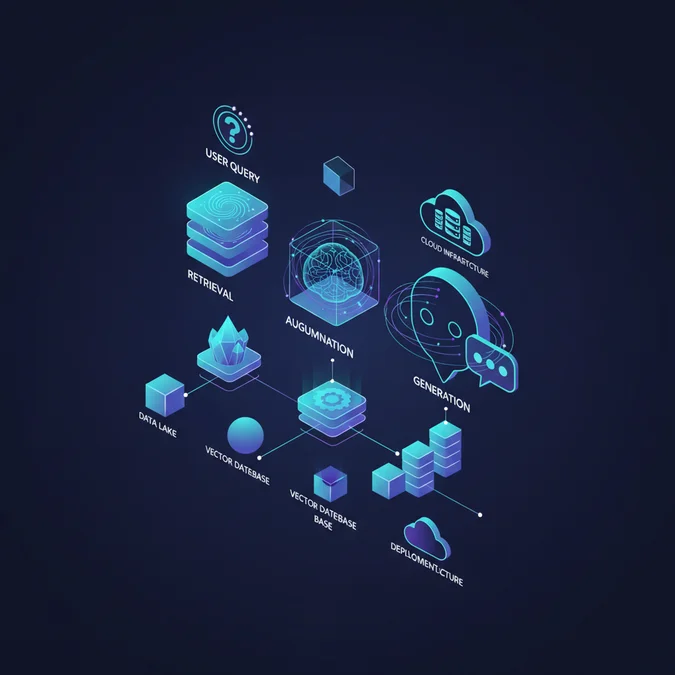

A production-grade RAG chatbot couples a generative large language model with an external retrieval pipeline, dynamically querying vector databases and structured data stores to inject authoritative domain context into inference prompts. In high-concurrency production environments, vanilla retrieval systems degrade rapidly under conversational drift, noisy top-k chunks, and unbounded token budgets.
Building conversational systems that survive real-world traffic requires moving past textbook implementations. Developers routinely encounter degraded precision when users ask ambiguous multi-turn follow-ups, latency spikes from unindexed vector filters, and hallucinations caused by out-of-order context injection.
This architectural reference dissects the mechanics required to engineer high-throughput, low-latency conversational retrieval systems. We cover contextual query rewriting, hybrid sparse-dense retrieval, cross-encoder reranking, vector engine benchmarks, role-based security, and observability frameworks built for scale in 2026.
Foundational Mechanics of a Modern RAG AI Chatbot
Standard parametric language models store facts statically within frozen network weights. While these models excel at reasoning and synthesis, their internal world state degrades over time, creating catastrophic failure modes in domain-critical enterprise workloads: hallucinations, context obsolescence, and an inability to track proprietary datasets. A rag ai chatbot decouples knowledge persistence from linguistic reasoning by implementing dynamic context grounding at inference time.
The fundamental flow executes across two synchronized computational loops: an offline data curation loop and an online inference pipeline. During offline processing, raw documents are parsed, stripped of boilerplate, segmented into semantic text chunks, embedded into continuous latent vectors, and indexed into a specialized storage engine. During online execution, the incoming user turn undergoes semantic analysis and transformation to retrieve the most contextually relevant passages from the index. These passages are prepended to the system prompt, strictly bounding the model’s response envelope.
Core Engineering Axiom: The primary failure point of an enterprise conversational system is rarely generative capability; it is context contamination. If noisy, redundant, or contradictory chunks reach the generator context window, even frontier models will hallucinate or suffer from attention degradation.
By enforcing deterministic grounding through an external knowledge corpus, engineering teams gain auditability, per-tenant data segregation, dynamic document lifecycle management, and near-zero cost updates compared to continual pretraining or parameter-efficient fine-tuning (PEFT).
RAG Chatbot Architecture: Ingestion, Retrieval, and Generation Loops
Enterprise conversational search engines require a modular, resilient three-tier execution layout. A robust rag chatbot architecture divides computational responsibilities across data ingestion, low-latency candidate retrieval, and generative prompt synthesis.
+-----------------------------------------------------------------------------------+
| INGESTION PIPELINE |
| [Raw Data] -> [Layout Parsing] -> [Semantic Chunker] -> [Embedding Engine] |
| | |
| v |
| [(Hybrid) Vector Store] |
+-----------------------------------------------------------------|-----------------+
 | |
+-----------------------------------------------------------------|-----------------+
| INFERENCE ENGINE | |
| [User Turn] | |
| | | |
| v | |
| [Query Rewriter] <- [Conversation History] | |
| | | |
| +---> [Dense Retriever (HNSW)] ---+ | |
| | |--> [Reciprocal Rank Fusion] |
| +---> [Sparse Retriever (BM25)] ---+ | |
| v |
| [Cross-Encoder Reranker] |
| | |
| v |
| [Generator LLM] <-- [Prompt Assembler] <----------- [Top-K Clean Context] |
| | |
| v |
| [Client Stream] |
+-----------------------------------------------------------------------------------+
Pipeline Breakdown: Mechanics and Invariants
- Ingestion Tier: Document pipelines must normalize heterogeneous formats (PDFs, Markdown, relational records) into structured node objects. Chunking strategies must preserve semantic completeness: fixed-size chunking (e.g. 512 tokens with 50-token overlap) causes boundary fragmentation. Modern systems leverage parent-document retrieval or recursive semantic chunking based on header hierarchies and embedding similarity thresholds.
- Retrieval Tier: The hybrid retriever balances sparse lexical signals with dense geometric similarities. Dense retrievers capture deep semantic associations but fail on alphanumeric IDs, skus, and exact product nomenclature. Sparse indexes (BM25 or SPLADE) catch exact tokens. The candidate lists are merged via Reciprocal Rank Fusion (RRF) and scored through a cross-encoder model to discard context noise.
- Generation Tier: The prompt compiler constructs the final context window. It injects system rules, conversational memory summaries, and reranked passages tagged with XML or JSON boundaries to prevent prompt injection and mitigate attention-sink failures.
| Pipeline Component | Standard Implementation | Production SLA / Target | Critical Edge Case |
|---|---|---|---|
| Document Chunking | Recursive Character Splitter | < 50ms per page | Split tables lose header-row relationships |
| Dense Embedding | Text-Embedding-3-Large / BGE-Large | < 35ms (batch size 32) | Truncation of inputs exceeding token capacity |
| Candidate Retrieval | HNSW Vector Index + BM25 | < 20ms p95 | Cold-start memory pagination spikes latency |
| Context Reranking | bge-reranker-v2-m3 / Cohere Rerank | < 65ms p95 | Quadratic compute growth with high candidate limits |
| Token Generation | vLLM / TensorRT-LLM / Claude / GPT-4o | < 25ms TTFT (Time to First Token) | Context window overflow during deep conversation turns |
Below is an architectural template for an async context assembly engine handling token truncation and structured metadata extraction:
import asyncio
from typing import List, Dict, Any
from dataclasses import dataclass

@dataclass
class RetrievedPassage:
 passage_id: str
 text: str
 metadata: Dict[str, Any]
 score: float

class ProductionContextAssembler:
 def __init__(self, max_context_tokens: int = 4096, token_safety_margin: int = 256):
 self.max_tokens = max_context_tokens - token_safety_margin

 def estimate_tokens(self, text: str) -> int:
 # Rule of thumb for standard subword tokenizers (approx 4 chars per token)
 return len(text) // 4

 def assemble_prompt(
 self,
 system_instruction: str,
 query: str,
 passages: List[RetrievedPassage]
 ) -> str:
 allocated_tokens = self.estimate_tokens(system_instruction) + self.estimate_tokens(query)
 context_blocks: List[str] = []

 for p in passages:
 block = f"<doc id='{p.passage_id}' score='{p.score:3f}'>{p.text}</doc>"
 block_tokens = self.estimate_tokens(block)

 if allocated_tokens + block_tokens > self.max_tokens:
 break

 context_blocks.append(block)
 allocated_tokens += block_tokens

 combined_context = "\n".join(context_blocks)
 return (
 f"{system_instruction}\n\n"
 f"<context>\n{combined_context}\n</context>\n\n"
 f"User Query: {query}\nAnswer:"
 )
Taxonomy and Trade-Offs: Naive RAG vs Advanced Hybrid RAG vs Agentic RAG
Developing a production rag based chatbot requires selecting an architectural topology that matches domain complexity, accuracy tolerance, and infrastructure budgets. Systems generally map across three distinct paradigms: Naive RAG, Advanced Hybrid RAG, and Agentic RAG.
1. Naive RAG: Executes a static top-k vector similarity search directly from raw user input, stitching returned chunks into the context window. While cheap and fast to build, it collapses in production when faced with complex terminology, semantic ambiguity, and fragmented documents.
2. Advanced Hybrid RAG: Augments vector retrieval with pre-retrieval optimization (query rewriting, expansion) and post-retrieval processing (cross-encoder reranking, context compression, deduplication). It blends dense vector semantic matching with sparse inverted indices to maximize retrieval recall across both abstract concepts and exact keywords.
3. Agentic RAG: Grants an autonomous execution graph access to multi-step tool calls, speculative query decomposition, self-reflection loops, and multi-index routing. The model evaluates whether the retrieved evidence is sufficient to resolve the prompt, branching dynamically into additional retrieval cycles if it detects gaps.
| Evaluation Vector | Naive RAG | Advanced Hybrid RAG | Agentic RAG |
|---|---|---|---|
| Retrieval Precision & Recall | Low to Moderate (Fails on exact keywords) | High (Combines semantic and exact lexical signals) | Very High (Iterative self-correction and query decomposition) |
| End-to-End Latency | Low (200ms to 600ms) | Medium (400ms to 1200ms) | High (1500ms to 6000ms+ due to agentic loops) |
| Token Consumption / Cost | Low (Fixed context injection) | Moderate (Added reranker and rewriting calls) | Very High (Recursive chain-of-thought and tool loops) |
| Failure Modes | Context noise, lost-in-the-middle, keyword drop | Reranker cold-starts, latency budget exhaustion | Infinite loops, state drift, compounding tool failures |
| Engineering Complexity | Minimal (Off-the-shelf wrappers) | Moderate (Requires pipeline tuning and index tuning) | High (Requires robust state machines and guardrails) |
Engineering teams deploying production customer-facing conversational interfaces should treat Advanced Hybrid RAG as their baseline standard. Agentic patterns should be reserved for complex analytical workflows that require deep exploratory querying across multiple disparate enterprise systems.
Multi-Turn Dialogue and State: Transforming Queries for an Interactive RAG Bot
A common vulnerability in naive systems is conversational drift. When a user interacts with a rag bot, subsequent turns rarely contain explicit semantic anchors. Consider this dialogue:
- User Turn 1: “What is the failover strategy for our Aurora PostgreSQL cluster?”
- User Turn 2: “How long does that typically take?”
Passing “How long does that typically take?” into a vector search engine fails completely. The embedding space maps this phrase toward generic duration queries rather than Aurora PostgreSQL failover latency metrics. To resolve this, production conversational engines must implement a Contextual Query Rewriter.
Production Rule: Never route raw multi-turn user text directly to the vector retrieval layer. Always rewrite the turn into a standalone, decontextualized semantic query before calculating embeddings.
The rewriter consumes the active conversation buffer, strips conversational filler, resolves pronouns, and synthesizes an optimized vector and keyword query string. Below is a production query transformation engine implemented with structured validation:
import os
from typing import List, Dict
from pydantic import BaseModel, Field
import litellm

class TransformedQuery(BaseModel):
 standalone_query: str = Field(
 description="Fully resolved, decontextualized query containing all semantic entities."
 )
 extracted_keywords: List[str] = Field(
 description="Key entities and technical terms suitable for sparse keyword search."
 )
 is_followup: bool = Field(
 description="True if the query depends on historical dialogue state."
 )

class ConversationStateEngine:
 def __init__(self, model_name: str = "gpt-4o-mini"):
 self.model_name = model_name
 self.system_prompt = (
 "You are an expert retrieval optimization engine. Analyze the conversational history "
 "and the latest user input. Reconstruct the user input into an independent, fully-qualified "
 "search query that contains all necessary context for a document retrieval engine. "
 "Resolve all pronouns (it, that, they) using historical context. Do not answer the question."
 )

 async def rewrite_turn(
 self,
 history: List[Dict[str, str]],
 current_user_turn: str
 ) -> TransformedQuery:
 formatted_dialogue = "\n".join(
 [f"{msg['role'].upper()}: {msg['content']}" for msg in history[-6:]
 )

 prompt = (
 f"Conversation History:\n{formatted_dialogue}\n\n"
 f"Current Input: {current_user_turn}\n\n"
 "Extract the standalone query and keywords:"
 )

 response = await litellm.acompletion(
 model=self.model_name,
 messages=[
 {"role": "system", "content": self.system_prompt},
 {"role": "user", "content": prompt}
 ],
 response_format={"type": "json_object"},
 temperature=0.0
 )

 raw_json = response.choices[0].message.content
 return TransformedQuery.model_validate_json(raw_json)
In systems handling multi-tenant chat loads, sliding window truncation (e.g. retaining the last 4-6 turns) paired with occasional conversation summarization prevents the rewriter prompt from inflating latency and cost.
How to Create a RAG Chatbot: Step-by-Step Implementation with Reranking
Understanding how to create a rag chatbot requires moving beyond toy framework abstractions. Below is a complete, production-grade hybrid retrieval and reranking implementation using Python, BM25, Chroma/Qdrant paradigms, and Cross-Encoder architectures.
- Document Ingestion & Dual Indexing: Process text segments and populate both an inverted index for lexical search and a vector store for semantic search.
- Query Transformation: Translate user turns into standalone search representations.
- Hybrid Candidate Retrieval: Query both sparse and dense stores simultaneously to retrieve top-k candidates (e.g. 25 documents each).
- Reciprocal Rank Fusion (RRF): Merge both candidate lists using positional scoring algorithms to balance scoring variations.
- Cross-Encoder Reranking: Pass the merged candidate pool through a cross-encoder model to score query-document pairs, selecting the final top-n passages (e.g. top-5) for context generation.
import numpy as np
from typing import List, Dict, Tuple
from rank_bm25 import BM25Okapi
from sentence_transformers import SentenceTransformer, CrossEncoder

class HybridRerankedRetriever:
 def __init__(
 self,
 documents: List[str],
 dense_model_name: str = "BAAI/bge-small-en-v1.5",
 reranker_model_name: str = "BAAI/bge-reranker-base"
 ):
 self.documents = documents
 self.dense_encoder = SentenceTransformer(dense_model_name)
 self.reranker = CrossEncoder(reranker_model_name)

 # Initialize sparse index (BM25)
 self.tokenized_corpus = [doc.lower().split() for doc in documents]
 self.bm25 = BM25Okapi(self.tokenized_corpus)

 # Initialize dense embeddings
 self.doc_embeddings = self.dense_encoder.encode(
 documents,
 show_progress_bar=False,
 convert_to_numpy=True,
 normalize_embeddings=True
 )

 def _dense_search(self, query: str, top_k: int = 25) -> List[Tuple[int, float]]:
 query_vector = self.dense_encoder.encode([query], normalize_embeddings=True)[0]
 # Compute cosine similarities via dot product on normalized vectors
 scores = np.dot(self.doc_embeddings, query_vector)
 top_indices = np.argsort(scores)[:-1][:top_k]
 return [(int(idx), float(scores[idx])) for idx in top_indices]

 def _sparse_search(self, query: str, top_k: int = 25) -> List[Tuple[int, float]]:
 tokens = query.lower().split()
 scores = self.bm25.get_scores(tokens)
 top_indices = np.argsort(scores)[:-1][:top_k]
 return [(int(idx), float(scores[idx])) for idx in top_indices]

 def reciprocal_rank_fusion(
 self,
 dense_results: List[Tuple[int, float]],
 sparse_results: List[Tuple[int, float]],
 k: int = 60
 ) -> List[int]:
 rrf_scores: Dict[int, float] = {}

 for rank, (doc_idx, _) in enumerate(dense_results):
 rrf_scores[doc_idx] = rrf_scores.get(doc_idx, 0.0) + (1.0 / (k + rank + 1))

 for rank, (doc_idx, _) in enumerate(sparse_results):
 rrf_scores[doc_idx] = rrf_scores.get(doc_idx, 0.0) + (1.0 / (k + rank + 1))

 sorted_docs = sorted(rrf_scores.items(), key=lambda item: item[1], reverse=True)
 return [doc_idx for doc_idx, _ in sorted_docs]

 def retrieve_and_rerank(
 self,
 query: str,
 candidate_pool_size: int = 30,
 final_top_k: int = 5
 ) -> List[Dict[str, Any]]:
 dense_res = self._dense_search(query, top_k=candidate_pool_size)
 sparse_res = self._sparse_search(query, top_k=candidate_pool_size)

 fused_indices = self.reciprocal_rank_fusion(dense_res, sparse_res, k=60)[:candidate_pool_size]

 # Prepare pairs for cross-encoder reranking
 candidate_texts = [self.documents[idx] for idx in fused_indices]
 query_doc_pairs = [[query, text] for text in candidate_texts]

 rerank_scores = self.reranker.predict(query_doc_pairs)

 ranked_order = np.argsort(rerank_scores)[:-1][:final_top_k]

 results = []
 for r_idx in ranked_order:
 doc_id = fused_indices[r_idx]
 results.append({
 "document_index": doc_id,
 "text": self.documents[doc_id],
 "rerank_score": float(rerank_scores[r_idx])
 })
 return results
This implementation eliminates the single points of failure common in basic vector retrievers: exact alphanumeric codes are preserved via BM25, while semantic context is surfaced through dense embeddings and filtered through the cross-encoder.
Production Hardening: Vector DB Latency, RBAC, and Context Observability
Migrating a rag chatbot from prototype to enterprise-scale infrastructure requires resolving storage latency, metadata access control, and quality observability.
Vector Engine Architecture Matrix
Selecting an indexing backend depends on write throughput, p99 latency thresholds, and metadata filtering capabilities:
| Vector Engine | Index Types | p99 Query Latency (<10M vectors) | Metadata Filtering Strategy | Operational Overhead |
|---|---|---|---|---|
| pgvector (PostgreSQL) | HNSW, IVFFlat | 35ms to 60ms | Native SQL WHERE clauses (Relational join speed) | Low if already operating RDS/PostgreSQL |
| Qdrant | HNSW + Scalar/Product Quantization | 8ms to 18ms | Payload schema indexing with Boolean filters | Low to Medium (Containerized / Rust binary) |
| Pinecone | Proprietary graph | 15ms to 28ms | Pre/Post metadata filtering via metadata dicts | Very Low (Fully managed serverless) |
| Milvus | HNSW, ScaNN, DiskANN | 10ms to 22ms | Segment-level scalar inverted indexing | High (Distributed distributed coordinator architecture) |
Security and Role-Based Access Control (RBAC)
Never rely on generator LLMs to enforce document access policies. If a user does not have permission to read a document, that document must not enter the context window. Security enforcement must occur at retrieval time using deterministic metadata filters:
# Example deterministic pre-filtering payload for vector engines
search_filter = {
 "must": [
 {"key": "tenant_id", "match": {"value": user_session.tenant_id}},
 {"key": "security_clearance_level", "range": {"lte": user_session.clearance_level}},
 {"key": "department", "match": {"any": user_session.department_memberships}}
 ]
}
Context Observability and the RAG Triad
Production conversational systems require quantitative evaluation tracking across three distinct vectors:
- Context Relevance: Measures whether the retrieved passages are focused and free of distracting tokens. Calculated via normalized semantic similarity between query and retrieved nodes.
- Groundedness (Faithfulness): Measures whether the LLM’s response relies solely on facts present in the injected context. Flags hallucinations when assertions cannot be mapped to source chunk spans.
- Answer Relevance: Measures whether the final response directly addresses the user’s intent without drift.
Production Readiness Checklist
- [ ] Contextual query rewriter handles conversational pronouns and multi-turn state drift.
- [ ] Hybrid retrieval pipeline pairs dense embeddings with sparse lexical search (BM25 or SPLADE).
- [ ] Cross-encoder reranker trims context candidates down to the top-5 high-signal chunks.
- [ ] Deterministic RBAC filtering executes at the vector database index level prior to candidate ranking.
- [ ] Context length is monitored and bounded with subword token budgets to prevent generator truncation.
- [ ] Automated evaluation pipelines track groundedness and context relevance across staging test sets.
Frequently Asked Questions
What is the primary difference between a fine-tuned model and a RAG chatbot?
A fine-tuned model bakes knowledge directly into model weights via gradient updates, making updates costly. A RAG chatbot decouples knowledge from computation, dynamically retrieving authoritative text from external databases during inference to eliminate hallucinations and allow instant documentation updates without retraining.
Why does a production rag based chatbot require a reranker?
Bi-encoder vector search surfaces top-k candidates rapidly but often misses subtle semantic nuances. A cross-encoder reranker scores document-query pairs together, reordering retrieved passages by genuine contextual relevance to ensure the generator LLM receives high-signal context without token waste or lost-in-the-middle degradation.
How do you handle conversation history in a rag bot without token explosion?
Production rag bots use query rewriting techniques. An intermediary LLM summarizes chat history into a dense, standalone search query, discarding unnecessary conversational turns. This retrieves relevant context for the current turn while managing context window limits and reducing token inference costs.
What vector database criteria matter most for enterprise rag chatbot architecture?
Key evaluation criteria include p99 query latency under load, metadata filtering efficiency for role-based access control (RBAC), horizontal sharding capabilities, and total operational cost. Hybrid indexes supporting sparse keyword search alongside dense HNSW indexing provide the highest enterprise retrieval recall.
Architecting an enterprise-ready RAG chatbot requires balancing semantic precision with aggressive latency and cost constraints. Moving beyond naive prototypes to production systems involves implementing hybrid search pipelines, cross-encoder reranking, and deterministic metadata filters that preserve security invariants before prompts reach generative models.
By transforming multi-turn queries, benchmarking retrieval backends against strict p99 latency targets, and continuously monitoring groundedness and context relevance, engineering teams can build resilient, hallucination-resistant conversational interfaces that scale reliably under real-world production demands.