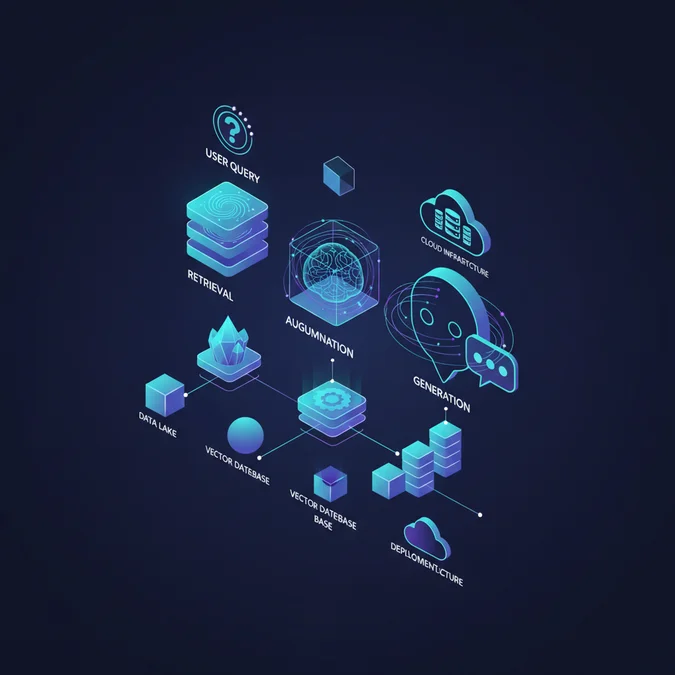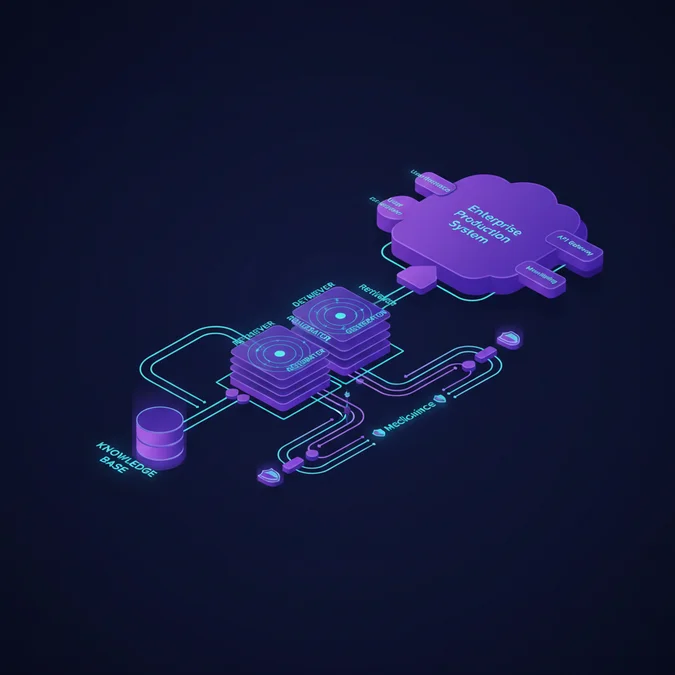

Moving from a proof-of-concept Retrieval-Augmented Generation (RAG) prototype to a robust production environment is where most projects fail. The jump from a localized notebook environment to enterprise-grade infrastructure introduces non-negotiable requirements for data security, multi-tenant isolation, and deterministic performance.
This article strips away the marketing abstractions to provide a technical blueprint for building systems that handle high-throughput, sensitive data workloads. We focus on the architectural primitives required to maintain system integrity while delivering accurate, context-aware AI responses at scale.
Foundations of Enterprise RAG Architecture
True enterprise rag architecture is defined by its constraints rather than its capabilities. While consumer models prioritize novelty, enterprise systems must prioritize trust, governance, and auditability. The primary shift involves moving from a flat vector database to a permission-aware, tiered retrieval strategy.
Architectural Callout: In an enterprise context, your vector database is not just a search index. It is a security boundary. Every document chunk must carry metadata tags representing access control lists (ACLs) to ensure that the RAG pipeline respects existing identity and access management (IAM) policies.
A production-ready system must handle:
- Data Residency: Ensuring vector embeddings do not leak across geographic or regulatory boundaries.
- PII Redaction: Automated pipelines that sanitize unstructured data before it reaches the embedding model.
- Auditability: Full traceability of which document chunks contributed to a specific model response.
Operationalizing Enterprise RAG Solutions
When selecting or building enterprise rag solutions, the trade-off is almost always between vendor-managed convenience and the need for deep, custom data-processing pipelines. The following table evaluates the key decision vectors for engineering teams.
| Feature | Managed SaaS | Self-Hosted/Custom |
|---|---|---|
| Security | Shared Responsibility | Full Control |
| Customization | Limited | Infinite |
| Latency | Variable (Network-bound) | Optimized (Co-located) |
| Cost | OpEx/Usage-based | CapEx/Infrastructure-heavy |
Production Readiness Checklist:
- Verify RBAC integration with existing LDAP/Active Directory.
- Implement a shadow-mode deployment for A/B testing new embedding models.
- Establish a data drift detection mechanism for the vector index.
- Define automated fallback logic for model API outages.
Core Mechanics: Data Ingestion and Retrieval Patterns
The core of a performant RAG system lies in hybrid search, combining semantic vector similarity with traditional keyword-based BM25 scoring. This ensures that technical acronyms or specific product IDs are not lost in the high-dimensional noise of embedding models.
[Ingestion Pipeline] -> [Chunking Engine] -> [Metadata Enrichment] -> [Vector + Keyword DB]Below is a conceptual implementation of a multi-tenant retrieval function that enforces security filters at query time:
def secure_retrieval(query, user_permissions, vector_db): # Enforce tenant isolation via metadata filters filter_expression = { "tenant_id": user_permissions.tenant_id } # Combine vector similarity with keyword boost results = vector_db.hybrid_search( query, filters=filter_expression, top_k=5, alpha=0.7 # Weighting between vector and keyword search ) return results
Production Readiness and Performance Monitoring
Latency in RAG systems is cumulative. Every hop from the frontend to the vector database, then to the LLM, and finally back to the client adds overhead. To maintain sub-500ms retrieval, teams must optimize the vector index and implement aggressive caching.
| Metric | Target | Tooling |
|---|---|---|
| Retrieval Latency | < 150ms | Prometheus / OpenTelemetry |
| Token Throughput | > 50 t/s | vLLM / TGI |
| Hallucination Rate | < 2% | RAGAS / Arize Phoenix |
To mitigate hallucinations, move beyond simple retrieval. Implement an agentic loop that validates the generated answer against the retrieved context before returning it to the user.
Frequently Asked Questions
What defines a production ready enterprise RAG system?
An enterprise RAG system is defined by its ability to maintain strict data governance, implement permission-aware retrieval, ensure high availability, and provide observability for hallucination mitigation. Unlike simple prototypes, these systems integrate with existing enterprise security protocols and support scalable multi-tenant architectures for diverse organizational workloads.
How do I evaluate different enterprise RAG solutions?
Evaluate enterprise RAG solutions based on their support for hybrid search, extensibility for custom embedding models, compatibility with existing data lakes, and the maturity of their security frameworks. Prioritize platforms that offer robust API support, vendor-neutral deployment options, and clear performance benchmarks for latency and throughput.
Building for the enterprise requires a shift from ‘making it work’ to ‘making it robust.’ By focusing on permission-aware retrieval, hybrid search, and rigorous observability, engineering teams can create AI systems that provide tangible business value while meeting strict security standards.
As you move forward, prioritize modularity. The AI landscape is shifting rapidly, and your ability to swap embedding models or vector backends without re-architecting your entire data pipeline is your most valuable asset.