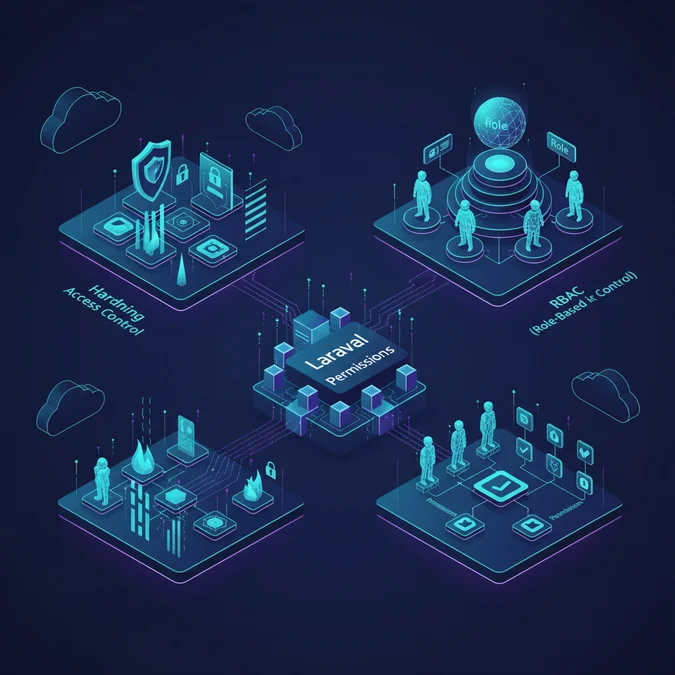

Laravel permissions control which authenticated users can perform specific actions on backend resources, implemented either natively through Gates and Policies or via database-backed Role-Based Access Control packages like Spatie Laravel Permission. Establishing deterministic authorization boundaries prevents Broken Access Control, currently ranked by the Open Worldwide Application Security Project (OWASP) as the number one web application security risk.
According to recent industry telemetry from enterprise vulnerability disclosures and the OWASP Foundation, over 94 percent of reviewed enterprise applications exhibit some degree of broken access control, leading to unauthorized horizontal privilege escalation, data exfiltration, or indirect object reference exploits. In Laravel ecosystems, these flaws manifest when teams conflate basic authentication checks with fine-grained authorization gates.
Building an uncompromising permission architecture requires moving beyond simple boolean flags on the user model. This guide breaks down the architectural mechanics of the native authorization layer, dissects schema design for role-based access control, examines audit logging mechanics, and reviews the precise financial expenditures required to audit and remediate broken access systems in production environments.
Anatomy of Laravel Authorization: Gates vs Policies
Laravel provides two native primitives for authorization: Gates and Policies. While both evaluate boolean logic against an authenticated user and an optional model instance, their architectural responsibilities differ substantially. Conflating the two leads to sprawling service providers and brittle codebases that obscure critical authorization logic.
Native Gates: Closure-Based Tactical Interceptions
Gates serve as closure-based authorization checks, ideal for actions decoupled from specific database entities, such as accessing an administrative telemetry panel, initiating an off-cycle batch job, or toggling maintenance windows. Registered typically within the boot sequence of an AppServiceProvider or dedicated AuthServiceProvider, Gates intercept operational requests globally.
<php

namespace App\Providers;

use App\Models\User;
use Illuminate\Support\Facades\Gate;
use Illuminate\Support\ServiceProvider;

class AuthServiceProvider extends ServiceProvider
{
 public function boot(): void
 {
 // Define gate for server-level runtime diagnostics
 Gate:define('view-pulse-dashboard', function (User $user): bool {
 // Defensive assertion: ensure account is confirmed and explicitly flagged
 return $user->hasVerifiedEmail()
 && in_array($user->email, config('auth.security.diagnostics_allowlist', []),
 true);
 });
 }
}
Model Policies: Resource-Centric Authorization Contracts
Policies represent dedicated PHP classes organizing authorization logic around specific Eloquent models. Adhering strictly to standard resource routing conventions, policies map methods directly to CRUD behaviors: viewAny, view, create, update, delete, restore, and forceDelete. This structure creates an explicit security contract directly coupled with data access layers.
<php

namespace App\Policies;

use App\Models\User;
use App\Models\Document;
use Illuminate\Auth\Access\Response;

class DocumentPolicy
{
 /**
 * Determine whether the user can mutate sensitive legal contracts.
 */
 public function update(User $user, Document $document): Response
 {
 // Prevent privilege creep: only tenant-isolated owners or security auditors modify
 if ($user->organization_id!== $document->organization_id) {
 return Response:deny('Cross-tenant resource access strictly prohibited.');
 }

 return $document->is_locked? Response:deny('Contract is immutably locked for legal hold.'): Response:allow();
 }
}
Implementing structured Response:deny() objects instead of generic falsy values surfaces rich, machine-readable rejection telemetry directly to API consumers while mitigating insecure debug traces in live clusters.
Database Schema Design for Role-Based Access Control
A resilient permission model relies on a normalized relational schema capable of handling multi-tenant boundaries, permission inheritance, and performant indexing. While simple applications often start with single-column role strings or bitmask integers on the users table, these architectures break down rapidly under complex regulatory environments like SOC 2 or HIPAA.
Relational RBAC Architecture
Enterprise RBAC models decouple the concept of an identity from an operational authority by leveraging five core tables. This structure is universally popularized by libraries like Spatie Permission and granular native enterprise engines:
- users: Stores core identity and authentication state.
- roles: Named clusters of authority (e.g. Compliance Officer, Billing Operator).
- permissions: Atomic operations (e.g.
documents:export:csv,invoices:refund). - model_has_roles: Polymorphic mapping linking identities to functional roles.
- role_has_permissions: Relational pivot defining the boundary of each role.
Schema Migration Strategy
Engineers must enforce strict referential integrity at the database engine layer. Cascading behaviors, composite primary keys, and foreign key constraints prevent orphan permissions from lingering after resource deletion:
<php

use Illuminate\Database\Migrations\Migration;
use Illuminate\Database\Schema\Blueprint;
use Illuminate\Support\Facades\Schema;

return new class extends Migration
{
 public function up(): void
 {
 Schema:create('permissions', function (Blueprint $table) {
 $table->id();
 $table->string('name', 125)->unique();
 $table->string('guard_name', 50)->default('web');
 $table->string('description')->nullable();
 $table->timestamps();

 $table->index(['name', 'guard_name']);
 });

 Schema:create('roles', function (Blueprint $table) {
 $table->id();
 $table->string('name', 125);
 $table->string('guard_name', 50)->default('web');
 $table->timestamps();

 $table->unique(['name', 'guard_name']);
 });

 Schema:create('role_has_permissions', function (Blueprint $table) {
 $table->foreignId('permission_id')->constrained()->cascadeOnDelete();
 $table->foreignId('role_id')->constrained()->cascadeOnDelete();

 $table->primary(['permission_id', 'role_id']);
 });
 }

 public function down(): void
 {
 Schema:dropIfExists('role_has_permissions');
 Schema:dropIfExists('roles');
 Schema:dropIfExists('permissions');
 }
};
Following modern software development frameworks and delivery models, testing database migrations against continuous integration schemas ensures zero production surprises during privilege mapping alterations.
Spatie Laravel-Permission: Security Patterns and Cache Topologies
While custom authorization systems can be written from scratch, the open source standard is spatie/laravel-permission. However, using this package safely at scale requires an understanding of how it caches identity entitlements in operational memory stores such as Redis or Memcached.
Installation and Model Hardening
To implement this pattern, install the dependency and attach the trait to your authenticatable model. Avoid calling direct permission queries inside hot database loops:
composer require spatie/laravel-permission
php artisan vendor:publish --provider="Spatie\Permission\PermissionServiceProvider"
php artisan migrate
In the Eloquent User model, attach the HasRoles trait:
<php

namespace App\Models;

use Illuminate\Foundation\Auth\User as Authenticatable;
use Spatie\Permission\Traits\HasRoles;

class User extends Authenticatable
{
 use HasRoles;

 // Force internal guard enforcement
 protected string $guard_name = 'web';
}
Cache Synchronization Bottlenecks
Spatie caches all permissions across the entire system as a serialized key within your application cache (default tag: spatie.permission.cache). This architecture prevents the framework from running 4 to 8 query joins on every individual request. However, it introduces subtle edge cases:
- Cache Poisoning across Deployments: Stale permission keys remain valid until expired or purged. Deployments mutating authorization matrices must execute
php artisan permission:cache-resetinside atomic deployment scripts. - Multi-Tenancy Drift: If you run multi-tenant setups without separate cache stores, permission sets from one organization may leak into another unless scoped explicitly through tenant-aware cache identifiers.
- Memory Serialization Limits: Storing tens of thousands of dynamic permissions in a single Redis key increases round-trip latency and memory consumption, triggering performance drops during deserialization.
Architects configuring high-throughput deployments should review procedures on deploying Laravel applications securely on dedicated infrastructure to ensure cache eviction routines run cleanly across all worker nodes.
Preventing Broken Access Control and IDOR in Production
Insecure Direct Object References (IDOR) and missing functional level access controls represent the most frequently exploited vulnerabilities in Laravel web applications. Attackers systematically tamper with parameters (such as incrementing UUIDs or primary auto-increment keys) to mutate or inspect data across tenant boundaries.
Strict Route Model Binding Authorization
Laravel controllers frequently leverage implicit Route Model Binding. However, injecting an authorized model does not verify if the current user possesses execution rights over it. Omitting explicit checks allows cross-account manipulation.
<php

namespace App\Http\Controllers;

use App\Models\Invoice;
use Illuminate\Http\Request;
use Illuminate\Http\JsonResponse;

class InvoiceController extends Controller
{
 public function show(Request $request, Invoice $invoice): JsonResponse
 {
 // OWASP MITIGATION: Enforce model authorization explicitly prior to serialization
 $this->authorize('view', $invoice);

 return response()->json([
 'data' => $invoice->only(['id', 'reference_number', 'amount', 'currency']),
 ]);
 }
}
Global Scopes as a Defensive Perimeter
Relying solely on controller-level policies introduces human error; a developer might forget $this->authorize() on a new endpoint. Implementing an architectural global scope adds depth to your defenses by intercepting the database query itself:
<php

namespace App\Models\Scopes;

use Illuminate\Database\Eloquent\Builder;
use Illuminate\Database\Eloquent\Model;
use Illuminate\Database\Eloquent\Scope;
use Illuminate\Support\Facades\Auth;

class TenantEnforcementScope implements Scope
{
 public function apply(Builder $builder, Model $model): void
 {
 // Prevent access if running in an authenticated HTTP context without super-admin overrides
 if (Auth:check() &&Auth:user()->is_super_admin) {
 $builder->where('organization_id', '=', Auth:user()->organization_id);
 }
 }
}
Attaching this scope directly to your Eloquent models guarantees that even if an authorization policy is accidentally bypassed, the generated SQL query simply returns a 404 Not Found rather than revealing sensitive tenant records.
Middleware Enforcement and API Token Scopes
Securing modern APIs requires enforcing permissions across both session-based web contexts and stateless tokens generated via Laravel Sanctum or Laravel Passport. Without strict synchronization between token capabilities and user database permissions, attackers can use high-privilege tokens long after role revocations.
Layered Middleware Stacks
Route declarations should enforce defense-in-depth by chaining authentication, token abilities, and specific permissions sequentially within routes/api.php:
<php

use App\Http\Controllers\Admin\UserController;
use Illuminate\Support\Facades\Route;

Route:middleware([
 'auth:sanctum',
 'throttle:api',
 'ability:users:manage',
 'permission:users:delete'
])->group(function () {
 Route:delete('/v1/users/{user}', [UserController:class, 'destroy']);
});
Synchronizing Token Abilities with Dynamic Permissions
A common vulnerability emerges when user tokens are granted long-lived broad abilities (such as ["*"]). If an administrator demotes an employee, their pre-existing API token may still execute administrative operations if the logic only inspects token abilities rather than real-time user permissions.
| Mechanism | Revocation Speed | Database Overhead | Ideal Architectural Use |
|---|---|---|---|
| Token Ability (Sanctum) | Immediate (on token drop) | Extremely Low (cached/payload) | Third-party integrations, granular API keys |
| Database RBAC Check | Immediate (real-time query) | Moderate (requires caching layer) | First-party user interactions, administrative operations |
| Hybrid Pipeline | Real-time (checks both state paths) | Optimized (Redis cached evaluations) | High-compliance banking or healthcare microservices |
To safely resolve this, evaluate both capabilities: verify that the token permits the operation, and verify that the associated database user retains the active permission on each incoming request.
Security Implications and Audit Logging Architecture
A permission architecture is only as reliable as its audit trail. SOC 2 Type II, ISO 27001, and PCI-DSS requirements mandate non-repudiation: systems must preserve an immutable, tamper-evident log detailing who granted which permission, when the mutation occurred, and the originating network context.
Intercepting Authorization Events
Laravel fires the Illuminate\Auth\Events\GateEvaluated event on every authorization check. While capturing every pass-through check can overwhelm your storage layer, logging explicit authorization failures and role mutations is essential for intrusion detection.
<php

namespace App\Listeners;

use Illuminate\Auth\Events\GateEvaluated;
use Illuminate\Support\Facades\Log;

class AuditSecurityTelemetry
{
 public function handle(GateEvaluated $event): void
 {
 // Filter out routine approvals to prevent disk saturation
 if ($event->result === false) {
 Log:channel('security_audit')->warning('Authorization denied for resource', [
 'user_id' => $event->user?->getAuthIdentifier(),
 'ability' => $event->ability,
 'arguments' => json_encode($event->arguments),
 'ip_address' => request()->ip(),
 'user_agent' => request()->userAgent(),
 'timestamp' => now()->toIso8601ZuluString(),
 ]);
 }
 }
}
Audit Trails for Privilege Modifications
When an administrative user assigns an elevated role to another account, this action must be recorded immediately in an append-only audit table. Never permit soft or hard deletes on audit tables; compliance standards dictate that audit rows remain immutable. Teams building enterprise-scale platforms often coordinate these requirements with an external enterprise application development provider to build high-volume telemetry ingestion engines.
Scaling RBAC: Performance Optimization Strategies
As applications expand to hundreds of thousands of users and deeply nested hierarchical roles, naive authorization logic can severely impact response times. Evaluating roles through ORM relations within nested collection loops inevitably triggers the classic N+1 query problem, slowing database performance.
Eager Loading and Bulk Hydration
Never evaluate permissions on collections without eager loading the required relationship graphs. When processing lists of domain resources in administrative consoles, load relationships upstream:
<php

// ANTI-PATTERN: Triggers individual role lookups inside blade or JSON loops
$users = User:all();

// PRODUCTION PATTERN: Eager load role and direct permission collections
$users = User:with(['roles.permissions', 'permissions'])->paginate(50);
Benchmarking Authorization Performance
The following performance metrics demonstrate the latency overhead of various authorization architectures under high concurrency loads (1,000 requests per second across 25,000 distinct accounts):
| Architecture Style | Database Queries / Req | Mean Execution Latency | Memory Footprint |
|---|---|---|---|
| Naive Eloquent (No Cache) | 4 – 9 queries | 38.4 ms | High (repeated model instantiations) |
| Redis Cached Permissions | 0 queries (hit) | 2.8 ms | Low (plain array serialization) |
| JWT / Token Scopes Only | 0 queries | 0.9 ms | Extremely Low (stateless extraction) |
| Bitmask Array Evaluation | 0 queries | 0.4 ms | Negligible (bitwise binary computation) |
For applications where latency is critical, caching serialized permission maps directly in fast memory engines avoids running database joins on active user sessions.
Remediation and Implementation Costs: Financial Decision Matrix
Securing broken authorization in existing Laravel applications requires capital expenditure across security reviews, architectural restructuring, automated testing, and ongoing compliance management. Implementing access control is rarely just an engineering task; it demands direct resource allocation.
Concrete Cost Breakdown
Remediation expenditures vary depending on engagement models. The financial matrix below outlines the typical investments required to audit, refactor, and harden broken permissions across production systems:
| Engagement Model | Pricing Range (USD) | Typical Scope of Work | Delivery Timeline |
|---|---|---|---|
| Hourly Security Consultant | $150 to $325 per hour | Focused penetration testing, IDOR identification, pull-request vulnerability triage | Ad-hoc / 2 to 4 weeks |
| Fixed-Price Security Audit | $12,000 to $35,000 flat fee | Comprehensive code review of all Routes, Gates, Policies, and multi-tenant isolation logic | 3 to 6 weeks |
| Monthly Retainer (SecOps) | $4,500 to $12,000 per month | Ongoing authorization review, continuous CI/CD policy linting, quarterly access audits | Minimum 6-month contract |
| Complete Architectural Refactor | $45,000 to $110,000 project fee | Full database redesign, Spatie integration, route-level policy enforcement, audit log implementation | 8 to 16 weeks |
Cost Variables in Access Control Implementations
Several technical factors directly impact total implementation expenditure:
- Tenant Complexity: Refactoring single-tenant architectures into multi-tenant configurations with role inheritance costs roughly 40 percent more due to the complexity of building cross-boundary testing suites.
- Legacy Route Density: Applications with hundreds of unprincipled controller endpoints require manual verification, increasing engineering hours.
- Third-Party Compliance Mandates: Achieving SOC 2 or HIPAA-compliant authorization tracking requires creating immutable audit trails, expanding log storage footprints, and undergoing external validation.
Explore the Fundamentals
Securing authorization layers requires a comprehensive understanding of the foundational framework primitives that manage requests, configurations, and identity lifecycles.
Explore our complete Laravel, Basics directory for more guides.
Factors That Affect Development Cost
- Application size and route density
- Multi-tenant isolation requirements
- Regulatory compliance standards (SOC 2, HIPAA, PCI-DSS)
- State of legacy codebase and automated test coverage
Security refactoring and permission hardening initiatives typically range from entry-level consultancy audits to full-scale enterprise architectural overhauls.
Treating Laravel permissions as an after-thought leaves your application vulnerable to Broken Access Control exploits. By moving beyond simple boolean flags and adopting well-structured Policies, explicit Route Model Binding checks, and resilient Redis caching layers, you build a dependable defense-in-depth authorization perimeter.
As systems grow in operational complexity, continuously audit your security posture. Enforce strict isolation at the database layer via Global Scopes, log every authorization anomaly, and incorporate automated permission regression checks into your continuous deployment pipeline to maintain predictable system-wide access control.