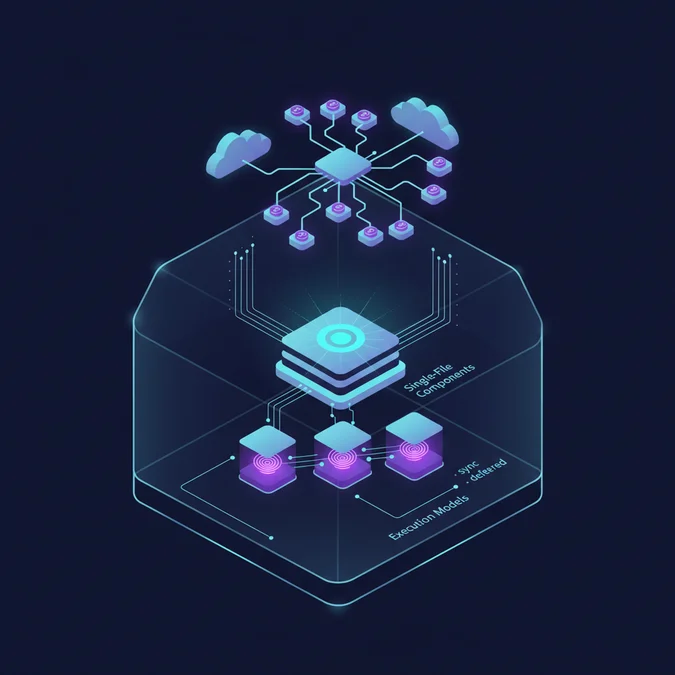

Laravel Livewire Volt is an officially supported single-file component framework for Livewire that merges PHP component logic and Blade view rendering into a unified file. It eliminates boilerplate class declarations by supporting both functional and class-based domain declarations without sacrificing Livewire execution lifecycle semantics or standard HTTP transport hooks.
Separation of concerns across distinct class and template files in modern web frameworks is an obsolete architectural crutch. Traditional full-stack component patterns force engineers into context-switching between separate directory trees for minor presentation tweaks, artificially fragmenting cohesive domain logic under the guise of clean architecture. Unifying the server-side lifecycle directly with the layout tree is not only cleaner; it is fundamentally more maintainable under high product velocity.
For cloud architects running distributed enterprise clusters, Volt alters the operational calculus. It retains the standard Livewire snapshot state hydration cycle over serialized HTTP POST payloads while shifting runtime resolution to optimized compilation caches. Understanding how this single-file paradigm impacts stateless application nodes, persistent caching layers, and containerized scale is essential before deploying it into production architectures.
Direct Answer: What Is Livewire Volt and How Does It Operate?
Laravel Livewire Volt is an elegant, single-file component execution engine for Laravel applications that consolidates PHP server-side actions, component state, lifecycle hooks, and Blade markup into a single physical .blade.php file. It resolves into standard Livewire component instances at runtime through on-the-fly compilation or ahead-of-time manifest caching.
Instead of maintaining a controller-like class inside app/Livewire/MetricsWidget.php alongside a view inside resources/views/livewire/metrics-widget.blade.php, Volt colocates state properties, validation rules, mutation methods, and render blocks within one file. When a user requests a Volt-backed interface, the framework extracts the server-side logic, serializes the public state footprint into an encrypted, signed payload, and sends the rendered HTML markup to the client browser.
Volt components integrate natively with the wider ecosystem. Teams exploring foundational server architectures with Laravel will find that Volt does not alter the underlying HTTP transport mechanics. Subsequent user actions trigger standard Livewire asynchronous POST requests to the internal /livewire/update endpoint, which hydrates the Volt state, executes requested actions, and returns an updated DOM diff along with a regenerated state snapshot.
Single-File Component Paradigms: Functional vs Class-Based Volt
Volt offers two distinct implementation patterns: the functional API and the class-based API. While both compile down to Livewire runtime instances, their internal mechanics appeal to different architectural preferences and testing profiles.
The Functional API
The functional API leverages closure-based method definitions and imported helper functions. State is declared using the state() helper, while actions and lifecycles bind directly via functional primitives:
<php

use function Livewire\Volt\{
 state,
 rules,
 mount,
 updated,
 computed
};
use App\Models\Deployment;

// Component state definition
state([
 'deploymentId' => null,
 'clusterStatus' => 'idle',
 'workerCount' => 1,
]);

// Validation schema binding
rules([
 'workerCount' => 'required|integer|min:1|max:64',
]);

// Execution lifecycle hook
mount(function ($id) {
 $this->deploymentId = $id;
 $this->clusterStatus = Deployment:findOrFail($id)->status;
});

// Reactive state mutation
$scaleCluster = function () {
 $this->validate();
 Deployment:where('id', $this->deploymentId)->update([
 'desired_workers' => $this->workerCount,
 ]);
 $this->clusterStatus = 'scaling';
};>

<div class="p-6 bg-slate-900 text-white rounded-lg">
 <h2>Cluster Target: {{ $deploymentId }}</h2>
 <p>Status: <span class="font-mono">{{ $clusterStatus }}</span></p>
 <input type="number" wire:model="workerCount" class="text-black px-2 py-1 rounded" />
 <button wire:click="scaleCluster" class="bg-blue-600 px-4 py-1 rounded text-white">
 Apply Scale Target
 </button>
</div>
The Class-Based API
The class-based pattern uses anonymous classes extending Livewire\Volt\Component within the blade template. This structure allows traditional object-oriented patterns, strict property types, and explicit dependency injection across methods:
<php

use Livewire\Volt\Component;
use App\Services\CloudProvisioner;

new class extends Component {
 public int $serverId;
 public string $instanceType = 'c6i.xlarge';
 public bool $isProvisioning = false;

 public function mount(int $serverId): void
 {
 $this->serverId = $serverId;
 }

 public function triggerProvisioning(CloudProvisioner $provisioner): void
 {
 $this->isProvisioning = true;
 $provisioner->provisionNode($this->serverId, $this->instanceType);
 }
};>

<div class="flex flex-col gap-4 border border-slate-700 p-4">
 <span>Instance Type: {{ $instanceType }}</span>
 <button wire:click="triggerProvisioning" @disabled($isProvisioning)>
 Deploy Compute Node
 </button>
</div>
From an architectural standpoint, the class-based approach is significantly easier to statically analyze using tools like PHPStan, whereas the functional approach reduces line count and simplifies high-density interactive dashboards.
Compilation Internals and Runtime Lifecycle Architecture
A critical inquiry for systems engineers revolves around the execution pipeline: does Volt parse PHP files via regex on every incoming network request? The answer lies in its multi-tiered compilation and caching engine.
When a request hits a route resolving a Volt component, the framework intercepts the template before evaluation. Volt scans the internal storage path (storage/framework/views) for a compiled PHP class artifact corresponding to that view’s unique cryptographic hash. If a cached artifact does not exist or if the application environment is local, the compiler parses the token stream:
- Tokenization: The engine divides the
.blade.phpfile into isolated PHP code segments and template markup segments via the standard PHP tokenizer. - Component Synthesis: For functional Volt components, the compiler transforms declared functions, state closures, and lifecycle hooks into an ephemeral, standard PHP class subclassing the core Livewire base engine.
- Disk Caching: In production mode, this transformed class is written to disk alongside Blade compiled templates. Subsequent HTTP interactions directly hydrate this generated class, bypassing the tokenizer entirely.
Understanding this compilation pattern is crucial during the standard stages of software development and system architecture. If you operate stateless containers, failure to pre-warm this compilation cache during your build pipeline forces the first incoming edge requests to execute disk-write operations, triggering initial request latency spikes.
Volt Architectural Comparison Against Standard Livewire and Inertia.js
Evaluating Volt requires balancing developer ergonomics against serialized payload overhead and runtime execution limits. The table below outlines how Volt stacks up against classic split-file Livewire components and client-side single-page application setups running Inertia.js with Vue or React.
| Evaluation Metric | Laravel Livewire Volt | Standard Livewire 3 | Inertia.js (Vue/React) |
|---|---|---|---|
| File Topology | Single physical file (.blade.php) | Two distinct files (Class + Blade) | Split front/back (Controller + SFC) |
| Client Transport | HTML diff + JSON State Snapshot | HTML diff + JSON State Snapshot | Pure JSON payload via Vue/React DOM |
| CPU Load on App Nodes | Moderate to High (Server Rendering) | Moderate to High (Server Rendering) | Low to Moderate (API serialization) |
| Hydration Security | HMAC-signed component snapshot | HMAC-signed component snapshot | Standard session/token API guard |
| Static Analysis Support | High (Class) / Moderate (Functional) | Full native PHPStan coverage | TypeScript & PHPStan isolation |
| Asset Bundle Impact | Zero client-side JS bundling needed | Zero client-side JS bundling needed | Full JavaScript bundle hydration |
Volt eliminates the context switching of standard Livewire while preserving its minimal JavaScript footprint. However, because each user interaction still results in a server-side DOM render, the underlying application tier consumes measurable compute cycles compared to pure client-side Inertia architectures.
State Management, Reactivity, and Server-Side Validation
State persistence in Livewire Volt differs radically from state management in client-side frameworks like React or Angular. Volt components are inherently stateless across request boundaries. State is hydrated and dehydrated on every cycle.
When public state properties are declared in a Volt component, the server evaluates them and attaches an encrypted, signed checksum string to the HTML payload. When the client executes an interaction, it returns this entire encrypted state block back to the backend. Volt verifies the cryptographic signature to ensure clients have not tampered with protected attributes, reassigns the properties, runs custom validation mechanisms, and updates the database.
<php

use function Livewire\Volt\{state, rules, updated};
use App\Rules\AllowedSubnet;

state([
 'vpcCidr' => '10.0.0.0/16',
 'subnetMask' => '10.0.1.0/24',
 'isValidating' => false,
]);

rules([
 'vpcCidr' => ['required', 'ip'],
 'subnetMask' => ['required', new AllowedSubnet()],
]);

// Real-time validation executed on state synchronization
updated([
 'subnetMask' => function () {
 $this->validateOnly('subnetMask');
 }
]);>

<div>
 <input type="text" wire:model.live.debounce.500ms="subnetMask" class="border p-2" />
 @error('subnetMask')
 <span class="text-red-500 text-sm">{{ $message }}</span>
 @enderror
</div>
Architects must recognize the risk of payload bloat. Storing large arrays or entire Eloquent collections within Volt public properties causes ballooning serialized state payloads traveling across user networks, increasing bandwidth saturation and degrading latency.
Advanced Usage: Computed Properties, Event Listeners, and Nested Components
Volt components must frequently communicate with adjacent components and efficiently manage computational overhead during request lifecycles. Volt provides dedicated primitives for memoized computation and decoupled event publication.
Computed Properties and Query Optimization
Directly executing database queries inside template markup causes unintended N+1 database queries when views evaluate loops or conditional blocks. Volt’s computed() primitive ensures dynamic values execute once per HTTP hydration cycle, memoizing the return value across subsequent reads:
<php

use function Livewire\Volt\{state, computed, on};
use App\Models\ComputeCluster;

state(['region' => 'us-east-1']);

// Memoized computed property; evaluated strictly once per lifecycle
$clusters = computed(function () {
 return ComputeCluster:query()
 ->where('region', $this->region)
 ->withCount('activeNodes')
 ->get();
});

// Event listener processing cluster reorganization
on([
 'cluster-rebalanced' => function () {
 // Invalidate memoized caches if needed
 unset($this->clusters);
 }
]);>

<div>
 <ul>
 @foreach($this->clusters as $cluster)
 <li>{{ $cluster->name }}: {{ $cluster->active_nodes_count }} Nodes</li>
 @endforeach
 </ul>
</div>
Components can dispatch events up the DOM tree or broadcast system messages using $this->dispatch('cluster-updated'), allowing sibling components to execute targeted DOM patches without full page reloads.
Performance Profiling: Hydration Overhead and Asset Footprints
In production web environments, performance bottlenecks inside Livewire Volt architectures typically materialize in two areas: payload serialization size and server CPU utilization during template rendering.
Every cycle requires running the PHP engine to reconstruct the component, execute lifecycle hooks, transform Blade components into plain HTML, and produce DOM diff updates. In high-traffic scenarios, this model trades memory and database connections for rapid development turnaround. Systems handling massive concurrent webhook ingestion or decoupled customer operations, such as those analyzed in our breakdown of enterprise integration patterns and webhook architectures, rely on lean background queues rather than synchronous execution cycles.
To retain low Time to First Byte (TTFB), engineers must profile their serialized hydration states using Laravel Telescope or Debugbar. Ensure that large data structures are decoupled from public properties and instead fetched via memoized computed methods as needed.
Infrastructure Design and Horizontal Scaling Strategies
Deploying Livewire Volt into multi-server cloud environments (such as AWS ECS, EKS, or Google Cloud Run) introduces stateless routing considerations. Because Volt components execute separate POST requests for subsequent interactions, state cannot reside in local server memory.
Session and Cache Decentralization
In a multi-node topology behind an Application Load Balancer (ALB), sticky sessions are not strictly mandatory for Volt because state travels inside the signed client payload. However, standard session tokens and rate limits must be centralized:
- Centralized Session Storage: Store sessions within a managed Redis cluster (e.g. AWS ElastiCache) rather than the local filesystem.
- Opcode and View Cache Consistency: Build compiled views directly into your Docker images during continuous deployment. If view compilation happens at runtime across different nodes, internal file hashing mismatches can invalidate component templates mid-session.
- Queue-Backed Workloads: If an action in a Volt component involves external network calls or long-running database operations, offload the processing to an asynchronous queue worker cluster via Laravel Horizon instead of blocking the synchronous Livewire HTTP lifecycle.
Adhering to these patterns ensures that any node in an auto-scaling group can serve any incoming Livewire request interchangeably.
Testing Methodologies: Unit, Feature, and Browser Automation
Volt components integrate seamlessly with Laravel’s testing suite, supporting both Pest PHP and PHPUnit without requiring headless browser infrastructure for standard state verification.
Using the native Volt:test() helper, teams can assert initial state, call mutating functions, pass parameters, verify validation triggers, and ensure correct data bindings without executing real browser drivers:
<php

use Livewire\Volt\Volt;
use App\Models\Deployment;
use Illuminate\Foundation\Testing\RefreshDatabase;

uses(RefreshDatabase:class);

it('validates worker count boundaries when scaling compute', function () {
 $deployment = Deployment:factory()->create([
 'status' => 'idle',
 ]);

 Volt:test('cluster-scaler', ['id' => $deployment->id])
 ->assertSet('clusterStatus', 'idle')
 ->set('workerCount', 128) // Exceeds max boundary of 64
 ->call('scaleCluster')
 ->assertHasErrors(['workerCount' => 'max'])
 ->assertSet('clusterStatus', 'idle');
});

it('successfully transitions deployment status on valid input', function () {
 $deployment = Deployment:factory()->create([
 'status' => 'idle',
 ]);

 Volt:test('cluster-scaler', ['id' => $deployment->id])
 ->set('workerCount', 8)
 ->call('scaleCluster')
 ->assertHasNoErrors()
 ->assertSet('clusterStatus', 'scaling');

 expect($deployment->fresh()->desired_workers)->toBe(8);
});
For complex end-to-end user workflows involving JavaScript events and real-time DOM reconciliation, supplement Volt feature tests with Laravel Dusk browser automation running inside your CI pipeline.
Common Operational Pitfalls and Failure Modes
When integrating Volt into real-world production environments, engineering teams frequently encounter edge cases that can compromise performance or security. Below are the primary failure modes and their resolutions:
- Accidental Exposure of Sensitive Models: Storing raw Eloquent models containing sensitive database columns inside public properties serializes those attributes into the frontend HTML. Always use bounded DTOs, primitive types, or strip sensitive columns with
public array $userDatainstead of passing raw User models. - Uncached Production Compilation: Failing to execute
php artisan view:cacheduring automated deployments forces the application node to read the filesystem, split tokens, and generate temporary classes dynamically on user requests, causing high disk I/O bottlenecks. - High-Frequency Polling Saturation: Overusing
wire:pollinside complex Volt components can bombard application load balancers with continuous HTTP cycles, creating a denial of service across database connections if connection pooling is not enforced via PgBouncer or AWS RDS Proxy. - State Size Bloat: Storing large query results or tabular collections in state increases the cryptographic signature size, leading to network transmission overhead and payload rejection errors on reverse proxies like Nginx or Cloudflare due to HTTP header or request body size limits.
Engineering Cost Models and Infrastructure Expenditure
Implementing Livewire Volt influences architectural expenditures across developer productivity, infrastructure capacity, and support maintenance. Because Volt eliminates the need to maintain parallel frontend stacks (such as Node.js, Webpack/Vite compilation layers, and API route abstractions), it materially shifts operational spend away from frontend maintenance into raw backend compute capacity.
The table below provides concrete pricing structures and cost ranges across development and cloud infrastructure models:
| Engagement / Infrastructure Model | Concrete Cost Range | Primary Cost Drivers | Trade-off & Allocation Note |
|---|---|---|---|
| Junior / Mid Laravel Developer (Contract) | $45.00 to $85.00 per hour | Feature complexity, test density | Rapid UI implementation; lower upfront engineering spend. |
| Senior Cloud Architect / Staff Engineer | $140.00 to $220.00 per hour | State optimization, infrastructure scaling | Required to structure high-throughput state hydration architectures. |
| Dedicated Full-Stack Retainer (Monthly) | $7,500.00 to $18,000.00 per month | Continuous deployment, SLA targets | Covers continuous optimization, view caching, and pipeline tuning. |
| Project-Based Modernization Sprints | $25,000.00 to $85,000.00 total cost | Legacy Blade migration to Volt components | Replaces detached SPAs with single-file component architectures. |
| AWS Infrastructure (Compute Node Base) | $180.00 to $650.00 per month | EC2 / ECS Fargate instances (c6i.xlarge) | Volt requires more server CPU due to continuous server-side rendering. |
| Managed Redis Cache (ElastiCache) | $65.00 to $240.00 per month | Redis node cluster sizing and replication | Required to store persistent session state across load balancers. |
While developer velocity increases substantially, the ongoing operational cost shifts toward server compute. Teams should anticipate allocating 15% to 30% more budget toward cloud compute resources to absorb the continuous hydration and rendering load compared to purely static or decoupled SPA frontends.
Explore our complete Laravel, Basics directory for more guides.
Factors That Affect Development Cost
- Developer seniority and familiarity with single-file component compilation
- Infrastructure compute overhead required for continuous server rendering
- Managed cache and session clustering requirements across horizontal availability zones
- Migration scope from decoupled JavaScript architectures to Livewire single-file components
Engineering implementation rates span from $45.00 per hour for general development up to $220.00 per hour for senior cloud optimization, alongside monthly AWS compute allocations ranging from $180.00 to $650.00 depending on cluster density.
Laravel Livewire Volt successfully challenges the dogma that presentation markup and backend logic must live in physically separated files. By streamlining the full-stack component paradigm into a single, cohesive file, it offers unmatched developer velocity for internal tools, management consoles, and rapid enterprise product releases without abandoning standard Laravel conventions.
However, running Volt at high scale demands technical discipline. Cloud architects must treat the serialized hydration payload as a bounded network resource, enforce aggressive view caching across stateless Docker builds, and ensure that centralized caching layers handle session persistence across distributed compute nodes. When applied within these architectural guardrails, Volt delivers an exceptionally responsive application workflow while keeping the underlying codebase compact and maintainable.