
A system design mock interview is a simulated technical evaluation where candidates architect scalable distributed systems under realistic operational constraints. To pass senior and staff assessments, you must rapidly formulate system boundaries, evaluate throughput bottlenecks, partition data tiers, and systematically enforce zero trust isolation across every communication channel.
A mock interview cannot compensate for unverified architectural assumptions or magically teach you distributed systems primitives in real time. If you treat this simulation as a superficial test of buzzwords rather than a defense of structural trade-offs, catastrophic failures in network latency, consistency semantics, and unauthorized boundary escalation will surface immediately under senior examiner scrutiny.
Operating from a defensive security perspective, this technical breakdown dissects the end-to-end framework necessary to command the whiteboard. By treating security controls, defensive data boundaries, and threat containment as first-class architectural constraints alongside throughput and availability, you demonstrate the engineering maturity expected of staff and principal engineers.
Deconstructing the Technical Bounds of Modern System Design Interviews
The core objective of a system design mock interview is to demonstrate that you can navigate ambiguous operational mandates while preserving availability, partition tolerance, and strict data confidentiality. Senior interviewers intentionally leave baseline parameters undefined to assess whether you instinctively isolate failure domains or haphazardly sketch monolithic diagrams that collapse under volumetric load.
Too many engineers bypass requirement extraction and instantly start sketching message queues and distributed caches. From an adversarial standpoint, this is disastrous. Deploying unauthenticated caching layers or ambiguous queue workers introduces vast attack vectors and synchronization anomalies that fail production readiness audits immediately.
A successful session demands establishing two distinct engineering boundaries within the first five minutes:
- Functional Boundaries: Defining precise API behaviors, client-facing payloads, and specific state mutations required by the business domain.
- Non-Functional Latency and Security Constraints: Hardening throughput SLAs, defining P99 latency budgets, establishing role-based data boundaries, and enforcing cryptographic validation of all inbound RPC transactions.
By mapping out throughput alongside trust perimeters, you prove that reliability and isolation are not secondary concerns. Every layer must assume downstream network components are potentially compromised or inherently unreliable.
Threat Modeling and System Constraints: The 45-Minute Execution Framework
Time management separates staff-level candidates from mid-level implementers. A standard 45-minute architectural interview leaves virtually zero margin for circular debates or structural backtracking. You must partition your session into distinct, strictly timed operational segments designed to de-risk the entire topology.
| Phase | Allocated Time | Technical Target | Primary Security and Architectural Deliverable |
|---|---|---|---|
| 1. Clarification and Scope | 0 to 5 min | Extract read/write ratios, QPS, data retention windows | Threat surface definition, trust domain identification |
| 2. Back-of-the-Envelope Math | 5 to 10 min | Network I/O, storage sizing, memory capacity bounds | Cryptographic compute overhead, log ingestion volumes |
| 3. High-Level Blueprint | 10 to 20 min | Component mapping, core ingestion pipelines, primary storage | Network boundary segmentation, edge authentication gate |
| 4. Deep Dive and Hardening | 20 to 38 min | Partitioning strategies, cache invalidation, consensus | Zero trust mTLS, cryptographic key rotation, race conditions |
| 5. Failure Modes and Recovery | 38 to 45 min | Circuit breakers, bulkheads, disaster recovery topologies | Blast-radius containment, replay-attack mitigation, data auditing |
To avoid spending too much time on edge scenarios, articulate your structural assumptions loudly. State clearly: “We are optimizing this tier for read latency under strict read-after-write consistency, accepting a minor partition delay during cross-region replication failovers.” When candidates systematically integrate security into team workflows, they naturally improve developer productivity by eliminating architectural regressions before writing a single line of application logic.
Back-of-the-Envelope Math: Capacity, Memory, and Cryptographic Overhead
Capacity calculations are not an academic ritual; they directly dictate the hardware, memory, and cryptographic footprint of your distributed topology. You must quantitatively estimate requests per second (RPS), total network bandwidth, and persistent storage growth across five-year lifecycles while accounting for transport encryption and hashing expenses.
Quantitative Sizing Scenario
Consider a high-scale ingestion platform handling 100 million daily active users (DAU) where each client initiates 20 discrete operational updates per day:
Total daily transactions:
100,000,000 users * 20 requests = 2,000,000,000 requests/dayAverage queries per second (QPS):
2,000,000,000 / 86,400 seconds =~ 23,150 QPSPeak traffic scaling factor (typically 2x to 3x):
23,150 QPS * 2.5 = ~58,000 Peak QPSBandwidth and Transport Layer Security Overhead
Assuming an average inbound JSON payload of 1 Kilobyte and an outbound response of 500 bytes, peak network ingestion evaluates as:
58,000 requests/sec * 1.5 KB = 87 MB/sec (~696 Mbps)From an enterprise security perspective, this ingress demands TLS termination architectures capable of negotiating tens of thousands of simultaneous handshakes without exhausting application CPU pools. Ephemeral Diffie-Hellman key exchanges across 58,000 QPS will quickly saturate standard single-tenant processors, mandating dedicated hardware security modules (HSM) or dedicated ingress load balancers offloading cryptographic verification before traffic reaches the VPC interior.
Storage Sizing with Cryptographic Bloat
If each raw record is 1 KB, the raw persistent storage needed daily is:
2,000,000,000 * 1 KB = 2 TB/day -> ~730 TB/yearHowever, once you introduce compliance structures (AES-256-GCM authenticated encryption tags, initialization vectors, cryptographic signatures, and audit trails), payload size grows by roughly 15 to 20 percent. Over five years, this scales your storage tier past 4.3 Petabytes, dictating immediate multi-tiered cold storage offloading and aggressive archival strategies.
Core Architectural Blueprints: Designing Resilient and Segmented Tiers
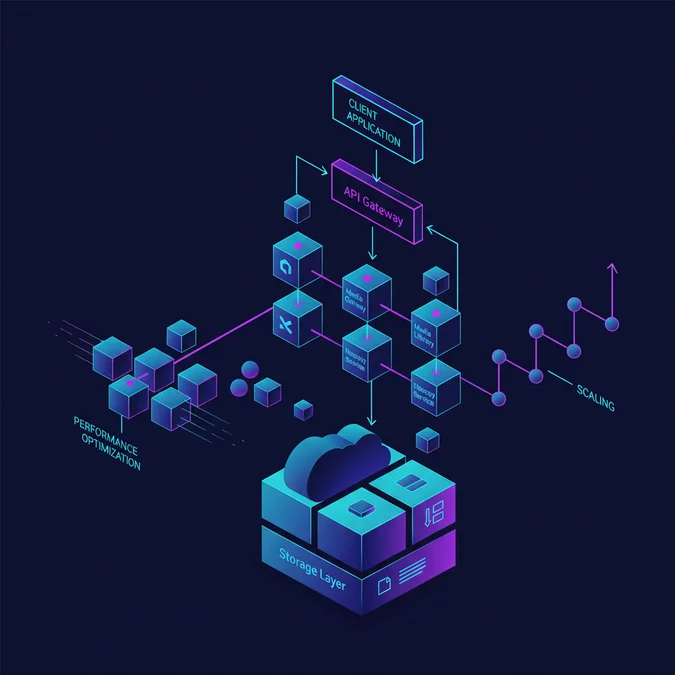
A high-level architecture diagram must cleanly differentiate between untrusted public internet networks, edge ingestion demilitarized zones (DMZs), internal application microservices, and protected persistence backends. Blurring these lines flags severe design weaknesses in a mock interview.
The flow of an enterprise distributed request must follow strict perimeter controls:
- Anycast DNS and Edge DDoS Scrubber: Absorbs layer 3 and 4 network attacks before passing clean TCP packets to geographically routed reverse proxies.
- API Gateway and Web Application Firewall (WAF): Terminates incoming TLS, analyzes HTTP layer traffic against the OWASP Top 10 vulnerabilities (SQLi, XSS, SSRF), and validates incoming authorization tokens (JWT/OAuth2) against public key revocation lists.
- Stateless Application Clusters: Services process business logic within private virtual clouds (VPCs). Nodes run in immutable container pods or long-lived PHP worker pools to eliminate initialization overhead, similar to how modern application runtimes maximize performance in high-scale environments.
- Partitioned Persistence and Cache Tiers: Secure database clusters operating in private subnets with strict security groups rejecting all traffic except authorized IP ranges from the application layer.
To guarantee that low-latency worker processes do not compromise security when handling extreme request volumes, architectures often incorporate runtimes like Swoole or RoadRunner. If you are exploring how long-lived memory models handle extreme traffic loads, check out our guide on Laravel Octane Performance Boost to evaluate the memory leak trade-offs inherent in stateful workers.
Data Layer Design: Schema Hardening, Partitioning, and Zero Trust Storage
Senior interview candidates must navigate the trade-offs between relational database systems (ACID-compliant RDBMS) and horizontally scalable NoSQL implementations without resorting to dogma. The choice depends on query access patterns, join complexity, write concurrency, and field-level encryption demands.
Relational versus Non-Relational Persistence Matrix
| Storage Paradigm | Primary Strengths | Inherent Bottlenecks | Data Security and Integrity Profile |
|---|---|---|---|
| RDBMS (PostgreSQL, MySQL) | Strict ACID guarantees, advanced indexing, foreign key integrity | Vertical scaling limits on primary write node; sharding overhead | Native row-level security (RLS), mature column encryption extensions |
| Document Store (MongoDB) | Dynamic schemas, horizontal auto-sharding, high write speed | Eventual consistency anomalies, risk of massive duplicate data | Field-level client-side encryption (CSFLE), broad blast radius on breach |
| Key-Value Store (Redis, DynamoDB) | Sub-millisecond read/write latency, partition tolerance | Extremely limited query filters, index management complexity | In-memory exposure risk, mandates TLS-in-transit across every internal node |
When defending horizontal partitioning (sharding) in your mock interview, explicitly outline your shard key strategy. Using a naive sequential integer ID introduces write hotspots on the most active shard while leaking operational volume trends to external observers. Instead, use cryptographically secure composite keys, such as an HMAC-derived customer tenant hash combined with a monotonically increasing, k-sorted snowflake ID.
Furthermore, ensure your design addresses zero trust persistent storage. Sensitive personally identifiable information (PII) must be encrypted using envelope encryption, where data encryption keys (DEKs) are rotated frequently and protected by centralized Key Management Services (KMS). Never propose architectures that allow databases to store unhashed, unpadded plain-text credentials or unsecured regulatory records.
Secure Ingestion and Edge Defense: WAF, Rate Limiting, and Mutual TLS
Edge ingestion architectures must be designed to withstand volumetric abuse, distributed denial of service floods, and credential stuffing operations. High-level mock interview designs frequently falter by routing unauthenticated raw requests directly to internal microservices.
To build an edge defense tier, implement a reverse-proxy gateway cluster using consistent token bucket or leaky bucket algorithms executed via in-memory data stores. Below is a production-hardened rate limiter design implemented in Lua for atomic execution inside a high-throughput Redis instance, preventing race conditions under high concurrency:
Mitigating High-Scale Object Storage Vulnerabilities and Bottlenecks
Modern system design prompts frequently involve massive unstructured data: media streaming pipelines, diagnostic document uploads, or long-term auditing archives. Routing hundreds of megabytes of raw binary payloads through application servers will rapidly saturate thread pools, cause out-of-memory crashes, and introduce severe Server-Side Request Forgery (SSRF) attack vectors.
The battle-tested architectural pattern utilizes direct-to-object-storage transfers orchestrated via cryptographically signed URLs. The client requests an upload authorization ticket from the API gateway, which issues a short-lived (60 to 300 second) time-limited S3 presigned PUT URL. The client then streams the binary object directly to bucket storage, offloading multi-gigabit transport processing from the internal application layer entirely.
However, from a security engineer's perspective, this introduces an unvalidated payload vulnerability: malicious users could upload malicious executables, macro-embedded binaries, or unmetered multi-terabyte files designed to inflate storage overhead. To remediate this, you must architect an asynchronous validation pipeline:
- Bucket Event Notification: The object storage bucket emits an event notification (via SQS or Kafka) upon successful
s3:ObjectCreated:Put execution. - Quarantine Isolation: Newly uploaded files land in an unprivileged, isolated quarantine bucket partition inaccessible to normal read traffic.
- Asynchronous Sanitization Workers: Sandboxed worker nodes pull notifications, verify payload magic bytes (ignoring spoofed HTTP
Content-Type headers), run cryptographic hash comparisons against threat databases, and scan files for malicious code. - Atomic Promotion: Only files that pass deep inspection are moved to the production public bucket or made available across downstream CDN edge nodes.
For a complete breakdown of secure bucket policies, least-privilege AWS IAM configurations, and streaming architectures, review our practical guide on Laravel S3 File Upload.
Distributed Caching Mechanics: Invalidation, Cache Stampede, and Memory Poisoning
Distributed caching is essential for hitting strict P99 read SLAs, but it introduces dangerous operational failure modes if managed naively. When discussing caching layers like Redis or Memcached in an interview, you must articulate exact mitigation strategies for Cache Penetration, Cache Breakdown (Stampede), and Cache Avalanche.
Cache Stampede Resolution using Probabilistic Early Expiration
A cache stampede occurs when an intensely accessed cache key expires while systems are under high QPS. Thousands of concurrent client connections encounter a cache miss simultaneously, bypassing the cache layer and slamming the underlying relational database with identical expensive analytical queries. This quickly cascades into persistent database connection pool exhaustion.
Rather than relying on simple Time-to-Live (TTL) timeouts or complex external distributed locking, state-of-the-art architectures deploy the XFetch probabilistic early expiration algorithm. A worker process statistically computes whether it should proactively recalculate and re-cache the value before the absolute expiration boundary occurs:
Event-Driven Topologies: Asynchronous Pipelines, Kafka, and Replay Defenses
Decoupling core business mutations from secondary workflows requires resilient asynchronous event pipelines. In systems like order processing or notification delivery, executing every task synchronously within the client request cycle violates latency constraints and compounds failure points. If an external messaging service fails, the entire transaction collapses.
Using distributed append-only logs such as Apache Kafka or AWS Kinesis introduces predictable decoupling, but interviewers will immediately probe your design for message ordering guarantees, at-least-once delivery duplicates, and replay attack vulnerabilities.
The Idempotent Consumer Pattern
Because distributed brokers rely on consumer offset acknowledgments over unreliable networks, network partitions frequently cause messages to be re-delivered. If consumers process monetary transfers or inventory reductions multiple times, data integrity is compromised. Every consumer pipeline must incorporate an explicit deduplication boundary using the Idempotent Consumer Pattern:
- Cryptographic Request Hashes: Producers assign every event a unique UUID alongside an HMAC derived from the mutation payload.
- Atomic Distributed Checking: The consuming worker evaluates whether the transaction ID has been registered within an in-memory Redis cluster or an uncommitted database table using an atomic
INSERT ON CONFLICT DO NOTHING or SETNX command. - Processing and State Commit: The event logic runs inside a strictly bounded local transaction. Upon completion, the idempotency key state moves from
PROCESSING to RESOLVED with an associated 24-hour expiration time. - Replay Defense: Any identical event arriving during or after execution is immediately dropped, returning the cached successful acknowledgment without re-running state mutations.
Distributed Consensus, Sharding, and Concurrency Control
When data volumes exceed the capacity of a single physical storage engine, you must split your data across multiple nodes. However, naive horizontal sharding without robust concurrency controls will cause dirty reads, non-repeatable reads, and lost updates across distributed partitions.
In a mock interview, demonstrating mastery over transactional isolation separates top candidates from the rest. You must clearly delineate when to apply Optimistic Concurrency Control (OCC) versus Pessimistic Locking, and understand how consensus algorithms like Raft govern state changes across replicated nodes.
Concurrency Control Mechanisms
- Optimistic Concurrency Control (OCC): Nodes read records without acquiring locks. Every record carries an integer
version or monotonic timestamp. Updates explicitly evaluate WHERE id =:id AND version =:expected_version. If the update fails (because another thread mutated the version), the transaction aborts and retries. OCC provides optimal throughput in systems dominated by read traffic with infrequent write collisions. - Pessimistic Distributed Locking: Transactions acquire exclusive row-level or distributed locks (using Redis Redlock or ZooKeeper ephemeral nodes) prior to querying or mutating state. While this guarantees absolute safety against write collisions, it introduces lock contention overhead, deadlocks, and severe latency penalties under heavy traffic.
When selecting consensus implementations for coordinator nodes, acknowledge the CAP Theorem trade-offs. A distributed system can only provide two of Consistency, Availability, and Partition Tolerance simultaneously. In real-world enterprise deployments, network partitions are inevitable physical realities, which means architectures must deliberately balance between strong consistency (CP systems like Raft/ZooKeeper) and high availability with eventual consistency (AP systems like Cassandra/DynamoDB).
Auditing, Observability, and Cryptographic Tamper-Proof Logs
A production system design is incomplete without comprehensive observability and security auditing. If an adversary compromises a perimeter node, standard file-based application logs can easily be wiped or altered, concealing the attacker's footprint. System architectures must enforce unalterable, append-only centralized log forwarding.
Log aggregation pipelines must separate standard application metrics from compliance and security audit trails. Sensitive audit events (such as authentication state changes, permission escalations, or data export tasks) require cryptographic chaining before landing in cold archival tiers:
Cryptographically Chained Audit Streams
Borrowing architectural primitives from Merkle Trees and append-only ledger designs, each log event must contain:
- A monotonically incrementing log sequence identifier.
- The UTC timestamp verified via Network Time Protocol (NTP) consensus.
- The operational payload, stripped of plain-text secrets and PII (using SHA-256 pseudonymization).
- The cryptographic hash of the immediately preceding log record (
PrevHash). - An asymmetric digital signature generated by the emitting node's Hardware Security Module.
If an intruder accesses the centralized log engine and attempts to delete or modify past transaction records, the cryptographic signature chain breaks immediately, alerting the Security Operations Center (SOC) during automated integrity verification passes.
Mock Interview Scoring Rubric: How Staff and Principal Candidates Are Evaluated
Understanding the exact grading rubric used by FAANG and tier-one enterprise engineering panels removes the mystery from the evaluation process. Staff-level system design rubrics do not measure how many open-source technologies you can name. They score structural reasoning, boundary enforcement, and failure domain containment.
Evaluation Dimension L5 (Senior Engineer) Standard L6+ (Staff / Principal) Standard Problem Formulation Asks basic scaling questions; identifies obvious functional requirements. Proactively uncovers edge cases, defines data retention liabilities, and challenges flawed operational assumptions. System Boundaries Segments system into basic 3-tier architectures (Client, Server, DB). Enforces zero trust isolation, isolates untrusted workloads, and specifies strict network ingress/egress policies. Data Architecture Chooses between SQL and NoSQL based on basic read/write patterns. Defines exact shard keys, models distributed transactions, analyzes replication lag, and implements cryptographic envelope encryption. Failure Mitigation Suggests adding more read replicas or scaling out container pools. Designs resilient bulkheads, multi-region active-active replication, data-reconciliation pipelines, and probabilistic circuit breakers.
To score in the highest percentile, you must lead the conversation. Do not wait for the interviewer to prompt you on edge-case failures. Explicitly highlight your trade-offs: "While this asynchronous pipeline lowers client response times to under 30 milliseconds, it introduces an eventual consistency window of up to two seconds across downstream read replicas. Here is how we enforce read-your-own-writes consistency for mutating clients.."
Curated Engineering Directories and Distributed System Resources
Mastering distributed systems, resilient cloud components, and secure backend patterns requires continuous study of production post-mortems and underlying framework internals. To deepen your hands-on implementation capabilities across modern server-side applications, explore our comprehensive collection of deep-dive architectural blueprints.
Explore our complete Laravel, Basics directory for more guides.
A system design mock interview is an intensive evaluation of how you balance real-world operational constraints against architectural scale. By treating security perimeters, defensive data structures, and deterministic failure isolation as primary design criteria rather than secondary considerations, you distinguish yourself as an engineer who builds durable systems that survive adversarial conditions.
Approach your next mock session with structural discipline: quantify capacity bounds early, establish clear trust boundaries across every communication bus, isolate your persistence layers, and explicitly validate failure modes. Building reliable, high-performance distributed architectures requires defending your trade-offs with clear mathematical and structural reasoning.
References & Further Reading