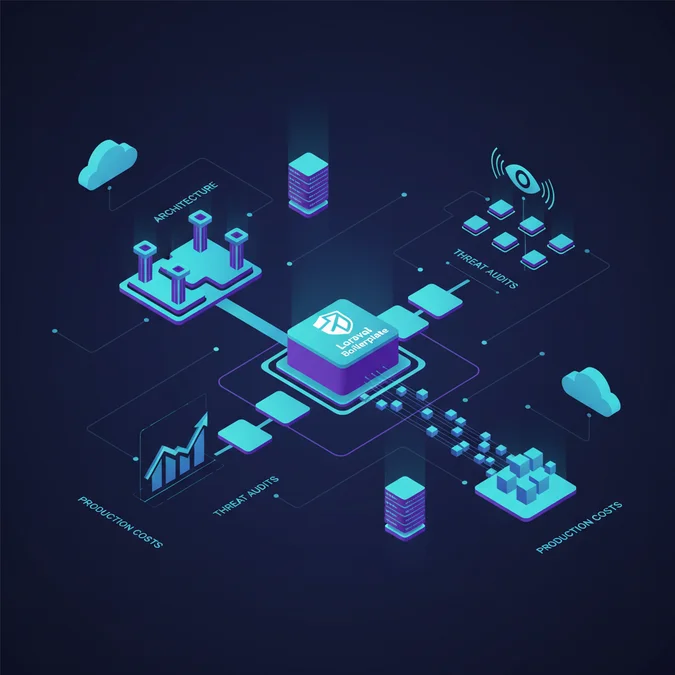

A Laravel boilerplate is a pre-configured software scaffolding providing pre-assembled authentication, database migrations, role-based access control, and API infrastructure on top of the Laravel framework. It eliminates repetitive setup steps, allowing engineering teams to deploy multi-tenant portals, SaaS backends, and administrative consoles rapidly without manually wiring initial foundational layers.
According to the 2024 Snyk State of Open Source Security Report, over 68 percent of audited application vulnerabilities originate directly from inherited third-party dependencies and misconfigured starter templates rather than custom application code. Pulling an untrusted or obsolete boilerplate introduces serious systemic risk into your enterprise boundary before your developers write their first domain logic.
From an adversarial perspective, adopting an off-the-shelf starter package trades upfront developer velocity for long-term supply-chain exposure. Evaluating, auditing, hardening, and maintaining an enterprise Laravel boilerplate requires rigorous cryptographic vetting, zero-trust RBAC enforcement, proactive dependency pinning, and deep structural awareness of framework isolation.
Threat Modeling the Modern Laravel Boilerplate
When an engineering team adopts a starter kit, they inherit every architectural choice, configuration oversight, and cryptographic shortcut implemented by the upstream maintainer. Unlike standard Composer packages that isolate logic within isolated library namespaces, a boilerplate writes concrete code directly into your repository tree: controllers, middleware, model factories, and database migrations. From a security perspective, this changes your blast radius entirely.
Vulnerability Propagation and Supply Chain Exposure
Upstream boilerplate authors rarely maintain security lifecycle commitments equivalent to framework vendors. When an unmaintained starter kit couples your application to vulnerable sub-dependencies or insecure architectural defaults, static application security testing (SAST) often misses subtle structural logic flaws. Consider the common threat vectors introduced by poorly configured baseline projects:
- Mass Assignment Vectors: Default models generated with unconstrained
$guarded = []arrays instead of explicitly validated$fillableattributes. - Broad Permissive CORS: Boilerplates shipped with
allowed_origins => ['*']to facilitate smooth local front-end debugging, which inadvertently reaches production environments. - Lax Session State Policies: Session cookies configured without the
Secure,HttpOnly, orSameSite=Strictflags active across all staging environments. - Exposed Debug Toolbars: Integrated profiling bundles such as Laravel Debugbar left enabled in production setups, exposing active environment variables, database credentials, and unmasked application keys.
Adversaries purposefully monitor popular boilerplate repositories for security patches. Once a public fix is committed to an open-source starter repository, bad actors construct automated scanners to probe the web for applications running older variants of the identical directory structure and endpoints.
Starter Kit Architectural Archetypes: Breeze, Jetstream, and Custom Scaffolding
Understanding the architectural profile of your scaffolding determines your attack surface. The Laravel ecosystem offers three distinct architectural archetypes for project initialization, each presenting varying security postures, maintenance costs, and blast radii.
| Archetype | Core Stack | Authentication Surface | Security Review Complexity | Maintenance Burden |
|---|---|---|---|---|
| Laravel Breeze | Blade / Inertia / Vue / React | Minimal Session / Token | Low (Minimal footprint) | Low (Tracks official releases) |
| Laravel Jetstream | Livewire / Inertia + Fortify | MFA, Teams, Sanctum Tokens | Moderate (Stateful Fortify logic) | Moderate (Complex dependencies) |
| Enterprise Custom Boilerplate | Full SaaS, Stripe, RBAC, Filament | Multi-tenant, OAuth, MFA, Webhooks | High (Broad external integrations) | High (Requires dedicated security team) |
Official options like Laravel Breeze keep surface complexity at an absolute minimum. Breeze configures simple controllers and routes that developers can inspect directly, presenting minimal abstraction layers between HTTP requests and Eloquent persistence. In contrast, Laravel Jetstream bundles complex lifecycle concerns: two-factor authentication via time-based one-time password (TOTP) algorithms, browser session destruction, API token management via Laravel Sanctum, and team invitation mechanics governed by Laravel Fortify.
When scaling beyond microservices into high-throughput systems, architectural blueprints must also account for persistent worker models. If your boilerplate operates inside environments leveraging a Laravel Octane performance boost, memory leakage within shared singletons can accidentally bleed authentication state across asynchronous worker processes.
Authentication Hardening: Passwords, MFA, and Session Lifecycle Mechanics
A resilient boilerplate enforces zero-trust identity authentication out of the box. Default out-of-the-box configurations frequently default to relaxed password policies and prolonged session timeouts to minimize development friction. In production, these defaults violate multiple compliance frameworks, including NIST SP 800-63B and PCI-DSS 4.0.
Strict Cryptographic Hashing and Rotation
Laravel defaults to the Bcrypt hashing algorithm with a work factor of 12. For mission-critical infrastructure, applications should standardize on Argon2id, which offers superior resistance against specialized GPU-accelerated side-channel and brute-force attacks. Configure this setting directly within config/hashing.php:
<php

return [
 // Enforce memory-hard Argon2id over classic Bcrypt
 'driver' => 'argon2id',

 'argon' => [
 'memory' => 65536, // 64 MB operational memory limit
 'threads' => 2,
 'time' => 4, // 4 computational passes
 ],
];
Your boilerplate must mandate two-factor authentication (TOTP) for all administrative and elevated operational roles. Secret keys stored for TOTP calculation must never exist in plain text within the database. Always use encrypted database fields via Laravel model attribute casting:
<php

namespace App\Models;

use Illuminate\Foundation\Auth\User as Authenticatable;

class User extends Authenticatable
{
 protected $casts = [
 'two_factor_secret' => 'encrypted',
 'two_factor_recovery_codes' => 'encrypted:array',
 'email_verified_at' => 'datetime',
 'password' => 'hashed',
 ];
}
Session invalidation must occur immediately upon privilege escalation or credential mutation. If an authenticated user modifies their password, all concurrent sessions across alternate devices must be destroyed by invoking Auth:logoutOtherDevices($currentPassword) to mitigate active session-hijacking windows.
Zero-Trust Authorization: Granular RBAC and Multi-Tenancy Boundary Isolation
Many commercial boilerplates package complex Role-Based Access Control (RBAC) engines, often relying on heavy packages like Spatie Laravel-Permission. While flexible, third-party permission schemas can introduce severe horizontal privilege escalation (BOLA/IDOR) vulnerabilities if global scope verification is not enforced at the database layer.
Preventing Insecure Direct Object References (IDOR)
Never rely solely on UI-level conditional rendering or simple middleware checks to restrict record access. Attackers manipulate resource identifiers directly within URI payloads. Secure boilerplates implement route-model binding tied explicitly to tenant ownership boundaries via explicit Eloquent Scopes:
<php

namespace App\Models\Scopes;

use Illuminate\Database\Eloquent\Builder;
use Illuminate\Database\Eloquent\Model;
use Illuminate\Database\Eloquent\Scope;
use Illuminate\Support\Facades\Auth;

class TenantScope implements Scope
{
 public function apply(Builder $builder, Model $model): void
 {
 // Prevent horizontal data leakage by binding execution to active tenant
 if (Auth:check() && Auth:user()->tenant_id!== null) {
 $builder->where($model->getTable(). '.tenant_id', '=', Auth:user()->tenant_id);
 }
 }
}
Enforce authorization policies on every discrete controller action rather than relying on blanket parent middleware. Implement Laravel Gate checks early inside Form Request classes:
<php

namespace App\Http\Requests;

use Illuminate\Foundation\Http\FormRequest;

class UpdateInvoiceRequest extends FormRequest
{
 public function authorize(): bool
 {
 $invoice = $this->route('invoice');
 // Explicit policy evaluation against incoming subject and authenticated agent
 return $invoice!== null && $this->user()->can('update', $invoice);
 }

 public function rules(): array
 {
 return [
 'amount' => ['required', 'numeric', 'min:0.01'],
 'notes' => ['nullable', 'string', 'max:1000'],
 ];
 }
}
When handling sensitive arrays in memory during bulk data transformations, review how the framework manages memory structures by consulting our guide on Laravel collections security risks and implementation to prevent denial-of-service vulnerabilities via unoptimized operations.
API Defense and Microservice Perimeter Security: Sanctum vs. Passport
Modern boilerplates universally ship with API endpoints configured out of the box. Choosing between Laravel Sanctum and Laravel Passport dictates your cryptographic perimeter, state management, and operational complexity.
Sanctum vs. Passport: Security Evaluation
Laravel Sanctum issues lightweight, database-backed personal access tokens (hashed via SHA-256) or facilitates stateful cookie-based session hydration for single-page applications (SPAs). Laravel Passport implements a complete OAuth2 server utilizing JSON Web Tokens (JWT) signed using asymmetric public and private keys via League OAuth2 Server.
- Laravel Sanctum Advantages: Instant revocation capabilities because tokens are validated directly against persistent storage on every request. Lower risk of stale claim exploitation.
- Laravel Sanctum Risks: In stateful SPA mode, loose configuration of
SANCTUM_STATEFUL_DOMAINScan expose endpoints to Cross-Site Request Forgery (CSRF) if top-level wildcard domains are improperly matched. - Laravel Passport Advantages: Cryptographically signed tokens permit stateless verification by downstream microservices without requiring database queries on every validation cycle.
- Laravel Passport Risks: Token revocation demands complex distributed token-blacklisting mechanisms or short-lived expiration windows coupled with active refresh-token exchange pipelines.
Regardless of the chosen token provider, you must configure strict, tiered rate-limiting policies within app/Providers/RouteServiceProvider.php or the HTTP Kernel to defend against distributed brute-force attacks and credential stuffing campaigns:
<php

use Illuminate\Cache\RateLimiting\Limit;
use Illuminate\Http\Request;
use Illuminate\Support\Facades\RateLimiter;

RateLimiter:for('api-sensitive', function (Request $request) {
 // Tiered rate limit based on authenticated token identity or client IP address
 return Limit:perMinute(10)->by($request->user()?->id? $request->ip())->response(function () {
 return response()->json([
 'error' => 'Too Many Requests',
 'message' => 'Security rate limit exceeded. Retry later.',
 ], 429);
 });
});
Preventing Front-End Injection: Blade, Inertia, and CSP Headers
Boilerplates typically bundle sophisticated front-end view layers: standard Blade templates, or rich client-side applications built with Inertia.js coupled to Vue or React. Each presentation layer presents distinct Cross-Site Scripting (XSS) vectors that demand intentional mitigation.
Laravel Blade escapes variables automatically when using the standard {{ $variable }} mustache syntax. However, third-party boilerplates often resort to raw echo tags {! $variable!} to render formatted user descriptions, system alerts, or HTML snippets from administrative settings. This practice introduces high-severity stored XSS vulnerabilities. For teams managing complex markup architectures, studying Laravel templates architecture and Blade mechanics provides critical insight into rendering safely without exposing client boundaries.
Automating Strict Content Security Policy (CSP)
Relying solely on framework-level output escaping is insufficient against advanced persistent client-side injection. A production-ready boilerplate must dispatch robust, nonced Content Security Policy headers on every HTTP response via specialized middleware:
<php

namespace App\Http\Middleware;

use Closure;
use Illuminate\Http\Request;
use Symfony\Component\HttpFoundation\Response;

class EnforceSecurityHeaders
{
 public function handle(Request $request, Closure $next): Response
 {
 $response = $next($request);

 // Inject defense-in-depth headers protecting against framing and sniffing
 $response->headers->set('X-Frame-Options', 'DENY');
 $response->headers->set('X-Content-Type-Options', 'nosniff');
 $response->headers->set('Referrer-Policy', 'strict-origin-when-cross-origin');
 $response->headers->set('Permissions-Policy', 'camera=(), microphone=(), geolocation=()');

 // Standardizing a strict CSP configuration
 $csp = "default-src 'self'; ".
 "script-src 'self'; ".
 "style-src 'self' 'unsafe-inline'; ".
 "img-src 'self' data: https: ".
 "object-src 'none'; ".
 "frame-ancestors 'none'; ".
 "base-uri 'self';";

 $response->headers->set('Content-Security-Policy', $csp);

 return $response;
 }
}
This middleware mitigates common clickjacking, MIME-type sniffing, and drive-by script injection threats across all rendered application surfaces.
Database Isolation and Safe Eloquent Construction
A common misconception among developers is that utilizing an ORM like Eloquent universally eliminates SQL injection. While parameterized queries are standard for basic queries, unvetted open-source boilerplates frequently introduce critical SQL injection vulnerabilities through dynamic filtering and sort implementations.
Vulnerabilities in Dynamic Query Scopes
To provide search and sorting grids, starter kits frequently accept unfiltered HTTP request parameters directly into raw query builder expressions:
<php

// INSECURE: Vulnerable to SQL Injection via dynamic order column
$column = $request->input('sort_by');
$users = User:orderByRaw($column)->get();

// SECURE: Enforce an explicit allowlist pattern for incoming sorting targets
$allowedSorts = ['name', 'created_at', 'email'];
$sortBy = in_array($request->input('sort_by'), $allowedSorts, true)? $request->input('sort_by'): 'id';
$direction = $request->input('direction') === 'desc'? 'desc': 'asc';

$users = User:orderBy($sortBy, $direction)->paginate(20);
Database migrations shipped with starter templates should enforce foreign key integrity with explicit cascading constraints. Failing to configure referential integrity risks orphaned historical records containing personal identifying information (PII), violating international compliance mandates such as GDPR Article 17 (Right to Erasure).
Cryptographic Management, Secret Storage, and Key Rotation
The foundation of Laravel security rests upon the APP_KEY defined within the environment configuration. This string acts as the encryption key for all symmetric cipher operations executed via the Illuminate\Support\Facades\Crypt facade, including session validation, encrypted Eloquent attributes, and signed cookies.
The Dangers of Static Key Leaks
If an enterprise deploys an application utilizing a boilerplate with a committed or static APP_KEY embedded into version control, any attacker who reads the source code can decrypt all active sessions, craft forged authentication cookies, and achieve Remote Code Execution (RCE) via untrusted object deserialization vulnerabilities. Ensure that your automated continuous deployment pipeline explicitly blocks deployment if the application key matches any known default or falls below 256 bits of cryptographic entropy.
# Always generate an isolated, cryptographically secure key during deployment bootstrap
php artisan key:generate --force
For enterprise installations handling sensitive payload exchanges across cloud microservices or asynchronous integrations, implementing resilient infrastructure like Azure serverless architecture requires centralized secrets injection via Azure Key Vault or AWS Secrets Manager rather than relying on unencrypted .env files residing on local instance disks.
Audit Checklist for Evaluating Open-Source Boilerplates
Before bringing an open-source Laravel boilerplate into your organization, run a structured threat evaluation. This audit checklist enables security engineers and engineering managers to evaluate whether a starter kit meets strict compliance and architectural benchmarks.
- Dependency Tree Freshness: Run
composer auditto discover known Common Vulnerabilities and Exposures (CVEs) across all packaged libraries. Verify that the project maintains zero dependencies with high or critical severity ratings. - Model Mass-Assignment Posture: Audit every Eloquent model inside
app/Models. Confirm that no model employsprotected $guarded = []. EnsureModel:preventSilentlyDiscardingAttributes()is enabled within local and testing environments. - Automated Test Coverage: High-quality scaffolding includes comprehensive automated security test coverage. Verify the existence of integration tests covering authentication throttling, unauthorized resource updates, and MFA enrollment pathways.
- Active Maintainer Velocity: Examine the Git commit history. Has the maintainer released patches within 30 days of official Laravel framework minor releases? Are issues and vulnerability disclosures answered rapidly?
- Zero Hardcoded Credentials: Run static analysis using tools like GitGuardian or Trufflehog across the entire commit history to verify that seeders, tests, or configurations do not contain hardcoded API tokens or production secrets.
Total Cost of Ownership: Free Open-Source vs. Commercial Kits vs. In-House Baseline
Choosing between a free open-source repository, a commercial scaffolding package, or building an in-house baseline requires evaluating total operational expenditures over a multi-year development lifecycle. While free open-source templates carry zero upfront software licensing costs, their security remediation, technical debt, and continuous patching overhead frequently exceed commercial alternatives.
Financial Model Comparison
Below is an objective comparison of resource allocation and financial requirements across a standard enterprise deployment lifecycle.
| Procurement Model | Initial License Cost | Security Audit and Hardening | Annual Maintenance and Upgrades | Total First-Year Cost |
|---|---|---|---|---|
| Free Open-Source (GitHub) | $0 | $3,500 to $7,000 | $6,000 to $12,000 | $9,500 to $19,000 |
| Commercial Pro Kit (e.g. Nova, Spark, SaaSykit) | $199 to $999 | $2,000 to $4,000 | $2,500 to $5,000 | $4,699 to $9,999 |
| Custom In-House Architecture Baseline | $0 (Direct Software) | $12,000 to $25,000 | $4,000 to $8,000 | $16,000 to $33,000 |
Engineering Labor and Hourly Rate Realities
Engineering labor is the dominant cost driver. Standard senior security engineering rates range from $125 to $225 per hour for external penetration testing and code auditing. Remedying an obsolete authentication flow or rewriting an insecure multi-tenant database migration within an open-source template typically requires 30 to 60 dedicated engineering hours ($3,750 to $13,500 in labor).
For enterprise organizations with strict compliance requirements, investing $16,000 to $33,000 to develop an internal company-standardized boilerplate is often the most cost-effective path over a three-year horizon. This approach ensures total governance over dependencies, uniform logging integrations, and zero proprietary commercial licensing hurdles.
Automating Continuous Security Testing in CI/CD Pipelines
A secure boilerplate is not a static asset. Frameworks evolve, dependencies degrade, and new attack vectors emerge continuously. To ensure long-term stability, integrate automated security gates directly into your CI/CD delivery pipeline (such as GitHub Actions or GitLab CI).
Incorporate the following automated checks on every pull request to enforce static code safety and dependency integrity:
name: Continuous Security Pipeline

on:
 push:
 branches: [ main, develop ]
 pull_request:
 branches: [ main ]

jobs:
 security-audit:
 runs-on: ubuntu-latest
 steps:
 - name: Checkout Code Repository
 uses: actions/checkout@v4

 - name: Set up PHP Environment
 uses: shivammathur/setup-php@v2
 with:
 php-version: '8.3'
 extensions: mbstring, bcmath, pdo_mysql

 - name: Audit Composer Dependencies
 run: composer audit --locked

 - name: Run PHPStan Static Analysis
 run:/vendor/bin/phpstan analyse --level=8 app

 - name: Run Pest Architectural Security Tests
 run: php artisan test --group=security
Implementing Pest or PHPUnit architectural tests allows you to establish explicit assertions prohibiting developers from introducing anti-patterns, such as utilizing raw queries without parameterization or calling debugging functions in application code:
<php

// Pest PHP Architectural Rule: Prevent debugging remnants in production code
test('codebase contains zero debugging statements')
 ->expect(['dd', 'dump', 'ray', 'var_dump'])
 ->not->toBeUsed();

test('models strictly enforce fillable attributes')
 ->expect('App\Models')
 ->toOnlyUseProperties(['fillable', 'casts', 'hidden'])
 ->ignoring('App\Models\BaseModel');
Mastering Framework Architecture and Core Mechanics
Evaluating and deploying a production-ready boilerplate requires a complete understanding of foundational framework primitives, security boundaries, and runtime execution patterns.
Explore our complete Laravel, Basics directory for more guides.
Factors That Affect Development Cost
- Open source dependency security auditing and ongoing CVE remediation
- Customization of default authorization policies and multi-tenancy models
- Commercial licensing fees vs. in-house baseline development hours
- Integration of automated static analysis and continuous vulnerability scanning
Total first-year costs range from $4,699 for well-maintained commercial starter kits to over $33,000 for fully governed, custom in-house foundations.
Adopting a Laravel boilerplate can accelerate your time-to-market, but it must never bypass architectural scrutiny. Evaluating starter kits through a strict security lens ensures that early developmental speed does not result in systemic data exposure, compliance penalties, or costly code refactoring down the line.
By enforcing zero-trust authorization patterns, selecting cryptographically sound authentication primitives, mandating automated pipeline audits, and calculating real total cost of ownership, engineering leaders can reliably harness the efficiency of boilerplates without sacrificing operational integrity.