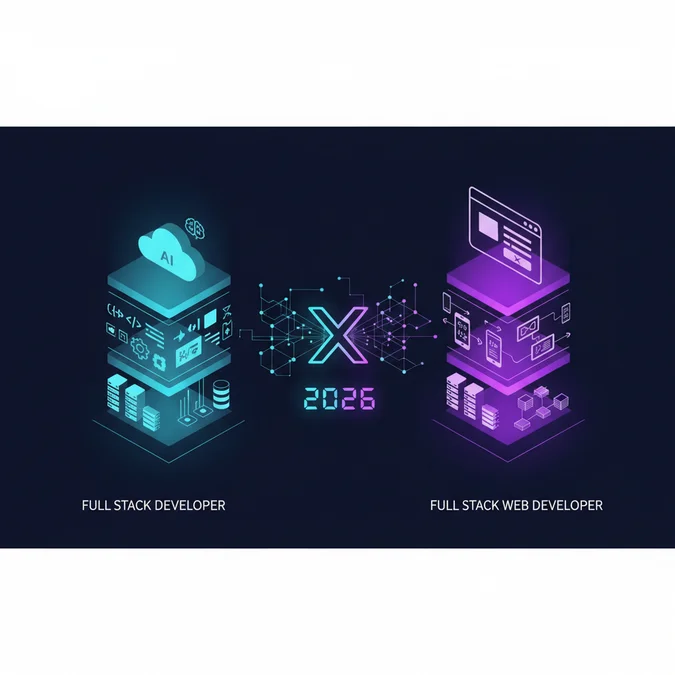

A Full Stack Developer possesses comprehensive skills across all software layers, including potentially mobile, desktop, or IoT, whereas a Full Stack Web Developer specializes exclusively in web-specific technologies, covering frontend, backend, and database for web applications. Understanding this distinction is critical for businesses seeking precise talent and for individuals charting their career paths in 2026’s dynamic tech landscape.
This article provides a definitive comparison, detailing the nuanced differences in skill sets, responsibilities, and strategic implications for both hiring organizations and aspiring developers. We will explore the technical breadth of each role, scrutinize their real-world applications, and offer actionable insights for successful project execution and career progression.
Understanding the Core: What Defines a Full Stack Developer?
A Full Stack Developer is an engineer proficient across the entire software stack, capable of working on both client-side and server-side components, and often database interactions. Their expertise typically spans the operating system, server, database, API, and user interface. This broad skill set enables them to manage projects end-to-end, from conceptualization to deployment and maintenance.
In 2026, a modern Full Stack Developer often masters cloud platforms (AWS, Azure, GCP), containerization (Docker, Kubernetes), and CI/CD pipelines, alongside traditional programming languages. Their role is to ensure seamless integration and functionality across all layers, making them invaluable for startups and projects requiring versatile engineering talent.
Callout: The Full Stack Developer’s breadth often extends beyond web-specific concerns, encompassing desktop applications with Electron, mobile apps with React Native or Flutter, or even embedded systems, demonstrating true multi-platform proficiency.
Typical technologies include:
- **Frontend:** React, Angular, Vue.js, Svelte, WebAssembly
- **Backend:** Node.js, Python (Django, Flask), Java (Spring), Go, C# (.NET)
- **Databases:** PostgreSQL, MongoDB, Redis, Cassandra
- **DevOps:** Docker, Kubernetes, Terraform, Jenkins, GitHub Actions
- **Cloud:** AWS EC2, S3, Lambda, Azure App Service, Google Cloud Run
The Web Developer’s Domain: Frontend, Backend, and Beyond
A Web Developer focuses specifically on creating and maintaining websites and web applications. This role is often segmented into Frontend Developers, who build the user interface and user experience, and Backend Developers, who manage server-side logic, databases, and APIs. A Full Stack Web Developer combines both, but strictly within the web ecosystem.
Frontend Web Developers are experts in HTML, CSS, and JavaScript frameworks, ensuring responsive, accessible, and performant user interfaces. Backend Web Developers handle data storage, server logic, authentication, and API development, often working with databases and cloud services to power the frontend. In 2026, both specializations demand strong understanding of web security, performance optimization, and modern browser APIs.
| Role Specialization | Primary Responsibilities | Key Technologies (2026) |
|---|---|---|
| Frontend Web Developer | User interface, user experience, responsiveness, accessibility, client-side logic | React, Vue.js, Svelte, Next.js, TypeScript, WebAssembly, Tailwind CSS, GraphQL client |
| Backend Web Developer | Server logic, database management, API development, authentication, security, scalability | Node.js (Express, NestJS), Python (Django, FastAPI), Go, Java (Spring Boot), PostgreSQL, MongoDB, Kafka, gRPC |
| Full Stack Web Developer | End-to-end web application development, integrating frontend and backend, deployment | Combination of frontend and backend technologies, Docker, CI/CD, cloud deployment (e.g., Vercel, Netlify, AWS Amplify) |
While a Full Stack Web Developer has a comprehensive understanding of web development, their focus remains on HTTP protocols, browser environments, and web-specific infrastructure, distinguishing them from a broader Full Stack Developer.
Key Distinctions: Full Stack Developer vs Full Stack Web Developer
The distinction between a Full Stack Developer vs Full Stack Web Developer lies primarily in the scope of their expertise. While there’s significant overlap, particularly in web technologies, the ‘web’ qualifier narrows the latter’s focus. A Full Stack Web Developer is inherently a Full Stack Developer, but a Full Stack Developer is not necessarily limited to web projects.
When considering a `web developer vs full stack developer`, the key is the breadth of application domains. A Full Stack Web Developer builds web applications, period. Their knowledge is deep within browser APIs, HTTP, web security models, and web-specific deployment pipelines. Conversely, a Full Stack Developer might apply their skills to mobile applications, desktop software, embedded systems, or even game development, leveraging a more generalized understanding of software architecture, data structures, and algorithms that transcend a single platform.
For instance, a `full stack developer vs full stack web developer` comparison highlights that the broader role might be proficient in technologies like C++ for game engines or Swift/Kotlin for native mobile development, areas typically outside a Full Stack Web Developer’s primary remit.
| Feature | Full Stack Developer | Full Stack Web Developer |
|---|---|---|
| Primary Domain | Any software application (Web, Mobile, Desktop, IoT) | Web applications exclusively |
| Technology Scope | Broader, includes non-web frameworks/languages | Web-specific languages, frameworks, protocols |
| Typical Projects | Enterprise applications, SaaS, mobile apps, desktop apps, specialized tools | Websites, web apps, e-commerce platforms, APIs for web |
| Deployment Focus | Multi-platform, cloud, on-premise, device-specific | Web servers, cloud hosting, CDNs |
| Example Skill beyond Web | Native mobile development (Swift, Kotlin), Desktop (Electron, WPF), IoT firmware | Deep expertise in web performance, SEO, progressive web apps (PWAs) |
Consider a simple backend API endpoint. A `full stack vs web developer` might approach it similarly, but the Full Stack Developer might also consider how that API could serve a native mobile app, not just a web frontend.
// Example: Simple API endpoint that both can build

const express = require('express');

const app = express();

const PORT = 3000;
app.get(‘/api/data’, (req, res) => {
// Logic to fetch data from a database
const data = { message: ‘Hello from API’, timestamp: new Date() };
res.json(data);
});
app.listen(PORT, () => {
console.log(`Server running on http://localhost:${PORT}`);
});
While both roles can write this, the Full Stack Developer might then integrate this into a non-web client, whereas the Full Stack Web Developer would focus on its consumption by a browser-based frontend.
Architectural Trade-offs and Backend Fullstack Implementations
When designing system architectures, the choice between hiring a specialized Full Stack Web Developer or a broader Full Stack Developer often hinges on the project’s ecosystem. For purely web-based products, a Full Stack Web Developer offers deep, concentrated expertise that can optimize web performance, security, and user experience. However, for systems requiring diverse client applications, such as a web portal, a native mobile app, and a desktop client all interacting with the same backend services, a Full Stack Developer’s broader perspective becomes invaluable.
The concept of `backend fullstack` refers to a developer who masters the entire backend stack, from database design and management through server-side logic, API development, and deployment infrastructure, without necessarily focusing on frontend UI. This specialization is critical for microservices architectures, complex data processing pipelines, or headless CMS systems where the frontend is decoupled or handled by another team/technology.
Callout: Backend fullstack roles are increasingly focused on distributed systems, event-driven architectures, and robust API contracts, demanding expertise in message queues (Kafka, RabbitMQ) and API gateways (Kong, Apigee).
Consider a `backend fullstack` implementation for a real-time analytics dashboard. Such a developer would be responsible for:
- Designing the data schema in PostgreSQL or MongoDB.
- Building a Node.js or Go API to ingest and process data.
- Implementing a WebSocket server for real-time updates.
- Setting up Kafka for message queuing and stream processing.
- Deploying services to Kubernetes on a cloud provider.
Here’s a simplified `backend fullstack` code example demonstrating a database interaction and API:
// Example: Node.js with PostgreSQL for a 'backend fullstack' approach

const { Pool } = require('pg');

const express = require('express');

const app = express();

const PORT = 3001;
const pool = new Pool({
user: ‘user’,
host: ‘localhost’,
database: ‘mydatabase’,
password: ‘password’,
port: 5432,
});
app.use(express.json());
// API to get all items
app.get(‘/api/items’, async (req, res) => {
try {
const result = await pool.query(‘SELECT * FROM items’);
res.json(result.rows);
} catch (err) {
console.error(err);
res.status(500).send(‘Server Error’);
}
});
// API to add a new item
app.post(‘/api/items’, async (req, res) => {
const { name, description } = req.body;
try {
const result = await pool.query(
‘INSERT INTO items(name, description) VALUES($1, $2) RETURNING *’,
[name, description]
);
res.status(201).json(result.rows[0]);
} catch (err) {
console.error(err);
res.status(500).send(‘Server Error’);
}
});
app.listen(PORT, () => {
console.log(`Backend Fullstack API running on http://localhost:${PORT}`);
});
This developer handles the entire server-side logic and database interaction, ensuring robust data persistence and API availability, irrespective of the client consuming it.
Strategic Hiring: Pricing, Deliverables, and Vetting for 2026
Hiring the right full stack talent in 2026 requires a clear understanding of your project’s specific needs and the nuances between a Full Stack Developer and a Full Stack Web Developer. Misalignment can lead to scope creep, budget overruns, or suboptimal technical solutions. Businesses must define whether their project is exclusively web-based or requires broader platform expertise.
| Role | Typical Deliverables | Strategic Fit | Considerations for 2026 |
|---|---|---|---|
| Full Stack Developer | Complete software solutions (web, mobile, desktop), API design & implementation, database management, cloud infrastructure setup, CI/CD pipelines | Startups, projects requiring multi-platform presence, complex enterprise systems, rapid prototyping, cross-functional teams | High demand, premium rates due to versatility; expertise in AI integration, Web3, or specialized hardware can further increase value. |
| Full Stack Web Developer | Fully functional web applications, responsive UIs, optimized APIs for web, secure web deployments, PWA development, e-commerce platforms | Web-centric businesses, SaaS products, agencies focusing on web solutions, projects with strong emphasis on web performance/SEO | Strong demand for modern frameworks (React, Vue, Svelte), serverless functions, Jamstack architecture; emphasis on accessibility and core web vitals. |
For vetting, beyond technical interviews, practical assessments are crucial. A coding challenge specific to your project’s domain will reveal practical problem-solving skills. For 2026, evaluate their understanding of:
- Cloud-native development and serverless patterns.
- Security best practices (OWASP Top 10, data privacy).
- Performance optimization techniques (code, database, network).
- Containerization and orchestration (Docker, Kubernetes).
- Testing methodologies (unit, integration, end-to-end).
- AI/ML integration patterns (if relevant to your domain).
Agency Vetting Checklist (2026)
- Portfolio Relevance: Does their portfolio showcase projects similar in scope and technology stack to yours?
- Technical Depth: Can they articulate architectural decisions and trade-offs clearly?
- Team Structure: How do they assign roles, and is there clear communication between frontend/backend specialists?
- Process & Methodologies: Do they follow agile, DevOps, or other structured development processes?
- Cloud & DevOps Expertise: Are they proficient in modern cloud deployments, CI/CD, and infrastructure as code?
- Security & Compliance: What are their security protocols and how do they handle data privacy (e.g., GDPR, CCPA)?
- Post-Launch Support: What level of maintenance, monitoring, and bug fixing is included post-deployment?
- Transparency & Reporting: How do they track progress, report issues, and communicate with stakeholders?
Career Trajectories and Future Outlook: Which Path is Right?
For individuals, choosing between a Full Stack Developer and a Full Stack Web Developer path involves evaluating personal interests, desired skill breadth, and long-term career aspirations. Both roles offer robust career growth and competitive compensation in 2026, but with different avenues for specialization and leadership.
A Full Stack Developer, with their broader generalist skill set, is well-positioned for roles like Solutions Architect, Principal Engineer, or CTO, particularly in organizations building diverse software products. Their ability to understand and integrate disparate systems makes them valuable in strategic planning and technical leadership. Average salary expectations for experienced Full Stack Developers in major tech hubs are projected to be in the range of $140,000 to $220,000+ annually in 2026, depending on specialization and location.
A Full Stack Web Developer, while specializing, can become an unparalleled expert in web technologies. Their path might lead to roles like Senior Web Architect, Frontend Lead (with deep backend knowledge), or Web Performance Specialist. Their deep understanding of web standards, accessibility, and user experience makes them indispensable for businesses whose core product is web-based. Average salary expectations for experienced Full Stack Web Developers in 2026 typically range from $130,000 to $200,000+ annually.
Callout: The future favors continuous learning. Regardless of the chosen path, proficiency in AI/ML integration, Web3 technologies, and advanced cloud-native patterns will be critical for career advancement in 2026 and beyond.
The decision boils down to whether you prefer deep specialization within the web domain or a broader, multi-platform generalist approach. Both paths demand strong problem-solving skills, a commitment to learning, and the ability to adapt to rapidly evolving technologies.
- Choose Full Stack Developer if: You enjoy working across diverse platforms (web, mobile, desktop), are fascinated by system-level architecture, and thrive on solving problems from end-to-end irrespective of the client.
- Choose Full Stack Web Developer if: Your passion lies specifically in crafting exceptional web experiences, optimizing web performance, and mastering the intricacies of browser-server interactions and web-specific infrastructure.
Both roles are foundational to the digital economy, and the ‘right’ path is ultimately the one that aligns best with your professional curiosity and long-term vision.
Factors That Affect Development Cost
- Project complexity and scale
- Required technology stack expertise
- Developer experience level (junior, mid, senior, lead)
- Geographic location of the talent
- Engagement model (freelance, agency, full-time)
- Ongoing maintenance and support needs
The cost for hiring these roles can vary significantly based on numerous project-specific and market factors, making a fixed universal price impossible.
Frequently Asked Questions
Is a Full Stack Web Developer different from a Full Stack Developer?
While often used interchangeably, a ‘Full Stack Web Developer’ specifically focuses on web technologies (frontend, backend, database for web applications). A ‘Full Stack Developer’ can have a broader scope, potentially including mobile, desktop, or even game development, though web is the most common specialization, making the distinction in `full stack developer vs full stack web developer` about the breadth of application domains.
What are the core responsibilities of a Web Developer?
A Web Developer’s core responsibilities involve building and maintaining websites or web applications. This includes designing user interfaces (frontend), managing server-side logic and databases (backend), or specializing in one area, ensuring functionality, performance, and security. This is a core aspect of understanding the `web developer vs full stack developer` comparison.
What skills are essential for a Backend Fullstack role in 2026?
For a `backend fullstack` role in 2026, essential skills include proficiency in server-side languages like Node.js, Python, or Go, database management (SQL/NoSQL), API development, cloud platforms (AWS, Azure, GCP), and containerization (Docker, Kubernetes). Security, performance optimization, and understanding distributed systems are also crucial.
Which role offers better career growth: Web Developer or Full Stack Developer?
Both roles offer excellent career growth, but the ‘better’ path depends on individual interests. Full Stack Developers often have more versatility, leading to roles like architect or tech lead. Specialized Web Developers can become experts in specific web domains, driving innovation in frontend or backend technologies. The `full stack vs web developer` choice is personal.
The distinction between a Full Stack Developer and a Full Stack Web Developer, while subtle, carries significant implications for project success and career trajectory in 2026. While the Full Stack Web Developer is a specialist within the vast web ecosystem, the Full Stack Developer commands a broader, multi-platform technical arsenal. Businesses must accurately assess their project’s scope, whether it’s purely web-centric or demands cross-platform capabilities, to make informed hiring decisions.
For developers, understanding these nuances is key to specializing effectively or broadening one’s skill set strategically. Both paths offer compelling opportunities for innovation and growth. By aligning your technical needs or career ambitions with these definitive role definitions, you can ensure optimal outcomes in the evolving landscape of software engineering.
NR Studio builds custom web apps, mobile apps, SaaS platforms, and internal tools for growing businesses. If you’re working through a technical decision, feel free to reach out — no commitment required.