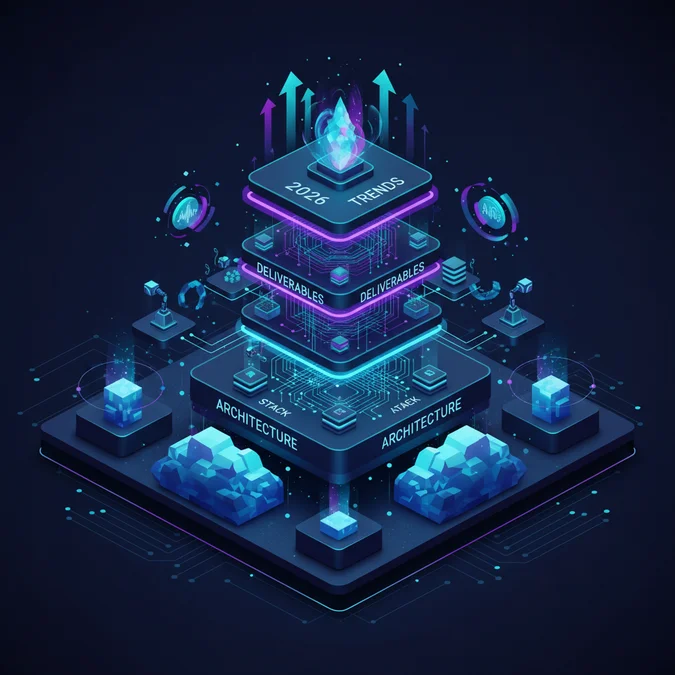

Full stack languages are pivotal for developing complete web applications, enabling developers to build both client-side and server-side components with a unified technology stack. This approach streamlines development, enhances maintainability, and is crucial for delivering robust, scalable digital products in 2026. Understanding these languages is key for architectural decisions and project success.
As the digital landscape evolves, the selection of appropriate full stack languages has become a strategic decision impacting project timelines, performance, and long-term scalability. This guide explores the core languages, their architectural implications, and the practical considerations for businesses and developers navigating the 2026 technology market. We will delve into specific ecosystems, provide actionable code examples, and discuss how to effectively vet talent.
Our focus is on providing practitioner-level insights, comparing real-world trade-offs, and offering a clear roadmap for leveraging full stack development to meet ambitious business objectives. By the end of this article, you will possess a comprehensive understanding necessary for making informed technology choices and fostering successful development initiatives.
Understanding Full Stack Languages: The Foundation of Modern Development
Full stack development encompasses both frontend (client-side) and backend (server-side) aspects of an application. The term “full stack languages” refers to programming languages and their associated frameworks that are proficiently used across this entire spectrum. This integrated approach allows for a more cohesive development process, often leading to faster iteration cycles and reduced cognitive load for development teams.
In 2026, the demand for developers proficient in full stack languages continues to surge. Organizations seek talent capable of managing everything from user interface design and interaction to database management and server logic. This unification of skills under a single language or a closely related set of technologies significantly simplifies deployment, debugging, and overall project management. It fosters a deeper understanding of the entire system, leading to more resilient and efficient applications.
The core benefit of adopting a full stack language strategy is the ability to maintain a consistent programming paradigm across the entire application. This reduces context switching, minimizes integration issues between disparate technology layers, and often allows for greater code reuse. For instance, using JavaScript for both frontend (React, Angular, Vue.js) and backend (Node.js) allows developers to share utility functions, validation logic, and even data models, accelerating development and reducing potential errors.
Critical Insight: A true mastery of full stack languages extends beyond syntax; it requires a deep understanding of how different layers of an application communicate, manage state, and handle data flow to ensure optimal performance and security.
Core Full Stack Languages: Architecture, Ecosystems, and Code Examples
The landscape of full stack languages is dominated by a few key players, each offering distinct advantages in terms of ecosystem, performance, and community support. Understanding their architectural patterns and typical use cases is crucial for informed decision-making.
JavaScript (Node.js, React/Angular/Vue.js)
JavaScript is arguably the most prevalent full stack language due to its ubiquitous presence in web browsers and the rise of Node.js for server-side execution. Its asynchronous, event-driven architecture makes it highly scalable for I/O bound operations. The ecosystem is vast, offering frameworks like React, Angular, and Vue.js for the frontend, and Express.js, NestJS, or Next.js for the backend.
Code Example: Simple Full Stack Interaction (Node.js + Express + React)
Backend (Node.js with Express):
// server.js
const express = require('express');
const app = express();
const port = 3001;

app.use(express.json());
app.get('/api/message', (req, res) => {
  res.json({ message: 'Hello from Node.js backend!' });
});

app.listen(port, () => {
  console.log(`Backend server running on http://localhost:${port}`);
});
Frontend (React component):
// src/App.js
import React, { useEffect, useState } from 'react';

function App() {
  const [message, setMessage] = useState('');

  useEffect(() => {
    fetch('/api/message')
      .then(response => response.json())
      .then(data => setMessage(data.message))
      .catch(error => console.error('Error fetching:', error));
  }, []);

  return (
    <div>
      <h1>Full Stack Demo</h1>
      <p>{message}</p>
    </div>
  );
}

export default App;
Python (Django, Flask, FastAPI)
Python is a powerful full stack developer language prized for its readability, extensive libraries, and rapid development capabilities. While primarily a backend language, its integration with frontend technologies is seamless. Frameworks like Django provide an ‘all-inclusive’ experience, while Flask and FastAPI offer more minimalist approaches. Python excels in data science, machine learning, and automation, making it a strong choice for applications requiring these capabilities.
Code Example: Simple Full Stack Interaction (Python with Flask)
Backend (Flask):
# app.py
from flask import Flask, jsonify

app = Flask(__name__)

@app.route('/api/message')
def get_message():
    return jsonify(message='Hello from Flask backend!')

if __name__ == '__main__':
    app.run(debug=True, port=5000)
Frontend (JavaScript fetch, similar to React example):
// script.js (used in a simple HTML file)
fetch('http://localhost:5000/api/message')
  .then(response => response.json())
  .then(data => document.getElementById('message').innerText = data.message)
  .catch(error => console.error('Error fetching:', error));
Java (Spring Boot, Jakarta EE)
Java, with its robust ecosystem centered around Spring Boot and Jakarta EE, remains a powerhouse for enterprise-grade full stack applications. Known for its strong typing, performance, and scalability, Java is ideal for large, complex systems requiring high throughput and reliability. While traditionally backend-focused, modern frameworks like Vaadin and JHipster facilitate full stack development, often integrating with JavaScript frontend frameworks.
Code Example: Simple Full Stack Interaction (Java with Spring Boot)
Backend (Spring Boot Controller):
// MessageController.java
package com.example.demo;

import org.springframework.web.bind.annotation.GetMapping;
import org.springframework.web.bind.annotation.RestController;

@RestController
public class MessageController {

    @GetMapping("/api/message")
    public Message getMessage() {
        return new Message("Hello from Spring Boot backend!");
    }
}

class Message {
    private String message;

    public Message(String message) {
        this.message = message;
    }

    public String getMessage() {
        return message;
    }

    public void setMessage(String message) {
        this.message = message;
    }
}
Frontend (JavaScript fetch, similar to previous examples):
// script.js (used in a simple HTML file)
fetch('http://localhost:8080/api/message')
  .then(response => response.json())
  .then(data => document.getElementById('message').innerText = data.message)
  .catch(error => console.error('Error fetching:', error));
Go (Gin, Echo)
Go, or Golang, is gaining significant traction for its performance, concurrency, and efficient compilation. While it doesn’t have a native frontend framework, it’s increasingly popular for building high-performance backend APIs that serve single-page applications (SPAs) built with JavaScript frameworks. Its strong typing and simple syntax make it a compelling choice for microservices and cloud-native applications.
Comparison of Core Full Stack Languages
| Language | Primary Strengths | Typical Use Cases | Frontend Frameworks (Common) | Backend Frameworks (Common) |
|---|---|---|---|---|
| JavaScript | Ubiquity, vast ecosystem, rapid development, asynchronous I/O | SPAs, real-time apps, APIs, cross-platform mobile/desktop | React, Angular, Vue.js | Node.js (Express, NestJS) |
| Python | Readability, extensive libraries (AI/ML), rapid prototyping | Web apps, data science, automation, APIs | (Integrated with JS frameworks) | Django, Flask, FastAPI |
| Java | Performance, scalability, enterprise solutions, strong typing | Large-scale enterprise apps, microservices, big data | (Integrated with JS frameworks, Vaadin) | Spring Boot, Jakarta EE |
| Go | Performance, concurrency, efficiency, strong typing | High-performance APIs, microservices, cloud infrastructure | (Integrated with JS frameworks) | Gin, Echo, Fiber |
Architectural Note: While a single language for both frontend and backend offers consistency, many modern full stack architectures leverage a polyglot approach, choosing the best language for each specific service or layer based on its unique requirements.
Strategic Selection: Choosing Full Stack Languages for Your 2026 Project
Selecting the right full stack languages for a project in 2026 is a critical decision that influences development velocity, long-term maintenance, and the project’s ability to scale. This choice should be driven by a clear understanding of project requirements, architectural goals, and team capabilities, not just by current popularity.
Consider the following factors when making your selection:
-
Project Scope and Complexity: Small, rapidly prototyped applications might benefit from Python/Flask or JavaScript/Node.js for quick iteration. Large, enterprise-grade systems with complex business logic and high transaction volumes might lean towards Java/Spring Boot for its robustness and mature ecosystem.
-
Scalability Requirements: For applications expecting massive user loads or needing to handle extensive real-time data, languages like Go or Node.js (due to their asynchronous, non-blocking I/O) offer excellent performance characteristics. Java also provides robust scaling mechanisms for distributed systems.
-
Performance Needs: If raw execution speed and low latency are paramount, compiled languages like Go and Java often outperform interpreted languages like Python or JavaScript in CPU-bound tasks. However, for I/O-bound web applications, the difference can be less pronounced.
-
Team Expertise and Learning Curve: The existing skill set of your development team is a significant factor. Adopting a language unfamiliar to your team will incur a learning curve, potentially impacting initial project velocity. Conversely, investing in a new language might be a strategic move for future projects.
-
Ecosystem Maturity and Tooling: A rich ecosystem of frameworks, libraries, development tools, and community support can dramatically accelerate development and troubleshooting. JavaScript, Python, and Java all boast incredibly mature and active ecosystems.
-
Deployment and Infrastructure: Consider how easily the chosen languages integrate with your preferred cloud providers, containerization strategies (Docker, Kubernetes), and CI/CD pipelines. Most mainstream full stack languages have excellent support across modern infrastructure.
Engineering Trade-offs in Language Selection (2026 Perspective)
| Factor | JavaScript/Node.js | Python/Django | Java/Spring Boot | Go/Gin |
|---|---|---|---|---|
| Development Speed | Very High (unified language, large component libraries) | High (readable syntax, batteries-included frameworks) | Moderate (verbose, but powerful tooling) | Moderate (simple syntax, but less high-level abstraction) |
| Runtime Performance | Good (V8 engine, async I/O) | Moderate (GIL can limit true parallelism) | Excellent (JVM optimizations, strong concurrency) | Exceptional (compiled, built-in concurrency) |
| Scalability | High (non-blocking I/O, microservices friendly) | High (with proper architecture, distributed systems) | Very High (enterprise-grade, microservices) | Very High (concurrency primitives, lightweight) |
| Ecosystem Size | Massive (NPM, frontend frameworks) | Very Large (PyPI, ML/AI libraries) | Massive (Maven/Gradle, enterprise tools) | Growing (focused on backend/infra) |
| Learning Curve | Moderate (async concepts, tooling breadth) | Low-Moderate (readable, clear syntax) | Moderate-High (OOP, JVM concepts, extensive frameworks) | Low-Moderate (simple syntax, but new paradigms) |
Strategic Imperative: Prioritize alignment with business goals. A rapid time-to-market for an MVP might favor Python or JavaScript, while a long-term, mission-critical application might justify the initial overhead of Java or Go for their inherent stability and performance.
Engaging Full Stack Talent: Deliverables, Pricing, and Vetting in 2026
Successfully delivering a full stack project hinges not only on technology choice but also on the quality of the talent engaged. In 2026, the market for skilled full stack developer languages practitioners is competitive. Understanding typical deliverables, pricing structures, and effective vetting processes is essential for securing the right expertise, whether through hiring or agency engagement.
Typical Deliverables from Full Stack Developers
When engaging full stack talent, expect a range of deliverables spanning the entire application lifecycle:
- Frontend Components: Reusable UI components, responsive layouts, client-side routing, state management implementation, API integration for data display.
- Backend APIs: RESTful or GraphQL APIs, data validation, authentication and authorization services, business logic implementation, error handling.
- Database Integration: Schema design, ORM/ODM configuration, data migration scripts, efficient query optimization.
- Infrastructure as Code (IaC): Basic cloud resource provisioning (e.g., serverless functions, database instances) using tools like Terraform or AWS CloudFormation.
- Testing: Unit tests, integration tests, end-to-end tests for both frontend and backend components.
- Documentation: API documentation, code comments, system design documents, deployment guides.
- CI/CD Pipeline Contributions: Integration with automated build, test, and deployment processes.
Pricing Models for Full Stack Development (2026)
Pricing for full stack development services varies significantly based on factors like geographic location, experience level, project complexity, and engagement model. Common models include:
| Pricing Model | Description | Best Suited For | Considerations |
|---|---|---|---|
| Hourly Rate | Billing based on actual hours worked. | Projects with evolving requirements, R&D. | Requires close monitoring, scope creep risk. |
| Fixed Price | A set price for a clearly defined project scope. | Well-defined MVPs, projects with stable requirements. | Less flexibility, detailed upfront planning required. |
| Time & Material (T&M) | Hybrid of hourly, often with estimated project total. | Mid-sized projects with some flexibility. | Balances flexibility with cost predictability. |
| Dedicated Team | Hiring a full team for an extended period. | Long-term projects, ongoing product development. | High commitment, full integration with client’s operations. |
Vetting Full Stack Developer Languages Expertise: A 2026 Checklist
A rigorous vetting process is crucial to ensure you hire or engage full stack talent capable of delivering high-quality, maintainable solutions.
Vetting Checklist:
-
Portfolio Review: Examine past projects. Look for applications that demonstrate proficiency across both frontend and backend, clean code, and effective problem-solving. Ask about their specific contributions.
-
Technical Interview (Live Coding): Conduct a live coding session focusing on a full stack challenge. This could involve building a simple API endpoint and integrating it with a basic UI component. Assess their thought process, debugging skills, and knowledge of chosen full stack developer languages and frameworks.
-
System Design Questions: Probe their understanding of architectural patterns, database design, API design principles, and scalability considerations. Ask how they would design a specific feature or handle anticipated traffic.
-
Knowledge of Best Practices: Inquire about their approach to security, performance optimization, testing strategies, and CI/CD. Ask about their experience with version control (Git) and collaborative development.
-
Problem-Solving Aptitude: Present hypothetical scenarios or past project challenges and ask how they would approach them. Look for critical thinking and adaptability.
-
Communication and Collaboration: Assess their ability to articulate technical concepts clearly, ask clarifying questions, and work effectively within a team. Full stack roles often require strong cross-functional communication.
-
Experience with Cloud Platforms: Given the prevalence of cloud-native development, inquire about their experience with AWS, Azure, GCP, or other platforms, especially in deploying and managing applications.
-
Culture Fit: Evaluate how well they align with your team’s values and working style. A technically brilliant individual who is a poor team player can hinder project progress.
The Future of Full Stack: Emerging Languages and 2026 Trends
The full stack development landscape is dynamic, with continuous innovation shaping how applications are built and deployed. In 2026, several trends and emerging technologies are influencing the evolution of full stack languages and practices, offering new opportunities for efficiency and performance.
Serverless Architectures and Function-as-a-Service (FaaS)
Serverless computing continues its ascent, abstracting away server management and allowing developers to focus purely on code. Full stack developers are increasingly designing applications around serverless functions (e.g., AWS Lambda, Azure Functions, Google Cloud Functions), often written in Node.js, Python, or Go. This trend optimizes operational costs and scales automatically, fundamentally changing backend development.
WebAssembly (Wasm) Beyond the Browser
While primarily a browser technology, WebAssembly is extending its reach to the server-side, enabling high-performance, near-native execution of code written in languages like C++, Rust, and Go outside the browser. This could lead to a new paradigm where backend services are written in Wasm-compatible languages, offering unprecedented speed and portability. Full stack languages like JavaScript might interact with these Wasm modules.
Type Safety and Developer Experience
The rise of TypeScript, a superset of JavaScript, underscores a strong industry trend towards type safety for enhanced code quality and maintainability, especially in large full stack projects. Similarly, languages like Go and Rust, with their robust type systems, are favored for their ability to prevent common runtime errors and improve developer experience through better tooling and refactoring capabilities.
AI-Assisted Development
AI coding assistants and generative AI tools are becoming integral to the development workflow. These tools accelerate code generation, suggest optimizations, and assist with debugging across various full stack languages. Developers leveraging these tools can achieve higher productivity, allowing them to focus on complex architectural challenges rather than boilerplate code.
Edge Computing Integration
As applications demand lower latency, edge computing is becoming more prevalent. Full stack developers are designing systems that push computation and data closer to the user, using technologies like Cloudflare Workers or Vercel Edge Functions. This requires an understanding of distributed systems and how to optimize applications for geographically dispersed deployments.
Future-Proofing Strategy: To remain competitive, developers and organizations should continuously evaluate new paradigms like serverless and WebAssembly, and invest in learning type-safe languages and AI-assisted development tools. Adaptability to these evolving full stack languages and methodologies is key for long-term success in 2026 and beyond.
Factors That Affect Development Cost
- Project complexity and feature set
- Required performance and scalability
- Geographic location of developers or agencies
- Experience level of the development team
- Duration of engagement
- Specific full stack languages and frameworks chosen
- Post-launch support and maintenance requirements
The cost for full stack development services varies significantly, reflecting the diverse factors involved in project execution and talent acquisition.
Frequently Asked Questions
What are the most in-demand full stack languages for 2026?
For 2026, JavaScript (with Node.js, React, Angular, Vue), Python (with Django, Flask), and Java (with Spring Boot) remain highly in-demand full stack languages. Emerging options like Go and TypeScript are also gaining significant traction due to their performance and developer experience.
Which full stack developer languages offer the best long-term career prospects?
Full stack developer languages with robust ecosystems and continuous innovation, such as JavaScript, Python, and Java, generally offer excellent long-term career prospects. Their widespread adoption across various industries ensures consistent demand and opportunities for growth and specialization.
How do project requirements influence the choice of full stack languages?
Project requirements significantly dictate full stack language choice. Factors like scalability, performance needs, development speed, existing infrastructure, and team expertise guide decisions. For instance, high-traffic applications might favor compiled languages, while rapid prototyping benefits from dynamic languages.
Can a single full stack language effectively handle both front-end and back-end development?
Yes, several full stack languages can effectively manage both front-end and back-end development. JavaScript, utilizing Node.js for the server-side and frameworks like React or Angular for the client-side, is a prime example. Python also offers full stack capabilities with frameworks like Django and various frontend integrations.
The landscape of full stack languages in 2026 is rich and diverse, offering powerful tools for building the next generation of digital experiences. From the ubiquitous flexibility of JavaScript to the enterprise-grade robustness of Java, the rapid development of Python, and the high performance of Go, each language presents a unique set of trade-offs and advantages. Strategic selection demands a deep understanding of project requirements, architectural goals, and team capabilities.
For businesses, engaging the right full stack talent is as crucial as the technology choice itself. A thorough vetting process, coupled with an understanding of project deliverables and pricing models, ensures that development initiatives are set up for success. By staying abreast of emerging trends like serverless architectures, WebAssembly, and AI-assisted development, both developers and organizations can future-proof their strategies and continue to innovate effectively.
NR Studio builds custom web apps, mobile apps, SaaS platforms, and internal tools for growing businesses. If you’re working through a technical decision, feel free to reach out — no commitment required.