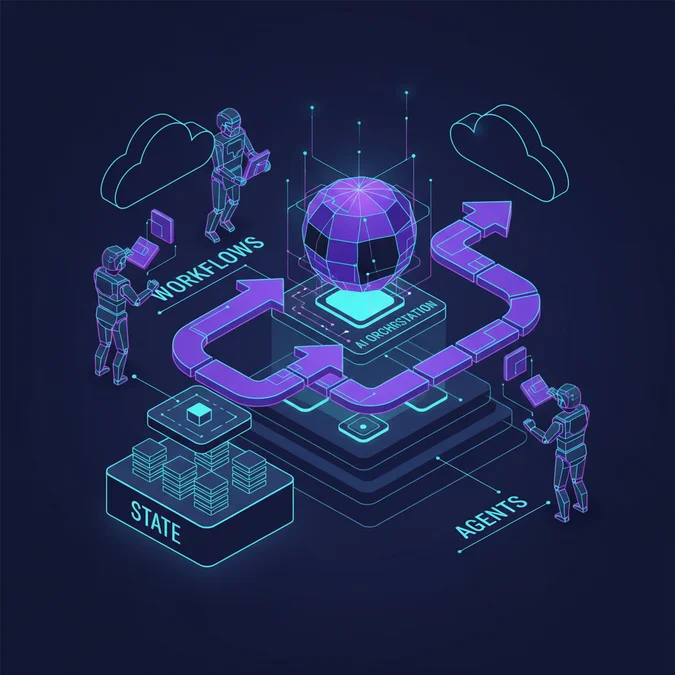

A production agent deployment fails rarely because the underlying frontier model lacked reasoning capability. It fails because the surrounding runtime environment collapsed: an unhandled cyclic graph loop drained the token budget, an in-memory state store dropped execution history during an auto-scaling node restart, or an unmanaged tool-calling abstraction injected silent JSON serialization errors into a critical microservice invocation. In 2026, building resilient autonomous systems requires moving past simplistic prompt-chaining scripts toward hardened runtime execution engines.
Agentic frameworks provide the runtime primitives necessary to govern complex model interactions. They manage distributed state persistence, define agent communication topologies, handle deterministic human-in-the-loop checkpoints, and interface with external tool ecosystems via open protocols like the Model Context Protocol (MCP). Yet the software ecosystem has fractured. Teams routinely struggle to choose between graph-based state machines, hierarchical multi-agent role-playing wrappers, and minimalist typed validation harnesses.
This architectural analysis examines the leading agentic AI frameworks operating across enterprise infrastructure. By evaluating deterministic state durability, token amplification overhead, and developer ergonomics, this evaluation establishes an objective engineering matrix to help teams select the optimal orchestration layer for mission-critical workloads.
Architectural Anatomy: Core Mechanics of Modern Agentic Frameworks
At its technical foundation, every modern agentic framework is a stateful execution harness wrapped around non-deterministic language model completions. While single-turn LLM pipelines resemble traditional stateless request-response architectures, autonomous agents operate as continuous loops that observe environment states, update internal contexts, compute tool calls, and execute actions until reaching a declared terminal condition. The underlying infrastructure powering modern agentic ai frameworks balances dynamic model flexibility with deterministic software constraints.
+---------------------------------------------------------------------------------+
| AGENTIC EXECUTION RUNTIME |
| |
| +-----------------------+ State Delta +---------------------------+ |
| | Context Window | <------------------ | State Persistence | |
| | (Token Conservation) | | (PostgreSQL / Redis) | |
| +-----------+-----------+ +-------------+-------------+ |
| | ^ |
| v | |
| +-----------------------+ Graph Edge +-------------+-------------+ |
| | Orchestration Core | ------------------> | Human-in-the-Loop Gate | |
| | (DAG / State Machine)| | (Approval / Time Travel) | |
| +-----------+-----------+ +---------------------------+ |
| | ^ |
| v Next Action | Tool Results |
| +-----------------------+ +-------------+-------------+ |
| | Inference Routing | ------------------> | MCP Tool Gateway | |
| | (Structured Outputs) | RPC Tool Call | (Sandboxed Execution) | |
| +-----------------------+ +---------------------------+ |
+---------------------------------------------------------------------------------+
Analyzing ai agents architectures frameworks applications reveals four critical architectural components that separate resilient production platforms from naive prompt wrappers:
- Deterministic Execution Graphs: Instead of letting agents wander infinitely across tool spaces, production ai agent orchestration frameworks model workflows as directed graphs. Nodes represent discrete compute tasks (such as LLM generation, Python execution, or database queries), while edges represent conditional transitions evaluated against structured state schemas.
- Durable State Checkpointing: Agents operating over long horizons must survive hardware failures and network timeouts. State checkpointing captures full application snapshots at every step, allowing execution resumption from the exact moment of failure without replaying historical context or consuming duplicate tokens.
- Structured Tool Gateways: Reliable frameworks for building ai agents reject arbitrary string parsing. They enforce rigorous JSON Schema validation, Pydantic type checking, and native integration with the Model Context Protocol (MCP) to standardize how models discover, invoke, and handle tool errors.
- Memory and Context Compaction: As interactions scale, context windows saturate. Modern runtimes decouple short-term message buffers from long-term episodic or semantic storage, using automatic summarization, rolling vector caches, and memory pruning engines to constrain token overhead.
Production Reality: An agent runtime without deterministic checkpointing is an operational liability. If your runtime stores execution state strictly in ephemeral RAM, a single pod eviction during a 45-second research-and-code loop invalidates the entire transaction, leaving third-party API mutations unrecorded and unrecoverable.
The table below outlines the core primitives that compose industrial agent runtimes:
| Runtime Primitive | Underlying Mechanism | Primary Architectural Risk | Mitigation Strategy |
|---|---|---|---|
| Execution Control | Cyclic Directed Graphs vs. ReAct Loops | Infinite execution loops, runaways | Max step ceilings, cycle detection guards |
| State Management | Append-only event stores (Postgres/Redis) | Race conditions during parallel branching | Optimistic concurrency control, atomic transactions |
| Tool Interfaces | Model Context Protocol (MCP) / JSON Schema | Malformed tool parameters, schema drift | Pydantic/Zod runtime serialization validation |
| Context Compaction | Recursive vector retrieval + summarization | Lost needle in context haystack, stale facts | Hierarchical memory tiers, active token pruning |
Comparative Taxonomy: Top Open Source Agentic AI Frameworks
The ecosystem of open source agentic ai frameworks in 2026 exhibits distinct specializations based on execution philosophy, typing rigor, and infrastructure target. While earlier generations focused on conversational demos, modern open source agentic framework options target complex workflow reliability. Understanding how these tools compare prevents teams from adopting abstractions that hinder production scalability.
Evaluating the current top ai agent frameworks requires analyzing how each platform handles state mutability, developer ergonomics, and concurrency:
1. LangGraph (LangChain Ecosystem)
LangGraph models multi-actor architectures as explicit cyclic computational graphs. It treats state as a centralized, append-only reducer schema. Nodes execute deterministic operations, while conditional edges determine routing based on node outputs. LangGraph provides first-class support for state persistence across Redis, SQLite, and PostgreSQL, enabling native human-in-the-loop workflows and state rewinding (time-travel debugging). It represents the industry benchmark for mission-critical, complex business process automations.
2. CrewAI
Among popular ai agent frameworks, CrewAI emphasizes role-based agent design. It abstracts orchestration into Agents, Tasks, Tools, and Crews. Built historically around structured collaboration patterns, CrewAI simplifies the deployment of hierarchical and sequential agent teams. While developer onboarding is fast due to its intuitive natural-language abstractions, deeply customized routing logic can hit abstraction ceilings when deterministic, non-linear edge conditions are required.
3. AG2 (Formerly AutoGen)
AG2 represents the evolution of Microsoft AutoGen into an independent open-source foundation. AG2 focuses heavily on multi-agent conversational patterns, peer-to-peer swarms, and human-in-the-loop chat interfaces. Its event-driven, asynchronous messaging core makes it exceptionally capable for complex research workflows, simulation environments, and exploratory multi-agent debates. However, its flexible conversational model demands strict application-level guardrails to avoid non-deterministic execution drift.
4. Pydantic AI
Built by the creators of Pydantic, this framework brings software engineering rigor and strict type safety to agent systems. Rather than introducing sprawling graph engines, Pydantic AI treats agents as typed Python functions wrapped around LLM endpoints. It leverages native Python control flow (if/else, loops) instead of proprietary domain-specific languages or rigid DAG definitions. For teams building internal services where code testability, static analysis, and type validation are paramount, Pydantic AI offers unmatched developer ergonomics.
5. Agno (Formerly Phidata)
Agno prioritizes low-latency, high-throughput agent operations with minimal boilerplate. It integrates memory, vector knowledge databases, and multi-modal tool calling into an unopinionated runtime. Agno is well-suited for high-concurrency API environments where developers need complete control over context-window construction without navigating layered abstractions.
6. Semantic Kernel (Microsoft)
Semantic Kernel bridges enterprise software engineering (supporting C#, Python, and Java) with agentic orchestration. It provides enterprise connectors, vector store abstractions, and plugin-based architectures designed for seamless integration into existing Microsoft Azure and corporate enterprise architectures.
The following ai agent frameworks comparison matrix evaluates structural capabilities across the top six engines:
| Framework | Primary Paradigm | State Persistence | Typing Rigor | Best For |
|---|---|---|---|---|
| LangGraph | Cyclic State Graphs | First-class (PostgreSQL, Redis, Mongo) | High (TypedDict, Pydantic) | Complex, durable enterprise DAGs |
| CrewAI | Role-based Hierarchical | Built-in file/SQLite cache | Medium (Pydantic models) | Rapid prototyping, collaborative teams |
| AG2 | Conversational Event Loops | Session-level, custom stores | Medium (Python native) | Research simulations, dynamic swarms |
| Pydantic AI | Typed Functional Harness | Application-managed (FastAPI, SQLModel) | Extremely High (Native Pydantic) | Microservices, API integrations, safety |
| Agno | Lightweight Modular Objects | Native PostgreSQL storage | Medium to High | Fast multi-modal assistants, RAG |
| Semantic Kernel | Plugin and Pipeline Connectors | Enterprise connectors, Azure Cosmos | High (C# / Typed Python) | Enterprise IT, hybrid C#/Python teams |
To execute a rigorous agent framework comparison, evaluate your target platform against this baseline operational checklist:
- Framework supports distributed transactional checkpointers rather than local memory arrays.
- Agent loops allow programmatic interruption and manual payload injection (Human-in-the-loop).
- Tool interfaces natively consume typed models without string-based regex parsing.
- The orchestration layer provides transparent telemetry exports compatible with OpenTelemetry.
- Subgraphs can be compiled and unit-tested in isolation without mocking external network infrastructure.
Normalized Implementation: Multi-Agent Workflows Across Python Frameworks
Abstract documentation often obscures real-world friction. To accurately assess developer experience, boilerplate requirements, and abstraction ceilings, we analyze the same concrete workflow across three modern frameworks: LangGraph, CrewAI, and Pydantic AI. The scenario is a common production pattern: a two-agent research-to-code pipeline where a Researcher Agent queries an external tool and passes structured findings to a Synthesizer Agent, which outputs a strictly validated configuration object.
1. LangGraph Implementation (Graph-Centric Architecture)
LangGraph demands explicit definition of shared state, compute nodes, and edge transitions. This architecture yields full control over state mutations at the cost of initial boilerplate.
from typing import TypedDict, Annotated, Sequence
import operator
from langgraph.graph import StateGraph, END
from langchain_core.messages import BaseMessage, HumanMessage, AIMessage
from pydantic import BaseModel, Field

# 1. Define Strict State Schema
class PipelineState(TypedDict):
 messages: Annotated[Sequence[BaseMessage], operator.add]
 research_data: str
 final_code: str

# 2. Define Node Execution Logics
def researcher_node(state: PipelineState) -> dict:
 latest_query = state["messages"][-1].content
 # In production, call external tool/MCP server
 retrieved_context = f"Analyzed specs for: {latest_query}"
 return {
 "messages": [AIMessage(content=f"Research Complete: {retrieved_context}")],
 "research_data": retrieved_context
 }

def coder_node(state: PipelineState) -> dict:
 research = state["research_data"]
 generated_code = f"# Auto-generated from: {research}\ndef execute_task():\n return True"
 return {
 "messages": [AIMessage(content="Code synthesis finished.")],
 "final_code": generated_code
 }

# 3. Compile Graph with Deterministic Edges
workflow = StateGraph(PipelineState)
workflow.add_node("researcher", researcher_node)
workflow.add_node("coder", coder_node)

workflow.set_entry_point("researcher")
workflow.add_edge("researcher", "coder")
workflow.add_edge("coder", END)

app = workflow.compile()
2. CrewAI Implementation (Role-Playing Abstraction)
CrewAI wraps agent interactions in high-level role personas, reducing configuration lines while abstracting internal message passing behind the framework runtime.
from crewai import Agent, Task, Crew, Process
from pydantic import BaseModel

class SystemBlueprint(BaseModel):
 architecture: str
 code_stub: str

# 1. Configure Specialized Agents
researcher = Agent(
 role="Technical Research Lead",
 goal="Analyze infrastructure requirements accurately",
 backstory="Senior distributed systems architect evaluating service requirements.",
 verbose=False
)

coder = Agent(
 role="Senior Systems Engineer",
 goal="Synthesize technical research into clean code implementations",
 backstory="Staff software engineer dedicated to zero-defect deployments.",
 verbose=False
)

# 2. Define Sequential Task Dependencies
research_task = Task(
 description="Investigate key performance metrics for Redis Cluster on Kubernetes.",
 expected_output="A technical bulleted list of constraints and performance limits.",
 agent=researcher
)

coding_task = Task(
 description="Generate Python provisioning scripts matching the research findings.",
 expected_output="A validated SystemBlueprint object containing implementation code.",
 output_pydantic=SystemBlueprint,
 agent=coder
)

# 3. Assemble and Execute Crew
pipeline_crew = Crew(
 agents=[researcher, coder],
 tasks=[research_task, coding_task],
 process=Process.sequential
)
3. Pydantic AI Implementation (Type-Safe Functional Architecture)
Pydantic AI dispenses with graph engines and role backstories. It treats an agent as a validated runtime unit that directly utilizes Python language mechanics for orchestration, making it an exceptional python ai agent framework for backend engineers.
from pydantic import BaseModel, Field
from pydantic_ai import Agent, RunContext

# 1. Define Typed Output Envelopes
class ResearchOutput(BaseModel):
 topic: str
 key_findings: list[str] = Field(description="Core technical criteria")

class CodeOutput(BaseModel):
 entrypoint: str
 source_code: str

# 2. Instantiate Type-Constrained Agents
research_agent = Agent(
 "openai:gpt-4o-mini",
 result_type=ResearchOutput,
 system_prompt="Extract concrete technical constraints for the target task."
)

coder_agent = Agent(
 "openai:gpt-4o-mini",
 result_type=CodeOutput,
 system_prompt="Generate operational Python solutions honoring the provided research data."
)

# 3. Native Python Orchestration Flow
async def run_pipeline(target_topic: str) -> CodeOutput:
 # Step 1: Execute typed research agent
 research_run = await research_agent.run(target_topic)
 research_data: ResearchOutput = research_run.data

 # Step 2: Inject research outputs into downstream agent context
 context_prompt = f"Target: {research_data.topic}. Specs: {', '.join(research_data.key_findings)}"
 code_run = await coder_agent.run(context_prompt)

 return code_run.data
Engineering Trade-off: High-abstraction ai agent development frameworks like CrewAI enable functional multi-agent prototypes in hours. However, when you need deterministic sub-graph rollbacks, granular message-level state transformations, or asynchronous socket streaming, lower-abstraction systems like LangGraph or Pydantic AI eliminate runtime mystery and provide predictable debugging traces.
Multi-Agent Topologies: Hierarchical, Cyclic, and Swarm Patterns
When choosing across multi agent frameworks, the critical structural consideration is communication topology. How agents exchange state determines token efficiency, error propagation paths, and system failure modes. Modern multi agent ai frameworks support three primary architectural topologies:
1. Centralized Hierarchical Orchestration
In a hierarchical pattern, a supervisor agent receives the global objective, breaks it down into sub-tasks, delegates these tasks to subordinate specialist agents, and aggregates results. The supervisor acts as a centralized gatekeeper. Subordinate agents do not communicate with each other directly; all context transitions pass through the orchestrator.
 +--------------------------+
 | Supervisor Agent |
 | (Router / Synthesizer) |
 +-------------+------------+
 |
 +-------------------------+-------------------------+
 | Delegate / Collect | Delegate / Collect | Delegate / Collect
 v v v
+-------------------+ +-------------------+ +-------------------+
| Data Worker Agent | | Code Worker Agent | | QA Worker Agent |
| (Domain Sandbox) | | (Domain Sandbox) | | (Domain Sandbox) |
+-------------------+ +-------------------+ +-------------------+
Failure Mode: The supervisor is a token bottleneck. If worker outputs are large, the supervisor context window saturates rapidly, introducing summarization degradation and high API costs.
2. Stateful Cyclic Graphs
Rather than relying on a model-based manager, stateful cyclic graphs enforce coordination via deterministic software code. Nodes execute actions, and mathematical transition functions (conditional edges) inspect outputs to determine next steps. This enables robust self-healing feedback loops: a code generation node routes to a unit-test node, which on failure cycles directly back to the coder node with diagnostic logs.
This architectural consistency makes graph-based systems the best multi agent framework design for mission-critical software workflows where human operators require predictable checkpoints.
3. Decentralized Swarms (Peer-to-Peer Handoffs)
Swarm topologies remove central orchestration entirely. Agents communicate peer-to-peer using dynamic handoff routines. Agent A evaluates its current input, determines that Agent B holds the necessary tools or context, and routes execution control directly to Agent B, transferring active conversation state along with the call.
The table below summarizes the trade-offs across these agent topologies:
| Topology Pattern | Coordination Driver | Token Overhead | Debugging Complexity | Failure Resilience |
|---|---|---|---|---|
| Hierarchical Supervisor | LLM Routing Node | High (Frequent context re-summarization) | Medium (Track supervisor decisions) | Low (Single point of failure at router) |
| Stateful Cyclic Graph | Deterministic Rules / Code | Optimized (Explicit state schemas) | Low (Deterministic trace routes) | High (Isolated retry loops) |
| Peer-to-Peer Swarm | Dynamic Model Handoffs | Medium (Context forwarded in payload) | High (Emergent execution loops) | Medium (Vulnerable to ping-pong cycles) |
To successfully implement multi-agent handoffs in production infrastructure, follow this ordered engineering sequence:
- Define Strict Boundary Schemas: Never pass unvalidated string payloads between agents. Define input and output contracts using JSON Schema or Pydantic classes to prevent invalid parameter states.
- Implement Edge Hop Ceilings: Enforce hard limits on agent-to-agent transfers. If a peer handoff sequence exceeds five iterations without emitting a terminal signal, trigger a circuit-breaker exception.
- Enforce Shared Thread Context: Ensure all participating agents append their execution outputs to an immutable, time-stamped ledger so downstream nodes retain complete situational awareness.
- Establish Sandbox Isolation: Run execution tools in sandboxed environments (such as isolated containers or WebAssembly runtimes) so untrusted multi-agent code generations cannot breach host environments.
Production Evaluation Matrix: State Durability, Latency, and Selection Criteria
Choosing the best ai agent framework for an enterprise roadmap requires looking past syntactic ease to benchmark production realities. Platforms must satisfy non-negotiable operational requirements: zero data loss during server interruptions, low latency overhead, auditability, and clear tool interoperability. The best agentic framework for your infrastructure is the one that aligns directly with your application’s state durability and throughput requirements.
The benchmark matrix below provides an empirical ai agent comparison across core engineering vectors in real-world deployment:
| Framework | Runtime Base Latency | State Checkpoint Storage | Human-in-the-Loop Mechanics | MCP Protocol Support | Token Amplification Risk |
|---|---|---|---|---|---|
| LangGraph | ~15ms overhead per node | PostgreSQL, Redis, SQLite, MongoDB | Native state pause, resume, and rewind | Full native client/server support | Low (Explicit state filtering) |
| CrewAI | ~85ms overhead per step | Local SQLite, FileStore | Manual console input loops | Community plugin wrappers | High (Prompt backstory propagation) |
| AG2 | ~40ms overhead per turn | In-memory session, custom hooks | Interactive conversational interrupts | External adapter layer | High (Conversational chat expansion) |
| Pydantic AI | <5ms overhead per call | External / Custom DB layer | Programmatic function pauses | Native protocol integration | Lowest (Zero injected prompt bloat) |
| Agno | ~10ms overhead per run | PostgreSQL, AWS DynamoDB | Session-level status hooks | Native support | Low (Direct context management) |
| Semantic Kernel | ~25ms overhead per plan | Azure Cosmos, Memory stores | Pipeline-level approval hooks | Enterprise plugin architecture | Medium (Plan-generation token cost) |
To determine the best ai framework for your specific engineering requirements, execute this architectural decision checklist:
- Scenario A: Enterprise Workflows with Complex Auditing. If you are automating regulated banking, healthcare, or IT operations requiring deterministic auditing, choose LangGraph. Its transactional checkpointers, graph-level rewind capabilities, and granular state isolation provide enterprise-grade reliability.
- Scenario B: Backend Microservices and Strict APIs. If your agent resides within a Kubernetes cluster backing public REST/gRPC endpoints, choose Pydantic AI. It introduces negligible runtime latency overhead, requires zero DSL learning curve, and enforces type validation across all model interactions.
- Scenario C: Rapid Collaborative Ideation and Swarms. If your team requires rapid prototyping of multi-persona brainstorming, automated research roundtables, or customer persona simulation, choose CrewAI or AG2 for their streamlined role definitions.
- Scenario D: Microsoft Enterprise Ecosystems. If your enterprise relies on Azure infrastructure, C# applications, and Azure OpenAI Service endpoints, deploy Semantic Kernel to leverage enterprise compliance guarantees.
Factors That Affect Development Cost
- Token amplification factor driven by agent communication topology
- Managed infrastructure footprint for checkpoint persistence databases
- Model inference tier routing across edge and central reasoning models
- Tool sandbox container concurrency and execution compute costs
Production operational costs correlate directly with token amplification rates and multi-agent cyclic loops rather than static framework licensing.
Frequently Asked Questions
What is the best open source ai agent framework for production systems in 2026?
LangGraph and AG2 lead production deployments in 2026. LangGraph offers granular graph-based control, persistent checkpointing, and deterministic state transitions, making it ideal for complex workflows. AG2 excels in conversational multi-agent research. Teams prioritizing type safety and validation increasingly adopt Pydantic AI.
How do multi-agent orchestration frameworks handle state persistence?
Modern frameworks manage persistence through transactional checkpointers backed by Redis, PostgreSQL, or SQLite. Every node execution records state snapshots, enabling time-travel debugging, recovery from infrastructure failures, and seamless human-in-the-loop execution pauses without losing context or conversational history.
Can I integrate Model Context Protocol (MCP) into existing agent frameworks?
Yes. Modern frameworks support MCP natively via standardized client-server interfaces. Agents dynamically discover external tools, databases, and local file systems through unified MCP endpoints, decoupling tool logic from agent orchestration and simplifying tool permissions across heterogeneous multi-agent topologies.
When should an engineering team build a custom agent loop instead of using a framework?
Teams should build custom loops when their orchestration requires simple, linear tool-calling with minimal latency overhead and no complex state branching. Frameworks become necessary once systems require multi-agent handoffs, durable checkpointing, dynamic DAG rerouting, or integrated human approval workflows.
Autonomous agent frameworks have graduated from novelty demo harnesses into critical architectural middleware. Selecting the right framework is an architectural commitment to how your engineering organization handles state persistence, multi-agent coordination, and system failure recovery. Frameworks that decouple deterministic software routing from probabilistic model inferences deliver the highest operational stability at scale.
As you architect your agentic infrastructure in 2026, evaluate candidate frameworks against production failure scenarios: audit their checkpoint recovery latency, measure token amplification across long-horizon executions, and verify native Model Context Protocol compatibility. Teams that anchor their systems in deterministic execution graphs and type-safe interfaces will scale reliable autonomous agents while keeping operational and API costs firmly under control.
Benchmarking Architecture Trade-offs?
Discuss real-world performance characteristics and production considerations for your specific workload.