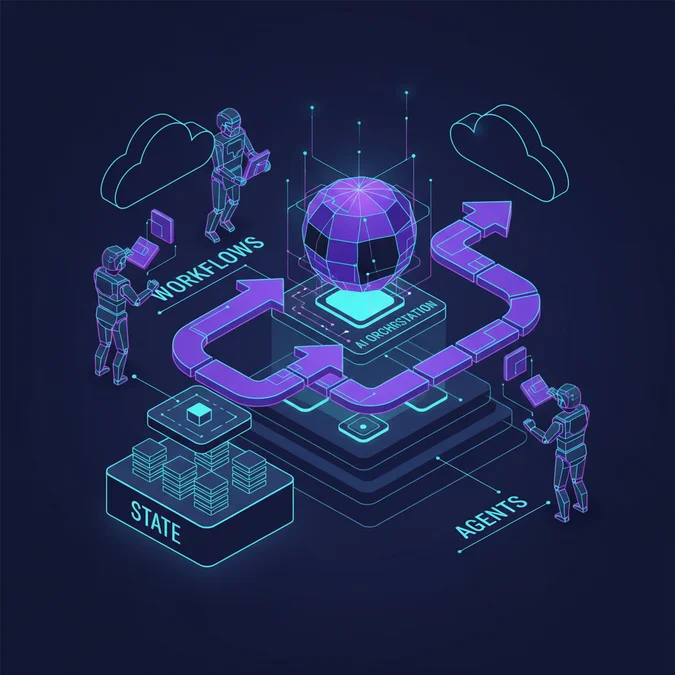

At its core, ai orchestration is the runtime control plane that manages model invocation, tool routing, dynamic state transition, and distributed context across heterogeneous machine learning models and autonomous agents. Rather than treating an LLM as a stateless endpoint, an enterprise orchestration layer treats language models as compute units within a stateful, fault-tolerant execution graph.
Building production systems on raw model APIs inevitably hits a wall: context windows fill with redundant conversational history, multi-turn tool loops spin into infinite token drains, and distributed microservices lose state synchronization when external APIs fail. Moving past naive prompt chaining requires a transition to deterministic state architectures, durable workflow execution, and isolated memory topologies.
This architectural reference examines the structural components of the orchestration runtime. We dissect the differences between static directed acyclic graphs and dynamic swarm protocols, benchmark key execution frameworks, provide production-ready Python blueprints for state machines, and outline failure-mode mitigation strategies for high-throughput enterprise deployments in 2026.
Deconstructing the AI Orchestration Layer: Core Architecture and Primitives
Enterprise engineering teams often conflate traditional data pipeline orchestration with the modern ai orchestration layer. In traditional data engineering, engines like Apache Airflow or Prefect schedule static batch transformations across predictable extract-transform-load (ETL) directed acyclic graphs (DAGs). These pipelines operate over structured datasets where each node in the graph yields deterministic outputs given identical inputs. By contrast, an enterprise ai orchestration engine must govern nondeterministic, multi-step inference loops, non-linear human-in-the-loop (HITL) checkpoints, dynamic tool invocation, and volatile runtime memory across distributed workers.
Understanding this architecture requires breaking the system down into its core primitives: context routers, state engines, model gateways, and runtime environments. Furthermore, a strict architectural separation must be maintained between simple ai model orchestration and full agentic workflow governance.
+-----------------------------------------------------------------------------------+
| AI Orchestration Layer |
| |
| +------------------+ +--------------------+ +-------------------------+ |
| | Context Router | --> | Stateful Evaluator | --> | Model Gateway / Router | |
| | (Semantic Guard)| | (Graph Runtime) | | (Rate Limits / Fallback)| |
| +------------------+ +--------------------+ +-------------------------+ |
| | | | |
| v v v |
| +------------------+ +--------------------+ +-------------------------+ |
| | Vector / Memory | | State Persistence | | Isolated Sandbox Tools | |
| | (Episodic Cache) | | (Postgres/Redis) | | (Wasm / MicroVMs) | |
| +------------------+ +--------------------+ +-------------------------+ |
+-----------------------------------------------------------------------------------+
Core Primitives of the Orchestration Runtime
- Context Routers and Semantic Gateways: The entry boundary that intercepts inbound user payloads, applies strict input sanitization, checks vector caches for semantic deduplication, and routes the request to an appropriate sub-workflow based on semantic intent classifications.
- Graph Execution Engine: The deterministic state machine that governs transitions between execution nodes. It tracks recursion depth, manages checkpoints, and evaluates dynamic branch criteria based on structured model responses.
- Model Gateway: The resilience abstraction layer that handles multi-provider fallbacks (for example, falling back from Claude 3.5 Sonnet to GPT-4o or local vLLM instances), rate limiting, token bucket budgeting, and prompt token serialization.
- Isolated Tool Runtime: Secure, isolated sandboxes (WebAssembly, gVisor, or ephemeral Docker microVMs) where code execution and database mutations occur without exposing core state machines to prompt injection exploits.
The table below contrasts traditional ETL orchestration, simple model routing, and true agentic orchestration across production dimensions:
| Architectural Dimension | Data Pipeline Orchestration (Airflow, Prefect) | AI Model Orchestration (LiteLLM, Portkey) | Full AI Agent Orchestration (LangGraph, Temporal) |
|---|---|---|---|
| Execution Topology | Static, pre-compiled Directed Acyclic Graphs (DAGs) | Point-to-point gateway routing, load balancing | Cyclic graphs, conditional loops, dynamic agent handoffs |
| Determinism | 100% deterministic given identical source inputs | Deterministic routing over non-deterministic outputs | Heuristic, dynamic transitions governed by model reasoning |
| State Persistence | Task-level metadata and database step checkpoints | Stateless or ephemeral session-based caching | Durable snapshotting, time-travel debugging, thread memory |
| Latency Profile | Batch, minutes to hours | Sub-second (100ms – 2s gateway overhead) | Multi-turn interactive (2s to 120s+ runtime loops) |
| Failure Recovery | Retry entire node or upstream task block | Fallback to secondary provider or smaller model | State rollback, context compaction, HITL intervention |
Architecture Rule: Keep ai model orchestration (protocol translation, provider fallbacks, quota tracking) strictly separated from your core agentic state engine. Interleaving model routing logic directly inside state transitions couples your business domain to external LLM provider quirks.
Comparing Enterprise AI Orchestration Platforms and Agent Toolsets
When selecting an enterprise ai orchestration platform, platform engineers must assess how each tool handles runtime persistence, process isolation, observability integrations, and high-concurrency scaling. The ecosystem has bifurcated into two primary paradigms: specialized, managed ai agent orchestration platform solutions designed for rapid enterprise delivery, and developer-centric ai agent orchestration tools built to sit within existing distributed systems infrastructure.
Commercial and managed platforms (such as LangSmith, AWS Bedrock Agent Core, and Google Cloud Vertex AI Agent Builder) provide managed enterprise governance, visual tracing, zero-infrastructure rollouts, and built-in role-based access control (RBAC). Conversely, modular agent orchestration tools (such as LangGraph, Temporal, and Semantic Kernel) provide the foundational code runtimes required to deploy custom state graphs inside internal Kubernetes clusters or on-prem air-gapped VPCs.
| Platform / Tool | Runtime Isolation Model | State Storage Engine | Telemetry Standard | Throughput Limit Factor | Best Suited Architectural Use Case |
|---|---|---|---|---|---|
| LangGraph / LangSmith | In-process / Containerized Nodes | Postgres, Redis, DynamoDB Checkpointers | Native OpenTelemetry, LangSmith Schema | Database I/O concurrency on state snapshots | Deterministic state graphs requiring cycles and fine-grained state inspection |
| Temporal (with LLM SDK) | Strict Worker Process Isolation | Cassandra, Postgres, MySQL, Event Log | OpenTelemetry, Prometheus metrics | Event history size per execution run (50k limit) | Mission-critical transactions, financial reconciliation, multi-day human workflows |
| CrewAI Enterprise | Process-level Worker Threads | SQLite, Ephemeral In-Memory, Vector RAG | Custom Telemetry, OpenTelemetry (Limited) | Python GIL, synchronous sub-task orchestration | Role-driven multi-agent simulations and structured research workflows |
| Microsoft AutoGen | Async Event Loop (Actors) | Custom State Stores, Memory Checkpoints | Custom Event Tracing, OpenTelemetry | Message bus throughput, actor state drift | Collaborative multi-agent debate, code interpretation, dynamic exploration |
| AWS Bedrock Agents | Fully Managed AWS Micro-services | AWS-managed session memory, S3, DynamoDB | AWS CloudWatch, AWS X-Ray | AWS API Service Quotas and concurrency limits | AWS-native enterprises requiring managed serverless IAM compliance |
To evaluate these solutions effectively against production requirements, engineering leadership must audit candidates against a rigorous capabilities checklist.
Enterprise Orchestration Evaluation Checklist
- Durable Thread Checkpointing: Does the platform allow complete thread execution freezing, serializing the state tree to Postgres or Redis, and resuming on a completely separate worker node without data loss?
- Distributed Lock Management: Does the system implement distributed transaction coordination (such as pessimistic locking or optimistic concurrency control via ETags) to prevent two parallel webhooks from concurrently updating the same agent conversation thread?
- Standardized Telemetry Pipelines: Does the runtime natively output standard OpenTelemetry (OTel) traces that capture prompt token distributions, model execution time, tool latency, and state mutations into DataDog, Dynatrace, or Honeycomb?
- Air-Gapped Tool Execution: Can external tool nodes execute within network-isolated microVMs (such as Firecracker or gVisor) with fine-grained egress filtering to protect internal systems from malicious prompt injections?
- Deterministic Time-Travel Debugging: Does the developer control plane support replaying an execution trace from node N with altered state parameters to reproduce and fix production edge-case failures?
Multi-Agent Orchestration Patterns: Topologies, State Routing, and Memory
Implementing production multi agent orchestration requires moving away from free-form, unconstrained chat groups. While multi-agent debate and unconstrained peer-to-peer swarms perform well in research benchmarks, they introduce high latency, token bloat, and nondeterministic loops in enterprise production. Robust ai agent orchestration instead relies on four well-defined structural execution topologies:
- Sequential Chains with Explicit Handshakes: Linear pipelines where Agent A emits a strictly typed Pydantic schema consumed as immutable context by Agent B. This pattern is ideal for extraction and validation steps.
- Concurrent Map-Reduce Fan-Out: A coordinator partitions an inbound request across multiple child agents running in parallel (for example, analyzing three distinct 10-K financial reports simultaneously) before consolidating results in an aggregation node.
- Hierarchical Supervisor Topology: A centralized supervisor node evaluates user input, delegates execution to domain-specific child agents, and inspects child output before deciding whether to transition to another agent or return execution to the client.
- Dynamic Collaborative Swarm (State-Gated): Peer agents directly hand off execution control to one another, but each handoff is validated against a deterministic permission matrix to prevent cyclic delegation.
The code below demonstrates a production-grade Hierarchical Supervisor pattern using LangGraph. Notice how state is strictly typed, shared state is maintained cleanly, and the supervisor router explicitly prevents infinite delegation.
import operator
from typing import Annotated, Sequence, TypedDict, Literal
from pydantic import BaseModel, Field
from langchain_core.messages import BaseMessage, HumanMessage, AIMessage
from langgraph.graph import StateGraph, END
from langgraph.checkpoint.memory import MemorySaver

# 1. Define Strict State Architecture
class AgentTeamState(TypedDict):
 messages: Annotated[Sequence[BaseMessage], operator.add]
 next_worker: str
 task_complete: bool
 iteration_count: Annotated[int, operator.add]

# 2. Supervisor Evaluation Schema
class RouterOutput(BaseModel):
 next_action: Literal["sql_expert", "code_runner", "final_responder"]
 reasoning: str = Field(description="Validation check explaining the choice")

# 3. Router Node Implementation
def supervisor_node(state: AgentTeamState) -> dict:
 # Circuit breaker: Hard limit on recursion depth
 if state.get("iteration_count", 0) >= 5:
 return {
 "next_worker": "final_responder",
 "messages": [AIMessage(content="Maximum execution budget reached. Compiling best effort response.")],
 "iteration_count": 1
 }

 last_message = state["messages"][-1].content

 # Simulate model routing decision logic
 if "SELECT" in last_message.upper() or "DATABASE" in last_message.upper():
 selected_node = "sql_expert"
 elif "EXECUTE" in last_message.upper() or "PYTHON" in last_message.upper():
 selected_node = "code_runner"
 else:
 selected_node = "final_responder"

 return {
 "next_worker": selected_node,
 "iteration_count": 1
 }

# 4. Domain Worker Nodes
def sql_expert_node(state: AgentTeamState) -> dict:
 return {
 "messages": [AIMessage(content="SQL Specialist: Extracted 42 records from customer_db.")],
 "next_worker": "supervisor"
 }

def code_runner_node(state: AgentTeamState) -> dict:
 return {
 "messages": [AIMessage(content="Code Specialist: Executed calculation with zero runtime errors.")],
 "next_worker": "supervisor"
 }

def final_responder_node(state: AgentTeamState) -> dict:
 return {
 "messages": [AIMessage(content="Workflow successfully aggregated and finalized for user delivery.")],
 "task_complete": True,
 "next_worker": END
 }

# 5. Graph Assembly and Edge Binding
workflow = StateGraph(AgentTeamState)

workflow.add_node("supervisor", supervisor_node)
workflow.add_node("sql_expert", sql_expert_node)
workflow.add_node("code_runner", code_runner_node)
workflow.add_node("final_responder", final_responder_node)

# Define Dynamic Conditional Transitions
workflow.add_conditional_edges(
 "supervisor",
 lambda state: state["next_worker"],
 {
 "sql_expert": "sql_expert",
 "code_runner": "code_runner",
 "final_responder": "final_responder"
 }
)

workflow.add_edge("sql_expert", "supervisor")
workflow.add_edge("code_runner", "supervisor")
workflow.add_edge("final_responder", END)

workflow.set_entry_point("supervisor")
app = workflow.compile(checkpointer=MemorySaver())
Memory Architecture Pattern: Distributed multi-agent systems should decouple Working Memory (ephemeral context passed between steps in the thread payload) from Episodic Memory (long-term historical interactions stored in a vector or relational store). Passing full chat histories across all sub-agents saturates context windows and exponentially escalates input token costs.
Evaluating Agent Orchestration Frameworks: Graph Runtimes vs Autonomous Swarms
When architecting systems around an agent orchestration framework, teams encounter a fundamental tradeoff: deterministic graph runtimes versus autonomous multi-agent swarms. Selecting between these patterns dictates system reliability, mean time to response, token expenditure, and auditability.
Graph runtimes (such as LangGraph and Temporal) treat orchestration as an explicit, strongly typed finite state machine. Every edge represents a valid, programmatic transition, and cyclic loops are governed by strict conditional checks. Conversely, autonomous swarm runtimes (such as AutoGen or CrewAI) lean into emergent behavior, allowing agents to iteratively message one another until a natural consensus or termination signal is reached.
Evaluating current ai orchestration frameworks across high-volume production benchmarks reveals stark trade-offs in resource utilization, latency, and determinism:
| Evaluation Metric | Graph State Machines (LangGraph, Temporal) | Role-Playing Frameworks (CrewAI) | Conversational Swarms (AutoGen) |
|---|---|---|---|
| P95 Latency (Multi-step Task) | 1.8s – 4.2s (Optimized, deterministic steps) | 6.5s – 18.0s (Prompt verbosity, persona overhead) | 8.0s – 25.0s (Multi-turn conversational iterations) |
| Token Overhead per Task | Baseline (1.0x, stripped state passing) | 2.4x – 4.0x (System persona instructions) | 3.5x – 6.0x (Chat history reflection cycles) |
| Execution Determinism | 98.5% (Hardcoded paths, structural constraints) | 82.0% (Agent handoffs depend on model adherence) | 71.5% (Risk of conversational deadlocks) |
| Failure Recovery Mechanism | Node-level rewind, checkpoint restoration | Sequential task retry, error bubble-up | Conversation restart or human intervention |
| State Graph Inspection | Native UI, full JSON schema tracing | Console logs, step event listeners | Message timeline traces, actor logs |
To contrast the code architectures directly, review the following side-by-side implementation patterns. The first demonstrates a structured CrewAI sequential process, while the second shows an AutoGen conversational swarm configuration.
Pattern A: CrewAI Hierarchical Task Execution
from crewai import Agent, Task, Crew, Process
from langchain_openai import ChatOpenAI

llm = ChatOpenAI(model="gpt-4o-mini", temperature=0.0)

# Configure Domain Specialist Agents with Clear Personas
security_auditor = Agent(
 role="Application Security Auditor",
 goal="Audit target API definitions for OWASP vulnerabilities",
 backstory="Veteran AppSec engineer who only reports high-confidence CVEs.",
 llm=llm,
 verbose=False
)

remediation_engineer = Agent(
 role="Cloud Infrastructure Remediation Engineer",
 goal="Draft infrastructure mitigation code based on reported vulnerabilities",
 backstory="Staff SRE experienced in building resilient Terraform configurations.",
 llm=llm,
 verbose=False
)

# Define Bound Tasks
audit_task = Task(
 description="Analyze the supplied OpenAPI spec for unauthenticated endpoints: {openapi_spec}",
 expected_output="A structured list of insecure endpoints with severity ratings.",
 agent=security_auditor
)

remediation_task = Task(
 description="Generate AWS WAF rules to patch endpoints identified by the auditor.",
 expected_output="Valid Terraform code containing the AWS WAF ACL configurations.",
 agent=remediation_engineer
)

# Bind to Process
security_crew = Crew(
 agents=[security_auditor, remediation_engineer],
 tasks=[audit_task, remediation_task],
 process=Process.sequential
)

# result = security_crew.kickoff(inputs={"openapi_spec": ".."})
Pattern B: AutoGen Conversational Actor Handoff
import autogen

config_list = [{"model": "gpt-4o-mini", "api_key": "sk-mock-key-prod"}]
gpt_config = {"config_list": config_list, "temperature": 0.1, "timeout": 30}

# Define Conversational Agents
user_proxy = autogen.UserProxyAgent(
 name="OperationsManager",
 human_input_mode="NEVER",
 max_consecutive_auto_reply=3,
 is_termination_msg=lambda x: "TERMINATE" in x.get("content", ""),
 code_execution_config={"use_docker": False}
)

database_analyst = autogen.AssistantAgent(
 name="DatabaseAnalyst",
 system_message="You analyze DB performance queries. When finished, emit TERMINATE.",
 llm_config=gpt_config
)

# Initiate Conversational Execution
# user_proxy.initiate_chat(
# database_analyst,
# message="Investigate slow queries reported on tenant node 402."
# )
For enterprise mission-critical processes where compliance, strict audit trails, and predictable latency bounds are non-negotiable, a deterministic graph runtime (LangGraph, Temporal) remains superior to a conversational multi agent orchestration framework.
Production Hardening: Mitigating Loops, State Drift, and Cascading Hallucinations
Deploying AI agents at scale exposes operational challenges rarely encountered in traditional stateless web services. Without explicit defense mechanisms, an autonomous system can execute dozens of redundant API calls, burn through thousands of dollars in tokens over minutes, or enter an unrecoverable hallucination loop. Hardening an enterprise agent runtime requires implementing robust defensive architectural patterns.
- Context Window Compaction and Pruning: As an agent execution thread progresses, tool responses, JSON schemas, and model outputs accumulate quickly. Implement dynamic context window compaction using a sliding message buffer combined with background summarization nodes. When thread tokens exceed 60% of the maximum model context, non-essential tool payload arrays should be aggressively pruned.
- Distributed Transaction Locks and State Versioning: Prevent race conditions caused by concurrent webhook requests or duplicate client interactions. Every state transition should evaluate an incremental state version tag (Optimistic Concurrency Control) stored in a transactional database like PostgreSQL.
- Human-in-the-Loop Interruption Gates: Critical mutating operations, such as database drops, payments exceeding predefined thresholds, or customer-facing emails, must suspend state execution and persist a checkpoint. Execution resumes only when an authenticated administrative webhook emits an approval signal.
- Loop Detection Circuit Breakers: Monitor tool call frequency, tool input hashes, and model response similarity across sequential turns. If an agent executes the identical tool signature twice with an error response, the runtime must trip a circuit breaker, strip the failing path from the available tool list, and force alternate path planning.
The following production Python module implements an industrial-grade Circuit Breaker and Token Budget Controller, engineered to safeguard enterprise orchestration engines from cascading failures:
import hashlib
import logging
from typing import Dict, Any, List

logger = logging.getLogger("OrchestrationGuard")

class ExecutionBudgetExceeded(Exception):
 """Raised when agent loop breaches allocated financial or operational limits."""
 pass

class InfiniteLoopDetected(Exception):
 """Raised when deterministic cycle detection catches repetitive tool invocation."""
 pass

class ProductionRuntimeGuard:
 def __init__(
 self,
 max_total_tokens: int = 40000,
 max_depth_iterations: int = 8,
 max_duplicate_calls: int = 2
 ):
 self.max_total_tokens = max_total_tokens
 self.max_depth_iterations = max_depth_iterations
 self.max_duplicate_calls = max_duplicate_calls

 self.consumed_tokens = 0
 self.current_iteration = 0
 self.tool_call_history: List[str] = []

 def track_token_usage(self, prompt_tokens: int, completion_tokens: int) -> None:
 """Accumulates token usage and verifies budget constraints."""
 self.consumed_tokens += (prompt_tokens + completion_tokens)
 if self.consumed_tokens > self.max_total_tokens:
 logger.error(f"Budget breached: {self.consumed_tokens} > {self.max_total_tokens}")
 raise ExecutionBudgetExceeded("Hard token limit exceeded for this workflow execution run.")

 def validate_execution_turn(self, tool_name: str, tool_kwargs: Dict[str, Any]) -> None:
 """Detects infinite loops and recursion anomalies across agent execution cycles."""
 self.current_iteration += 1

 if self.current_iteration > self.max_depth_iterations:
 raise InfiniteLoopDetected(f"Maximum depth iteration threshold ({self.max_depth_iterations}) hit.")

 # Generate a deterministic hash representing the tool call footprint
 serialized_payload = f"{tool_name}:{sorted(tool_kwargs.items())}"
 call_hash = hashlib.sha256(serialized_payload.encode("utf-8")).hexdigest()

 # Check for repetitive calls with matching inputs
 duplicate_count = self.tool_call_history.count(call_hash)
 if duplicate_count >= self.max_duplicate_calls:
 logger.warning(f"Cycle detected: Tool '{tool_name}' triggered {duplicate_count + 1} times with identical arguments.")
 raise InfiniteLoopDetected(f"Infinite loop detected on tool '{tool_name}'. Terminating agent branch.")

 self.tool_call_history.append(call_hash)
 logger.info(f"Turn {self.current_iteration} validated for tool '{tool_name}'. Total tokens: {self.consumed_tokens}")

# Example Usage
guard = ProductionRuntimeGuard(max_total_tokens=10000, max_depth_iterations=5)
try:
 # Turn 1: Normal call
 guard.validate_execution_turn("query_sales_data", {"region": "EMEA", "quarter": "Q1"})
 guard.track_token_usage(1200, 350)

 # Turn 2: Erroneous duplicate call
 guard.validate_execution_turn("query_sales_data", {"region": "EMEA", "quarter": "Q1"})
 guard.track_token_usage(1100, 300)

 # Turn 3: Duplicate threshold breached (raises InfiniteLoopDetected)
 guard.validate_execution_turn("query_sales_data", {"region": "EMEA", "quarter": "Q1"})
except InfiniteLoopDetected as err:
 logger.error(f"Mitigation triggered: {err}")
 # Route execution to safe fallback node or human-in-the-loop queue
Hallucination Defense: Never permit an agent to report a tool execution outcome without validating that the raw output is grounded in a deterministic payload. Force your extraction layers to output strictly validated JSON containing citations pointing to specific record IDs returned by your external APIs.
Factors That Affect Development Cost
- Inference token consumption per multi-turn agent interaction
- State persistence datastore read/write I/O operations
- Observability and distributed tracing ingestion costs
- Sandboxed runtime compute overhead for isolated tool execution
Production orchestration costs vary primarily with agent recursion limits, model provider selection, and memory retention strategies.
Frequently Asked Questions
What is the primary difference between AI model orchestration and AI agent orchestration?
AI model orchestration coordinates static data flows, fine-tuning jobs, and batch inferences across raw LLMs. In contrast, AI agent orchestration manages dynamic, goal-oriented autonomy, coordinating multi-turn tool execution, state graph transitions, runtime memory retrieval, and decentralized decision-making loops across heterogeneous software agents in real time.
When should an enterprise deploy a managed AI orchestration platform instead of a custom state graph?
Deploy a managed AI orchestration platform when your engineering team needs built-in enterprise governance, unified observability via OpenTelemetry, strict role-based access control, and turn-key deployment pipelines. Build custom state graphs when you require ultra-low latency, custom deterministic execution loops, on-prem air-gapped runtimes, or zero vendor lock-in.
What mechanisms prevent infinite loops in a multi-agent orchestration framework?
A resilient multi agent orchestration framework avoids infinite loops by enforcing deterministic execution budgets, maximum recursive depth thresholds, cycle-detecting directed acyclic graphs (DAGs), and automated supervisor circuit breakers. When an agent exceeds token quotas or repeats identical tool calls, the supervisor aborts and routes to human intervention.
How does an enterprise AI orchestration layer persist state across distributed workflows?
An AI orchestration layer preserves distributed state across asynchronous workflows by decoupling runtime memory from execution containers. It serializes agent state, execution history, and short-term working context into low-latency datastores like Redis or Postgres, enabling durable checkpointing, zero-loss task resumption, and reliable human-in-the-loop state suspension.
Modern ai orchestration is shifting from exploratory conversational swarms toward deterministic, observable, and resilient state machines. While autonomous agent patterns offer powerful flexibility during experimental phases, production systems require predictable execution boundaries, isolated tool sandboxes, and strict operational circuit breakers. Architectural success lies in decoupling your model gateways from your state persistence layer, ensuring that changing underlying foundation models does not require rewriting your core business logic.
As you scale your agent workflows, treat every agent execution path as an untrusted, distributed process. Enforce strict type validation across inputs and outputs, maintain comprehensive OpenTelemetry trace visibility, and implement hard budget guardrails. Teams that adopt these defensive engineering principles will build reliable agentic systems that scale predictably in production environments.