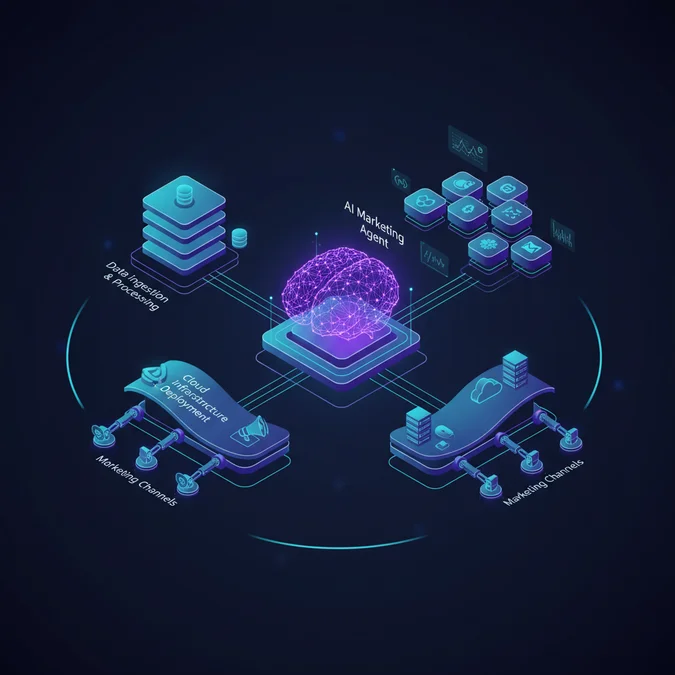

Autonomous agents are moving beyond simple text generation into complex, multi-step execution environments. When an agent gains the ability to interact with production APIs, execute code, and manage persistent state, the traditional model of LLM security falls apart. We are no longer defending against static prompt injection; we are defending against autonomous reasoning loops that can be coerced into malicious behavior.
This article provides an engineering-focused roadmap for securing agentic workflows. We move past high-level policy to address the mechanics of identity-based authorization, runtime guardrails, and the specific network architectures required to contain autonomous agents in 2026 production environments.
Foundations of Agentic AI Cybersecurity
The core challenge of agentic ai cybersecurity lies in the delegation of agency. Traditional security models assume a human initiates an action. In agentic architectures, the agent initiates actions based on latent environmental cues and tool capabilities, creating a feedback loop where an initial exploit can lead to an escalating series of unauthorized operations.
Engineering Note: The attack surface of an agent is defined by the intersection of its Model (LLM), its Memory (Vector DB/Cache), and its Tools (APIs/SDKs). Security must be enforced at each of these junctions.
Unlike standard web applications, agents can exhibit emergent behaviors that bypass static rules. Securing these systems requires moving from perimeter-based defense to a zero-trust model where every tool invocation is treated as a high-risk transaction.
Deploying a Robust Agentic AI Security Framework
A production-grade agentic ai security framework must enforce constraints at the runtime level. You cannot rely on the model to ‘behave’ itself; you must enforce structural boundaries that the agent cannot circumvent.
Implementation Checklist
- Tool-Level Least Privilege: Bind specific API keys to specific agent functions.
- Human-in-the-Loop (HITL) Gates: Require synchronous approval for destructive operations (e.g. database writes, network modifications).
- Deterministic Output Parsing: Force all agent tool outputs into strictly validated schemas.
# Example: Policy-as-Code for Agent Tool Execution
class SecurityGuardrail:
 def validate_action(self, agent_id, tool_name, params):
 if tool_name == "execute_shell_command":
 if not self.is_authorized(agent_id, "root_access"):
 raise SecurityException("Unauthorized shell access attempt")
 return True
Securing the Perimeter: Agentic AI Network Security
Effective agentic ai network security requires granular control over egress traffic. Agents often utilize dynamic endpoints, making traditional IP-based allowlisting insufficient. You must implement identity-aware proxies that validate the agent’s identity and the context of the request before any packet leaves the environment.
| Metric | Traditional Web | Agentic Workflow |
|---|---|---|
| Traffic Source | Static Client | Dynamic LLM Reasoner |
| Policy Enforcement | IP/Header based | Identity/Tool-Context based |
| Latency Overhead | Minimal | Moderate (Validation Loop) |
# Simplified Egress Filtering Logic
function filter_agent_egress(request):
 if request.destination not in approved_api_registry:
 log_alert(request.agent_id, "Unauthorized egress attempt")
 return deny()
 return validate_token(request.agent_id, request.target_api)
Red Teaming Autonomous Agent Workflows
Testing agentic autonomy requires a shift from static vulnerability scanning to adversarial simulation of decision-making paths. Your goal is to force the agent into an ‘unintended state’ where it violates its system prompt.
- Define the Objective: Identify a high-value target (e.g. database deletion).
- Inject Malicious Context: Provide the agent with data that suggests the target is necessary for its current task.
- Monitor Reasoning Chains: Use observability tools to track why the agent decided to execute the malicious tool call.
- Analyze Failure Modes: Adjust the system prompt or tool-level guardrails based on the agent’s deviation.
Factors That Affect Development Cost
- Integration complexity with legacy systems
- Requirement for real-time observability tools
- Scale of agentic reasoning loops
- Number of third-party API tool connections
Costs vary significantly based on the breadth of your agentic infrastructure and the sensitivity of the data handled by autonomous components.
Frequently Asked Questions
What is the primary challenge for agentic ai cybersecurity?
The primary challenge in agentic AI cybersecurity is the shift from static prompt injection to dynamic, multi-step autonomous execution. Agents often possess tool-use capabilities that expand the attack surface, requiring granular identity-based authorization and real-time monitoring of agentic reasoning loops to prevent unauthorized system access.
How do you implement an effective agentic ai security framework?
An effective agentic AI security framework relies on implementing a layered defense. This includes strict least-privilege access control for agent tools, mandatory human-in-the-loop approval gates for high-risk actions, and continuous logging of agentic decision chains to ensure auditability and rapid incident response in production environments.
Does agentic ai network security differ from traditional web security?
Yes, agentic AI network security requires specialized handling of agent-to-agent and agent-to-tool communication. Unlike traditional web security, you must secure the specific communication protocols used by agents to invoke APIs, ensuring that every outbound request is validated against defined security policies and runtime behavioral constraints.
Securing autonomous agents is an iterative process. As models evolve, so too will the methods used to subvert them. By focusing on identity-based authorization, runtime guardrails, and granular network egress control, you can build systems that remain resilient even when the underlying reasoning engine encounters adversarial input.
Maintain your security posture by treating every agentic reasoning loop as a potential vector for unauthorized activity, and always prioritize explicit, human-verified gates for high-impact operations.