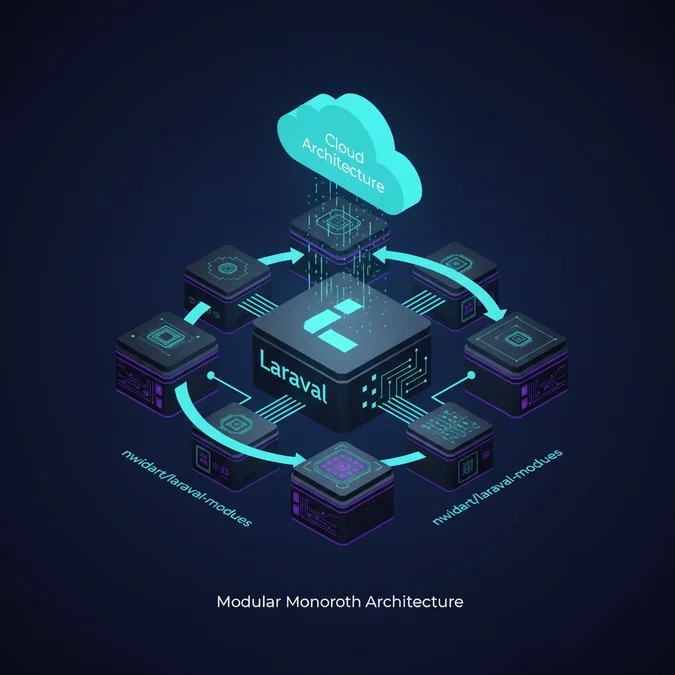

nwidart/laravel-modules is an open-source Laravel package created by Nicolas Widart that organizes large-scale PHP applications into independent, domain-driven modules rather than keeping all code within a single global app/ directory. It provides isolated namespaces, routes, service providers, models, views, and database migrations for every distinct feature boundary.
The package maintainers actively align current updates with the latest Laravel framework releases, focusing on modern Composer autoloading optimizations, PHP 8 attributes, seamless integration with Laravel Vite, and automated dependency resolution between modular boundaries. Rather than pushing engineering organizations into the operational overhead of fragmented distributed microservices, the project roadmap doubles down on modular monolith architectures that scale development velocity.
As software systems grow, standard MVC directory structures degrade. Teams experience heightened merge friction, cross-boundary side effects, and cognitive overload. Partitioning application code into explicit boundaries allows engineering teams to parallelize development, limit blast radiuses, and protect long-term code maintainability without taking on premature distributed systems complexity.
The Architectural Case for Modular Monoliths in Laravel
Standard Laravel applications place controllers in app/Http/Controllers, Eloquent models in app/Models, and domain events in app/Events. This layer-by-type convention serves initial development velocity well, but creates significant friction as codebases scale past hundreds of database tables and dozens of engineers. When business logic spans dozens of intermingled models, refactoring one subdomain introduces regressions in unrelated domains.
Microservices often get proposed as the default remedy for monolithic complexity. However, microservices introduce cross-network latency, data serialization overhead, eventual consistency complexities, distributed transaction failures, and significant DevOps operational costs. For most mid-sized to enterprise applications, microservices swap code organization challenges for complex distributed infrastructure operations.
A modular monolith strikes the pragmatic balance. Code is organized around business capabilities rather than technical frameworks, while sharing a single runtime, process memory, and deployment pipeline. Adopting Laravel for fintech application development illustrates this necessity, where compliance, billing, and ledger systems must remain isolated yet execute within unified transactional boundaries.
The nwidart/laravel-modules package structures this architectural pattern directly within the framework. It partitions application subdomains into standalone packages living inside the Modules/ directory. Each module functions as an autonomous unit complete with its own routes, service providers, configuration files, and migrations.
Package Installation and Foundational Configuration
Installing nwidart/laravel-modules requires pulling the package via Composer and publishing its global configuration file to customize module namespaces and autoloading behavior.
composer require nwidart/laravel-modules
php artisan vendor:publish --provider="Nwidart\Modules\LaravelModulesServiceProvider"
Executing this command generates the config/modules.php file. This file controls where modules live, how files generate via Artisan, and how the autoloader detects service providers. By default, modules reside inside a root-level Modules/ directory. The package can register these paths automatically, but configuring standard Composer PSR-4 autoloading in composer.json remains the industry benchmark for zero runtime overhead:
{
 "autoload": {
 "psr-4": {
 "App\\": "app/",
 "Database\\Factories\\": "database/factories/",
 "Database\\Seeders\\": "database/seeders/",
 "Modules\\": "Modules/"
 }
 }
}
After editing your composer.json, regenerate the optimized autoloader mapping:
composer dump-autoloadThe published configuration file permits deep customization of generator stubs, cache strategies, and default file paths. The following parameters in config/modules.php demand explicit architectural decisions:
- cache.enabled: Setting this to
truein production environments caches the manifest of active modules to eliminate filesystem disk I/O on every request lifecycle. - register.translations: Dictates whether translation files automatically load into the translator instance upon module initialization.
- activators: Configures how active and inactive module states are tracked, defaulting to local JSON manifest files.
Internal Directory Anatomy and Boundary Isolation
When generating a new module via the CLI using php artisan module:make Billing, nwidart/laravel-modules scaffolds an isolated domain directory structure. Each module acts as a self-contained domain application.
Modules/
└── Billing/
 ├── app/
 │ ├── Http/
 │ │ └── Controllers/
 │ │ └── BillingController.php
 │ ├── Models/
 │ │ └── Invoice.php
 │ └── Providers/
 │ ├── BillingServiceProvider.php
 │ └── RouteServiceProvider.php
 ├── config/
 │ └── config.php
 ├── database/
 │ ├── factories/
 │ ├── migrations/
 │ └── seeders/
 ├── resources/
 │ └── views/
 ├── routes/
 │ ├── api.php
 │ └── web.php
 ├── tests/
 │ ├── Feature/
 │ └── Unit/
 ├── composer.json
 └── module.json
The primary driver of module independence is the module.json metadata manifest. It defines the module name, description, priority order, and direct dependencies:
{
 "name": "Billing",
 "alias": "billing",
 "description": "Core billing and subscription processing engine",
 "keywords": ["billing", "payments"],
 "priority": 10,
 "providers": [
 "Modules\\Billing\\App\\Providers\\BillingServiceProvider"
 ],
 "files": [],
 "requires": ["Core", "User"]
}
Maintaining domain isolation requires strong boundaries. If the Billing module imports domain models directly from an unrelated module like Warehouse, encapsulation fails. Modules should interact through explicit service interfaces, contracts, or domain events rather than tight coupling to another module’s internal database models.
Service Provider Lifecycle and Bootstrapping Mechanics
Understanding how modules register into the Laravel application lifecycle prevents unexpected service container bugs and memory leaks. The parent package hooks into Laravel’s boot sequence to register and boot each active module’s designated providers.
During the register phase, the module’s BillingServiceProvider binds internal interfaces to implementations, merges domain-specific configuration files, and registers contextual singletons. Notice how the provider explicitly maps module configuration and views:
<php

namespace Modules\Billing\App\Providers;

use Illuminate\Support\ServiceProvider;

class BillingServiceProvider extends ServiceProvider
{
 protected string $moduleName = 'Billing';
 protected string $moduleNameLower = 'billing';

 public function register(): void
 {
 // Merge domain-specific configuration safely
 $this->mergeConfigFrom(
 module_path($this->moduleName, 'config/config.php'),
 $this->moduleNameLower
 );
 }

 public function boot(): void
 {
 // Load migrations directly from the module database directory
 $this->loadMigrationsFrom(module_path($this->moduleName, 'database/migrations'));

 // Load module translations with namespaced keys
 $this->loadTranslationsFrom(
 module_path($this->moduleName, 'resources/lang'),
 $this->moduleNameLower
 );

 // Load modular views with namespace: view('billing:index')
 $this->loadViewsFrom(
 module_path($this->moduleName, 'resources/views'),
 $this->moduleNameLower
 );
 }
}
Module boot order matters when domains depend on foundational services. The priority attribute in module.json dictates sequence: modules with lower priority numbers boot before higher ones. Core modules containing authorization matrices or event dispatchers should run at priority 1, ensuring their service bindings resolve before downstream consumers boot.
Database Migrations, Seeders, and Factoring at Scale
Running database operations across multiple module boundaries requires structured execution tooling. Running the standard php artisan migrate command will only scan database/migrations unless module paths are explicitly loaded or executed via the module Artisan command suite.
The package provides dedicated Artisan wrappers for running schema updates across one or all domains:
# Migrate all modules in order of priority
php artisan module:migrate

# Migrate only the Billing module
php artisan module:migrate Billing

# Roll back the last migration step for a specific module
php artisan module:migrate-rollback Billing

# Seed database records across all active modules
php artisan module:seed
Cross-module foreign keys represent a critical architectural trade-off. While relational foreign key constraints preserve referential integrity at the database level, hard database constraints between modules break physical modularity. If the Invoices table in Billing possesses a direct foreign key constraint referencing the Users table in the Auth module, the database schemas cannot be separated cleanly if a module ever needs to move to an independent database.
Pragmatic engineering teams often implement soft references using UUIDs or standard integer IDs without database-level cascading deletes across module borders. Domain integrity is maintained instead via model-level validation, domain events, or database triggers.
Inter-Module Communication: Contracts, Events, and Queries
The greatest threat to a modular monolith is spaghetti dependencies, where modules reach deep into each other’s models, query builders, and private classes. To maintain low coupling and high cohesion, engineers should establish three approved patterns for inter-module communication:
- Contract Interfaces: Define a public PHP interface inside a shared namespace or the target module. The consumer references only the interface, resolved through Laravel’s service container.
- Domain Events: A module executes an action and dispatches an immutable event (such as
OrderPlaced). Other modules listen asynchronously without the sender knowing who consumes it. - Direct Service APIs: Expose a single public service class per module (for example,
BillingFacadeorBillingService) acting as an API boundary. Other modules are strictly forbidden from querying the Eloquent models directly.
Here is an example of an asynchronous domain event handling flow across modules:
<php

namespace Modules\Order\App\Events;

use Illuminate\Foundation\Events\Dispatchable;
use Illuminate\Queue\SerializesModels;

class OrderPaidEvent
{
 use Dispatchable, SerializesModels;

 public function __construct(
 public readonly string $orderId,
 public readonly int $userId,
 public readonly int $amountInCents
 ) {}
}

// Inside Modules/Fulfillment/App/Listeners/GenerateShipment.php
namespace Modules\Fulfillment\App\Listeners;

use Modules\Order\App\Events\OrderPaidEvent;
use Illuminate\Contracts\Queue\ShouldQueue;

class GenerateShipment implements ShouldQueue
{
 public function handle(OrderPaidEvent $event): void
 {
 // Fulfillment module handles shipment without touching Order models directly
 $orderId = $event->orderId;
 // Process shipping workflow logic here..
 }
}
Decoupling through dispatched queue events ensures that background workloads execute smoothly. For high-volume transaction environments, configuring Redis on Laravel Forge provides a resilient queue broker to handle these cross-module event pipelines under heavy concurrent load.
Frontend Assets and Routing with Vite
Modern Laravel applications leverage Vite for compiling frontend assets. When working with modular boundaries, managing Blade views, Tailwind configurations, and frontend TypeScript or Vue files requires explicit registration within both the module providers and the central Vite build pipeline.
Routes in nwidart/laravel-modules are separated by default into routes/web.php and routes/api.php. The module’s internal RouteServiceProvider attaches these with preconfigured route prefixes and namespaces:
<php

namespace Modules\Billing\App\Providers;

use Illuminate\Foundation\Support\Providers\RouteServiceProvider as ServiceProvider;
use Illuminate\Support\Facades\Route;

class RouteServiceProvider extends ServiceProvider
{
 public function map(): void
 {
 $this->mapApiRoutes();
 $this->mapWebRoutes();
 }

 protected function mapWebRoutes(): void
 {
 Route:middleware('web')
 ->prefix('billing')
 ->name('billing.')
 ->group(module_path('Billing', '/routes/web.php'));
 }

 protected function mapApiRoutes(): void
 {
 Route:middleware('api')
 ->prefix('api/v1/billing')
 ->name('api.billing.')
 ->group(module_path('Billing', '/routes/api.php'));
 }
}
For frontend compilation, define module entry points inside the root vite.config.js file. This allows compilation of individual stylesheets and scripts without polluting the primary application bundles:
import { defineConfig } from 'vite';
import laravel from 'laravel-vite-plugin';

export default defineConfig({
 plugins: [
 laravel({
 input: [
 'resources/css/app.css',
 'resources/js/app.js',
 'Modules/Billing/resources/assets/sass/app.scss',
 'Modules/Billing/resources/assets/js/app.js',
 ],
 refresh: true,
 }),
 ],
});
Within modular Blade files, render assets using Laravel’s standard Vite helper: {{ Vite:module('billing', 'resources/assets/js/app.js') }}.
Automated Testing Strategies for Modular Architectures
A major benefit of modular systems is the ability to run targeted test suites. Instead of running thousands of application tests during local feature development, engineers can test only the isolated module under change.
Each module generated by nwidart/laravel-modules contains its own tests/Unit and tests/Feature directories. Configure the application’s root phpunit.xml to recognize modular test directories dynamically:
<testsuites>
 <testsuite name="Application">
 <directory>/tests</directory>
 </testsuite>
 <testsuite name="Modules">
 <directory>/Modules/*/tests/Feature</directory>
 <directory>/Modules/*/tests/Unit</directory>
 </testsuite>
 <testsuite name="Billing">
 <directory>/Modules/Billing/tests/Feature</directory>
 <directory>/Modules/Billing/tests/Unit</directory>
 </testsuite>
</testsuites>
This configuration unlocks targeted testing commands that streamline local workflows and optimize Continuous Integration (CI) runtimes:
# Execute tests exclusively for the Billing module./vendor/bin/phpunit --testsuite Billing

# Or run tests using Laravel's Artisan test runner
php artisan test Modules/Billing/tests
Unit tests inside a module must avoid assertions against other modules’ internal states. Feature tests should evaluate end-to-end HTTP interactions and event boundaries, mocking external dependencies where necessary to maintain isolation.
Performance Optimization and Production Deployment
While nwidart/laravel-modules provides code structure, unoptimized modular setups can incur filesystem overhead in high-throughput environments. Scanning dozens of module directories for service providers, routes, and translations on every request adds input-output latency if not cached properly.
To achieve bare-metal performance in production, execute these essential optimization commands during your deployment pipeline:
# Optimize Laravel core configurations and routes
php artisan config:cache
php artisan route:cache
php artisan view:cache

# Optimize and cache the module manifest
php artisan module:cache
The php artisan module:cache command parses all active module.json files and compiles a cached PHP array of active modules, registered paths, and provider classes. This eliminates filesystem reads for module discovery during runtime.
| Metric / Workflow | Default (Flat Monolith) | Modular Monolith (Uncached) | Modular Monolith (Optimized) |
|---|---|---|---|
| Boot Time (ms) | ~12ms | ~22ms | ~13ms |
| Autoload Strategy | Composer Classmap | Filesystem Scanning | Optimized PSR-4 |
| Git Conflict Rate | High (Shared directories) | Very Low (Domain-isolated) | Very Low (Domain-isolated) |
| CI Pipeline Duration | Full Suite Execution | Full Suite Execution | Selective Test Sharding |
As illustrated above, caching completely bridges the performance gap between a flat Laravel application and a modular architecture. Combining php artisan module:cache with standard OPcache and route caching delivers enterprise-grade organization without runtime penalties.
Architectural Anti-Patterns and Common Pitfalls
Even well-intentioned teams can slip into anti-patterns that erode the benefits of a modular monolith. Understanding these structural mistakes keeps codebases clean and scalable over time.
The Distributed Monolith Trap
Avoid treating modules as mini-microservices that communicate internally through synchronous local HTTP requests. Making internal HTTP calls to curl localhost/api/.. adds latency, bypasses local transaction safety, and consumes unnecessary web server worker threads. Use PHP interfaces or event dispatchers for internal communication.
Direct Cross-Module Database Joins
Writing an Eloquent query in the Customer module that joins the orders table and the invoices table across three separate module boundaries destroys domain decoupling. When schemas update, unexpected regressions cascade across domains. If you frequently need cross-boundary database joins, your boundary definitions may be flawed; consider merging those subdomains into a single module.
The God Module Pattern
Creating a Common or Shared module that houses generic business models is a common anti-pattern. Over time, engineers dump complex logic into this shared directory, turning it into an unmaintained junk drawer. Keep shared modules strictly limited to generic utilities, fundamental base classes, or zero-dependency value objects.
Related Laravel Architecture Guides
Building resilient, scalable web applications requires evaluating architectural patterns, storage engines, and domain modeling strategies. Deepen your understanding of Laravel development paradigms through our foundational guides.
Explore our complete Laravel, Basics directory for more guides.
Frequently Asked Questions
What is nwidart/laravel-modules?
It is a popular open-source package for Laravel that organizes code into discrete, domain-focused modules containing their own controllers, models, routes, views, and migrations.
Does using laravel-modules slow down Laravel application performance?
When uncached, it can introduce negligible filesystem overhead due to scanning module directories. Running php artisan module:cache compiles the module manifest, bringing runtime performance on par with standard flat applications.
How should different modules communicate with each other?
Modules should communicate via explicit public service interfaces, typed data transfer objects (DTOs), or asynchronous domain events rather than querying each other’s Eloquent models directly.
Can modules created with this package be extracted into microservices later?
Yes. Because every module maintains isolated routes, migrations, and service providers, extracting a mature module into an autonomous repository or microservice requires minimal structural refactoring.
Adopting nwidart/laravel-modules provides a pragmatic architectural path between the messy sprawl of an unconstrained monolith and the distributed complexity of microservices. By enforcing explicit domain boundaries, isolated service providers, and structured inter-module communication, engineering teams can maintain fast deployment cycles and clean team ownership.
When implemented with strict boundaries, automated testing sharding, and production manifest caching, the modular monolith framework empowers engineering teams to scale velocity and codebase size without taking on unnecessary operational overhead.