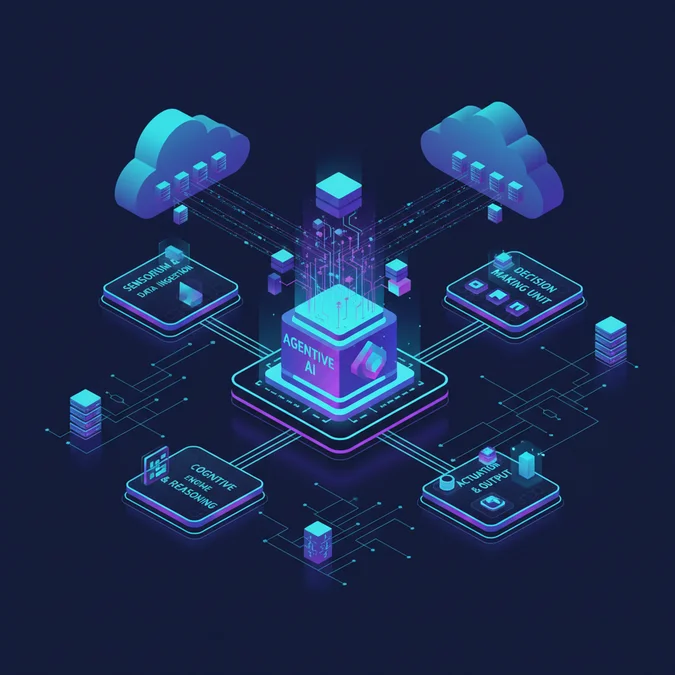

Enterprise agency AI deployments fail when software leaders contract out development as simple prompt engineering rather than distributed systems engineering. An autonomous agent is not an API wrapper around a foundation model; it is a long-running, non-deterministic state machine integrated directly into enterprise databases, authentication layers, and external APIs. When an agent experiences token exhaustion, infinite recursion, or unauthorized schema mutations in production, liability falls squarely on the enterprise infrastructure.
Procuring specialized agency AI services in 2026 requires engineering leadership to look past marketing demos and evaluate vendors on deterministic state graphs, runtime observability, strict token economics, and comprehensive human-in-the-loop fallback mechanisms. Unvetted agency partners frequently deliver fragile proof-of-concept scripts that collapse under enterprise concurrency, exposing companies to security exploits, uncontrollable API billing spirals, and vendor lock-in.
This technical guide provides CTOs, engineering directors, and procurement teams with an objective framework to assess, contract, and inspect agency AI deliverables. Inside, you will find direct architectural vetting rubrics, cost breakdown matrices across frontier foundation models, production-grade Python code patterns that every agency must be able to deploy, and contract templates designed to mitigate autonomous system liabilities.
Executive Scope and Technical Deliverables of Modern Agency AI
When selecting a technical vendor, distinguishing between a superficial prompt studio and a true agency AI engineering partner is critical. Basic agencies deliver static system prompts coupled with simple LangChain chains that break when upstream API response formats drift. In contrast, an enterprise agency AI firm delivers resilient, stateful automation engines built on explicit state graphs, strict JSON schema validation, and defensive circuit breakers.
Architecture Rule: Never accept an agent project deliverable that treats the Large Language Model as an unconstrained controller. Production-grade agency AI systems treat LLMs as untrusted, stochastic reasoning engines bounded by deterministic state machine transitions and compiled validation schemas.
Below is the architectural standard that separates hobbyist agent implementations from production-ready systems:
+-----------------------------------------------------------------------------------+| ENTERPRISE AGENCY AI RUNTIME ARCHITECTURE |+-----------------------------------------------------------------------------------+| Incoming User Request / Event Trigger || | || v || +-----------------------+ State Load +------------------------------+ || | API Gateway & Auth | -------------------> | Postgres (pgvector) Session | || +-----------------------+ +------------------------------+ || | ^ || v | Update || +-----------------------------------------------------------+ | State || | Deterministic Orchestrator (LangGraph / State Machine) | -+ || | - Recursion Breakers (Max Steps = 10) | || | - JSON Schema Tool Call Interceptors | || | - Token Budget Guardrails ($0.05 / session max) | || +-----------------------------------------------------------+ || | | || | (Valid Schema) | (Schema Violation / Exception) || v v || +-----------------------+ +-------------------------------------+ || | Model Context Protocol| | Deterministic Fallback Engine | || | (MCP) Tool Calling | | - Rule-Based Path | || | - CRM, ERP, DB Ops | | - Human-in-the-Loop Slack / Jira | || +-----------------------+ +-------------------------------------+ || | | || +---------------------------+---------------------------+ || v || +-------------------------------+ || | OpenTelemetry / Langfuse Tracing | || +-------------------------------+ |+-----------------------------------------------------------------------------------+Your contract with any agency AI provider must mandate concrete engineering assets across the entire deployment lifecycle. The following deliverable matrix establishes the baseline requirements for production acceptance:
| Capability Area | Amateur Agency AI Deliverable | Enterprise-Grade Agency AI Deliverable |
|---|---|---|
| State Management | In-memory conversation history; lost on process restart. | Externalized PostgreSQL state snapshots with checkpoints and rollbacks. |
| Tool Integration | Unconstrained function calls using raw strings. | Strict Pydantic / Model Context Protocol (MCP) schemas with validation. |
| Error Handling | Generic try/catch blocks that surface raw LLM errors to users. | Deterministic fallback routes, automated retries with backoff, and alerts. |
| Safety and Guardrails | Basic system prompt instructions (e.g. “Never hallucinate”). | Dual-layer semantic filters, regex egress validation, and prompt injection detection. |
| Observability | Basic console logs or standard cloud provider metric counters. | OpenTelemetry-instrumented trace spans for every thought step and tool call. |
2026 Realistic Cost Drivers and Engagement Pricing Matrix
Pricing models for an external ai agent agency have shifted significantly away from traditional Time and Materials (T&M) toward milestone-driven architecture deliverables combined with usage-based infrastructure retainers. Engaging an ai agent agency involves three distinct cost layers: initial discovery and schema modeling, iterative graph development, and ongoing agent operations (AgentOps).
Understanding baseline engineering requirements enables technical buyers to evaluate proposed fee structures effectively. The following steps outline how transparent vendor budgets are structured:
- Architecture and Deterministic Path Mapping: Scoping domain knowledge, defining tool JSON schemas, drafting security boundaries, and designing PostgreSQL checkpointer architectures.
- State Graph Implementation: Engineering state nodes, cyclical reasoning loops, schema parsers, and Model Context Protocol (MCP) tool bindings.
- Adversarial Red-Teaming and Eval Suite Construction: Running dynamic test suites across hundreds of edge-case prompts to measure tool-selection drift, prompt injection resilience, and hallucination rates.
- CI/CD Integration and Enterprise Egress Controls: Hardening deployment containers, establishing secrets rotation for MCP servers, and configuring OpenTelemetry collectors.
- AgentOps Retainers: Active trace monitoring, dataset curation for prompt tuning or fine-tuning, regression testing against foundation model version updates, and database vacuuming for state persistence.
The table below outlines standard market ranges and engineering structures for hiring a professional ai agent agency:
| Engagement Tier | Scope and Architecture Complexity | Typical Timeline | Core Operational Cost Drivers |
|---|---|---|---|
| Agent Proof of Value (PoV) | Single-agent task runner (Agent 1 AI) with 2 to 3 read-only tools and structured JSON output. | 3 to 5 Weeks | Frontier API testing tokens, single-node cloud hosting, evaluation dataset curation. |
| Production Departmental Agent | Multi-step graph orchestrator with state persistence, 5 to 10 read/write tools, and human checkpointing. | 8 to 12 Weeks | Persistent DB checkpointers, vector retrieval pipelines, continuous Langfuse tracing. |
| Autonomous Multi-Agent System | Decentralized multi-agent state machines, MCP server clusters, real-time streaming, and transactional rollback. | 14 to 20 Weeks | High token throughput, cold-standby backup models, self-hosted LLM gateway infrastructure. |
The Engineering Vetting Checklist and Five Technical Red Flags
During technical due diligence, an ai agent agency will often showcase polished demonstration videos depicting agents seamlessly booking appointments or updating ERP records. Engineering leaders must dig deeper into the codebase to inspect the underlying control flow. If the agency cannot demonstrate robust mechanisms for handling non-deterministic failures, their software will degrade in production.
Run candidate engineering teams through this technical vetting checklist before issuing an RFP response or signing a statement of work:
- State Persistence Architecture: Does the ai agent agency write agent execution state to an external, ACID-compliant database (such as PostgreSQL or Redis) after every tool transition? Or does state vanish if an application container recycles?
- Structured Schema Enforcement: Are tool calls validated via strict Pydantic v2 schemas before execution? How does the orchestrator recover if an LLM returns invalid JSON or extra hallucinated parameters?
- Model Context Protocol (MCP) Compliance: Does the vendor build decoupled MCP servers for database and API tools, or are integrations tightly coupled to proprietary prompt libraries?
- Loop-Breaking and Egress Control: What algorithmic circuit breakers prevent an agent from invoking the same failing API endpoint repeatedly and consuming millions of tokens?
- Evaluation Frameworks: Does the agency provide automated evaluation pipelines using tools such as Ragas, DeepEval, or Promptfoo to measure performance against baseline test suites?
Warning: The Five Technical Red Flags:
1. The “Prompt-Only” Fix: The agency solves edge-case failures by lengthening system prompts rather than adding programmatic schema validation or deterministic fallback nodes.
2. Zero Semantic Tracing: The agency does not use OpenTelemetry, LangSmith, or Langfuse to record trace IDs, latencies, and token expenditures per execution step.
3. Client-Borne Rate Limit Exposure: The agent lacks exponential backoff, rate-limiting queues, or secondary model fallbacks when encountering upstream 429 errors.
4. Unbounded Agent Recursion: No hard execution depth limit is configured on cyclic state graphs, introducing risks of infinite execution loops.
5. Proprietary Wrapper Lock-In: The code depends on the agency’s private hosted runtime rather than open-source orchestration engines like LangGraph, CrewAI, or Semantic Kernel.
Defensive Architecture: Production Code Patterns for Mission-Critical Agents
Enterprise clients must verify that their chosen agency ai engineers write resilient, production-ready code. A foundational indicator of code quality is how the agency implements tool calling, handles parsing exceptions, and enforces human-in-the-loop (HITL) checkpoints.
The following runnable Python example demonstrates the minimum defensive programming standard an enterprise should expect from an agency ai partner. It leverages Pydantic for validation, defines a deterministic state schema, and includes a loop-breaking interceptor:
import json
from typing import Dict, Any, Optional
from pydantic import BaseModel, Field, ValidationError

# 1. Define Strict Input Schema for Agent Tool Calling
class DatabasePatchRequest(BaseModel):
 record_id: str = Field(.. pattern=r"^[A-Z]{3}-\d{4}$", description="Format: ABC-1234")
 field_name: str = Field(.. max_length=64)
 new_value: str = Field(.. max_length=512)
 audit_reason: str = Field(.. min_length=10)

# 2. Defensive Agent Tool Wrapper with Schema Enforcement
def execute_database_patch(raw_arguments: str) -> Dict[str, Any]:
 """
 Validates untrusted LLM tool call arguments against strict Pydantic models.
 Enforces deterministic error handling to prevent runtime crashes.
 """
 try:
 # Guard against malformed JSON from model output
 parsed_args = json.loads(raw_arguments)
 except json.JSONDecodeError as err:
 return {
 "status": "error",
 "error_type": "JSONDecodeError",
 "message": f"LLM emitted invalid JSON: {str(err)}",
 "retry_action": "Regenerate payload using valid JSON syntax."
 }

 try:
 validated_request = DatabasePatchRequest(**parsed_args)
 except ValidationError as err:
 return {
 "status": "error",
 "error_type": "SchemaValidationError",
 "details": err.errors(),
 "retry_action": "Fix field types and matching patterns specified in the schema."
 }

 # Simulate atomic database update with audit trail
 return {
 "status": "success",
 "applied_update": validated_request.model_dump(),
 "transaction_id": "tx_89172491a7b"
 }

# 3. Deterministic Loop Breaker and Step Guardrail
class AgentExecutionState:
 def __init__(self, max_steps: int = 5, max_cost_limit_usd: float = 0.10):
 self.current_step = 0
 self.max_steps = max_steps
 self.accumulated_cost = 0.0
 self.max_cost_limit_usd = max_cost_limit_usd

 def intercept_and_validate(self, estimated_step_cost: float) -> bool:
 self.current_step += 1
 self.accumulated_cost += estimated_step_cost

 if self.current_step > self.max_steps:
 raise RuntimeError(
 f"Execution loop detected: Exceeded max steps ({self.max_steps}). "
 "Triggering deterministic human fallback."
 )
 if self.accumulated_cost > self.max_cost_limit_usd:
 raise MemoryError(
 f"Token budget exceeded: ${self.accumulated_cost:4f} > ${self.max_cost_limit_usd:4f}. "
 "Halting autonomous operations."
 )
 return True

# Example Usage
if __name__ == "__main__":
 state_controller = AgentExecutionState(max_steps=3, max_cost_limit_usd=0.05)

 # Simulated LLM output with formatting error
 untrusted_llm_payload = '{"record_id": "INV-2026", "field_name": "status", "new_value": "PAID", "audit_reason": "Short"}'

 # Check guards
 state_controller.intercept_and_validate(estimated_step_cost=0.008)
 result = execute_database_patch(untrusted_llm_payload)
 print(f"Execution Output: {result}")
Any agency ai vendor lacking structured validation code of this caliber introduces severe stability risks into client enterprise environments. Ensure that code reviews during preliminary evaluation specifically inspect error handling and recursion safeguards.
SLA Vulnerabilities and Contract Traps in Autonomous Agent Engagements
Traditional software development Master Services Agreements (MSAs) rely on deterministic assumptions: given input A, the system yields output B. However, because agency ai contracts involve probabilistic models, traditional SLAs break down without explicit probabilistic performance clauses.
Procurement teams must ensure that contracts guard against critical failure modes common in autonomous agent engagements:
- Liability for Infinite Execution Loops: If an agent gets stuck in a recursive loop while hitting an external API, who pays the resulting token and computing charges? Contracts must stipulate that the agency is responsible for costs incurred past defined recursion bounds.
- Intellectual Property of System Prompts and State Graphs: Many agencies claim ownership of the orchestration framework, leaving the client with only an API wrapper. The MSA must grant the client complete IP ownership of all state transition graphs, system prompts, fine-tuning artifacts, and evaluation datasets.
- Accuracy Guarantees versus Schema Conformity: Agencies cannot legally guarantee 100 percent model accuracy due to hallucinations. Instead, enterprise buyers should contractually enforce 99.5 percent schema conformity and deterministic routing fallbacks whenever the model generates ambiguous outputs.
- Data Privacy and Egress Security: Explicit language must forbid agencies from using client enterprise data or production prompt traces to train or fine-tune general public models.
The matrix below provides contractual benchmarks to mandate across all statement of work negotiations:
| Contractual Area | Vulnerable Standard Language | Defensive Enterprise Clause |
|---|---|---|
| Token Overrun Liability | “Client assumes all infrastructure and API consumption costs.” | “Agency reimburses token expenditures resulting from software defects or unthrottled recursive loops exceeding defined step thresholds.” |
| Schema Precision | “Agency will use commercially reasonable efforts to ensure model accuracy.” | “System must achieve >=99.0% JSON validation against defined Pydantic schemas across all eval benchmark runs.” |
| IP and Work Product | “Agency retains core orchestration components and agent libraries.” | “Client owns all custom state graphs, MCP server tool interfaces, evaluation harnesses, and domain prompt libraries as Works Made for Hire.” |
| Fallback Latency | No explicit speed requirements for autonomous runs. | “If primary agent reasoning step exceeds 3,000ms, orchestrator must automatically route to deterministic fallback or human review queue.” |
The 12-Week Production Delivery Roadmap from PoC to Full Autonomy
Scaling autonomous agent infrastructure requires disciplined, iterative delivery. To prevent scope creep and mitigate risks associated with agent hallucination, enterprise buyers should structure agency ai engagements into a 12-week delivery framework that advances systematically from controlled test harnesses to bounded autonomy.
- Weeks 1 to 2: Domain Boundary and Model Context Protocol Scoping
Establish data models, isolate transactional boundaries, and define MCP schemas for enterprise integrations. Identify required read and write operations along with security privilege profiles. - Weeks 3 to 4: Golden Test Dataset and Evaluation Harness Setup
Compile an evaluation set of 200 real-world enterprise scenarios, complete with edge cases, adversarial prompt attacks, and malformed inputs. Establish automated scoring pipelines using deterministic assertions and semantic similarity benchmarks. - Weeks 5 to 7: State Graph Assembly and Human-in-the-Loop Integration
Implement state machines using LangGraph or similar graph runtimes. Integrate human approval queues into transactional operations, ensuring sensitive database updates require manual authorization via webhooks. - Weeks 8 to 9: AgentOps Telemetry and Failure Inversion
Configure complete OpenTelemetry, LangSmith, or Langfuse instrumentation. Execute chaos testing against the state graph by simulating API timeouts, malformed responses, and model rate limits to verify deterministic fallbacks. - Weeks 10 to 11: Shadow Production Staging
Deploy the agent system to mirror live production traffic in shadow mode. The system processes inputs and suggests operations without executing real state changes, validating behavior against live enterprise data. - Week 12: Controlled Canary Deployment and Production Handoff
Release the agent to process live transactions under strict token budget limits and bounded concurrency thresholds. Deliver runbooks, architectural documentation, and full code repositories to internal engineering teams.
Below is a phase-gate milestone table to tie project invoices directly to tangible technical achievements rather than elapsed calendar time:
| Milestone Phase | Key Engineering Exit Gate | Sign-Off Deliverable |
|---|---|---|
| Phase 1: Architecture | Deterministic state machine graph architecture approved by enterprise security. | OpenAPI and MCP schemas, architecture blueprint, system threat model. |
| Phase 2: Validation | Automated evaluation suite running against baseline test cases. | Evaluation pipeline dashboard showing baseline schema conformity. |
| Phase 3: Integration | End-to-end integration with human-in-the-loop webhooks and checkpointers. | Functional staging deployment integrated with client development sandbox. |
| Phase 4: Launch | Completion of shadow execution phase with under 1% unhandled fallback rate. | Production canary rollout, complete repository handoff, and AgentOps runbook. |
Factors That Affect Development Cost
- Complexity of state machine graphs and multi-agent topologies
- Number of custom Model Context Protocol (MCP) tool integrations
- Human-in-the-loop workflow requirements and approval routing
- Evaluation dataset construction and automated testing pipelines
- Infrastructure tracing, vector storage, and continuous AgentOps monitoring
Total investment varies significantly depending on whether the engagement delivers a single scoped proof of concept or an integrated enterprise-grade multi-agent autonomous system.
Frequently Asked Questions
What is agent 1 ai and how does it fit into agency roadmaps?
Agent 1 AI refers to baseline single-agent execution architectures designed to handle isolated, synchronous tasks using structured tool calling. In enterprise agency projects, Agent 1 AI acts as the foundational pilot pattern before scaling into multi-agent orchestration graphs like LangGraph or CrewAI.
What is the typical cost of hiring an ai agent agency in 2026?
Production enterprise contracts with an AI agent agency typically range between $40,000 and $150,000 for bespoke delivery over 8 to 14 weeks. Ongoing maintenance retainers and agentops monitoring generally cost between $5,000 and $20,000 per month.
How do enterprise contracts define agency AI latency and accuracy SLAs?
Standard agency AI agreements avoid subjective precision guarantees, establishing concrete schema conformity thresholds above 99 percent, deterministic fallback execution within 2,500 milliseconds, and strict monthly token budgets backed by automated circuit breakers to protect against infinite loops.
What intellectual property rights should enterprise clients retain?
Enterprises must own full copyright to proprietary domain prompts, database integration schemas, custom state machine logic, and fine-tuned adapter weights. Agencies may retain rights only to generic scaffolding libraries and open-source orchestration wrappers.
Procuring agency AI services requires engineering rigor rather than passive outsourcing. Autonomous agent architectures are complex, stateful systems that interact directly with mission-critical data. By holding prospective partners to strict engineering criteria, such as explicit state graph design, schema validation, loop breakers, and comprehensive AgentOps telemetry, engineering leaders can prevent brittle deployments, token cost overruns, and unmaintainable codebases.
Before signing an agency agreement, review candidate proposals against the vetting rubrics and code standards outlined here. Align technical milestones directly with automated evaluation exit gates to ensure your organization deploys durable, secure, and production-ready autonomous systems.
Need Engineering Guidance for Your Production Stack?
Evaluate architecture trade-offs, scalability limits, and implementation feasibility with experienced systems engineers.