For small business owners and startup founders, the choice between off-the-shelf SaaS and custom software development is rarely just about cost. It is a strategic decision that dictates your long-term operational flexibility, data ownership, and ability to differentiate in a crowded market. Many businesses gravitate toward SaaS for its immediate availability, only to find themselves constrained by rigid workflows or escalating subscription fees as they grow.
This article provides an objective framework to navigate the build-versus-buy dilemma. We will analyze the technical trade-offs between subscription-based platforms and bespoke solutions, helping you determine when to adopt a standard tool and when to invest in a custom architecture that serves as a unique asset for your business.
The SaaS Model: Speed to Market and Predictable Costs
SaaS products provide immediate access to a pre-built feature set. They are designed for the lowest common denominator of a specific industry, which is both their greatest strength and their primary limitation. From a technical perspective, SaaS platforms rely on multi-tenancy, where a single instance of software serves multiple customers. This architecture allows providers to offer lower price points, but it prevents you from modifying the core database schema or logic to suit your unique workflows.
When SaaS is the correct choice:
- Your operational requirements match the standard industry flow (e.g., basic accounting or email marketing).
- You need to validate a business process quickly without upfront capital expenditure.
- The software does not provide a competitive advantage; it is merely a utility for your business.
Custom Software: Ownership and Strategic Differentiation
Custom software is an investment in intellectual property. By building a bespoke application, you control the roadmap, the security protocols, and the data architecture. Unlike SaaS, where you are at the mercy of the provider’s API limits and pricing adjustments, custom software allows for deep integration with your existing internal systems. You can build features that are proprietary to your business, effectively creating a barrier to entry for your competitors.
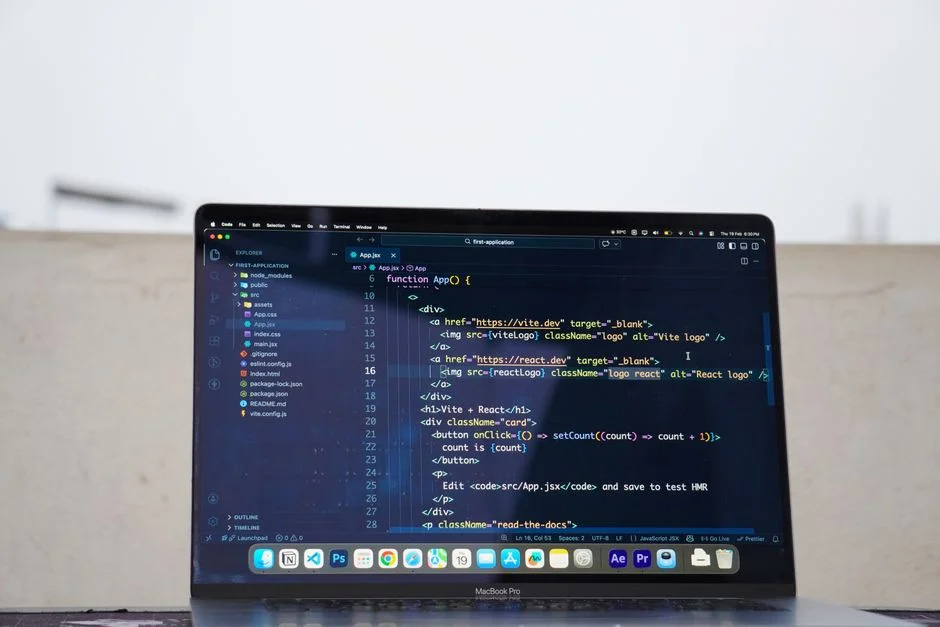
Consider a simple data retrieval scenario. In a custom application, you have direct database access or a private API, whereas SaaS often forces you to wait for a public endpoint or pay for high-tier access:
// Example: Direct database query in a custom Laravel application

$data = Order::where('status', 'pending')

             ->where('created_at', '>=', now()->subDays(7))

             ->get();
This level of precision is rarely available in rigid SaaS dashboards.
The Core Trade-off: Rigidity vs. Maintenance Burden
The primary trade-off between these two models is maintenance. With SaaS, the vendor handles security patches, server uptime, and feature updates. You trade control for convenience. With custom software, you own the entire lifecycle. You are responsible for the security, the server costs, and the technical debt that accumulates over time. If your business is not prepared to manage or outsource software maintenance, the custom route will eventually become a liability.
Comparison Table:
| Feature | SaaS | Custom Software |
|---|---|---|
| Deployment | Instant | Weeks/Months |
| Customization | Limited to UI/Settings | Unlimited |
| Ownership | Subscription | Full Intellectual Property |
| Security | Vendor Responsibility | Your Responsibility |
Financial Considerations: OpEx vs. CapEx
SaaS is typically treated as an Operating Expense (OpEx). It is predictable, recurring, and easy to scale up or down based on user count. However, as your team grows, the per-user licensing fees can eventually exceed the amortized cost of building and maintaining a custom solution. Custom software represents a Capital Expenditure (CapEx). While the initial development cost is significantly higher, the long-term total cost of ownership (TCO) often stabilizes once the core product is built, assuming you avoid feature creep.
When evaluating costs, consider the ‘hidden’ costs of SaaS: integration fees, data export limitations, and the loss of productivity due to software that doesn’t fit your specific business processes.
Decision Framework: When to Build vs. When to Buy
To decide, ask yourself: ‘Does this software provide a unique advantage?’ If the answer is no, buy SaaS. If the answer is yes, build custom. For example, a restaurant needs a POS system (buy SaaS), but a restaurant chain with a proprietary inventory management system that predicts food waste based on historical local data might need custom development to stay ahead of margins.
Evaluation Checklist:
- Does an existing SaaS solution satisfy 90% of your requirements?
- Is your data sensitive enough to require a private, isolated infrastructure?
- Can your team afford the ongoing cost of developer support?
Factors That Affect Development Cost
- Initial development hours
- Infrastructure maintenance
- Feature complexity
- Third-party API integration fees
- Long-term security updates
SaaS costs are predictable and recurring, while custom software requires a significant upfront investment followed by ongoing maintenance costs.
Frequently Asked Questions
What is replacing SaaS?
SaaS is not being replaced entirely, but it is being augmented by headless architecture and composable commerce. Businesses are moving toward smaller, specialized custom microservices that connect via APIs rather than relying on massive, monolithic SaaS suites.
Is SaaS suitable for small businesses?
Yes, SaaS is often the best starting point for small businesses because it eliminates the need for a dedicated engineering team and provides immediate functionality for a predictable monthly fee.
Do I need an LLC for a SaaS?
While you do not need an LLC to write code, forming a legal entity is highly recommended if you are charging customers for SaaS access to limit your personal liability and manage intellectual property correctly.
Is Netflix a SaaS or PaaS?
Netflix is a SaaS (Software as a Service) application. It provides a finished service to end-users over the internet, whereas PaaS (Platform as a Service) would provide the development tools and infrastructure for someone else to build their own application.
Choosing between SaaS and custom software is a balance of immediate utility and long-term leverage. While SaaS provides a path of least resistance, custom software provides the structural integrity to scale your specific business model without external constraints. If your business depends on a workflow that is uniquely yours, the investment in a bespoke solution is rarely a mistake.
At NR Studio, we specialize in building custom web and mobile applications that bridge the gap between off-the-shelf limitations and enterprise-grade performance. Whether you are looking to scale your current operations or replace a restrictive SaaS platform, we provide the technical expertise to ensure your software remains a competitive asset. Contact us to discuss your architectural requirements.
Not Sure Which Direction to Take?
Book a 30-minute call with one of our engineers — we’ll help you decide without the sales pitch.