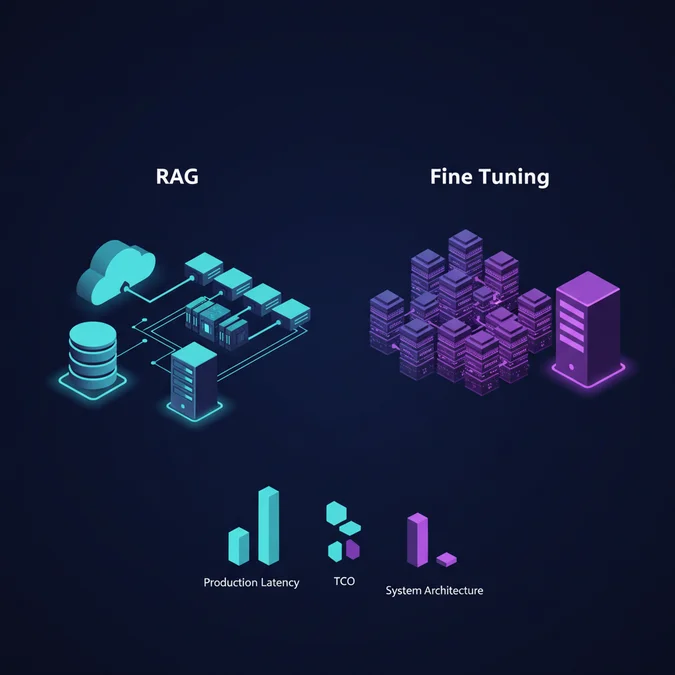

When enterprise systems require grounded domain knowledge, choosing between dynamic vector retrieval and direct weight adaptation dictates your infrastructure overhead for quarters to come. In strict engineering terms, vector retrieval externalizes knowledge retrieval to an indexed datastore, whereas fine-tuning modifies the internal activation pathways of the model itself. Neither approach is a universal substitute for the other.
Deploying naive retrieval-augmented pipelines often results in critical time-to-first-token (TTFT) bottlenecks, context window pollution, and indexing drift. Conversely, attempting to inject fast-moving business facts directly into weights via supervised parameter adaptation yields catastrophic forgetting, unquantifiable hallucinations, and high training costs across continuous deployment cycles.
This architectural guide breaks down the core mechanics of vector index retrieval against parameter-efficient fine-tuning (PEFT/LoRA). We compare runtime memory constraints, examine empirical throughput benchmarks, provide dual production implementations, and outline the hybrid paradigm of Retrieval-Augmented Fine-Tuning (RAFT).
Executive Verdict: Choosing RAG vs Fine Tuning by Workload
When evaluating rag vs fine tuning, the primary decision variable is whether your objective is knowledge injection or behavioral alignment. Non-parametric retrieval structures (RAG) provide access to dynamic, verifiable data sources with explicit attribution. Parametric adaptation (fine-tuning) trains an LLM to master idiosyncratic syntaxes, structural constraints, stylistic profiles, or task-specific reasoning steps without bloating the inference prompt.
System Rule: Never fine-tune a model simply to teach it static enterprise facts. Updating model parameters to recall evolving factual knowledge exhibits severe training loss decay, high maintenance costs, and an inability to handle fine-grained, document-level access control.
| Evaluation Vector | Retrieval-Augmented Generation (RAG) | Supervised Fine-Tuning (PEFT / LoRA) |
|---|---|---|
| Primary Objective | Dynamic knowledge access, data ground-truth, semantic search | Stylistic alignment, specialized output syntax, structural reasoning |
| Data Freshness Latency | Sub-second (instant vector ingestion and index upsert) | Hours to days (requires dataset prep, validation, GPU training) |
| Hallucination Risk | Low to moderate (constrained by top-k context window precision) | High (generates plausible parametric completions without provenance) |
| Access Control / RBAC | Native (document filtering at index or query metadata level) | Impossible (weights compress all data uniformly across checkpoints) |
| Auditability & Citations | Native (exact document chunk and metadata source attribution) | Black box (impossible to extract deterministic parametric provenance) |
| Latency Profile | Higher TTFT (incurs vector lookup, re-ranking, and KV cache bloat) | Lower TTFT (clean inference context window, rapid token generation) |
Choose RAG when your corpus mutates continuously, when source verification is non-negotiable, or when your compliance requirements mandate role-based permissions at the tenant or user level. Reserve fine-tuning for teaching models obscure code syntax, uncompressed JSON schemas, specialized medical nomenclature, or when optimizing generation costs by eliminating lengthy in-context instructions.
Runtime Architecture and Memory: Retrieval Augmented Generation vs Fine Tuning
The mechanical differences between retrieval augmented generation vs fine tuning surface most visibly in their runtime memory footprints and execution graphs. A standard RAG pipeline introduces non-deterministic network I/O, dense retrieval layers, and substantial Key-Value (KV) cache bloat inside the GPU cluster.
RAG INFERENCE RUNTIME: EXTERNAL RETRIEVAL PIPELINE
[User Query]
 │
 ▼
[Bi-Encoder Model] ──> (Vector Generation: 1536d / 3072d)
 │
 ▼
[Vector Database (HNSW / ScaNN)] ──> Top-k ANN Dense Search
 │
 ▼
[Cross-Encoder Reranker] ──> Top-n Reranked Chunks
 │
 ▼
[Prompt Assembly] ──> Query + System Instructions + Injected Context (~4k - 16k tokens)
 │
 ▼
[Base LLM GPU Engine] ──> Large KV Cache Allocation ──> High TTFT ──> Generation Output

────────────────────────────────────────────────────────────────────────────────────────

FINE-TUNED INFERENCE RUNTIME: NATIVE PARAMETRIC INFERENCE
[User Query]
 │
 ▼
[Prompt Assembly] ──> Query + Minimal System Instructions (<256 tokens)
 │
 ▼
[Base LLM + LoRA Adapter] ──> Small KV Cache Allocation ──> Ultra-low TTFT ──> Generation Output
During retrieval-augmented generation, injecting 8,000 tokens of context across an enterprise workload stresses the GPU memory subsystem. For instance, using an FP16 context profile with a 14-billion parameter model requires allocating approximately 2 bytes per parameter per layer for the attention KV cache. As the context length expands to hold top-k chunks, the KV cache grows linearly:
KV Cache Memory = 2 * n_layers * n_heads * d_head * n_tokens * n_bytes_per_elemIn contrast, a model fine-tuned via Low-Rank Adaptation (LoRA) merges low-rank adapter matrices directly into the frozen attention projection weights ($W_0 + \Delta W$, where $\Delta W = B \times A$). The inference graph executes natively without dynamic context injection, preserving GPU VRAM for higher concurrent batch throughput and lower latency ceilings.
Memory Architecture Note: At a batch size of 32, a 16k-token RAG query can consume more than 24GB of pure VRAM solely for KV caching, forcing speculative decoding off-ramps or distributed tensor parallelism across multiple A100/H100 nodes. LoRA-adapted architectures process lightweight prompts, yielding up to a 6x increase in continuous batching density.
Total Cost of Ownership and Throughput: LLM Fine Tuning vs RAG Benchmarks
Evaluating llm fine tuning vs rag requires analyzing compute spend across both cold-start development and continuous operations. Teams frequently assume RAG is cheaper because it eliminates high offline GPU training passes. However, when serving millions of monthly requests, high token consumption in long-context prompts can quickly outpace training amortizations.
| Metric & Cost Category | RAG Architecture (HNSW + FlashAttention-2) | LoRA / QLoRA Parametric Adaptation |
|---|---|---|
| Time to First Token (TTFT) | 450ms – 1,800ms (Retrieval + Rerank + KV Prefill) | 65ms – 180ms (Minimal context prefill) |
| Inference P99 Latency | 3,200ms (High variance via long output + reranker) | 850ms (Low variance, predictable generation) |
| Inference VRAM Footprint | 40GB – 80GB (KV Cache dominant for batching) | 16GB – 24GB (Static adapter footprint) |
| Data Ingestion / Training Compute | Low ($0.0001 per 1k chunk embeddings) | Moderate to High ($50 – $400 per training run on H100s) |
| Marginal Cost per 1,000 Queries | High ($0.03 – $0.15 depending on injected token count) | Ultra-Low ($0.002 – $0.008 via prompt compression) |
| Operational Complexity | Vector DB clustering, index re-indexing, chunk tuning | Dataset engineering, validation, adapter registry, canary deploys |
Consider an enterprise application processing 5,000,000 requests monthly. A typical RAG deployment injecting 4,000 tokens per prompt consumes 20 billion prompt tokens each month. Fine-tuning an open-source architecture (such as Llama-3-8B or Qwen-2.5-7B) to interpret a terse instruction set can compress the prompt to just 200 tokens.
While fine-tuning incurs upfront training cycles (typically requiring 4 to 8 hours of 8x H100 SXM5 compute), the reduction in recurring inference bandwidth often yields a lower total cost of ownership (TCO) within 60 to 90 days. Conversely, if your underlying knowledge base undergoes continuous daily mutations, the operational costs of maintaining automated retraining pipelines and regression validation suites can exceed vector storage infrastructure expenses.
Production Implementation: LlamaIndex Pipeline vs HuggingFace LoRA Adapter
To understand the operational realities of both paradigms, let us compare production implementations: an asynchronous hybrid vector retrieval pipeline using LlamaIndex, followed by a HuggingFace PEFT/TRL training script executing a LoRA fine-tuning pass.
1. Enterprise Hybrid Retrieval Pipeline (LlamaIndex + Dense/Sparse Fusion)
import os
from llama_index.core import SimpleDirectoryReader, VectorStoreIndex, StorageContext
from llama_index.core.node_parser import SentenceSplitter
from llama_index.vector_stores.qdrant import QdrantVectorStore
from llama_index.embeddings.openai import OpenAIEmbedding
from llama_index.core.postprocessor import SentenceTransformerRerank
from qdrant_client import AsyncQdrantClient

async def build_production_retriever(data_dir: str):
 # Initialize async storage client
 client = AsyncQdrantClient(url=os.getenv("QDRANT_URL"), api_key=os.getenv("QDRANT_API_KEY"))
 vector_store = QdrantVectorStore(client=client, collection_name="enterprise_kb", prefer_grpc=True)
 storage_context = StorageContext.from_defaults(vector_store=vector_store)

 # Ingest and split documents into overlapping parent-child chunks
 documents = SimpleDirectoryReader(input_dir=data_dir).load_data()
 splitter = SentenceSplitter(chunk_size=512, chunk_overlap=64)
 nodes = splitter.get_nodes_from_documents(documents)

 embed_model = OpenAIEmbedding(model_name="text-embedding-3-large", dimensions=1536)

 index = VectorStoreIndex(
 nodes=nodes,
 storage_context=storage_context,
 embed_model=embed_model,
 use_async=True
 )

 # Cross-encoder reranker to prune low-signal context chunks
 reranker = SentenceTransformerRerank(
 model="cross-encoder/ms-marco-MiniLM-L-6-v2",
 top_n=5
 )

 return index.as_query_engine(
 similarity_top_k=20,
 node_postprocessors=[reranker],
 response_mode="compact"
 )
2. Supervised Parameter-Efficient Fine-Tuning Pipeline (PEFT / LoRA / TRL)
import torch
from datasets import load_dataset
from transformers import AutoModelForCausalLM, AutoTokenizer, TrainingArguments
from peft import LoraConfig, get_peft_model, TaskType
from trl import SFTTrainer

def run_peft_training(dataset_path: str, output_dir: str):
 base_model_id = "meta-llama/Llama-3-8B"

 tokenizer = AutoTokenizer.from_pretrained(base_model_id, use_fast=True)
 tokenizer.pad_token = tokenizer.eos_token

 model = AutoModelForCausalLM.from_pretrained(
 base_model_id,
 torch_dtype=torch.bfloat16,
 device_map="auto",
 attn_implementation="flash_attention_2"
 )

 # Target attention projections and MLP layers for comprehensive behavioral adaptation
 peft_config = LoraConfig(
 task_type=TaskType.CAUSAL_LM,
 r=16,
 lora_alpha=32,
 lora_dropout=0.05,
 target_modules=["q_proj", "k_proj", "v_proj", "o_proj", "gate_proj", "up_proj", "down_proj"]
 )

 dataset = load_dataset("json", data_files=dataset_path, split="train")

 training_args = TrainingArguments(
 output_dir=output_dir,
 per_device_train_batch_size=4,
 gradient_accumulation_steps=4,
 warmup_ratio=0.03,
 learning_rate=2e-4,
 logging_steps=10,
 num_train_epochs=3,
 bf16=True,
 lr_scheduler_type="cosine",
 save_strategy="epoch",
 optim="adamw_torch_fused"
 )

 trainer = SFTTrainer(
 model=model,
 train_dataset=dataset,
 peft_config=peft_config,
 dataset_text_field="text",
 max_seq_length=2048,
 tokenizer=tokenizer,
 args=training_args
 )

 trainer.train()
 trainer.model.save_pretrained(output_dir)
Failure Modes Under Pressure: Retrieval Degradation vs Catastrophic Forgetting
Deploying these architectures into high-throughput production environments reveals distinct operational failure modes. Understanding where each pipeline breaks under pressure prevents costly mid-flight refactoring.
Retrieval-Augmented System Failure Modes
- Context Window Contamination: Low-relevance top-k chunks pass through semantic thresholds, introducing noise that distracts model attention heads and leads to hallucinations.
- Chunk Boundary Truncation: Arbitrary character or sentence splitting breaks cross-paragraph semantic structures, severing relationships between core entities and their dependent clauses.
- Embedding Model Out-of-Domain Drift: General-purpose embedding algorithms often fail to map niche domain terminology accurately, resulting in zero-recall states for specialized queries.
- Query-Document Semantic Mismatch: Short user queries occupy different vector spaces than dense technical documentation, causing semantic searches to miss high-relevance chunks.
Fine-Tuned Weight Adaptation Failure Modes
- Catastrophic Forgetting: Adjusting weights for specialized downstream tasks can overwrite foundational reasoning, leading to regressions in math, logic, or standard instruction-following capabilities.
- Parametric Knowledge Hallucination: An adapted model may present stale training data with high confidence scores, lacking internal mechanisms to signal uncertainty.
- Data Poisoning and Distribution Overfitting: Skewed or repetitive instruction datasets can trigger mode collapse, causing the model to repetitively output fixed token sequences regardless of variations in the prompt.
- Expensive Schema Updates: When external APIs or structural formats change, a fine-tuned model cannot be quickly patched via database transactions; it requires a new training run and regression testing cycle.
The Hybrid Paradigm: Implementing RAG Fine Tuning with RAFT and Self-RAG
The traditional dichotomy of choosing either vector retrieval or weight adaptation is increasingly outdated. Leading AI engineering teams employ rag fine tuning through techniques like Retrieval-Augmented Fine-Tuning (RAFT) and Self-RAG. Rather than relying on off-the-shelf generalist models to decipher dense retrieved chunks, RAFT fine-tunes the base model explicitly to read, verify, and cite domain documents while ignoring irrelevant distractor chunks.
RAFT TRAINING DATASET PIPELINE
┌────────────────────────────────────────────────────────┐
│ Enterprise Question + Verified Ground-Truth Answer │
└───────────────────────────┬────────────────────────────┘
 │
 ┌─────────────┴─────────────┐
 ▼ ▼
┌───────────────────────────┐ ┌──────────────────────────┐
│ Oracle Document Chunk │ │ Distractor Chunks (4-6) │
│ (Contains True Answer) │ │ (Irrelevant Corpus Data) │
└─────────────┬─────────────┘ └───────────┬──────────────┘
 └─────────────┬─────────────┘
 │
 ▼
┌────────────────────────────────────────────────────────┐
│ Combined Context Assembly │
│ Model trained via Chain-of-Thought (CoT) to: │
│ 1. Identify and extract relevant oracle facts │
│ 2. Disregard misleading distractor noise │
│ 3. Output verifiable citations with final response │
└────────────────────────────────────────────────────────┘
Implementing a RAFT data preparation strategy follows a structured four-stage process:
- Corpus Sampling: Extract document clusters and generate representative domain queries paired with verified ground-truth target completions.
- Distractor Injection: For each training instance, concatenate the positive document chunk (oracle) with four to six distractor chunks retrieved via semantic similarity that do not contain the answer.
- Chain-of-Thought Formatting: Structure the training completion to force the model to quote the source chunk directly before generating its logical answer steps.
- Adversarial Tuning: Supervise the training pass using standard PEFT/LoRA protocols, configuring the loss function to heavily penalize answers that cite distractor context.
def format_raft_instruction(query: str, oracle_doc: str, distractor_docs: list[str], answer: str) -> dict:
 """
 Formats a single training example for RAFT adaptation.
 Forces the LLM to learn distractor resistance and citation extraction.
 """
 context_blocks = [f"<doc id={i}>{doc}</doc>" for i, doc in enumerate([oracle_doc] + distractor_docs)]
 # Shuffle context blocks randomly to avoid position bias
 import random
 random.shuffle(context_blocks)

 prompt = (
 "You are an enterprise system evaluating technical context. "
 "Answer the question relying strictly on valid source documents. "
 "Quote the source document directly before answering.\n\n"
 f"Context:\n{'\n'.join(context_blocks)}\n\n"
 f"Question: {query}\n"
 "Response:"
 )

 completion = f"Citation: {oracle_doc}\nThought: Context confirms the target query.\nAnswer: {answer}"
 return {"text": f"{prompt} {completion}"}
By combining vector retrieval with fine-tuned context parsing, RAFT models demonstrate substantially higher resilience to retrieval noise, generating accurate outputs even when early-stage vector retrieval produces sub-optimal precision.
Engineering Decision Matrix: Update Cadence, Latency Budgets, and RBAC
When selecting your final production architecture, run your application requirements through the following operational scorecard. This framework systematically evaluates update frequency, latency budgets, security constraints, and stylistic complexity.
| Operational Parameter | Favors Dynamic RAG | Favors LoRA Fine-Tuning | Demands Hybrid (RAFT) |
|---|---|---|---|
| Information Volatility | Dynamic (> hourly/daily updates) | Static (< semi-annual shifts) | Semi-Static (Stable corpus with dynamic edge updates) |
| Inference Budget (TTFT) | Tolerates > 500ms | Requires < 150ms | Tolerates ~ 350ms – 600ms |
| Role-Based Access (RBAC) | Mandatory (Document-level ACLs) | None (Uniform public context) | Mandatory (Enforced upstream in retriever) |
| Stylistic & Syntactic Rigidity | Standard prose or lightly steered JSON | Rigid custom DSL, code, or strict schemas | Rigid schemas combined with deep document extraction |
| Hallucination Tolerance | Zero (Must supply exact citations) | Low to Moderate (Creative or synthetic output) | Zero (Must identify false context in retrievals) |
Production Deployment Checklist
- Corpus Auditing: Map the velocity of your data updates. If more than 5% of your target corpus changes weekly, standalone fine-tuning will introduce high retraining costs.
- Latency Profiling: Calculate your end-to-end service level agreements. If your user-facing interface demands under 200ms TTFT, standalone RAG requires extensive caching and high-end hardware. Fine-tuning an adapted base model can resolve these latency bottlenecks.
- Access Control Verification: Determine whether user requests cross multi-tenant permission boundaries. If tenant data must remain strictly isolated, implement RAG with vector-level metadata filtering. Avoid embedding privileged data directly into fine-tuned weights.
- Dataset Readiness: Assess whether you possess at least 1,500 validated instruction pairs. Fine-tuning on sparse or low-quality prompt-completion pairs can degrade model performance compared to a well-indexed base model.
Frequently Asked Questions
When should an enterprise prefer RAG over LLM fine-tuning?
Choose RAG when dynamic data updates occur frequently, source attribution is mandatory, or strict role-based access control applies. RAG avoids costly model retraining by retrieving real-time ground-truth documents at query runtime, effectively eliminating hallucinations tied to stale parametric memory.
Can fine-tuning reliably inject new knowledge into a foundational model?
No, fine-tuning is inefficient for teaching factual knowledge. Parameter updates excel at adjusting voice, tone, formatting, and complex task alignment, but attempting to force new facts into weights often causes hallucination and catastrophic forgetting of core pre-trained capabilities.
What is RAFT (Retrieval-Augmented Fine-Tuning)?
RAFT is an architectural technique that fine-tunes an LLM directly on domain documents alongside distractor chunks. This conditions the model to accurately parse retrieved vector context, discard irrelevant content, and generate cited answers, bridging the gap between RAG and fine-tuning.
How do large 2M context windows impact retrieval augmented generation vs fine tuning?
Large context windows reduce chunk fragmentation but dramatically increase inference latency and cost. RAG remains crucial for filtering gigabytes of corporate documentation down to high-signal tokens, while fine-tuning ensures the model adheres strictly to target response formats.
The choice between vector retrieval pipelines and parametric model adaptation is not a zero-sum architectural decision. Production-grade systems increasingly leverage both techniques: non-parametric vector databases supply verifiable, real-time context, while compact fine-tuned adapters align the model to parse that context efficiently and respond in your exact target format.
Before provisioning expensive GPU training clusters or scaling out distributed vector databases, trace your core system constraints. If your architecture demands source attribution and real-time data freshness, begin with a resilient hybrid retrieval system. If prompt token overhead degrades user-facing latency and inflates operating costs, train a focused LoRA adapter to handle the structural workload.
Benchmarking Architecture Trade-offs?
Discuss real-world performance characteristics and production considerations for your specific workload.