
Fine-tuning has moved beyond academic curiosity into a standard operational requirement for enterprises seeking domain-specific model performance. However, the path from a raw dataset to a deployed endpoint is fraught with technical trade-offs that determine both inference latency and model reliability. Relying on default training configurations often leads to wasted compute budget and degraded model reasoning.
This guide establishes a vendor-agnostic framework for engineers to implement consistent fine-tuning pipelines. We focus on the architectural mechanics of data preparation, evaluation, and production lifecycle management, moving past simple API calls to ensure your models remain performant and stable under production load.
When to Fine Tune a Model vs Prompt Engineering
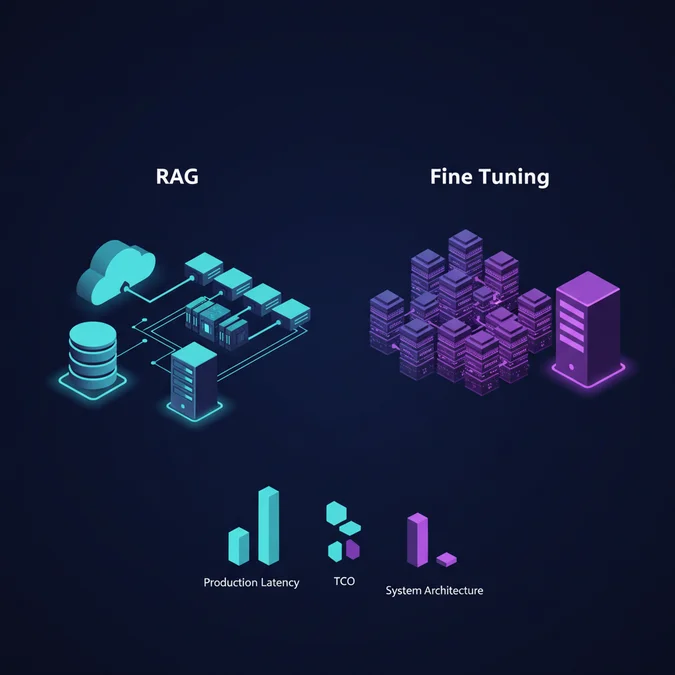
Before allocating budget to training, you must validate if fine-tuning is the correct solution. Many teams attempt to solve domain-specific knowledge gaps through fine-tuning when RAG or advanced prompting would yield better results at a lower cost.
| Method | Primary Use Case | Maintenance Effort | Latency Impact |
|---|---|---|---|
| Prompt Engineering | General reasoning, few-shot tasks | Low | Negligible |
| RAG | Retrieval of external, dynamic data | Medium | High (due to retrieval) |
| Fine-Tuning | Style, format, or task-specific constraints | High | Low |
Engineering Callout: Only proceed with fine-tuning when you need to teach the model a specific behavioral output format or a highly specialized domain dialect that cannot be captured in a 128k context window.
Data Pipeline Architecture: Preparing Your Dataset
When you decide to fine tune ai model architectures, the quality of your JSONL dataset is the primary determinant of success. Garbage input consistently results in model hallucinations and loss of instruction-following capability.
[{"messages": [{"role": "system", "content": "You are a technical assistant."}, {"role": "user", "content": "Explain the API."}, {"role": "assistant", "content": "The API is defined as.."}]}]
- Use at least 500 high-quality, diverse examples for initial testing.
- Ensure the system prompt is consistent across all training entries.
- Remove any duplicates or ambiguous instructions that contradict standard model behavior.
- Perform token count validation to ensure samples do not exceed the model context limit.
How to Fine Tune APIs: A Technical Implementation Guide
Interacting with training endpoints requires a modular approach. By abstracting the request logic, you can swap providers without rewriting your entire pipeline. Below is a standard implementation pattern for initiating a training job.
- Validate dataset structure against the provider’s schema requirements.
- Upload the training file to the provider’s cloud storage via the API.
- Initiate the training job with specific hyper-parameters like learning rate and epoch count.
- Poll the status endpoint until the job transitions to a succeeded state.
import requests

def start_training(file_id, model_base):

 payload = {'training_file': file_id, 'model': model_base}

 response = requests.post('https://api.provider.com/v1/fine_tuning/jobs', json=payload)

 return response.json()['id']
Validation and Avoiding Catastrophic Forgetting
Learning new patterns often causes models to degrade in their ability to perform general tasks. This phenomenon, known as catastrophic forgetting, must be mitigated through rigorous testing.
| Metric | Target | Tooling |
|---|---|---|
| Semantic Similarity | >0.90 | Cosine similarity on test set |
| Format Adherence | 100% | Regex validation |
| Reasoning Baseline | Stable | MMLU or custom benchmark |
Engineering Callout: Always include a ‘control set’ of general-purpose prompts in your validation suite to ensure that your model still functions as a general assistant after training.
Production Lifecycle Management
A successful fine tuning model example is not just about the training run; it is about the long-term management of the model artifact. You must treat your fine-tuned weights with the same rigor as your application source code.
- Versioning: Tag your fine-tuned models with the dataset hash and training date.
- Monitoring: Track latency and token usage metrics for the fine-tuned endpoint compared to the base model.
- Drift Detection: Periodically run your production inputs against a baseline model to ensure the fine-tuned version provides measurable value.
- Rollback Strategy: Keep the previous model version active during deployment to allow for instantaneous reversal if performance metrics drop.
Frequently Asked Questions
What is the most effective way to start a fine tuning model example?
Begin by curating a high-quality, diverse dataset of at least 500 examples formatted as JSONL. Establish a clear baseline using zero-shot prompting before initiating training. This allows you to measure performance gains against your baseline metrics specifically for your target domain tasks.
Is there a difference in how to finetune a model via API versus self-hosting?
API-based fine-tuning abstracts away hardware orchestration and distributed training complexity. Self-hosting requires managing VRAM, GPU clusters, and checkpointing manually. APIs are generally preferred for teams prioritizing speed to market, while self-hosting offers superior control over data privacy and custom training architectures.
How do I ensure I know how to fine tune a model correctly for production?
You ensure success by implementing rigorous evaluation pipelines. Use a holdout test set to measure metrics like BLEU or semantic similarity. Monitor for catastrophic forgetting by testing the model on general-purpose tasks periodically during the training process to ensure core reasoning capabilities remain intact.
Fine-tuning is a powerful lever for enterprise AI, but it requires a disciplined engineering approach to avoid the pitfalls of overfitting and performance degradation. By treating your data as a versioned asset and implementing rigorous evaluation pipelines, you ensure that your fine-tuned endpoints deliver consistent value.
As you scale, focus on automating your evaluation loop to detect drift early. The goal is not just to train a model, but to maintain a reliable, high-performance interface that integrates cleanly into your existing production stack.