
Instruction tuning serves as the critical bridge between raw generative capability and actionable utility. By transforming a base model that predicts the next token into a conversational agent that follows human directives, engineers unlock the true potential of large language models. This process relies on high-quality, task-specific datasets that define the boundaries of expected behavior.
As production requirements for domain-specific models grow, the need for robust, repeatable pipelines becomes paramount. This guide examines the technical mechanics of instruction tuning, moving beyond conceptual frameworks to address the realities of memory management, catastrophic forgetting, and evaluation methodologies required for high-performance deployments in 2026.
Foundational Concepts of Instruction Tuning
At its core, instruction tuning is a supervised learning paradigm designed to steer a pretrained model toward task-oriented behaviors. Unlike base training, which minimizes loss on massive corpora of raw text, instruction tuning focuses on conditional generation. The model learns a mapping function: given an input prompt (instruction) and context, produce a specific output.
Instruction tuning requires a distinct shift in data strategy. The focus moves from distributional similarity of natural language to adherence to structured, intent-based dialogue patterns.
When successful, the model internalizes the format of the instruction. This alignment prevents the model from diverging into irrelevant text completion, ensuring that it remains focused on the user’s intent, whether that involves summarization, code generation, or structured data extraction.
Taxonomy of Instruction Finetuning Approaches
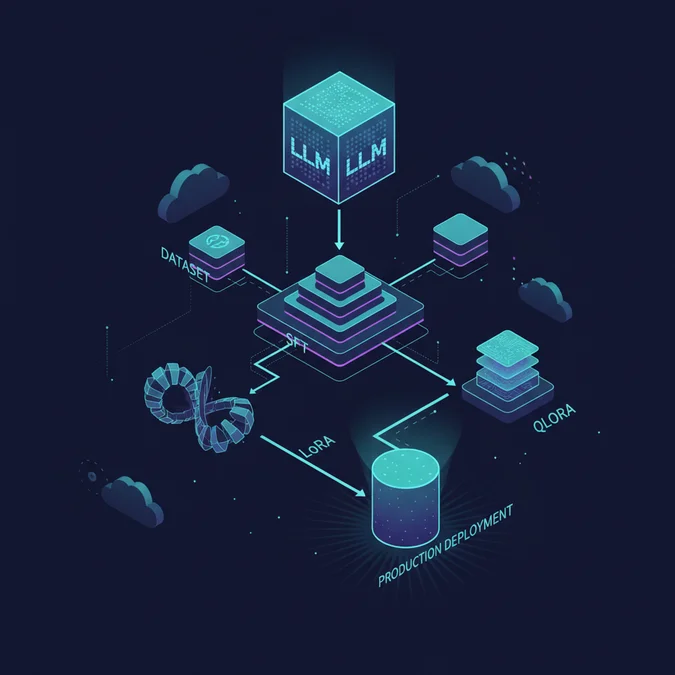
Choosing the right methodology for instruction finetuning is a trade-off between computational budget, model performance, and architectural constraints. The following table outlines the current industry standards for 2026.
| Approach | Memory Footprint | Compute Intensity | Performance |
|---|---|---|---|
| Full Fine-Tuning | Extreme (requires massive VRAM) | Very High | Optimal |
| LoRA | Low (1-2% of parameters) | Moderate | Excellent |
| QLoRA | Minimal (4-bit quantization) | Moderate | High |
| Prompt Tuning | Negligible | Low | Limited |
For most production environments, QLoRA has become the default choice, allowing teams to fine-tune 70B parameter models on single-node GPU clusters while retaining the performance profile of full fine-tuning.
Engineered Workflows to Instruction Fine Tuning
Implementing a production-grade instruction fine tuning pipeline requires strict adherence to data formatting and hyperparameter discipline. The following steps outline a typical workflow using HuggingFace TRL.
- Data Sanitization: Ensure every sample follows a consistent schema, such as the ChatML format.
- Tokenization: Utilize a padding token that aligns with the model’s vocabulary to prevent training instability.
- Trainer Setup: Configure the SFTTrainer with proper gradient accumulation steps to simulate larger batch sizes.
from trl import SFTTrainer
from transformers import AutoModelForCausalLM, TrainingArguments

training_args = TrainingArguments(
 output_dir="./results",
 per_device_train_batch_size=4,
 gradient_accumulation_steps=4,
 learning_rate=2e-4,
 optim="paged_adamw_8bit"
)

trainer = SFTTrainer(
 model="base-model-id",
 train_dataset=dataset,
 args=training_args,
 max_seq_length=2048
)
trainer.train()
Strategies to Fine Tune Instruct Models at Scale
When you fine tune instruct model deployments, you must manage the risk of catastrophic forgetting, where the model loses its general reasoning capabilities in favor of the specialized instruction set. Mitigation strategies include mixing in a small percentage of general-purpose data during the training phase.
- Checklist for Production:
- Ensure evaluation sets include zero-shot benchmarks.
- Monitor loss curves for sudden spikes indicative of learning rate issues.
- Validate output formatting against strict JSON schemas.
# Example of mixing general and task-specific data
combined_dataset = concatenate_datasets([general_data, task_data])
# Shuffle to prevent order-based biases
shuffled_dataset = combined_dataset.shuffle(seed=42)
Frequently Asked Questions
What is the primary goal of instruction tuning?
Instruction tuning is a supervised learning process designed to align base language models with human intent. By training on formatted input output pairs, the model learns to follow specific commands, adopt persona roles, and provide contextually accurate responses rather than merely predicting the next token in a sequence.
How does instruction finetuning differ from standard continued pretraining?
While continued pretraining focuses on expanding knowledge by consuming massive raw text corpora, instruction finetuning focuses on behavioral alignment. It uses curated, high quality datasets that demonstrate specific interaction patterns, effectively teaching the model how to interpret and execute task oriented prompts effectively.
What hardware is required to fine tune instruct models?
Hardware requirements depend on the model size and method. Using Parameter Efficient Fine Tuning techniques like QLoRA, engineers can fine tune instruct models on consumer grade GPUs with 24GB of VRAM. Full parameter fine tuning typically requires multi GPU clusters to manage massive memory overhead and gradient accumulation.
Achieving parity between a base model and a specialized instruction-tuned agent requires more than just compute; it demands rigorous data hygiene and architectural foresight. By utilizing PEFT techniques like QLoRA and maintaining a balanced training corpus, engineering teams can build highly efficient, domain-aware models.
As the field evolves through 2026, focus on automating your evaluation pipelines. Using LLM-as-a-judge frameworks allows for iterative improvements, ensuring that your fine-tuning efforts yield tangible gains in model reliability and user satisfaction.