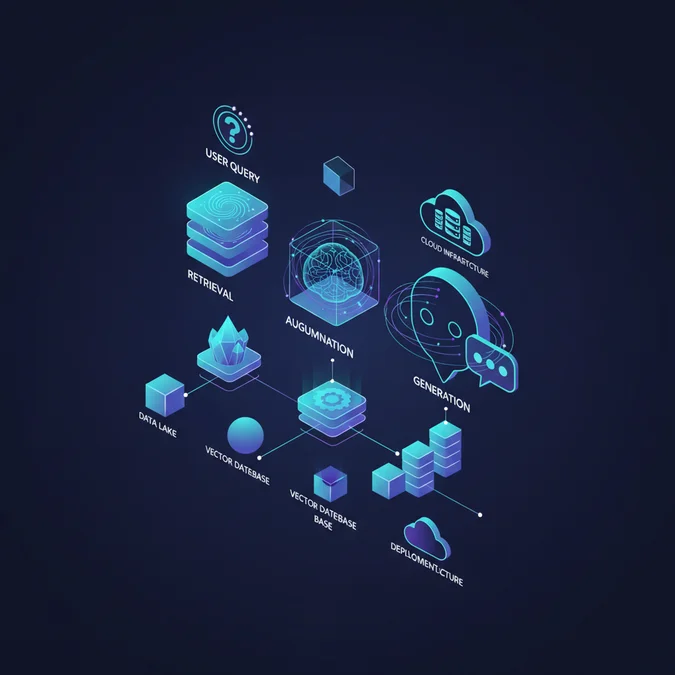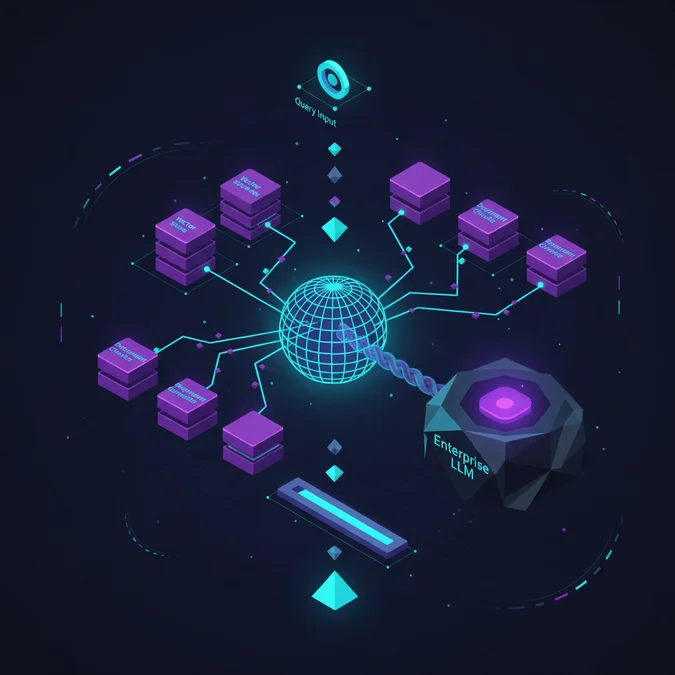

A RAG pipeline, or Retrieval Augmented Generation pipeline, is an architectural pattern that significantly enhances the capabilities of Large Language Models (LLMs) by providing them with access to external, up-to-date, and domain-specific information. This process addresses critical limitations of pre-trained LLMs, such as hallucination, outdated knowledge, and the inability to access proprietary data, thereby enabling them to generate more accurate, factual, and contextually relevant responses.
Understanding the full rag pipeline meaning is crucial for any organization deploying generative AI. This guide delves into the core components, advanced architectural patterns, and critical production considerations necessary to build robust and scalable RAG systems in 2026. We will explore how these systems move beyond basic prompt engineering to deliver truly intelligent, verifiable, and enterprise-ready AI applications.
Decoding RAG: The Core Concepts of Retrieval Augmented Generation
At its heart, Retrieval Augmented Generation (RAG) is a technique that marries the vast generative power of Large Language Models with the precision of information retrieval systems. The acronym RAG stands for ‘Retrieval Augmented Generation’, a clear descriptor of its two primary phases: retrieval and generation. This approach is fundamental to overcoming inherent limitations of standalone LLMs, which are often prone to ‘hallucinations’ or providing outdated information because their knowledge is static, based only on their training data.
When we discuss rag ai, we’re referring to an AI paradigm where an LLM’s response is informed by a dynamic, external knowledge base. This is crucial for applications requiring high factual accuracy, such as legal research, medical diagnostics, or customer support. The core rag meaning lies in its ability to ground LLM outputs in verifiable, external data, making the generated content more reliable and trustworthy.
Many ask, what is rag in artificial intelligence or what does rag mean in ai? Essentially, it’s a mechanism that allows an LLM to ‘look up’ relevant documents or data snippets before formulating a response. This process is transformative for the utility of any rag llm, enabling it to answer questions about specific, current, or proprietary information that was not part of its original training corpus. For example, a customer support chatbot powered by RAG can access the latest product manuals or service agreements to provide precise answers, rather than relying solely on its general training knowledge.
Callout: The Necessity of RAG for LLMs
The primary driver for RAG is to enhance the factual accuracy, relevance, and transparency of LLM outputs. Without RAG, LLMs often struggle with domain-specific queries, provide outdated information, or generate plausible but incorrect facts. RAG provides a verifiable source for the LLM’s claims, making it indispensable for enterprise-grade AI applications.
Understanding what does rag stand for in ai is key to grasping its value. It’s not just about providing more data; it’s about providing *relevant* data at the *right time* to guide the LLM’s generation process. This dynamic data injection makes the rag ai meaning synonymous with robust, context-aware, and verifiable generative AI.
Inside the RAG System: Components, Data Flow, and Interplay
A typical rag architecture comprises several interconnected components, working in concert to retrieve relevant information and augment the LLM’s generation. To understand how does rag work, it’s essential to dissect these elements and trace the data flow through the entire rag system. The process begins with a user query and culminates in a contextually rich, factual response.
Here’s a breakdown of the primary components and how retrieval augmented generation works:
- Knowledge Base/Corpus: This is the repository of your raw, unstructured data (documents, articles, web pages, databases).
- Chunking: Large documents are broken down into smaller, manageable ‘chunks’ or segments. This is crucial for efficient retrieval and to fit within the LLM’s context window.
- Embedding Model: Each chunk is converted into a numerical vector representation (an embedding) using a specialized embedding model. These embeddings capture the semantic meaning of the text.
- Vector Store/Database: The chunk embeddings are stored in a vector database, optimized for fast similarity searches. This is a core part of rag technologies.
- Retriever: When a user submits a query, the retriever component takes the query, converts it into an embedding (using the same embedding model), and then performs a similarity search in the vector store to find the most relevant chunks.
- Augmentation: The retrieved chunks are then combined with the original user query to form an enriched prompt.
- Generator (LLM): This augmented prompt is fed to the Large Language Model. The LLM uses this provided context to generate a precise and factual answer.
- Response: The LLM’s generated response is returned to the user.
This detailed flow explains how does rag work with llms, ensuring the LLM operates with the most pertinent information available. The rag server typically orchestrates these steps, handling requests, managing component interactions, and serving the final response.
Data Flow Diagram for a Basic RAG Pipeline:
+-----------------+ +-----------------+ +-----------------+ +-------------------+ +-----------------+ +-----------------+ +------------------+
| User Query | --> | Embedding Model | --> | Vector Database | --> | Retriever | --> | Augmentation | --> | LLM (Generator) | --> | Final Response |
+-----------------+ +-----------------+ +-----------------+ | (Similarity | | (Query + Context) | +-----------------+ +------------------+
 ^ | Search) | | |
 | +-------------------+ +-----------------+
 | |
 | v
 | +-----------------+
 +-------------------------------------------------------------< | Chunks from |
 | Knowledge Base |
 +-----------------+
Key Component Characteristics:
| Component | Function | Typical Technologies/Considerations |
|---|---|---|
| Knowledge Base | Source of truth for domain-specific data. | Databases, document stores, internal wikis, web pages. |
| Chunking Strategy | Breaks down documents for efficient retrieval and context window fitting. | Fixed size, semantic, recursive, metadata-aware. |
| Embedding Model | Transforms text into dense vector representations. | OpenAI Embeddings, Cohere Embed, Sentence Transformers (e.g. all-MiniLM-L6-v2), BGE. |
| Vector Database | Stores and indexes vector embeddings for fast similarity search. | Pinecone, Weaviate, Milvus, Qdrant, Chroma, Faiss. |
| Retriever | Fetches top-K most relevant chunks based on query embedding. | Vector search, keyword search (sparse retrieval), hybrid. |
| LLM (Generator) | Synthesizes an answer using the augmented prompt. | GPT-4, Llama 3, Claude 3, Mistral, custom fine-tuned models. |
Engineering RAG: Frameworks, Implementation Patterns, and Best Practices
Building a robust rag system from scratch can be complex, involving multiple services and data pipelines. Fortunately, several open-source rag frameworks have emerged to streamline the development process, abstracting away much of the boilerplate. Key among these are LangChain and LlamaIndex, which provide comprehensive toolkits for constructing, orchestrating, and optimizing RAG pipelines.
A skilled rag architect needs to understand not just the individual components but also how to effectively integrate them using these frameworks. Here’s a practical example using Python with LangChain to illustrate a basic RAG setup:
import os
from langchain_community.document_loaders import TextLoader
from langchain_text_splitters import RecursiveCharacterTextSplitter
from langchain_community.embeddings import OpenAIEmbeddings
from langchain_community.vectorstores import Chroma
from langchain_openai import ChatOpenAI
from langchain.chains import RetrievalQA

# 1. Load Data (Example: a simple text file)
def load_documents(file_path):
 loader = TextLoader(file_path)
 documents = loader.load()
 return documents

# 2. Chunk Documents
def chunk_documents(documents, chunk_size=1000, chunk_overlap=200):
 text_splitter = RecursiveCharacterTextSplitter(
 chunk_size=chunk_size,
 chunk_overlap=chunk_overlap
 )
 chunks = text_splitter.split_documents(documents)
 return chunks

# 3. Create Embeddings and Store in Vector DB
def create_vector_store(chunks, api_key):
 # Ensure OPENAI_API_KEY is set in environment or passed directly
 os.environ["OPENAI_API_KEY"] = api_key
 embeddings = OpenAIEmbeddings()
 vector_store = Chroma.from_documents(chunks, embeddings)
 return vector_store

# 4. Initialize LLM and RAG Chain
def setup_rag_chain(vector_store, llm_model_name="gpt-3.5-turbo"):
 llm = ChatOpenAI(model_name=llm_model_name, temperature=0.1)
 qa_chain = RetrievalQA.from_chain_type(
 llm=llm,
 chain_type="stuff", # Other options: "map_reduce", "refine", "map_rerank"
 retriever=vector_store.as_retriever()
 )
 return qa_chain

# Main execution
if __name__ == "__main__":
 # Create a dummy document for demonstration
 with open("example_doc.txt", "w") as f:
 f.write("The capital of France is Paris. Paris is known for its Eiffel Tower and Louvre Museum. \n")
 f.write("The current year is 2026. Artificial intelligence advancements are rapid. \n")
 f.write("Retrieval Augmented Generation is a key technique for enterprise LLMs.")

 # Replace with your actual OpenAI API key
 OPENAI_API_KEY = os.getenv("OPENAI_API_KEY")
 if not OPENAI_API_KEY:
 raise ValueError("OPENAI_API_KEY environment variable not set.")

 print("Loading documents..")
 documents = load_documents("example_doc.txt")

 print("Chunking documents..")
 chunks = chunk_documents(documents)

 print("Creating vector store..")
 vector_store = create_vector_store(chunks, OPENAI_API_KEY)

 print("Setting up RAG chain..")
 qa_chain = setup_rag_chain(vector_store)

 query = "What is the capital of France and what is a key AI technique for enterprise LLMs?"
 print(f"\nQuery: {query}")
 response = qa_chain.invoke({"query": query})
 print(f"Response: {response['result']}")

 query_2 = "What year is it and what is Paris known for?"
 print(f"\nQuery: {query_2}")
 response_2 = qa_chain.invoke({"query": query_2})
 print(f"Response: {response_2['result']}")

 # Clean up dummy file
 os.remove("example_doc.txt")
This code snippet demonstrates the basic flow: loading text, splitting it, embedding chunks, storing them, and then using a retrieval chain to answer queries. For production environments, considerations include:
- Scalability: Ensuring the vector store and embedding service can handle high query volumes and large document corpora.
- Latency: Optimizing retrieval times.
- Cost Management: Monitoring API calls to embedding models and LLMs.
- Data Freshness: Implementing strategies for updating the knowledge base and re-embedding documents.
- Security and Governance: Protecting sensitive data within the knowledge base and ensuring compliance.
Callout: The Role of the RAG Architect
A RAG architect is responsible for designing the entire RAG pipeline, selecting appropriate technologies (vector databases, embedding models, LLMs), defining chunking strategies, establishing evaluation metrics, and ensuring the system is scalable, secure, and maintainable in production. This role bridges the gap between AI research and practical, enterprise-grade deployment.
Best practices also include robust error handling, monitoring of component health, and A/B testing different retrieval and generation strategies to continuously improve performance.
Elevating RAG: Advanced Architectures for Enhanced Performance in 2026
While a basic RAG pipeline offers significant improvements, advanced architectures are crucial for tackling more complex queries, reducing noise, and further enhancing the accuracy of generative AI models. As of 2026, rag updates continually introduce sophisticated techniques that refine both the retrieval and generation phases. These advanced strategies directly address the question of how does rag improve the accuracy of generative ai models beyond simple context provision.
Advanced Retrieval Techniques:
- Re-ranking: After an initial retrieval of top-K documents, a smaller, more powerful model (e.g. a cross-encoder or a specialized re-ranker) re-scores these documents based on their relevance to the query. This filters out less pertinent information.
- Multi-Hop Retrieval: For complex questions requiring information synthesis across multiple documents or iterative steps, the RAG system might perform several retrieval steps. The output of one retrieval informs the next query.
- Hybrid Retrieval: Combining vector-based semantic search with traditional keyword-based search (e.g. BM25) to leverage the strengths of both. Keyword search excels at exact matches, while vector search captures semantic similarity.
- Query Expansion/Rewriting: Before retrieval, the original user query might be expanded with synonyms, related terms, or rewritten by an LLM to capture more facets of the user’s intent, leading to better initial retrieval results.
- Contextual Compression: Instead of passing entire chunks to the LLM, only the most relevant sentences or paragraphs within the retrieved chunks are extracted and sent, reducing token usage and improving focus.
Advanced Generation Techniques:
- Fine-tuning the LLM for RAG: While RAG primarily relies on prompt engineering, some advanced systems might fine-tune a smaller LLM specifically on the style and type of answers expected from the RAG system.
- Self-Correction/Verification: The LLM might generate an answer, then use a separate prompt or a smaller model to verify its own answer against the retrieved context, identifying and correcting potential inaccuracies.
Diagram: Advanced RAG Architecture with Re-ranking and Hybrid Retrieval
+-----------------+ +--------------------------+ +-----------------+
| User Query | --> | Query Expansion/Rewriting| --> | Hybrid Retriever|
+-----------------+ +--------------------------+ | (Vector + Keyword)|
 | +--------+--------+
 | |
 | v
 | +-----------------+
 | | Initial Top-K |
 | | Chunks |
 | +--------+--------+
 | |
 | v
 | +-----------------+
 | | Re-ranker |
 | | (Re-score Chunks)|
 | +--------+--------+
 | |
 | v
 | +-----------------+
 | | Contextual |
 | | Compression |
 | +--------+--------+
 | |
 | v
 | +-----------------+
 +----------------------------------------------> | LLM (Generator) |
 | + Self-Correction |
 +--------+--------+
 |
 v
 +-----------------+
 | Final Response |
 +-----------------+
These architectural enhancements directly contribute to how does rag improve the accuracy of generative ai models by ensuring that the LLM receives the most precise, concise, and highly relevant context possible. This minimizes the LLM’s reliance on its internal, potentially outdated knowledge and maximizes its ability to produce verifiable, grounded responses.
Comparison of Vector Database Features for Advanced RAG:
| Feature | Pinecone | Weaviate | Milvus | Qdrant | Chroma | Faiss |
|---|---|---|---|---|---|---|
| Deployment | Managed, Cloud | Managed, Self-host | Self-host | Managed, Self-host | Embedded, Self-host | Library |
| Scalability | High | High | Very High | High | Low-Medium | Medium (single node) |
| Hybrid Search | Yes | Yes | Yes | Yes | No (external) | No (external) |
| Filtering | Extensive | Extensive | Extensive | Extensive | Basic | No |
| Data Model | Vectors + Metadata | Graphs + Vectors | Vectors + Metadata | Vectors + Metadata | Vectors + Metadata | Vectors only |
| Open-Source | No (proprietary) | Yes | Yes | Yes | Yes | Yes |
| Ideal Use Case | Large-scale, production | Knowledge graphs, complex search | Massive scale, real-time | Flexible, feature-rich | Local dev, small apps | High-perf vector search |
RAG in Practice: Real-World Use Cases, Evaluation, and Production Considerations
The practical application of RAG pipelines spans a multitude of industries, transforming how organizations leverage generative AI. The robust capabilities enabled by the full rag pipeline meaning translate into tangible business value across diverse sectors. These rag applications are proving indispensable for enhancing efficiency, accuracy, and user experience.
Real-World RAG Applications:
- Customer Support Chatbots: Providing instant, accurate answers to customer queries by retrieving information from product manuals, FAQs, and internal knowledge bases. This reduces agent workload and improves customer satisfaction.
- Legal Research: Assisting legal professionals in quickly finding relevant case law, statutes, and legal precedents from vast document repositories, significantly speeding up research processes.
- Medical Information Systems: Helping healthcare providers access the latest research, patient records, and drug information to inform diagnoses and treatment plans.
- Enterprise Knowledge Management: Building internal Q&A systems that allow employees to query internal documentation, HR policies, and project specifications, fostering better knowledge sharing.
- Financial Advisory: Generating personalized financial advice or market analysis by retrieving real-time market data, company reports, and economic indicators.
- Content Creation and Summarization: Assisting writers and analysts by pulling factual information from curated sources to create reports, articles, or summaries, ensuring accuracy and depth.
For any of these rag apps to be successful, rigorous evaluation and careful production considerations are paramount. Evaluating RAG systems requires looking beyond typical LLM metrics to focus on the quality of retrieval and the faithfulness of generation to the retrieved context.
Key Evaluation Metrics for RAG Systems:
| Metric | Description | Importance |
|---|---|---|
| Context Relevance | Measures how relevant the retrieved documents/chunks are to the query. | High: Poor relevance leads to poor answers. |
| Answer Faithfulness | Verifies if the generated answer is solely supported by the retrieved context. | Critical: Prevents hallucination. |
| Answer Relevance | Assesses if the generated answer directly addresses the user’s query. | High: User satisfaction. |
| Context Recall | Measures if all necessary information for the answer was present in the retrieved context. | High: Ensures completeness. |
| Latency | Time taken from query submission to response. | Critical for real-time applications. |
| Throughput (QPS) | Queries per second the system can handle. | Crucial for scalability. |
| Cost per Query | API costs for embeddings, LLM calls, and infrastructure. | Business viability. |
Production Readiness Checklist for RAG Pipelines:
- Scalability Testing: Stress test vector database and LLM endpoints for expected load.
- Latency Optimization: Implement caching, optimize embedding model inference, and fine-tune retrieval parameters.
- Monitoring & Alerting: Set up dashboards for system health, query performance, and LLM token usage.
- Data Freshness Strategy: Define clear processes for updating the knowledge base and re-indexing embeddings.
- Security & Access Control: Ensure sensitive data is protected and user access is appropriately managed.
- Error Handling & Retry Mechanisms: Implement robust strategies for transient failures in external services.
- Version Control: Manage versions of embedding models, LLMs, and retrieval algorithms.
- A/B Testing Framework: Continuously experiment with different RAG configurations to improve performance.
- Cost Management: Monitor and optimize cloud resource usage and API costs.
- Observability: Log query, retrieved context, and generated answer for debugging and auditing.
By meticulously addressing these evaluation and production considerations, organizations can ensure their RAG systems deliver consistent, reliable, and high-performing generative AI experiences.
Frequently Asked Questions
What does the acronym RAG specifically stand for in AI?
In artificial intelligence, RAG stands for Retrieval Augmented Generation. It’s a technique that enhances large language models (LLMs) by giving them access to external, up-to-date information sources. This allows LLMs to generate more accurate, factual, and contextually relevant responses, overcoming their inherent knowledge limitations.
Is ‘RAG’ in AI related to ‘RAG’ in operating systems or ‘file RAG’?
No, RAG in the context of AI (Retrieval Augmented Generation) is entirely distinct from ‘Resource Allocation Graph’ (RAG) used in operating systems for deadlock detection, or any file system-related ‘file RAG’ concepts. The AI term specifically refers to augmenting LLMs with retrieval capabilities.
Where can I find a comprehensive overview of RAG for LLMs?
While there isn’t a single official ‘RAG wiki’, comprehensive overviews can be found in academic papers, technical blogs, and engineering guides from leading AI organizations. This article aims to provide a detailed, architecturally focused guide to RAG pipelines, serving as a robust resource for understanding its intricacies.
What are critical engineering considerations for how rag works?
When implementing how rag works, prioritize deterministic execution, rigorous error handling, observability metrics, and strict security isolation to maintain production reliability and eliminate latency bottlenecks.
What are critical engineering considerations for how does retrieval augmented generation work?
When implementing how does retrieval augmented generation work, prioritize deterministic execution, rigorous error handling, observability metrics, and strict security isolation to maintain production reliability and eliminate latency bottlenecks.
What are critical engineering considerations for what is rag in the context of ai?
When implementing what is rag in the context of ai, prioritize deterministic execution, rigorous error handling, observability metrics, and strict security isolation to maintain production reliability and eliminate latency bottlenecks.
What are critical engineering considerations for rag in operating system?
When implementing rag in operating system, prioritize deterministic execution, rigorous error handling, observability metrics, and strict security isolation to maintain production reliability and eliminate latency bottlenecks.
The journey from basic prompt engineering to architecting sophisticated RAG pipelines represents a significant leap in the capabilities and reliability of Large Language Models. By grounding LLMs in external, verifiable knowledge, Retrieval Augmented Generation addresses the critical challenges of factual accuracy, data freshness, and domain specificity. As we move further into 2026, the demand for robust, scalable, and observable RAG systems will only intensify, making the architectural considerations and best practices outlined here essential for any engineering team.
Mastering the intricacies of RAG, from component interplay to advanced retrieval strategies and rigorous evaluation, is no longer optional but a fundamental requirement for deploying truly intelligent and trustworthy AI solutions in the enterprise. The future of generative AI is not just about larger models, but about smarter, more context-aware architectures like RAG.