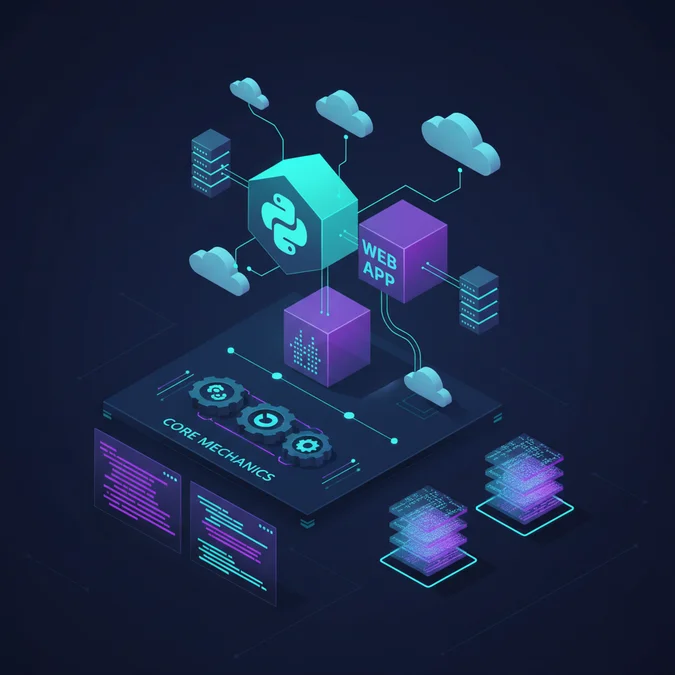

A Python web app is a server-side application built using the Python programming language that handles web requests, processes data, interacts with databases, and generates dynamic web content. It serves as the backend logic for websites and web services, providing APIs and rendering HTML, making Python a highly versatile and popular choice for web development.
This article provides a practitioner’s guide to building robust and scalable Python web applications. We will explore the fundamental components, compare leading frameworks like Django, Flask, FastAPI, and Streamlit, and delve into architectural patterns and deployment strategies. Expect detailed code examples, best practices for security and performance, and a look into advanced topics that define modern Python app development.
What is a Python Web Application?
A python web application fundamentally refers to any software application that runs on a web server and is written using Python. Its primary function is to respond to HTTP requests from clients (web browsers, mobile apps, other services) by executing server-side logic, interacting with databases or other external services, and then returning an HTTP response, often in the form of HTML, JSON, or XML.
The core components of a typical python web application include:
- Web Server Gateway Interface (WSGI) or Asynchronous Server Gateway Interface (ASGI): These are specifications that define how web servers communicate with Python web applications. WSGI is synchronous, while ASGI supports asynchronous operations, crucial for modern high-concurrency applications.
- Web Framework: A collection of libraries and tools that simplify and standardize web development, providing functionalities like routing, templating, ORMs, and session management.
- Database: Stores and retrieves application data. Common choices include PostgreSQL, MySQL, SQLite, or NoSQL databases like MongoDB.
- Templating Engine: Used to generate dynamic HTML content by embedding Python logic within HTML files. Jinja2 and Django Templates are prevalent examples.
- Client-Side Technologies: While primarily server-side, a web application often serves HTML, CSS, and JavaScript to the browser, which handles the user interface.
Why Choose Python for Web Development?
Python’s appeal for web development stems from several key advantages:
- Readability and Simplicity: Python’s clean syntax allows for faster development and easier maintenance.
- Extensive Libraries: A vast ecosystem of third-party libraries and frameworks accelerates development, from data science to machine learning.
- Large Community: A supportive global community contributes to documentation, tools, and problem-solving.
- Versatility: Python integrates seamlessly with other technologies and can handle diverse tasks, making it suitable for various application types.
Understanding Python Web Frameworks: Django, Flask, FastAPI, Streamlit
Choosing the right framework is a critical decision in any python web app development project. Each framework offers a distinct philosophy and feature set, catering to different project requirements and developer preferences. Here, we compare four prominent Python web frameworks:
- Django: A high-level, batteries-included framework designed for rapid development of complex, database-driven web applications. It follows the Model-View-Template (MVT) architectural pattern and includes an ORM, an administrative panel, authentication, and more.
- Flask: A lightweight WSGI microframework, offering maximum flexibility and minimal overhead. Flask provides the essentials, allowing developers to choose their preferred tools for databases, templating, and other functionalities.
- FastAPI: A modern, fast (high-performance) web framework for building APIs with Python 3.7+ based on standard Python type hints. It leverages Starlette for the web parts and Pydantic for data validation and serialization, offering automatic interactive API documentation (Swagger UI/ReDoc).
- Streamlit: An open-source app framework specifically designed for machine learning engineers and data scientists to create beautiful, custom web apps for data science and ML. It simplifies UI creation significantly, abstracting away traditional web development complexities.
When to Choose Which Python Web App Framework:
- Django: Ideal for large, complex web applications, CMS, e-commerce platforms, and projects requiring rapid development with a full suite of features out-of-the-box.
- Flask: Best for smaller applications, microservices, APIs, or when you need fine-grained control over components and a minimalist setup.
- FastAPI: Excellent for building high-performance APIs, microservices, and applications where data validation, serialization, and asynchronous operations are critical. Its automatic documentation is a significant advantage.
- Streamlit: Perfect for data visualization dashboards, interactive ML models, and quick prototypes for data-centric applications where the focus is on data presentation rather than traditional web functionality.
| Feature | Django | Flask | FastAPI | Streamlit |
|---|---|---|---|---|
| Type | Full-stack framework | Microframework | API framework | Data app framework |
| Learning Curve | Moderate to High | Low | Moderate | Very Low |
| Key Use Cases | CMS, CRM, E-commerce | Small apps, APIs, Microservices | High-perf APIs, Microservices | Data dashboards, ML demos |
| Asynchronous Support | Limited (ASGI support growing) | No native (via extensions) | First-class | Not primary concern |
| ORM Included | Yes (Django ORM) | No (use SQLAlchemy, etc.) | No (use SQLAlchemy, Tortoise ORM) | No (direct data manipulation) |
| Templating Engine | Django Templates | Jinja2 | None (API-focused) | Built-in UI components |
| API Documentation | Manual/DRF extensions | Manual/Extensions | Automatic (OpenAPI) | N/A (UI-driven) |
| Performance | Good | Good | Excellent (async) | Dependent on data ops |
Building a Python Web Application: Step-by-Step Code Examples
To illustrate the practical differences and similarities in developing a python web application, let’s walk through building a basic ‘Hello World’ application and a simple API endpoint using Flask and FastAPI, demonstrating core concepts of a python web app.
Flask: A Simple Web Page
This example demonstrates routing and rendering a simple HTML template.
- Install Flask:
pip install Flask - Create
app.py:from flask import Flask, render_template app = Flask(__name__) @app.route('/') def home(): return render_template('index.html') @app.route('/hello/') def hello_name(name): return f"Hello, {name}!" if __name__ == '__main__': app.run(debug=True) - Create a
templatesfolder andtemplates/index.html:<!DOCTYPE html> <html lang="en"> <head> <meta charset="UTF-8"> <meta name="viewport" content="width=device-width, initial-scale=1.0"> <title>Flask Home</title> </head> <body> <h1>Welcome to our Flask Python Web Application!</h1> <p>Visit <a href="/hello/World">/hello/World</a> for a personalized greeting.</p> </body> </html> - Run the application:
python app.pyAccess it at
http://127.0.0.1:5000/andhttp://127.0.0.1:5000/hello/YourName.
FastAPI: A Simple REST API
This example demonstrates creating a basic API endpoint with data validation.
- Install FastAPI and Uvicorn (ASGI server):
pip install fastapi uvicorn - Create
main.py:from fastapi import FastAPI from pydantic import BaseModel app = FastAPI() class Item(BaseModel): name: str description: str | None = None price: float tax: float | None = None @app.get("/") async def read_root(): return {"message": "Welcome to FastAPI Python Web App!"} @app.post("/items/") async def create_item(item: Item): return {"message": "Item received", "item": item} @app.get("/items/{item_id}") async def read_item(item_id: int, q: str | None = None): return {"item_id": item_id, "q": q} - Run the application:
uvicorn main:app --reloadAccess the interactive documentation at
http://127.0.0.1:8000/docsto test the API endpoints.
Python Web App Architecture: Components and Design Patterns
A well-designed python web app architecture is crucial for scalability, maintainability, and performance. Understanding the interplay of various components and common design patterns is fundamental for any serious development effort.
Core Architectural Components:
- Client-Side (Frontend): This is what users interact with directly. It typically consists of HTML for structure, CSS for styling, and JavaScript for interactivity. Modern web apps often use frontend frameworks like React, Vue, or Angular, which communicate with the backend via APIs.
- Server-Side (Backend): This is where the python web app logic resides. It handles business logic, processes requests, authenticates users, and interacts with the database. This layer is built using a Python web framework (e.g., Django, Flask, FastAPI) and runs on a web server (e.g., Gunicorn, Uvicorn, Apache, Nginx).
- Database: The persistent storage layer for application data. Choices range from relational databases (PostgreSQL, MySQL, SQLite) to NoSQL databases (MongoDB, Cassandra, Redis). The choice depends on data structure, scalability needs, and consistency requirements.
- APIs (Application Programming Interfaces): These define how different software components or services communicate. In web applications, RESTful APIs are common, allowing the frontend to retrieve and manipulate data from the backend. GraphQL is another increasingly popular alternative for more flexible data fetching.
- Caching Layer: Improves performance by storing frequently accessed data in fast memory (e.g., Redis, Memcached), reducing the load on the database and speeding up response times.
- Task Queues: For long-running or resource-intensive tasks (e.g., sending emails, processing images, generating reports), task queues (e.g., Celery with Redis/RabbitMQ) offload work from the main request-response cycle, improving responsiveness.
Common Design Patterns:
Model-View-Controller (MVC) / Model-View-Template (MVT):
These patterns separate the application into three interconnected components:
- Model: Manages data and business logic. It interacts with the database and enforces data integrity.
- View: Presents data to the user. In MVC, it might be a UI layer; in MVT (Django’s variant), it’s often the HTML template rendered by the server.
- Controller: Handles user input, interacts with the Model, and selects the appropriate View to display. In MVT, this role is often fulfilled by the ‘View’ function or class in Django.
This separation of concerns enhances modularity and maintainability.
- RESTful API Architecture: A stateless client-server communication style that uses standard HTTP methods (GET, POST, PUT, DELETE) to interact with resources identified by URIs. This is the de-facto standard for building web services and is heavily used in modern single-page applications (SPAs) and mobile backends.
- Microservices Architecture: An approach where a single application is composed of many loosely coupled, independently deployable services. Each service runs its own process and communicates through lightweight mechanisms, often HTTP APIs. This offers greater flexibility, scalability, and resilience but introduces operational complexity.
Deploying and Optimizing Your Python Web App
Bringing a python web app from development to production involves careful planning for deployment, security, and performance. Effective python app development extends beyond coding to encompass the entire lifecycle of the application.
Deployment Strategies:
Deployment involves making your application accessible to users. Common options include:
- Platform-as-a-Service (PaaS): Services like Heroku, Google App Engine, or AWS Elastic Beanstalk abstract away infrastructure management, allowing you to focus on code. They handle scaling, load balancing, and updates.
- Infrastructure-as-a-Service (IaaS) / Virtual Machines: Cloud providers like AWS EC2, Google Compute Engine, or Azure VMs give you more control over the operating system and software stack. This requires more manual configuration but offers greater customization.
- Containerization (Docker) and Orchestration (Kubernetes): Docker packages your application and its dependencies into isolated containers, ensuring consistent environments. Kubernetes automates the deployment, scaling, and management of containerized applications, ideal for microservices.
- Serverless Functions: Services like AWS Lambda or Google Cloud Functions allow you to run backend code without provisioning or managing servers. You pay only for the compute time consumed, making it cost-effective for event-driven architectures.
Example: Deploying a Flask App with Gunicorn and Nginx
For IaaS deployments, a common setup involves Gunicorn (a WSGI HTTP server) to run the Flask python web app and Nginx (a reverse proxy) to handle static files, SSL termination, and load balancing.
Gunicorn Configuration (gunicorn_config.py):
bind = "0.0.0.0:8000"
workers = 4  # Adjust based on CPU cores
errorlog = "/var/log/gunicorn/error.log"
accesslog = "/var/log/gunicorn/access.log"
loglevel = "info"
Nginx Configuration (/etc/nginx/sites-available/myapp):
server {
    listen 80;
    server_name your_domain.com www.your_domain.com;

    location / {
        proxy_pass http://127.0.0.1:8000;
        proxy_set_header Host $host;
        proxy_set_header X-Real-IP $remote_addr;
        proxy_set_header X-Forwarded-For $proxy_add_x_forwarded_for;
        proxy_set_header X-Forwarded-Proto $scheme;
    }

    location /static/ {
        alias /path/to/your/app/static/;
    }
}
Security Best Practices for Python Web Apps:
Security is paramount in python app development. Neglecting it can lead to data breaches and reputational damage. Implement the following:
Security Checklist:
- Input Validation: Sanitize and validate all user inputs to prevent SQL injection, XSS (Cross-Site Scripting), and other injection attacks.
- Authentication and Authorization: Use strong, industry-standard authentication mechanisms (e.g., OAuth2, JWT) and implement granular authorization to control access to resources.
- Secure Password Storage: Never store plaintext passwords. Use strong hashing algorithms like bcrypt or Argon2.
- Secret Management: Keep API keys, database credentials, and other sensitive information out of your codebase. Use environment variables or dedicated secret management services.
- HTTPS: Always use HTTPS to encrypt communication between clients and your server, protecting data in transit.
- Dependency Management: Regularly audit your project’s dependencies for known vulnerabilities using tools like Snyk or Bandit.
- Error Handling: Avoid revealing sensitive information in error messages. Implement custom error pages.
- Rate Limiting: Protect against brute-force attacks and denial-of-service (DoS) by limiting the number of requests a user can make within a given timeframe.
Performance Optimization:
A fast python web app provides a better user experience and reduces infrastructure costs.
- Caching: Implement various caching strategies (e.g., in-memory, Redis, CDN) for frequently accessed data, database queries, and rendered pages.
- Database Optimization: Optimize queries, use proper indexing, and consider database-specific performance tuning.
- Asynchronous Programming: For I/O-bound operations (network requests, database calls), leverage
asynciowith ASGI frameworks like FastAPI or Starlette to handle many concurrent connections efficiently. - Load Balancing: Distribute incoming traffic across multiple instances of your application to prevent overload and ensure high availability.
- Profiling: Use Python profilers (e.g.,
cProfile) to identify bottlenecks in your code and optimize critical paths. - Static File Serving: Serve static assets (images, CSS, JS) efficiently using Nginx or a Content Delivery Network (CDN) to offload the application server.
Advanced Python App Development and Future Trends
As the landscape of web technology evolves, so too does the complexity and capability of python app development. Advanced topics and emerging trends are crucial for building cutting-edge and future-proof applications.
Asynchronous Programming:
The introduction of asyncio and the async/await syntax in Python 3.5 revolutionized how Python handles concurrency. For I/O-bound operations common in web applications (database queries, external API calls, file I/O), asynchronous programming allows a single thread to manage multiple operations concurrently without blocking. This significantly improves throughput and responsiveness, especially for high-concurrency python app development.
import asyncio
import httpx

async def fetch_data(url):
    async with httpx.AsyncClient() as client:
        response = await client.get(url)
        return response.json()

async def main():
    results = await asyncio.gather(
        fetch_data("https://api.example.com/data1"),
        fetch_data("https://api.example.com/data2")
    )
    print(results)

if __name__ == "__main__":
    asyncio.run(main())
Microservices Architecture:
Moving beyond monolithic applications, microservices break down a large application into smaller, independent services that communicate via APIs. This approach enhances scalability, allows for independent development and deployment of services, and promotes technology diversity. While it introduces operational complexity (service discovery, distributed tracing, API gateways), it’s a powerful pattern for large-scale enterprise python app development.
Serverless Architectures:
Serverless computing, exemplified by AWS Lambda, Google Cloud Functions, and Azure Functions, allows developers to build and run application code without provisioning or managing servers. The cloud provider dynamically manages server resources, scaling automatically and charging only for the compute time consumed. This model is excellent for event-driven architectures, APIs, and background processing, simplifying operations for many python app development scenarios.
Emerging Trends in Python Web Development:
- WebAssembly (Wasm) Integration: While Python runs server-side, efforts are underway to bring Python to the browser via WebAssembly, potentially enabling full-stack Python development without JavaScript. Pyodide and WASM-HPy are key projects.
- AI/ML Integration: Python’s dominance in AI and machine learning means that integrating ML models into web applications is a growing trend. Frameworks like FastAPI are particularly well-suited for serving ML inference APIs.
- Real-time Applications (WebSockets): For applications requiring instant updates (chat apps, live dashboards), WebSockets provide persistent, bidirectional communication channels between client and server, supported by ASGI frameworks.
- Edge Computing: Deploying parts of a python app development logic closer to the user to reduce latency and improve responsiveness, often leveraging serverless functions at the edge.
Embracing these advanced concepts and staying informed about future trends ensures that your python app development efforts remain competitive and robust in a rapidly evolving technological landscape.
Frequently Asked Questions
What is the primary use of a python web app?
A Python web app is primarily used for building dynamic websites and web services. It excels in backend logic, data processing, API creation, and integrating with databases, making it suitable for a wide range of applications from simple blogs to complex enterprise systems.
How long does it take to develop a basic python web application?
Developing a basic Python web application can take anywhere from a few hours to a few days, depending on the developer’s experience and the chosen framework. Simple prototypes using Flask or Streamlit can be built very quickly, while a more structured Django app might take longer.
What are the key steps in python app development?
Key steps in Python app development include planning the application’s features, selecting an appropriate framework, writing the code for both frontend and backend, setting up a database, thorough testing, and finally, deploying the application to a server or cloud platform.
Is Python good for web app development?
Yes, Python is excellent for web app development due to its readability, extensive libraries, robust frameworks like Django and Flask, and a large, supportive community. It allows for rapid development, scalability, and integration with various technologies, making it a versatile choice.
Developing a Python web app offers immense flexibility and power, catering to a spectrum of needs from simple scripts to complex enterprise systems. We’ve navigated the landscape of foundational concepts, compared the leading frameworks like Django, Flask, FastAPI, and Streamlit, and provided actionable code examples to kickstart your projects.
Understanding architectural patterns, implementing robust security measures, and optimizing for performance are not merely good practices, but essential pillars for successful deployment. As the Python ecosystem continues to evolve, embracing advanced paradigms like asynchronous programming and microservices, alongside emerging trends, will ensure your Python web applications are not only functional but also scalable, secure, and future-proof.
NR Studio builds custom web apps, mobile apps, SaaS platforms, and internal tools for growing businesses. If you’re working through a technical decision, feel free to reach out — no commitment required.