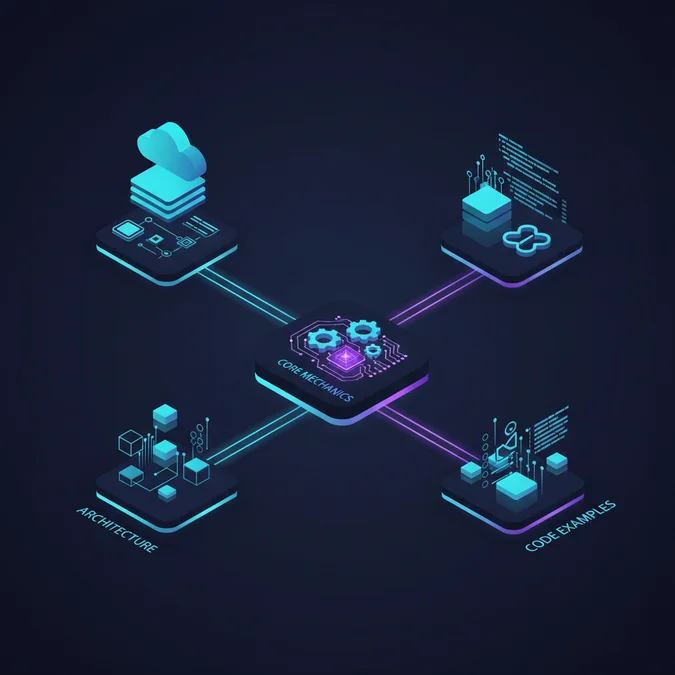

The landscape of software development trends is rapidly evolving, driven by advancements in automation, distributed systems, and intelligent platforms. Key current shifts include AI-driven engineering, widespread cloud-native adoption, refined DevSecOps practices, and the emergence of edge computing and Web3. Understanding these trends is crucial for building scalable, secure, and efficient applications.
This article provides a practitioner’s guide to the latest trends in software development, moving beyond superficial lists to explore architectural implications, core mechanics, and practical implementation strategies. We will analyze the engineering trade-offs and best practices necessary for successful adoption, equipping developers and architects with the knowledge to navigate this dynamic environment.
We focus on actionable insights, including code examples and strategic considerations, to help you understand not just what these trends are, but how to integrate them effectively into your projects and career trajectory. Prepare to delve into the foundational shifts defining the future of software engineering.
The Evolving Landscape of Software Development Trends
The software development industry is in a perpetual state of flux, continuously reshaped by technological innovation and shifting market demands. Staying abreast of the latest trends in software development is not merely advantageous, it is a prerequisite for maintaining competitive advantage and delivering robust solutions. From agile methodologies that optimize team collaboration to advancements in programming paradigms, each wave of innovation brings new opportunities and challenges.
Understanding these shifts requires a holistic perspective, examining not only individual technologies but also their synergistic effects on the entire software development lifecycle. The current era emphasizes automation, resilience, and intelligence, pushing the boundaries of what applications can achieve. This section sets the stage by highlighting the critical areas where significant transformations are occurring, preparing for a deeper dive into specific software development trends.
Insight: The rapid pace of change necessitates continuous learning and adaptation. Ignoring emerging software development trends risks technical debt and reduced market relevance.
AI-Driven Development: Core Mechanics and Automation
Artificial Intelligence and Machine Learning are no longer confined to specialized applications; they are fundamentally transforming the software development process itself. AI-driven development encompasses tools and techniques that leverage AI to assist, automate, and optimize various stages of the software development lifecycle. This includes intelligent code generation, automated testing, smart debugging, and predictive analytics for project management.
One of the most impactful applications is AI-assisted code completion and generation. Tools like GitHub Copilot, powered by large language models, analyze existing codebases and context to suggest or even write entire functions, significantly accelerating development velocity. The core mechanics involve pattern recognition across vast code repositories, statistical inference, and contextual understanding of natural language prompts. This shifts the developer’s role from writing boilerplate to reviewing, refining, and architecting.
Automated testing frameworks also benefit immensely from AI, which can generate test cases, prioritize tests based on code changes, and identify potential edge cases that human testers might miss. This leads to higher code quality and reduced debugging time.
| AI-Driven Development Aspect | Core Mechanic | Developer Impact |
|---|---|---|
| Code Generation/Completion | Large Language Models (LLMs), contextual analysis | Increased velocity, boilerplate reduction, focus on architecture |
| Automated Testing | Reinforcement learning, anomaly detection | Higher test coverage, early bug detection, improved quality |
| Code Review/Refactoring | Static analysis, pattern matching, semantic understanding | Enhanced code quality, adherence to standards, security vulnerability detection |
| Project Management | Predictive analytics, resource optimization | Improved sprint planning, risk mitigation, resource allocation |
Consider a simple Python function that an AI might generate:
# Prompt: "write a python function to calculate factorial recursively"
def factorial(n):
    if n == 0:
        return 1
    else:
        return n * factorial(n-1)
This example, while basic, illustrates how AI can quickly provide functional code snippets, allowing developers to focus on integrating complex logic rather than syntax. The ethical implications and potential biases in AI-generated code remain critical considerations for practitioners.
Cloud-Native and Serverless Architectures: Scalability Trade-offs
Cloud-native development and serverless architectures represent a fundamental shift in how applications are designed, deployed, and operated. Cloud-native emphasizes building and running applications that leverage the elasticity and distributed nature of cloud computing, often involving microservices, containers, and declarative APIs. Serverless, a subset of cloud-native, abstracts away server management entirely, allowing developers to focus purely on code logic, typically in the form of functions as a service (FaaS).
The primary advantage of these architectures is unparalleled scalability and reduced operational overhead. Resources are provisioned and scaled automatically based on demand, leading to cost efficiencies for fluctuating workloads. However, these benefits come with significant architectural trade-offs, including increased complexity in debugging distributed systems, potential vendor lock-in, and challenges in managing state across ephemeral functions.
Understanding the balance between operational simplicity and architectural control is crucial. For instance, while a serverless function can scale instantly to handle millions of requests, managing its dependencies, cold start latencies, and observability across numerous small components requires sophisticated tooling and monitoring strategies.
| Feature | Cloud-Native Architecture | Serverless Architecture |
|---|---|---|
| Infrastructure Management | Managed by platform, but configuration required | Fully abstracted, developer focuses on code |
| Scalability Model | Auto-scaling groups, container orchestration | Event-driven, scales instantly per request |
| Cost Model | Resource consumption (VMs, containers) | Execution time, memory, invocations (pay-per-use) |
| Operational Overhead | Moderate (monitoring, orchestration) | Low (focus on business logic) |
| Vendor Lock-in Risk | Moderate (platform services) | High (specific FaaS implementations) |
Here is a basic example of an AWS Lambda function, a common serverless component:
import json

def lambda_handler(event, context):
    # Log the event for debugging purposes
    print(f"Received event: {json.dumps(event)}")

    # Process the request
    if 'queryStringParameters' in event and 'name' in event['queryStringParameters']:
        name = event['queryStringParameters']['name']
        message = f"Hello, {name}! This is a serverless greeting."
    else:
        message = "Hello from Serverless! Provide a 'name' query parameter."

    # Return a response
    return {
        'statusCode': 200,
        'headers': {
            'Content-Type': 'application/json'
        },
        'body': json.dumps({'message': message})
    }
This Python function demonstrates the core principle of serverless: a discrete unit of code triggered by an event, executing without explicit server provisioning. The trade-off lies in managing the event source, API Gateway integration, and potential cold start delays for infrequently invoked functions.
Microservices and Containerization: Building Resilient Systems
The shift from monolithic applications to microservices architectures has become a prevalent software development trend, enabling greater agility, scalability, and independent deployment. Microservices break down large applications into smaller, loosely coupled services, each responsible for a specific business capability. Containerization technologies, particularly Docker and orchestration platforms like Kubernetes, are foundational to implementing microservices effectively.
Containers encapsulate an application and its dependencies into a standardized unit, ensuring consistent execution across different environments. Kubernetes then automates the deployment, scaling, and management of these containerized applications, providing self-healing capabilities and load balancing. This combination allows for building highly resilient, fault-tolerant systems where the failure of one service does not necessarily bring down the entire application.
However, the distributed nature of microservices introduces complexities such as inter-service communication, distributed tracing, data consistency, and increased operational overhead. Effective implementation requires robust API design, event-driven architectures, and comprehensive monitoring.
Key Considerations for Microservices and Containerization:
- Service Granularity: Define service boundaries based on business capabilities, avoiding overly small or large services.
- Communication Patterns: Utilize lightweight protocols (REST, gRPC) or asynchronous messaging (Kafka, RabbitMQ) for inter-service communication.
- Data Management: Each service should ideally manage its own data store to ensure autonomy and loose coupling.
- Observability: Implement robust logging, metrics, and distributed tracing to understand system behavior.
- Deployment Automation: Leverage CI/CD pipelines for automated build, test, and deployment of individual services.
- Security: Secure inter-service communication and API gateways.
Here’s a simplified Dockerfile for a Python microservice:
# Use an official Python runtime as a parent image
FROM python:3.9-slim-buster

# Set the working directory in the container
WORKDIR /app

# Copy the current directory contents into the container at /app
COPY . /app

# Install any needed packages specified in requirements.txt
RUN pip install --no-cache-dir -r requirements.txt

# Make port 80 available to the world outside this container
EXPOSE 80

# Run the application
CMD ["python", "./app.py"]
This Dockerfile packages a Python application, making it portable and ensuring its dependencies are met. When deployed to Kubernetes, this container can be scaled up or down, self-healed, and load-balanced automatically, forming a crucial component of a resilient distributed system.
DevSecOps: Integrating Security Across the SDLC
DevSecOps represents a cultural and technical shift that embeds security practices throughout the entire Software Development Life Cycle (SDLC), rather than treating security as an afterthought. This integration is crucial in an era where cyber threats are increasingly sophisticated and the cost of breaches is escalating. DevSecOps aims to automate security tasks, empower developers with security knowledge, and foster collaboration between development, operations, and security teams.
The core principle is “shift left,” meaning security considerations are introduced at the earliest stages of development, from design and coding to testing and deployment. This proactive approach helps identify and remediate vulnerabilities much earlier, reducing the cost and effort of fixing them later in the cycle. Key practices include automated security testing, static application security testing (SAST), dynamic application security testing (DAST), software composition analysis (SCA), and infrastructure as code (IaC) security scanning.
Critical Practice: Implementing DevSecOps is not just about tools; it requires a cultural shift towards shared responsibility for security across all teams involved in software delivery.
For example, integrating SAST tools into CI/CD pipelines can automatically scan code for common vulnerabilities like SQL injection or cross-site scripting before it even reaches a testing environment. SCA tools can identify known vulnerabilities in third-party libraries, a common attack vector. By making security checks an inherent part of the automated pipeline, teams can maintain high velocity while significantly enhancing the security posture of their applications.
DevSecOps also emphasizes continuous monitoring and feedback loops, ensuring that security issues are detected and addressed promptly even after deployment. This holistic approach builds security into the very fabric of the application, rather than bolting it on as an external layer.
Emerging Software Development Technology: Edge, Web3, and Quantum
Beyond the established trends, several cutting-edge software development technologies are poised to redefine the future of computing. These emerging areas, while still maturing, represent significant opportunities and challenges for developers and architects alike. Understanding their potential impact and current state is vital for strategic planning and innovation.
Edge Computing extends cloud computing capabilities closer to the data source, such as IoT devices, local servers, or user devices. This minimizes latency, conserves bandwidth, and enables real-time processing for applications demanding immediate responses, like autonomous vehicles or industrial automation. Developing for the edge involves managing distributed data, ensuring intermittent connectivity, and optimizing resource-constrained environments.
Web3, encompassing blockchain and decentralized applications (DApps), aims to create a more decentralized and user-controlled internet. This software development technology leverages cryptographic principles to ensure data integrity, transparency, and immutability. Smart contracts, self-executing agreements on the blockchain, are central to Web3 development, opening new paradigms for digital ownership, finance, and identity. Developers must grapple with concepts like consensus mechanisms, gas fees, and wallet integration.
Quantum Computing is still largely in the research phase but holds immense promise for solving problems intractable for classical computers. It utilizes quantum-mechanical phenomena like superposition and entanglement to perform computations. While practical applications are limited today, quantum algorithms could revolutionize fields like drug discovery, material science, and cryptography. Developers exploring this frontier are working with quantum programming languages and simulators.
| Emerging Technology | Core Concept | Key Challenge for Developers | Potential Impact |
|---|---|---|---|
| Edge Computing | Processing data closer to its source | Distributed data management, resource constraints, intermittent connectivity | Real-time analytics, reduced latency, improved privacy |
| Web3 (Blockchain, DApps) | Decentralized, trustless, user-controlled internet | Scalability, high transaction costs, complex security models, evolving standards | Digital ownership, decentralized finance, enhanced data privacy |
| Quantum Computing | Leveraging quantum mechanics for computation | Hardware limitations, complex algorithms, specialized programming models | Revolutionary breakthroughs in optimization, cryptography, simulation |
Future Outlook: While Web3 and Edge Computing are seeing increasing adoption, Quantum Computing remains a long-term prospect. However, keeping an eye on these latest trends in software development is crucial for identifying future strategic advantages.
Each of these areas represents a distinct domain of software development technology, demanding specialized knowledge and offering unique opportunities for innovation and career growth.
Developer Impact: Skills, Tools, and Career Growth in Modern Software Development
The rapid evolution of software development trends profoundly impacts individual developers, necessitating continuous skill development and adaptation. As automation and AI handle more routine tasks, the demand for higher-level problem-solving, architectural design, and interdisciplinary skills increases. Developers must evolve from pure coders to versatile engineers capable of understanding complex systems and business needs.
Key skill sets now include proficiency in cloud platforms (AWS, Azure, GCP), container orchestration (Kubernetes), and a foundational understanding of data science and machine learning concepts. Expertise in distributed systems, asynchronous programming, and robust API design is becoming indispensable. Furthermore, security awareness, particularly DevSecOps principles, is no longer a niche skill but a core competency.
The tools ecosystem is also expanding, with new IDEs, CI/CD platforms, observability suites, and AI-powered assistants becoming standard. Developers need to be adept at integrating and utilizing these tools to maximize productivity and ensure high-quality output. Career growth increasingly favors those who can demonstrate adaptability, a strong grasp of architectural patterns, and the ability to learn new software development technology quickly.
Essential Skills for Modern Developers:
- Cloud Platform Proficiency: Experience with at least one major cloud provider (AWS, Azure, GCP).
- Containerization & Orchestration: Docker, Kubernetes, and related ecosystem tools.
- Distributed Systems Design: Microservices, event-driven architectures, message queues.
- DevSecOps Principles: Security-first mindset, automated security testing, threat modeling.
- Data Engineering & AI/ML Fundamentals: Understanding data pipelines, model deployment, basic ML concepts.
- Observability & Monitoring: Tools like Prometheus, Grafana, ELK stack, distributed tracing.
- API Design & Management: RESTful, GraphQL, gRPC, API gateways.
- Soft Skills: Collaboration, communication, problem-solving, continuous learning.
Adopting these software development trends requires a proactive approach to learning. Online courses, certifications, open-source contributions, and participation in developer communities are all critical avenues for staying relevant. The future belongs to adaptive engineers who embrace complexity and leverage new software development technology to build innovative solutions.
Frequently Asked Questions
What are the most significant software development trends shaping the industry today?
The most significant software development trends include AI-driven engineering, widespread adoption of cloud-native architectures, microservices, enhanced DevSecOps practices, and the emergence of edge computing and Web3. These trends emphasize automation, scalability, security, and decentralized systems, fundamentally altering how software is built and deployed.
How is AI impacting the latest trends in software development?
AI is profoundly impacting the latest trends in software development by automating code generation, enhancing testing processes, and providing intelligent insights for optimization. It’s shifting developer roles towards overseeing AI-assisted workflows, focusing on higher-level problem-solving, and leveraging AI for predictive analytics in project management.
What new software development technology should developers focus on learning?
Developers should prioritize learning cloud platforms (AWS, Azure, GCP), container orchestration (Kubernetes), AI/ML frameworks (TensorFlow, PyTorch), serverless functions, and blockchain fundamentals. Proficiency in these areas, coupled with strong architectural understanding and security practices, will be crucial for navigating the evolving landscape of software development technology.
What are the architectural trade-offs when adopting modern software development trends?
Adopting modern software development trends like microservices or serverless introduces trade-offs such as increased operational complexity, distributed system challenges, and potential vendor lock-in. However, these are often balanced by significant gains in scalability, resilience, faster deployment cycles, and improved developer productivity, requiring careful strategic planning.
The journey through current software development trends reveals a landscape defined by intelligent automation, distributed architectures, and a heightened focus on security. From AI-driven development and the pervasive adoption of cloud-native and serverless paradigms to the strategic integration of DevSecOps, the industry is accelerating towards more efficient, resilient, and secure systems. Emerging software development technology like Edge, Web3, and Quantum computing further underscore the dynamic nature of this field.
For developers, these shifts present both challenges and immense opportunities. Mastering new tools, embracing architectural complexities, and prioritizing continuous learning are paramount for career growth. The ability to navigate these technological currents, understand the inherent trade-offs, and apply best practices will distinguish leading engineers in the years to come. By proactively engaging with these transformative trends, the software community can continue to build the innovative solutions that shape our future.
NR Studio builds custom web apps, mobile apps, SaaS platforms, and internal tools for growing businesses. If you’re working through a technical decision, feel free to reach out — no commitment required.