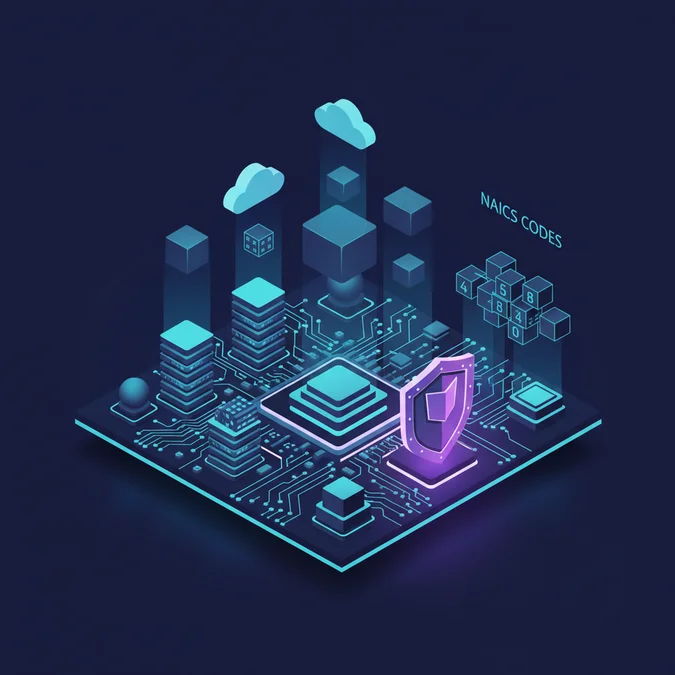

The primary NAICS code for software development is 541511 (Custom Computer Programming Services) for bespoke applications and client contracts, or 513210 (Software Publishers) for prepackaged software and SaaS platforms under the 2022 Census revisions. Selecting the correct code establishes an engineering organization’s federal contracting baseline, industry risk profiling, and regulatory compliance posture across federal systems.
With the release of the Economic Census updates and refined federal procurement schedules, commercial tech entities must navigate strict distinctions between publishing proprietary IP, developing bespoke client applications, and hosting managed digital infrastructure. Misclassification risks procurement disqualification, audit penalties, and invalid cyber liability insurance assessments.
For engineering leads and security architects, NAICS codes are not merely administrative filings. They dictate regulatory scope under NIST SP 800-171, CMMC, and SOC 2 attestations. Understanding the boundaries of each classification ensures your software delivery pipeline, technical architecture, and legal compliance model remain aligned with federal standardizations.
Primary NAICS Codes for Software Development: The Definitive Breakdown
NAICS (North American Industry Classification System) groups commercial activities into specific six-digit economic codes. In modern application development, software operations typically fall under one of four core codes, each carrying distinct structural, legal, and regulatory assumptions.
| NAICS Code | Official Description | Engineering Focus | Primary Revenue Driver |
|---|---|---|---|
| 541511 | Custom Computer Programming Services | Contract development, custom microservices, APIs | Time and materials, milestone contracts |
| 513210 | Software Publishers (Replaced 511210) | SaaS platforms, desktop suites, packaged kernels | Recurring subscriptions, licensing royalties |
| 541512 | Computer Systems Design Services | Enterprise infrastructure, hardware-software integration | Architecture design, systems integration |
| 518210 | Data Processing, Hosting, and Related Services | Cloud infrastructure, PaaS, managed data pipelines | Compute usage, storage, network ingress/egress |
Engineering teams often bridge multiple disciplines. A team might build a bespoke platform under 541511, while spinning off a proprietary multi-tenant tool categorized under 513210. Defining your primary classification requires calculating which activity produces the greatest operational expenditure and revenue contribution.
NAICS 541511: Custom Computer Programming Services Architecture
NAICS 541511 covers businesses primarily engaged in writing, modifying, testing, and supporting software to meet the needs of a specific client. In this paradigm, the intellectual property is often transferred to or licensed exclusively for an external enterprise buyer.
Architecturally, operations classified under 541511 emphasize continuous integration pipelines, isolated multi-tenant staging environments, and client-specific access controls. Because code is engineered to order, security engineers must enforce rigorous boundaries to prevent cross-contamination of proprietary IP and secrets between client codebases.
# Example: Isolating deployment environments for custom client deliverables
# Enforcing strict IAM roles and scoped repository secrets per tenant
git checkout -b client-alpha-custom-api
export AWS_PROFILE="client-alpha-staging"
terraform init -backend-config="backend-alpha.hcl"
terraform apply -auto-approve
Adhering to foundational software engineering principles ensures that bespoke deliverables avoid unvetted third-party libraries. Under 541511, delivery scopes require clear Software Bills of Materials (SBOM) to satisfy client security reviews.
NAICS 513210: Software Publishers and SaaS Platform Models
Historically categorized under code 511210, the 2022 NAICS restructuring introduced 513210 (Software Publishers) to properly encapsulate cloud-delivered software, SaaS architectures, and off-the-shelf downloadable software. The defining characteristic of a 513210 entity is that the business designs, distributes, and retains ownership of the underlying application codebase.
From an architectural standpoint, 513210 systems focus heavily on multi-tenancy, dynamic schema partitioning, identity federation (SAML/OIDC), and defense-in-depth security. The risk profile shifts from third-party contract liability to large-scale data breach exposure across shared databases.
- Shared Database, Separate Schemas: Ensures tenant isolation while maximizing compute utilization.
- Row-Level Security (RLS): Programmatic access enforcement executed directly at the persistence layer.
- Zero Trust Token Validation: Every inter-service RPC validates identity context, mitigating lateral traversal.
Security postures must reflect this continuous multi-user exposure. When deploying recurring SaaS products, teams must run continuous static and dynamic security analysis (SAST/DAST) against every production deployment.
NAICS 541512 vs 518210: Systems Integration and Infrastructure Services
While custom application development and product publishing dominate modern software, many engineering groups operate at the infrastructure integration boundary. Here, 541512 (Computer Systems Design Services) and 518210 (Data Processing, Hosting, and Related Services) govern operations.
Differentiating Integration from Managed Compute
NAICS 541512 applies when engineers design end-to-end architectures, tying legacy databases, local microservices, and identity providers together. The deliverable is an integrated architecture rather than standalone application code.
Conversely, 518210 applies when the primary service is hosting, execution, and continuous data processing. If your product runs automated streaming pipelines or managed container clusters where the customer pays for runtime resource consumption, 518210 is your functional operational baseline.
| Metric | NAICS 541512 (Systems Integration) | NAICS 518210 (Hosting & Processing) |
|---|---|---|
| Core Asset | Network topology, middleware config | Bare-metal nodes, VPCs, hypervisors |
| Threat Vector | Integration vulnerability, misconfigured IAM | DDoS, side-channel attacks, data leaks |
| Compliance | NIST 800-53, Zero Trust architecture | SOC 2 Type II, ISO 27001, FedRAMP |
Federal Contracting and CMMC Compliance Impact of NAICS Codes
For federal contractors, NAICS code selection governs eligibility for Small Business Administration (SBA) set-asides and dictates the applicable cybersecurity standards. Federal acquisitions categorized under 541511 or 541512 frequently enforce strict CMMC (Cybersecurity Maturity Model Certification) and DFARS 252.204-7012 mandates.
When bidding on federal custom development scopes, engineering environments must comply with NIST Special Publication 800-171 controls to protect Controlled Unclassified Information (CUI). Failure to implement these operational controls can lead to contract termination and False Claims Act liability.
- Endpoint Protection: FIPS 140-3 validated cryptographic modules for all administrative tunnels.
- Source Code Control: Multi-factor authenticated access with signed Git commits and verified developer identities.
- Audit Logging: Immutable log retention spanning at least 365 days across all development and production clusters.
Aligning your NAICS filing with actual technical workflows prevents compliance mismatches during pre-award federal technical evaluations.
Cyber Liability Insurance and Risk Profiling Under NAICS Classifications
Underwriters use NAICS codes to determine actuarial risk models for technology errors and omissions (E&O) and cyber liability policies. A company classified under 541511 is assessed primarily on code defect liability and delivery failure risks, whereas a 513210 SaaS operator is evaluated on system availability and data breach vectors.
If an enterprise files under an inaccurate NAICS code, insurers can challenge coverage claims following an incident. For example, if a SaaS company files as a systems consultant (541511) but experiences a catastrophic multi-tenant leak of protected health information, the underwriter may argue the operational risk profile was misrepresented.
Security teams can protect insurance posture by maintaining clean traceability matrices between functional software services, automated testing logs, and code-level vulnerability mitigations.
State Tax Apportionment and Software Revenue Mechanics
State tax authorities use NAICS classifications to determine sales tax nexus, research and development tax credits, and apportionment formulas. Custom software services (541511) are often exempt from state sales taxes in jurisdictions that classify them as professional services, while prewritten or cloud-hosted software (513210/518210) is frequently subject to digital transaction taxes.
Modern engineering systems can mitigate cross-border tax audit risks by standardizing automated billing APIs to split invoice line items across distinct NAICS functional activities.
{
 "invoice_id": "inv_2026_0981",
 "client_id": "enterprise_corp",
 "line_items": [
 {
 "description": "Custom API Middleware Implementation",
 "classification": "NAICS-541511",
 "tax_category": "exempt_professional_service"
 },
 {
 "description": "Monthly Multi-Tenant Engine Access",
 "classification": "NAICS-513210",
 "tax_category": "taxable_digital_good"
 }
 ]
}
Maintaining strict technical accounting records ensures that hybrid engineering agencies accurately apportion gross receipts without triggering state audit penalties.
Architecture Deep Dive: Multi-Tenant SaaS Under NAICS 513210
Software publishers operating under 513210 require architecture capable of maintaining strict isolation while serving hundreds of thousands of concurrent sessions. The primary architectural concern is avoiding cross-tenant data leaks at the ORM layer.
Building a multi-tenant framework demands defense against broken object level authorization (OWASP API1:2023). Engineers often achieve this through global query scopes that dynamically inject tenant identifiers into every database operation.
<php

namespace App\Models\Scopes;

use Illuminate\Database\Eloquent\Builder;
use Illuminate\Database\Eloquent\Model;
use Illuminate\Database\Eloquent\Scope;

class TenantScope implements Scope
{
 /**
 * Apply tenant isolation constraints to the Eloquent query.
 */
 public function apply(Builder $builder, Model $model): void
 {
 // Ensure operations only query data belonging to the authenticated tenant context
 if (auth()->check() && auth()->user()->tenant_id) {
 $builder->where(
 $model->getTable(). '.tenant_id',
 '=',
 auth()->user()->tenant_id
 );
 }
 }
}
When launching new products, early stages benefit from structured rapid validation. Adopting clean approaches to prototyping software allows development teams to confirm tenant isolation architectures before committing to wide-scale infrastructure deployments.
Implementation Strategy: Controlled Feature Rollouts Across Hybrid Classifications
Engineering businesses that transition from bespoke development (541511) to SaaS commercialization (513210) often run hybrid business models. Safely navigating this operational shift requires granular runtime control over feature sets, allowing engineers to partition legacy bespoke logic from standardized product modules.
Feature gating at scale ensures that custom operational logic does not leak into standardized product releases. Teams managing scalable deployments can streamline controlled feature rollouts by implementing feature flags with Laravel Pennant to enforce environment boundaries at runtime.
<php

namespace App\Providers;

use Laravel\Pennant\Feature;
use App\Models\User;
use Illuminate\Support\ServiceProvider;

class AppServiceProvider extends ServiceProvider
{
 public function boot(): void
 {
 // Segment access between bespoke client tenants and generic SaaS subscribers
 Feature:define('bespoke-reporting-engine', function (User $user) {
 return $user->account_type === 'custom_contract'
 && $user->hasPermissionTo('execute:bespoke-reports');
 });
 }
}
Implementing programmatic runtime segmentation safeguards codebases from structural bloat while maintaining distinct commercial service tiers.
API Gateways and Edge Security for High-Volume Mobile Backends
When digital platforms expand into high-throughput mobile ecosystems, backends face elevated brute-force, reverse engineering, and injection risks. Applications classified under 513210 or 518210 must deploy defense mechanisms directly at the API edge.
Protecting endpoints requires automated rate limiting, TLS 1.3 termination, cryptographic payload verification, and strict schema validation. For engineers tasked with building a robust mobile app backend, edge security measures must be paired with database protections to mitigate data extraction attacks.
- Rate Limiting: Enforce strict per-token token-bucket algorithms to prevent automated scrapers.
- HMAC Signatures: Require signed request headers for critical financial or identity operations.
- Strict Type Coercion: Invalidate unexpected JSON schema parameters before routing requests into service controllers.
Edge fortifications ensure that software operations maintain resilience against distributed denial-of-service attempts and credential stuffing campaigns.
Audit Trail and Security Logging Frameworks
Federal examiners, SOC 2 auditors, and compliance regulators evaluate software systems based on evidence of continuous observability. Regardless of whether an organization files under 541511 or 513210, maintaining immutable audit trails is a foundational security mandate.
Log poisoning and injection vulnerabilities occur when user input is written to administrative log outputs without sanitization. Software architectures must decouple log formatting from user-controlled parameters, forwarding events directly to dedicated security information and event management (SIEM) systems.
<php

namespace App\Services;

use Illuminate\Support\Facades\Log;
use JsonException;

class SecurityAuditLogger
{
 /**
 * Record an immutable security event with sanitized parameters.
 */
 public function logSecurityEvent(string $event, array $context): void
 {
 // Sanitize context to prevent log injection and strip private keys
 unset($context['password'], $context['token'], $context['secret']);

 $payload = [
 'timestamp' => gmdate('Y-m-d\TH:i:s\Z'),
 'event' => preg_replace('/[^a-zA-Z0-9_.-]/', '', $event),
 'actor_id' => auth()->id()? 'system',
 'ip_address' => request()->ip(),
 'context' => $context,
 ];

 // Stream formatted JSON to secure append-only audit destination
 Log:channel('security_audit')->info(json_encode($payload, JSON_THROW_ON_ERROR));
 }
}
Centralized, tamper-resistant logging preserves organizational credibility during formal external security assessments and incident investigations.
Selecting Your Code: An Engineering Decision Matrix
When establishing your legal entity, applying for system awards, or submitting compliance registrations, you must select your primary NAICS code based on quantifiable operational metrics rather than marketing terminology. Use this decision matrix to evaluate your dominant engineering activity.
- Are you delivering source code directly to a client repository under an intellectual property transfer agreement? If yes, classify as 541511 (Custom Computer Programming Services).
- Are you maintaining a unified codebase where external customers purchase subscription access or recurring software licenses? If yes, classify as 513210 (Software Publishers).
- Is your revenue driven by connecting specialized on-premise hardware, legacy networking, and third-party software layers? If yes, classify as 541512 (Computer Systems Design Services).
- Does your business provide managed compute infrastructure, cloud hosting, or massive automated data pipelines? If yes, classify as 518210 (Data Processing, Hosting, and Related Services).
Review this distribution annually. If custom development billings decline while recurring subscription usage scales, update your primary filing on your federal System for Award Management (SAM) profile and insurance declarations.
Framework Documentation and Technical Resources
Maintaining technical precision across software architecture and regulatory compliance requires ongoing operational rigor. For teams standardizing their engineering architectures, exploring core platform resources and best practices provides a solid baseline for clean systems design.
Explore our complete Laravel, Basics directory for more guides.
Selecting the correct NAICS code for software development requires a precise evaluation of code ownership, revenue mechanics, and deployment architecture. Whether your team operates as custom programming specialists under 541511 or SaaS publishers under 513210, your operational classification directly determines your compliance obligations, risk posture, and federal contracting parameters.
As production systems scale, ensure your software architecture matches your formal classification. Maintain clear boundaries between client-specific custom work and shared multi-tenant products, enforce automated security controls across all build pipelines, and regularly verify that your administrative designations accurately reflect your real-world engineering footprint.