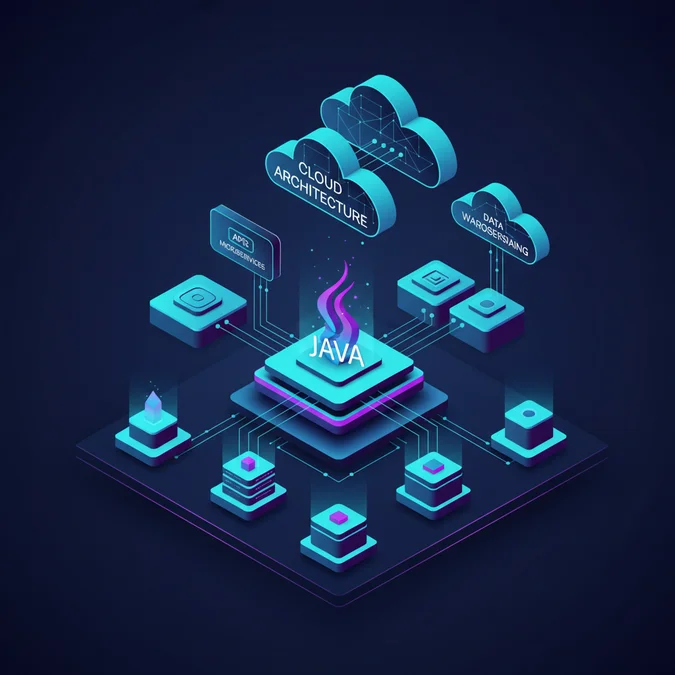

Why do global financial institutions, healthcare providers, and high-volume logistics platforms consistently build their mission-critical backbones on the Java Virtual Machine instead of chasing newer application frameworks? Enterprise application development in Java is the engineering discipline of designing, deploying, and maintaining large-scale, fault-tolerant business software utilizing the Java platform to guarantee backward compatibility, predictable throughput, and rock-solid system stability under heavy transactional concurrency.
Engineering organizations do not select Java for novelty; they choose it because predictability is the premier metric of enterprise survivability. When engineering systems process billions of dollars in daily ledger transfers or manage millions of patient medical records, raw developer agility takes a back seat to deterministic performance, memory profiling, backward runtime compatibility, and long-term talent availability.
From an executive vantage point, your architecture choices dictate your five-year Total Cost of Ownership (TCO), organizational delivery velocity, and operational risk. This comprehensive guide dissects modern Java enterprise patterns, framework selections, concurrency models, infrastructure costs, and technical debt governance for engineering executives who need pragmatic, production-tested guidance.
Core Architectural Foundations: Why the JVM Dominates Enterprise Backends
Enterprise application development in Java centers around the runtime capabilities of the Java Virtual Machine (JVM). The JVM provides a hardware-agnostic, battle-tested execution environment that handles dynamic memory management, native thread dispatching, and run-time optimization via the Just-In-Time (JIT) compiler. Understanding these baseline mechanics is essential for system architects managing high-throughput services.
The Tiered Compilation mechanism in HotSpot ensures that systems run immediately through the C1 compiler while collecting runtime profiling data. Once a code path reaches invocation thresholds, the C2 compiler optimizes bytecode directly into native machine instructions, applying loop unrolling, monomorphic dispatch inlining, and escape analysis to allocate memory on the stack rather than the heap:
- Deterministic Runtime Optimization: JIT compilation continuously optimizes active code paths based on live system metrics, outperforming statically compiled languages in long-running transactional scenarios.
- Strict Memory Safety: Absence of raw pointer arithmetic and automatic memory reclamation eliminate entire classes of buffer overflow security risks.
- Platform Portability: A single containerized bytecode artifact executes with identical semantics across Linux arm64 and x86_64 host kernels.
When evaluating these attributes against foundational concepts such as the core engineering lifecycle and architectural baseline, the JVM emerges as a predictable vehicle for mitigating multi-year system degradation.
Framework Decisions: Spring Boot vs Quarkus vs Jakarta EE
Selecting an application framework fundamentally influences runtime performance, developer onboarding latency, and infrastructure resource consumption. For enterprise engineering organizations, the choice between Spring Boot, Quarkus, and traditional Jakarta EE is not a matter of developer preference; it is a financial and operational trade-off.
Spring Boot Ecosystem
Spring Boot represents the dominant enterprise standard. Its comprehensive ecosystem covers distributed tracing, cloud-native configuration, authentication via Spring Security, and extensive object-relational abstraction. However, Spring relies heavily on runtime reflection, dynamic proxies, and classpath inspection during context initialization. This architectural characteristic results in longer cold-start intervals and substantial base memory consumption.
Quarkus and Micronaut: The Container-First Paradigms
Quarkus flips this model by shifting annotation processing, reflection metadata collection, and dependency injection analysis to compile time via GraalVM substrate compilation. This shift yields sub-second container startups and a dramatically reduced Resident Set Size (RSS), making Quarkus ideal for ephemeral Kubernetes pods and autoscaling serverless functions.
| Evaluation Metric | Spring Boot 3.x | Quarkus 3.x | Jakarta EE 10 |
|---|---|---|---|
| Primary Execution Paradigm | Dynamic JIT / Optional AOT | Build-time Optimization / Native | Dynamic Application Server |
| Baseline RSS (Heap + Native) | 350 MB to 650 MB | 45 MB to 120 MB | 500 MB to 1.2 GB |
| Cold Start Latency | 3.5s to 9.0s | 0.05s to 0.4s (Native) | 15.0s to 45.0s |
| Developer Talent Availability | Exceptionally High | Growing / Moderate | Stable / Legacy Leaning |
| Third-Party Ecosystem Size | Massive | Targeted / MicroProfile | Enterprise Focused |
Engineering leaders balancing these trade-offs often implement Quarkus on high-scale, autoscaled microservices while retaining Spring Boot for orchestrators and stateful domain cores where rich integration libraries are mandatory.
Concurrency Models: Virtual Threads vs Reactive Programming
Enterprise transaction processing demands high concurrency. Historically, Java applications allocated a dedicated OS thread per incoming HTTP connection. Because an OS thread claims roughly 1MB of stack memory, a service handling 10,000 concurrent blocking I/O calls required 10GB of RAM purely for thread stacks, accompanied by extreme OS context-switching penalties.
To bypass this bottleneck, reactive frameworks like Project Reactor and RxJava adopted asynchronous, non-blocking event loops. While highly memory-efficient, reactive programming complicates codebase readability, fragments stack traces during incident troubleshooting, and breaks the conventional ThreadLocal execution pattern used by security and logging libraries.
Project Loom and Virtual Threads
Java 21 fundamentally resolved this friction through Virtual Threads (JEP 444). Virtual threads are lightweight user-mode threads managed by the JVM rather than the host OS. When a virtual thread encounters a blocking operation (such as a database query or an HTTP call), the JVM automatically unmounts it from the underlying carrier thread, allowing other virtual threads to execute.
// Configuring an ExecutorService with Virtual Threads in modern Java enterprise backends
import java.util.concurrent.ExecutorService;
import java.util.concurrent.Executors;

public class ConcurrencyConfig {
 public static ExecutorService createEnterpriseExecutor() {
 // Spawns unbounded virtual threads, using carrier threads equal to CPU cores
 // Eliminates the need for traditional thread-pool sizing calculations
 return Executors.newVirtualThreadPerTaskExecutor();
 }
}
This architectural evolution allows teams to write simple, sequential, blocking code while matching the throughput efficiency of complex reactive paradigms. Organizations migrating to modern Java runtimes can phase out brittle reactive constructs without sacrificing container density.
Domain-Driven Design and Clean Architecture in Java Systems
A classic failure mode in enterprise Java platforms is the proliferation of the ‘Anemic Domain Model’, where entities serve as glorified data bags wrapped by bloated, multi-thousand-line Service classes. This antipattern obscures business logic, encourages circular dependencies, and escalates regression risk during standard feature updates.
Pragmatic enterprise architectures enforce Clean Architecture or Hexagonal Architecture (Ports and Adapters) to isolate critical business invariants from databases, network protocols, and third-party SDKs:
- Core Domain: Contains domain entities, value objects, and business state transitions. This layer maintains zero external framework dependencies (pure Java standard library).
- Application Layer: Defines inbound use cases, transactional boundaries, and commands.
- Adapters & Infrastructure: Houses JPA/Hibernate repositories, REST controllers, Kafka consumers, and external third-party API clients.
Decoupling the domain layer ensures that future changes, such as migrating from relational SQL databases to document stores or moving from REST to gRPC, do not leak into or destabilize business logic. Adapting your domain architecture cleanly matches principles found in adaptive software development methodologies, keeping enterprise engineering teams responsive to shifting market requirements.
Enterprise Data Persistence: Beyond Basic JPA and Hibernate
Data access layers are the primary source of performance degradation in Java enterprise backends. While Object-Relational Mapping (ORM) tools like Hibernate increase baseline developer velocity, naive implementations silently generate pathological database operations.
The N+1 select problem is the most notorious ORM pitfall. An initial query fetching 1,000 customer records triggers 1,000 subsequent queries to retrieve associated order lines if fetch relationships are misconfigured. Engineering teams must enforce explicit JOIN FETCH mechanisms or adopt Entity Graphs to fetch relationships in single operations.
// Spring Data JPA custom repository with dynamic EntityGraph to prevent N+1 queries
package com.enterprise.billing.repository;

import com.enterprise.billing.domain.Account;
import org.springframework.data.jpa.repository.EntityGraph;
import org.springframework.data.jpa.repository.JpaRepository;
import org.springframework.data.jpa.repository.Query;
import java.util.Optional;
import java.util.UUID;

public interface AccountRepository extends JpaRepository<Account, UUID> {

 // Eagerly fetches invoices and line items in a single query execution
 @EntityGraph(attributePaths = {"invoices", "invoices.lineItems"})
 @Query("SELECT a FROM Account a WHERE a.id =:id")
 Optional<Account> findByIdWithDetailedHistory(UUID id);
}
For analytical workloads or batch transactions processing hundreds of thousands of records, ORM abstractions should be completely bypassed in favor of JOOQ or Spring JDBC Client. JOOQ delivers type-safe SQL construction while mapping records directly into immutable Java Records, eliminating memory allocation overhead and Hibernate session caching entirely.
Distributed Resiliency: Circuit Breakers, Retries, and Idempotency
In an enterprise topology containing dozens of distributed services, network partitions and microservice degradation are inevitable. Robust Java architecture operates on the assumption that any dependent upstream service can and will fail.
Implementing Resilience4j allows teams to wrap external calls with fine-grained circuit breakers, preventing cascading failures across the enterprise grid. When an external system exceeds error or latency thresholds, the circuit breaker opens, failing fast and serving cached fallback data without holding open thread resources:
- Sliding Window Circuit Breaking: Tracks failures over the last N invocations, dynamically evaluating if downstream endpoints are healthy.
- Exponential Backoff with Jitter: Adds randomized delays between retries to prevent retry storms from overwhelming recovering infrastructure.
- Idempotency Keys: Persists unique client-provided UUIDs inside distributed stores (like Redis) within transactions to protect against duplicated mutation requests.
By pairing Resilience4j decorators with Virtual Threads, platforms preserve stability across high-latency network calls without creating thread-starvation deadlocks.
Security Architecture: Enterprise Identity, Token Verification, and RBAC
Enterprise Java systems process sensitive corporate and customer information. Relying on default framework configurations often leads to critical vulnerabilities, such as insecure object deserialization, broken object level authorization (BOLA), and token validation leakage.
Modern Java security architectures decouple authentication from internal application logic by using modern identity providers (such as Okta, Ping Identity, or Keycloak) communicating via OpenID Connect (OIDC) and OAuth 2.0. The Java application serves as a Resource Server, verifying cryptographically signed JSON Web Tokens (JWT) without incurring external roundtrip latency.
// Security filter chain configuring stateless JWT validation in Spring Security
import org.springframework.context.annotation.Bean;
import org.springframework.context.annotation.Configuration;
import org.springframework.security.config.annotation.web.builders.HttpSecurity;
import org.springframework.security.config.http.SessionCreationPolicy;
import org.springframework.security.web.SecurityFilterChain;

@Configuration
public class SecurityConfig {

 @Bean
 public SecurityFilterChain filterChain(HttpSecurity http) throws Exception {
 return http.csrf(csrf -> csrf.disable()) // Stateless APIs using bearer tokens do not require CSRF.sessionManagement(session -> session.sessionCreationPolicy(SessionCreationPolicy.STATELESS)).authorizeHttpRequests(auth -> auth.requestMatchers("/actuator/health").permitAll().requestMatchers("/api/v1/admin/**").hasRole("ENTERPRISE_ADMIN").anyRequest().authenticated()
 ).oauth2ResourceServer(oauth2 -> oauth2.jwt(jwt -> {})).build();
 }
}
Furthermore, internal service-to-service communication must enforce mutual TLS (mTLS) via service mesh sidecars or JVM-managed truststores, ensuring full encryption in transit across multi-region enterprise clusters.
Observability and Profiling: OpenTelemetry, Prometheus, and JFR
When an enterprise service encounters elevated latencies or unexpected out-of-memory errors in production, traditional logging alone is insufficient. Systems must expose three complementary observability pillars: distributed traces, granular metrics, and low-overhead flight recorder data.
By integrating OpenTelemetry Java agents, systems automatically inject trace contexts across HTTP boundaries and Kafka message headers. This enables operators to follow individual transaction journeys across dozens of downstream microservices via distributed tracing tools like Jaeger or Datadog.
JDK Flight Recorder (JFR) in Production
Unlike third-party instrumentation agents that incur significant CPU overhead, JDK Flight Recorder is embedded directly into the JVM runtime, allowing continuous production profiling at under 1% CPU utilization. JFR records allocation rates, lock contention, GC pause intervals, and file I/O operations.
When combined with Prometheus metrics exported via Micrometer, platform engineering teams can establish automated alerts for early indicators of system stress, such as heap memory inflection points, carrier thread pinning, or sudden spikes in garbage collection CPU cycles.
Total Cost of Ownership: Development, Infrastructure, and Modernization Pricing
Assessing the cost of enterprise Java development requires analyzing long-term Total Cost of Ownership (TCO). While initial engineering salaries for seasoned Java developers trend higher than those for scripting languages, Java systems consistently offer lower long-term modernization, maintenance, and operational scaling costs.
Engineering Sourcing and Billing Models
Organizations standardizing on Java enterprise applications procure engineering talent through three primary commercial engagements: time-and-materials contracting, dedicated offshore/nearshore team retainers, or fixed-scope project deliveries.
| Engagement Model | Rate / Cost Range (USD) | Typical Scope & Commitment | Primary Risk / Trade-Off |
|---|---|---|---|
| US-Based Senior Java Architect | $140 to $220 per hour | Architecture, ADRs, Concurrency Tuning | High hourly burn; exceptional domain velocity |
| Nearshore Java Feature Team (5 Eng.) | $32,000 to $48,000 per month | Domain core development, microservices | Time zone alignment; moderate ramp-up period |
| Enterprise Migration Project (Fixed) | $150,000 to $450,000 total | Monolith to Spring Boot 3 / JDK 21 | Scope boundaries require rigid contract specs |
| Managed Platform Retainer | $15,000 to $35,000 per month | L3 support, patching, zero-day mitigation | Ongoing operational overhead commitment |
Infrastructure and Licensing Costs
Direct infrastructure costs depend on heap allocation, CPU utilization, and JVM licensing models:
- JVM Distribution Licensing: Standardizing on open-source distributions such as Eclipse Temurin or Amazon Corretto incurs $0 in runtime licensing fees, fully avoiding Oracle Java SE Universal Subscription costs ($15 per user/month or $50,000+ annually for mid-tier enterprises).
- Cloud Container Compute: Migrating legacy monoliths requiring 8 vCPU / 32GB RAM ($280/month per instance) to right-sized Quarkus/Spring Boot 3 containers consuming 1 vCPU / 2GB RAM ($35/month per instance) delivers substantial cloud compute savings across scaled deployments.
- Technical Debt Amortization: High-performance Java backends typically boast service lifespans of 7 to 12 years, yielding a much lower annual rewrite cost compared to ecosystems with high library churn.
Common Technical Mistakes in Enterprise Java Implementations
Decades of enterprise development have highlighted repeating architectural anti-patterns that degrade velocity and destabilize runtime environments. Engineering teams must monitor and correct these systemic missteps early:
- Virtual Thread Carrier Pinning: Executing
synchronizedblocks or invoking native JNI methods within virtual threads prevents the JVM from unmounting them from their underlying carrier threads. This pins the carrier thread and degrades system-wide concurrency. Teams should replacesynchronizedblocks withjava.util.concurrent.locks.ReentrantLock. - Unbounded Thread Pools: Permitting unbounded queue lengths in custom
ThreadPoolExecutorinstances risks catastrophicOutOfMemoryErrorconditions when downstream systems experience latency hiccups. Rejection execution handlers must always be configured explicitly. - Over-Reliance on Spring Context During Testing: Writing unit tests that spin up full Spring ApplicationContexts inflates CI/CD pipeline execution times from minutes to hours. Domain logic should be verified with zero-framework Mockito tests, reserving context startup strictly for end-to-end integration suites.
- Ignoring Heap Overhead in Containers: Failing to pass proper JVM container awareness flags (e.g.
-XX:MaxRAMPercentage=75.0) in Kubernetes pod manifests leads to sudden Linux kernel OOM kills when the JVM exceeds container memory cgroups.
Migration Strategy: Decommissioning Monoliths Without Downtime
Enterprise systems rarely have the luxury of greenfield development. The vast majority of Java engineering initiatives involve untangling large-scale legacy codebases (such as monolithic systems on Java 8 or legacy WebLogic/WebSphere application servers) and transitioning them to modern microservices running on Java 21.
Attempting a high-risk ‘big bang’ rewrite almost always leads to delivery overruns or outright project cancellation. Instead, successful migrations leverage the Strangler Fig pattern:
- Edge Routing Layer: Place an API gateway (e.g. Envoy or Spring Cloud Gateway) in front of the existing legacy monolith.
- Domain Extraction: Identify self-contained domain boundaries with minimal coupling (such as notification services or read-heavy catalogs).
- Traffic Shadowing: Route identical live production traffic to both the legacy service and the newly written modern Java microservice, verifying output parity without exposing end users to operational risk.
- Canary Cutover: Gradually increment traffic routing from 5% to 100% to the new service while maintaining real-time rollback capabilities.
This disciplined, staged approach ensures business continuity, lowers cognitive load across engineering teams, and keeps operational risk within safe, measurable boundaries.
Explore our complete Laravel, Basics directory for more guides.
Factors That Affect Development Cost
- Target concurrency and throughput volume
- Legacy monolith refactoring versus greenfield development
- JVM licensing and vendor support tier choices
- Senior backend architectural talent availability
Engineering implementation costs vary significantly based on architectural complexity, regulatory constraints, and existing technical debt.
Enterprise application development in Java continues to serve as the bedrock of mission-critical global software. By combining modern language enhancements like Virtual Threads and pattern matching with lightweight runtimes and decoupled clean architectures, organizations can achieve high transactional throughput without sacrificing maintainability.
Pragmatic technology leaders recognize that framework selection, concurrency models, and cloud resource sizing directly dictate an organization’s Total Cost of Ownership. Prioritizing architectural decoupling, strict automated observability, and zero-downtime migration patterns ensures your core enterprise assets remain resilient, secure, and cost-effective for the decade ahead.