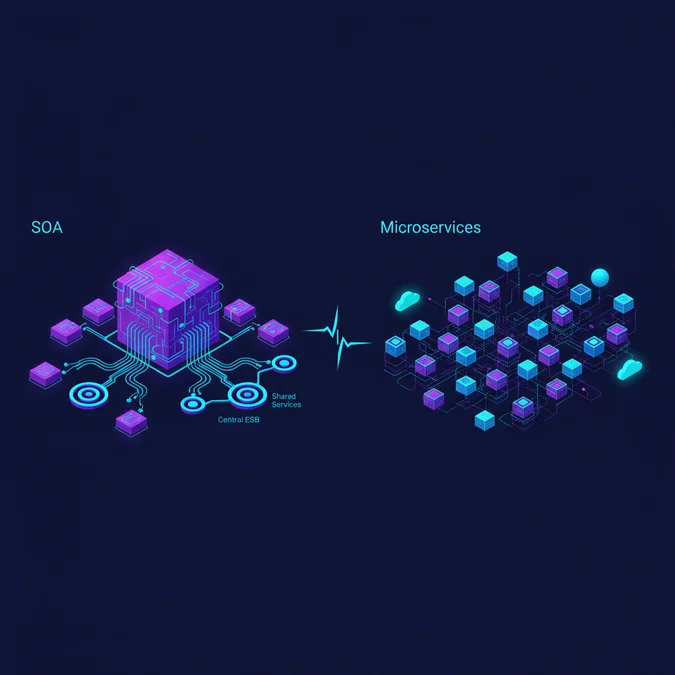

When monolithic applications buckle under the weight of increasing user load and feature demands, exhibiting slow deployments, complex debugging, and scaling bottlenecks, the path to a more resilient and agile architecture often leads to microservices. This architectural style fundamentally redefines how software systems are built, deployed, and managed, breaking down large applications into smaller, independently deployable services.
This article provides an authoritative, practitioner-level guide to designing, building, and operating microservices, focusing on the critical considerations for achieving high performance, particularly with low-level languages like C/C++. We will explore the foundational principles, common architectural patterns, communication strategies, data management challenges, and the operational best practices essential for successful microservices adoption in 2026.
Foundations of Microservices: Defining the Distributed Paradigm
At its core, a microservice is a small, autonomous service designed around a specific business capability, independently deployable, and communicating via lightweight mechanisms. Understanding what is a microservice begins with recognizing its distinct characteristics compared to traditional monolithic applications. The microservices definition emphasizes decentralization, loose coupling, and high cohesion.
When we ask what are microservices in software, we are referring to an architectural approach that structures an application as a collection of loosely coupled services. Each service is self-contained, owning its data and logic, and can be developed, deployed, and scaled independently. This contrasts sharply with a monolithic application where all components are tightly integrated into a single deployable unit.
The microservices meaning extends beyond mere size; it encompasses a philosophy of organizational structure, development agility, and operational resilience. Services are typically owned by small, cross-functional teams who are responsible for their entire lifecycle, from development to production. This autonomy fosters faster iteration and reduced coordination overhead.
To define microservices accurately, one must consider several key properties: service autonomy, domain-driven design, decentralized data management, and fault isolation. Each service focuses on a single business function, such as ‘User Management’ or ‘Order Processing’, making it easier to understand, develop, and maintain. This microservices overview highlights the shift from a single, complex system to a constellation of simpler, interconnected services.
Key Characteristics of Microservices
- Single Responsibility Principle: Each service performs one well-defined business function.
- Loose Coupling: Services can evolve independently without impacting others significantly.
- High Cohesion: Components within a service are strongly related.
- Independent Deployability: Services can be deployed and updated without affecting the entire application.
- Decentralized Data Management: Each service typically manages its own data store.
- Resilience: Failure in one service does not necessarily bring down the entire system.
Designing Your Microservices Architecture: Principles and Patterns
Effective microservices adoption hinges on sound architectural design. An example microservices architecture typically involves several patterns working in concert to manage complexity and ensure scalability. The role of a microservice architect is paramount in defining the boundaries of services, selecting appropriate communication mechanisms, and establishing deployment strategies.
A common micro service architecture diagram illustrates how various components interact. Clients usually communicate with an API Gateway, which acts as a single entry point, routing requests to the appropriate backend services. Service Discovery mechanisms allow services to find and communicate with each other dynamically, avoiding hardcoded endpoints. Each service often has its own database, enforcing data autonomy and reducing coupling.
Consider this conceptual microservice based architecture blueprint:
+-----------------+ +-----------------+ +-----------------+ +-----------------+ +-----------------+
| Web/Mobile | | API Gateway |<----| Service Discovery |<----| Auth Service |
| Clients |<-----| | +-----------------+ +-----------------+
+-----------------+ +--------+--------+
 | +-----------------+
 | | Product Service|
 +--------------| (DB: Products) |
 | +-----------------+
 | +-----------------+
 +--------------| Order Service |
 | | (DB: Orders) |
 | +-----------------+
 | +-----------------+
 +--------------| User Service |
 | (DB: Users) |
 +-----------------+
This micro service architecture emphasizes loose coupling, where each service operates independently. The API Gateway handles concerns like authentication, rate limiting, and request routing, shielding clients from the underlying service topology. This setup is a common microservices application architecture that promotes modularity and independent scaling.
Designing a sample microservice architecture also involves considering cross-cutting concerns such as logging, monitoring, and security, which need to be consistently applied across all services. Domain-Driven Design (DDD) is a critical principle here, helping to identify clear service boundaries aligned with business capabilities, which is a primary responsibility of a microservice architect. Properly defined bounded contexts prevent services from becoming mini-monoliths, ensuring that the benefits of the microservices approach are fully realized.
Architectural Design Considerations
- Domain-Driven Design (DDD): Align service boundaries with business domains.
- API Gateway: Centralize entry point, handle routing, authentication, and rate limiting.
- Service Discovery: Enable dynamic location of services.
- Database per Service: Ensure data autonomy and loose coupling.
- Observability: Implement centralized logging, tracing, and monitoring.
Building Robust Microservices: Inter-Service Communication and Data Management
The practical implementation of microservices requires careful consideration of how services communicate and manage their data. The choice of communication protocols and data consistency models significantly impacts the overall system’s performance, resilience, and complexity. The various components of microservices, from service definitions to data stores, must be selected and integrated strategically during microservices development.
Inter-service communication can be synchronous (e.g. REST, gRPC) or asynchronous (e.g. message queues, event streams). Synchronous communication is often simpler for request/response patterns but introduces tight coupling and potential cascading failures. Asynchronous communication, while more complex to implement, enhances resilience and scalability by decoupling services in time.
Microservices technologies for communication:
| Protocol/Technology | Mechanism | Typical Use Case | Latency | Throughput | Complexity |
|---|---|---|---|---|---|
| REST/HTTP | Synchronous Request/Response (JSON/XML) | Public APIs, CRUD operations | Moderate (tens-hundreds ms) | Moderate | Low |
| gRPC | Synchronous Request/Response (Protobuf) | Internal APIs, high-performance RPC | Low (single-tens ms) | High | Moderate |
| Apache Kafka | Asynchronous Event Streaming | Event sourcing, data pipelines | Very Low (sub-ms) | Very High | High |
| RabbitMQ/ActiveMQ | Asynchronous Message Queues | Task queues, reliable messaging | Low (single-tens ms) | Moderate | Moderate |
Data management in a microservice application presents unique challenges. The ‘database per service’ pattern, while promoting autonomy, necessitates strategies for maintaining data consistency across services. Distributed transactions are generally avoided due to their complexity and performance overhead. Instead, patterns like Saga (a sequence of local transactions, each updating its own service’s database and publishing an event) or Eventual Consistency are employed.
For microservices development, many frameworks and libraries facilitate building a robust microservices app. For C#, ASP.NET Core provides excellent support for building RESTful APIs and gRPC services. For C++, libraries like Boost.Beast for HTTP or gRPC C++ are commonly used. Below is a simplified C# gRPC service definition:
// In a.proto file:
// syntax = "proto3";
// package greet;
// service Greeter { rpc SayHello (HelloRequest) returns (HelloReply); }
// message HelloRequest { string name = 1; }
// message HelloReply { string message = 1; }

// C# Greeter Service Implementation
using Grpc.Core;
using System.Threading.Tasks;

namespace MyMicroservice.Services
{
 public class GreeterService: Greeter.GreeterBase
 {
 private readonly ILogger<GreeterService> _logger;

 public GreeterService(ILogger<GreeterService> logger)
 {
 _logger = logger;
 }

 public override Task<HelloReply> SayHello(HelloRequest request, ServerCallContext context)
 {
 _logger.LogInformation($"Received SayHello request for: {request.Name}");
 return Task.FromResult(new HelloReply
 {
 Message = $"Hello {request.Name}"
 });
 }
 }
}
This example demonstrates how a simple gRPC service can be defined and implemented, showcasing one of the key microservices technologies for high-performance inter-service communication.
Operationalizing Microservices: Platforms and Infrastructure Management
Deploying and managing a dynamic landscape of microservices requires a robust operational strategy and suitable infrastructure. The success of a microservices platform hinges on its ability to automate deployment, scaling, monitoring, and recovery. Containerization technologies like Docker have become the de facto standard for packaging microservices, ensuring consistency across development, testing, and production environments.
Orchestration platforms, most notably Kubernetes, form the backbone of modern microservices infrastructure. Kubernetes automates the deployment, scaling, and management of containerized applications. It provides capabilities like service discovery, load balancing, self-healing, and declarative configuration, which are essential for managing hundreds or thousands of service instances.
Beyond orchestration, a comprehensive microservices platform also includes:
- CI/CD Pipelines: Automated build, test, and deployment workflows for each service.
- Observability Tools: Centralized logging (e.g. ELK Stack, Grafana Loki), distributed tracing (e.g. Jaeger, OpenTelemetry), and metrics collection (e.g. Prometheus, Grafana).
- API Management: Tools to manage, secure, and publish APIs, often integrated with the API Gateway.
- Security: Implementing strong authentication and authorization, network segmentation, and secrets management.
- Cloud-Native Services: Leveraging managed services from cloud providers (AWS, Azure, GCP) for databases, message queues, and serverless functions to reduce operational overhead.
Operational Readiness Checklist for Microservices
- Containerization: All services are containerized (e.g. Docker).
- Orchestration: A robust orchestrator (e.g. Kubernetes) is in place.
- Automated CI/CD: Each service has its own automated pipeline for build, test, and deploy.
- Centralized Logging: Logs from all services are aggregated and searchable.
- Distributed Tracing: End-to-end request flows are traceable across services.
- Metrics & Alerts: Key performance indicators are monitored with automated alerts.
- Secrets Management: Sensitive data is securely managed and injected.
- Automated Scaling: Services can scale horizontally based on load.
- Health Checks: Services expose health endpoints for readiness and liveness probes.
- Disaster Recovery: Backup and restore procedures are defined and tested.
Establishing this robust microservices infrastructure ensures that services remain resilient, performant, and manageable even as the system scales and evolves. The continuous feedback loop provided by comprehensive observability is crucial for quickly identifying and resolving operational issues.
Performance Engineering for Microservices: Tailoring for Low-Level Languages (Microservices C)
While many microservices are built with managed languages like Java, C#, or Go, there are specific scenarios where the raw performance and fine-grained control offered by low-level languages like C and C++ become indispensable. Building microservices C (referring to C/C++ based services) is a strategic choice for performance-critical components, such as high-frequency trading systems, real-time data processing, gaming backend services, or embedded systems where resource efficiency is paramount.
The fundamental microservices architecture principles still apply, but the implementation details shift considerably. C/C++ microservices demand meticulous memory management, efficient data structures, and optimized algorithms to fully leverage their performance advantages. Unlike garbage-collected languages, manual memory handling in C++ means developers must prevent leaks and dangling pointers, which can compromise stability and performance.
When designing a microservices architecture diagram that includes C/C++ components, special attention is paid to inter-process communication (IPC) optimization. For example, using shared memory, message queues, or high-performance RPC frameworks like gRPC with its C++ implementation can drastically reduce latency compared to traditional HTTP/JSON over TCP. The diagram below illustrates an optimized IPC path for a critical C++ service:
+-----------------+ +---------------------+ +---------------------+
| API Gateway |<-------| High-Perf C++ RPC |<------| Core Logic (C++ Service) |
| (Load Balancer) | | (gRPC/IPC) | | (Optimized Memory, CPU)|
+-----------------+ +----------+----------+ +----------+----------+
 | |
 | (Shared Memory/Zero-Copy IPC) |
 V V
 +---------------------+ +---------------------+
 | Data Cache (C++) |<------| External Data Store |
 | (e.g. Redis Client)| | (e.g. Cassandra) |
 +---------------------+ +---------------------+
This configuration highlights how a C++ microservice can interact with other components using highly optimized communication paths. For HTTP-based C++ microservices, libraries like Boost.Beast provide asynchronous, high-performance network programming capabilities. Here’s a simplified example of a C++ HTTP server using Boost.Beast:
#include <boost/beast/core.hpp>
#include <boost/beast/http.hpp>
#include <boost/beast/version.hpp>
#include <boost/asio/ip/tcp.hpp>
#include <iostream>
#include <string>

namespace beast = boost:beast; // from <boost/beast/core.hpp>
namespace http = beast:http; // from <boost/beast/http.hpp>
namespace net = boost:asio; // from <boost/asio/ip/tcp.hpp>
using tcp = boost:asio:ip:tcp;

// Handler for HTTP requests
void handle_request(http:request<http:string_body>&& req, tcp:socket& socket)
{
 http:response<http:string_body> res{
 http:status:ok, req.version()};
 res.set(http:field:server, BOOST_BEAST_VERSION_STRING);
 res.set(http:field:content_type, "text/plain");
 res.keep_alive(req.keep_alive());
 res.body() = "Hello from C++ Microservice!";
 res.prepare_payload();

 http:write(socket, res);
}

// Accepts incoming connections and dispatches them to handlers
void do_listen(net:io_context& ioc, tcp:acceptor& acceptor)
{
 acceptor.async_accept(
 net:make_strand(ioc),
 [&](beast:error_code ec, tcp:socket socket)
 {
 if (!ec)
 {
 // Spawn a new coroutine for each connection
 boost:asio:co_spawn(
 ioc,
 [&]() -> boost:asio:awaitable<void>
 {
 beast:error_code ec_handle;
 beast:flat_buffer buffer; // For reading incoming requests
 for (;)
 {
 http:request<http:string_body> req;
 http:read(socket, buffer, req, ec_handle);
 if (ec_handle == http:error:end_of_stream) break;
 if (ec_handle) break;
 handle_request(std:move(req), socket);
 }
 socket.shutdown(tcp:socket:shutdown_send, ec_handle);
 // Handle error codes for shutdown if needed
 },
 net:detached);
 }
 do_listen(ioc, acceptor); // Continue listening for new connections
 });
}

int main(int argc, char* argv[])
{
 auto const address = net:ip:make_address("0.0.0.0");
 auto const port = static_cast<unsigned short>(8080);

 net:io_context ioc{1}; // One thread for IO context
 tcp:acceptor acceptor{ioc, {address, port}};
 do_listen(ioc, acceptor);
 std:cout << "C++ Microservice listening on port " << port << std:endl;
 ioc.run();

 return 0;
}
This C++ server snippet demonstrates the use of `Boost.Beast` for building a basic HTTP microservice. The asynchronous nature and direct memory control allow for extreme optimization. The trade-off is increased development complexity and a steeper learning curve compared to higher-level languages. However, for a microservices architecture demanding the lowest possible latency and highest throughput, especially when integrating with existing C/C++ libraries or hardware, this approach is often justified.
Comparative performance for typical microservice tasks:
| Metric | C++ (e.g. Boost.Beast, gRPC) | C# (e.g. ASP.NET Core, gRPC) | Java (e.g. Spring Boot, gRPC) |
|---|---|---|---|
| RPC Latency | ~0.1-0.5 ms | ~0.5-2 ms | ~0.8-3 ms |
| Throughput (Req/Sec) | Very High (50k-200k+) | High (20k-80k+) | High (15k-70k+) |
| Memory Footprint | Low (tens of MB) | Moderate (hundreds of MB) | High (hundreds of MB to GB) |
| Startup Time | Very Fast (ms) | Fast (hundreds of ms) | Moderate (seconds) |
| Development Velocity | Moderate to Low | High | High |
| Error Handling | Manual, complex | Managed exceptions | Managed exceptions |
Choosing to implement microservices C means embracing a performance-first mindset, accepting the additional development rigor for the benefits of unparalleled speed and resource efficiency. This is particularly relevant in 2026, where edge computing and high-density, low-latency applications are increasingly prevalent.
Frequently Asked Questions
What are the key characteristics and properties of effective microservices?
Effective microservices are characterized by being small, independent, loosely coupled, and focused on a single business capability. They typically communicate via lightweight mechanisms, can be developed and deployed independently, and are owned by small, cross-functional teams, promoting agility and resilience in distributed systems. These `microservices features` and `microservices properties` enable modularity and scalability.
How do ‘service micro’ patterns differ from a general microservice architecture?
The term ‘service micro’ often implies an emphasis on extremely granular services or specific patterns that optimize for minimal overhead and high performance, sometimes pushing boundaries beyond conventional microservices. While a microservice architecture is a broad style, ‘service micro’ might refer to a more specialized, lightweight approach within that paradigm, focusing on ultra-minimalist services.
Can you provide a simple conceptual microservices diagram to illustrate the architecture?
A basic `microservices diagram` typically shows multiple independent services (e.g. ‘User Service’, ‘Product Service’, ‘Order Service’) communicating through an API Gateway. Each service often has its own database. Clients interact with the API Gateway, which routes requests to the appropriate backend services, demonstrating decoupled components working together for a unified application.
What types of microservices solutions and development services are available for enterprise adoption?
Enterprises can leverage various `microservices solutions`, including cloud-native platforms, container orchestration tools like Kubernetes, and serverless computing. Development services often involve consulting for architectural design, migration from monoliths, custom service development, API management, and establishing CI/CD pipelines to support a microservices ecosystem, forming comprehensive `microservices architecture and development services`.
Microservices architecture offers a powerful paradigm for building scalable, resilient, and agile distributed systems. By decomposing monolithic applications into smaller, manageable services, organizations can achieve faster development cycles, independent deployments, and improved fault isolation. However, this architectural style introduces its own complexities, particularly around inter-service communication, data consistency, and operational management.
For systems where extreme performance, low latency, and resource efficiency are paramount, leveraging low-level languages like C/C++ for critical microservices components can provide significant advantages. This choice demands a higher degree of engineering discipline but delivers unparalleled control and speed. Ultimately, the successful adoption of microservices, whether in C#, Java, Go, or C++, hinges on a deep understanding of its principles, careful design, robust implementation, and meticulous operational practices.