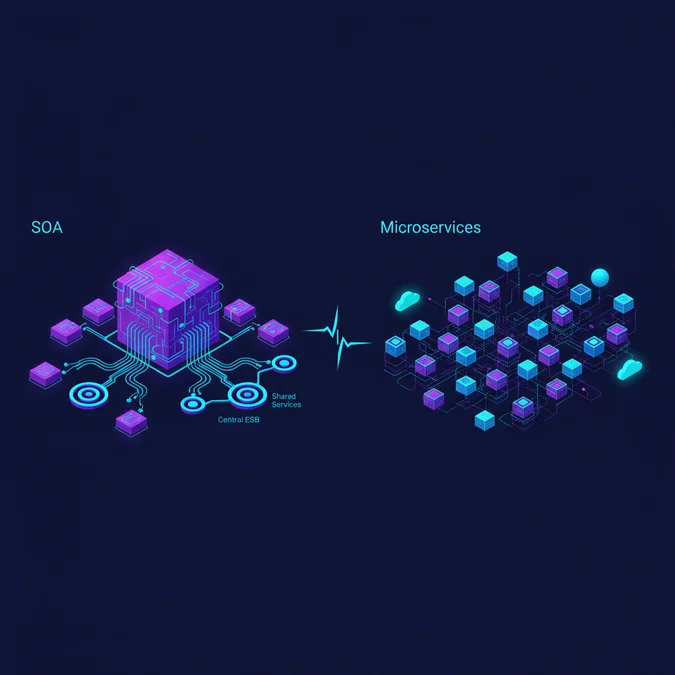

A distributed system fails when network calls cross process boundaries without isolation, turning a single degraded service into a cluster-wide outage. Microservices design patterns provide the architectural blueprints required to enforce data consistency, maintain system boundaries, and isolate cascade failures across distributed topologies.
Splitting monolithic systems into distributed services introduces network latency overhead, partial network failures, and distributed data anomalies. Without disciplined adherence to patterns such as the Transactional Outbox, Saga orchestration, and bulkhead isolation, engineering teams inadvertently build distributed monoliths that combine the deployment friction of monoliths with the debugging complexity of distributed networks.
This architectural guide analyzes core microservices design patterns through production-tested implementations, formal trade-off matrices, and Java 21 / Spring Boot 3 code. You will examine practical mechanics for data persistence, fault tolerance, domain boundary decomposition, and W3C context propagation for observability.
Core Foundations: Microservices Design Principles and Domain Boundaries
Microservices are not simply lightweight Web APIs running in separate containers. They represent autonomous domain boundaries where operational runtime independence aligns directly with distinct business lifecycles. Rushing into code without establishing foundational microservices design principles invariably results in shared databases, chattiness across networks, and synchronized release dependencies.
Architectural Principle: A service boundary is valid only if its operational team can modify its schema, refactor internal structures, and deploy changes into production without requiring synchronized deployments from any other service team.
When designing a microservice, teams must apply Domain-Driven Design (DDD) strategic design principles. Identifying Bounded Contexts establishes unambiguous semantic boundaries. Within the ‘Inventory’ context, a ‘Product’ entity tracks stock-keeping units (SKUs), bin locations, and replenishment thresholds. Within the ‘Billing’ context, a ‘Product’ models line items, tax jurisdictions, and amortization schedules. Attempting to unify these contexts into a shared model yields tight database coupling.
+-----------------------------------------------------------------------------------+| ENTERPRISE DOMAIN BOUNDARY |+-----------------------------------------------------------------------------------+ | | v v+---------------------------------+ +---------------------------------+| Order Context | | Fulfillment Context || - Aggregate: Order | Domain Event | - Aggregate: Shipment || - Invariants: Total, Payment | --------------> | - Invariants: Package Weight, || - Storage: Document Store | (Kafka Topic) | Carrier Tracking ID |+---------------------------------+ | - Storage: Relational DB | +---------------------------------+Prerequisite Checklist for Designing a Microservice
Before decomposing a legacy codebase or standing up new service boundaries, verify that your service blueprint passes this operational readiness checklist:
- Isolated Data Persistence: The service strictly possesses its own persistent store. No foreign services execute direct SQL reads or cross-schema joins.
- Autonomous CI/CD Pipeline: The service can be built, packaged as an immutable image, and deployed independently without coordinated lock-step rollouts.
- Domain-Driven Bounded Context: Ubiquitous language is formally defined, ensuring data schemas express only internal aggregate invariants.
- Failure Isolation (Blast Radius Containment): Network timeouts, circuit breakers, and thread/connection pools are defensively configured so upstream service failures cannot exhaust local CPU or worker threads.
- Explicit Telemetry Contracts: Distributed tracing headers (W3C traceparent) are ingested and propagated across all egress network communications.
Decomposition Strategies: Modern Microservices Architecture Patterns
Decomposition is an architectural trade-off balancing operational cohesion against inter-service network hops. Adopting microservices architecture patterns requires choosing between decomposition by business capability (e.g. Billing, Shipping, Catalog) or decomposition by subdomain (Core, Supporting, Generic). Failure to evaluate transaction frequency and entity relationships during decomposition creates chatty architectures that suffer from chronic distributed deadlocks and excessive tail latency.
Anti-Pattern Warning: The Distributed Monolith: If Service A must synchronously invoke Service B, which synchronously queries Service C to serve a simple read request, your architecture remains a monolith over unreliable HTTP/REST sockets. Strive for event-carried state transfer to eliminate synchronous dependency chains.
The following evaluation matrix outlines modern microservices architecture design patterns for decomposing business domains, detailing latency implications, data freshness, and maintenance overhead.
| Decomposition Pattern | Primary Coupling Dimension | Latency Impact | Data Freshness | Operational Overhead |
|---|---|---|---|---|
| Decomposition by Business Capability | High business alignment, low network coupling | Low (0-1 hops for localized domain queries) | Strong inside capability boundary | Moderate: requires deep domain discovery workshops |
| Decomposition by Subdomain (DDD Core/Supporting) | Strict semantic model boundaries | Moderate (depends on aggregate interaction frequency) | Eventual across disparate subdomain boundaries | High: requires continuous domain model governance |
| Strangler Fig Pattern | Legacy boundary proxying via API Gateway | Slight increase (+2-5ms API Gateway routing cost) | Hybrid: dual-read synchronization windows | Low-to-Moderate: predictable, phased migration path |
| Command Query Responsibility Segregation (CQRS) | Segregated Read/Write storage engines | Ultra-low read latency (optimized materialized views) | Eventual (bounded by asynchronous message broker lag) | High: multi-model synchronizers and schema migrations |
To safely migrate legacy systems without high-risk refactoring, apply the Strangler Fig pattern. Intercept inbound traffic at the API gateway layer. Gradually intercept discrete routes (such as customer notifications or payment webhooks) and redirect them to standalone microservices while preserving the core system behind facade endpoints.
Data Consistency Mechanics: Saga and Transactional Outbox Patterns
In distributed architectures, two-phase commit (2PC) protocols do not scale across cloud networks due to coordinator bottlenecks and row-level blocking hazards. To navigate transactions across services without 2PC, software architects apply modern microservices design patterns: the Saga pattern for multi-service business transactions, and the Transactional Outbox pattern to prevent data loss from dual-write operations.
Dual-writes occur when an application attempts to write to a relational database and publish an event to Apache Kafka within the same thread. If the application crashes or network partitions emerge between the database commit and the broker message push, data falls into an inconsistent state. Below is a production microservices design patterns with example showing an Outbox Entity and a reliable Spring Data JPA repository pattern.
package com.example.orderservice.outbox;import jakarta.persistence.*;import java.time.Instant;import java.util.UUID;@Entity@Table(name = "outbox_events")public class OutboxEvent { @Id @GeneratedValue(strategy = GenerationType.UUID) private UUID id; @Column(nullable = false, name = "aggregate_type") private String aggregateType; @Column(nullable = false, name = "aggregate_id") private String aggregateId; @Column(nullable = false) private String type; @Lob @Column(nullable = false) private String payload; @Column(nullable = false, name = "created_at") private Instant createdAt; protected OutboxEvent() {} public OutboxEvent(String aggregateType, String aggregateId, String type, String payload) { this.aggregateType = aggregateType; this.aggregateId = aggregateId; this.type = type; this.payload = payload; this.createdAt = Instant.now(); } public UUID getId() { return id; } public String getPayload() { return payload; } public String getType() { return type; }}With this entity defined, the order persistence logic executes atomically within a single local transaction, avoiding external network operations before the commit:
package com.example.orderservice.service;import com.example.orderservice.domain.Order;import com.example.orderservice.outbox.OutboxEvent;import com.example.orderservice.repository.OrderRepository;import com.example.orderservice.repository.OutboxRepository;import com.fasterxml.jackson.databind.ObjectMapper;import org.springframework.stereotype.Service;import org.springframework.transaction.annotation.Transactional;@Servicepublic class OrderApplicationService { private final OrderRepository orderRepository; private final OutboxRepository outboxRepository; private final ObjectMapper objectMapper; public OrderApplicationService(OrderRepository orderRepository, OutboxRepository outboxRepository, ObjectMapper objectMapper) { this.orderRepository = orderRepository; this.outboxRepository = outboxRepository; this.objectMapper = objectMapper; } @Transactional public Order createOrder(Order order) { Order savedOrder = orderRepository.save(order); try { String payload = objectMapper.writeValueAsString(savedOrder); OutboxEvent event = new OutboxEvent( "Order", savedOrder.getId().toString(), "OrderCreated", payload ); outboxRepository.save(event); } catch (Exception e) { throw new IllegalStateException("Failed to serialize outbox event", e); } return savedOrder; }}A Change Data Capture (CDC) engine such as Debezium reads the database transaction log (e.g. PostgreSQL WAL) and streams records directly to Apache Kafka. This guarantees at-least-once message delivery without transactional dual-write vulnerabilities.
Saga Coordination: Choreography vs Orchestration
When orchestrating multi-step distributed operations (e.g. reserve stock, debit credit line, issue invoice), teams select between two coordination models:
| Criteria | Choreography (Event-Driven) | Orchestration (Centralized Workflow) |
|---|---|---|
| Coupling Profile | Decoupled publishers/subscribers; zero direct coordinator links | Services depend on orchestrator contracts and status APIs |
| Traceability & Debugging | Difficult; requires correlating cross-service trace IDs | High; workflow execution state is centralized and queryable |
| Compensating Actions | Complex; cyclic dependency risks in distributed rollbacks | Straightforward; explicit compensating state handlers |
| Optimal Topology | Simple, 2-3 step asynchronous events | Complex business flows with branched failure compensations |
Resilience in Production: Practical Microservice Design Patterns in Java
In distributed systems, downstream timeouts inevitably compound. If an upstream service blocks worker threads waiting on an unresponsive downstream dependency, the entire thread pool becomes exhausted within seconds. Implementing microservice design patterns java with Resilience4j and Spring Boot 3 provides fault isolation using Circuit Breakers, Bulkheads, and Rate Limiters according to microservices architecture best practices.
[ Inbound Request ] | v+-------------------------------------------------------------+| Resilience4j Circuit Breaker Router |+-------------------------------------------------------------+ | | | (State: CLOSED) (State: OPEN) (State: HALF-OPEN) v | v[ Invoke Remote API ] | [ Probe Canary Requests ] | | | +----------------+-----------------------------+ v [ Execute Fallback Routine / Degraded Payload ]Step-by-Step Implementation of Circuit Breaker & Bulkhead
- Declare Resilience4j Dependencies: Add the Spring Boot 3 starter for Resilience4j and Spring AOP to your Gradle or Maven build file:
implementation 'io.github.resilience4j:resilience4j-spring-boot3:2.2.0' - Configure Circuit Breaker and Bulkhead Thresholds: Set rolling window parameters, failure rate thresholds, and concurrency barriers in your application YAML configuration:
resilience4j: circuitbreaker: instances: paymentService: slidingWindowType: COUNT_BASED slidingWindowSize: 20 minimumNumberOfCalls: 10 failureRateThreshold: 50.0 waitDurationInOpenState: 10000ms permittedNumberOfCallsInHalfOpenState: 3 automaticTransitionFromOpenToHalfOpenEnabled: true bulkhead: instances: paymentService: maxConcurrentCalls: 15 maxWaitDuration: 10ms3. Annotate Remote Client Methods with Fallback Guards: Decorate outbound HTTP/REST clients with Resilience4j annotations. The following production code demonstrates a resilient client handling degraded downstreams cleanly:
package com.example.orderservice.client;import io.github.resilience4j.bulkhead.annotation.Bulkhead;import io.github.resilience4j.circuitbreaker.annotation.CircuitBreaker;import org.slf4j.Logger;import org.slf4j.LoggerFactory;import org.springframework.stereotype.Component;import org.springframework.web.client.RestClient;import java.math.BigDecimal;import java.util.UUID;@Componentpublic class PaymentServiceClient { private static final Logger log = LoggerFactory.getLogger(PaymentServiceClient.class); private final RestClient restClient; public PaymentServiceClient(RestClient.Builder restClientBuilder) { this.restClient = restClientBuilder.baseUrl("https://api.payment-gateway.internal").build(); } @CircuitBreaker(name = "paymentService", fallbackMethod = "processPaymentFallback") @Bulkhead(name = "paymentService", type = Bulkhead.Type.SEMAPHORE) public PaymentResponse processPayment(UUID orderId, BigDecimal amount) { return restClient.post().uri("/v1/charges").body(new PaymentRequest(orderId, amount)).retrieve().body(PaymentResponse.class); } public PaymentResponse processPaymentFallback(UUID orderId, BigDecimal amount, Throwable ex) { log.warn("Payment gateway degraded. Fallback invoked for order: {}. Reason: {}", orderId, ex.getMessage()); return new PaymentResponse(orderId, "QUEUED_FOR_OFFLINE_PROCESSING", null); } public record PaymentRequest(UUID orderId, BigDecimal amount) {} public record PaymentResponse(UUID orderId, String status, String transactionRef) {}}With this configuration, when the payment gateway fails or takes longer than the expected timeout, Resilience4j intercepts the exception. It trips the circuit breaker to OPEN once the 50% failure rate is breached, shedding network traffic immediately and executing the local fallback routine without saturating worker threads.
Distributed Tracing and Observability for Faster Incident Resolution
Diagnosing root causes in microservice topologies without distributed tracing is slow and inefficient. When an edge request traverses six decoupled services and fails on the final call, aggregated log engines cannot pinpoint the bottleneck unless every trace statement shares a unified context. Achieving microservices architecture faster resolution distributed applications requires strict instrumentation using OpenTelemetry and the W3C Trace Context standard.
Observability Golden Rule: Logs without distributed correlation IDs create operational bottlenecks during outages. Ingest and propagate
traceparentandtracestateheaders across every HTTP request, gRPC invocation, and message broker payload.
The standard W3C traceparent header structure consists of four dash-delimited hex fields:
Value = version-trace_id-parent_id-trace_flagsExample: 00-4bf92f3577b34da6a3ce929d0e0e4736-00f067aa0ba902b7-01Field Breakdown: 00 - Version 00 4bf92f3577b34da6a3ce929d0e0e4736 - 16-byte Globally Unique Trace ID 00f067aa0ba902b7 - 8-byte Parent Span ID 01 - 8-bit Field Flags (01 = Context Recorded / Sampled)Spring Boot 3 integrates distributed tracing natively through Micrometer Tracing. Below is an interceptor implementation showing context injection into asynchronous message headers prior to Kafka dispatch:
package com.example.orderservice.telemetry;import io.opentelemetry.api.trace.Span;import io.opentelemetry.api.trace.Tracer;import io.opentelemetry.context.Context;import io.opentelemetry.context.propagation.TextMapSetter;import org.apache.kafka.clients.producer.ProducerRecord;import org.springframework.kafka.core.ProducerPostProcessor;import org.springframework.stereotype.Component;import java.nio.charset.StandardCharsets;@Componentpublic class TracingProducerPostProcessor implements ProducerPostProcessor<String, Object> { private final Tracer tracer; private static final TextMapSetter<ProducerRecord<String, Object>> SETTER = (carrier, key, value) -> { if (carrier!= null && carrier.headers()!= null) { carrier.headers().remove(key); carrier.headers().add(key, value.getBytes(StandardCharsets.UTF_8)); } }; public TracingProducerPostProcessor(Tracer tracer) { this.tracer = tracer; } @Override public ProducerRecord<String, Object> apply(ProducerRecord<String, Object> record) { Span currentSpan = tracer.spanBuilder("kafka.produce").startSpan(); try (var ignored = currentSpan.makeCurrent()) { currentSpan.setAttribute("messaging.system", "kafka"); currentSpan.setAttribute("messaging.destination", record.topic()); io.opentelemetry.api.GlobalOpenTelemetry.getPropagators().getTextMapPropagator().inject(Context.current(), record, SETTER); return record; } finally { currentSpan.end(); } }}When downstream consumers read records from the Kafka topic, they extract the traceparent header, restore the OpenTelemetry context, and attach their child spans to the parent trace ID. This unbroken telemetry graph enables site reliability engineers to immediately correlate failures and isolate bottlenecks in distributed applications.
Frequently Asked Questions
What are the most critical microservices design patterns for transactional integrity?
The Saga pattern and the Transactional Outbox pattern are critical for transactional integrity. Saga coordinates multi-service transactions using compensating actions, while the Transactional Outbox pattern avoids dual-write hazards by atomically writing business events to a database table before dispatching them to an event broker.
How do you achieve faster incident resolution in distributed microservices applications?
Faster incident resolution relies on distributed tracing through OpenTelemetry and structured logging with unified correlation IDs. Propagating W3C Trace Context across HTTP and gRPC boundaries enables real-time bottleneck identification, dependency mapping, and immediate root-cause isolation across decoupled services.
When designing a microservice, what is the best strategy for database segregation?
Adopt the Database-per-Service pattern. Each microservice must own its persistent datastore privately, forbidding external direct SQL access. All inter-service data queries and modifications must execute strictly via defined public APIs or asynchronous event streams to preserve schema autonomy and domain encapsulation.
Which Java frameworks best support resilient microservices architecture design patterns?
Spring Boot 3 paired with Resilience4j provides robust primitives for Circuit Breaker, Rate Limiter, and Retry patterns. For high-throughput asynchronous communication, Spring Cloud Stream with Apache Kafka or Apache Pulsar ensures reliable event delivery and decoupling.
Mastering microservices design patterns requires balancing loose architectural coupling against distributed systems overhead. While decomposing systems into autonomous microservices accelerates deployment velocity, it also demands rigorous strategies for data consistency, resilient communications, and distributed observability.
By implementing the Transactional Outbox pattern with CDC, orchestrating complex lifecycles using Sagas, guarding remote boundaries via Resilience4j circuit breakers, and enforcing end-to-end W3C tracing, engineering organizations can scale systems reliably while avoiding the distributed monolith anti-pattern.