
A production billing outage at a major logistics provider exposed a classic architectural vulnerability: a single malformed XML schema modification deployed to an Enterprise Service Bus (ESB) choked the enterprise transformation pipeline, halting warehouse dispatches globally for nine hours. Downstream inventory, shipping, and customer portal services were healthy, but because every request traversed a centralized integration bus coupled to a massive shared Oracle cluster, the entire distributed system locked up simultaneously.
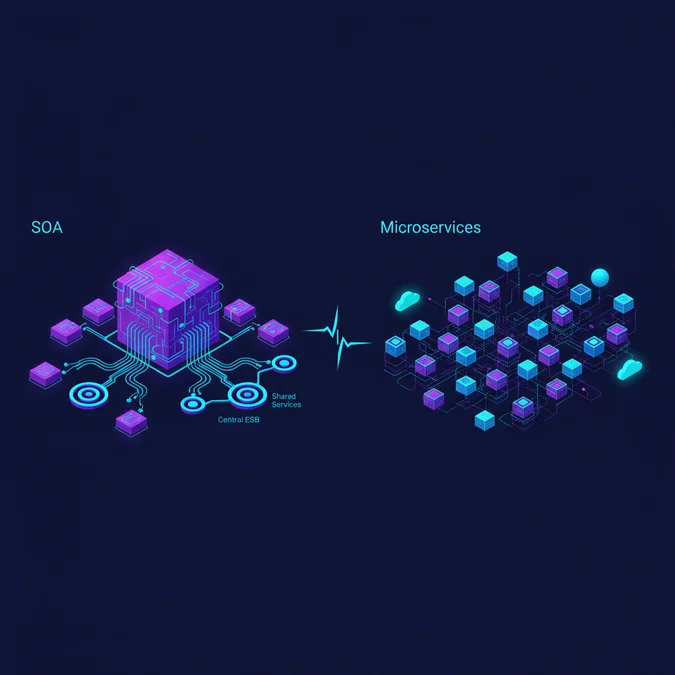
This scenario underscores the core operational tension between Service-Oriented Architecture (SOA) and microservices. While both paradigms deconstruct monolithic applications into networked components, their fundamental philosophies diverge completely on data ownership, integration complexity, protocol efficiency, and failure domain containment.
Understanding the architectural mechanics of soa vs microservices requires looking past vendor marketing and inspecting the physical reality of networked state. This breakdown examines how enterprise bus orchestration contrasts with smart endpoints, how shared enterprise schemas compare to bounded contexts, and how systems architects in 2026 successfully evaluate or migrate between these architectures without sacrificing operational stability.
Architectural Fundamentals: Service Oriented Architecture vs Microservices
When analyzing service oriented architecture vs microservices, software historians often describe microservices as SOA done right. From a systems engineering standpoint, this characterization is dangerously incomplete. Service-Oriented Architecture emerged in the late 1990s and early 2000s as an enterprise integration strategy designed to unlock data trapped in disparate, multi-vendor legacy mainframes, ERPs, and relational databases. Microservices emerged a decade later inside digital-native organizations attempting to solve organizational scaling bottlenecks under high-concurrency web workloads.
Architectural Axiom: The primary difference between soa and microservices is their approach to shared resources. SOA maximizes enterprise-wide software asset reuse through centralized abstraction layers, while microservices maximize autonomous team velocity and fault containment through complete decoupling of state and runtime.
In a classic SOA implementation, services are classified by business scope across the entire enterprise. A single CustomerService might be invoked by retail web apps, core banking mainframes, call center terminals, and business intelligence extractors. To accommodate this cross-organizational footprint, SOA relies on canonical data models (such as OAGIS or custom enterprise XSD schemas) and intermediate translation layers.
+-----------------------------------------------------------------+
| CLASSIC SOA ENTERPRISE TOPOLOGY |
+-----------------------------------------------------------------+
 [Web Client] [ERP Mainframe] [Partner B2B]
 | | |
 v v v
 +---------------------------------------------------------+
 | ENTERPRISE SERVICE BUS (ESB) |
 | (Protocol Mediation, XSLT Transformation, Routing) |
 +---------------------------------------------------------+
 | | |
 v v v
 [Order Service] [Inventory Service] [Customer Service]
 \_____________________|_____________________/
 |
 v
 [Shared Enterprise Database]

+-----------------------------------------------------------------+
| MODERN MICROSERVICES TOPOLOGY |
+-----------------------------------------------------------------+
 [Ingress / API Gateway]
 |
 +-----------------------+-----------------------+
 | (gRPC / HTTP) | (gRPC / HTTP) |
 v v v
 +-------------+ +-------------+ +-------------+
 | Order Svc | |Inventory Svc| |Customer Svc |
 +------+------+ +------+------+ +------+------+
 | | |
 v v v
 [(Order DB)] [(Inven DB)] [(Cust DB)]
 | | |
 +------[Event Broker: Kafka / NATS / RabbitMQ]--+
Microservices enforce strict bounded contexts derived from Domain-Driven Design (DDD). Rather than attempting to standardize a universal customer entity across an entire corporation, a microservices topology acknowledges that a customer in the Billing bounded context has a different data shape, lifecycle, and operational SLA than a customer in the Delivery bounded context.
| System Dimension | Service-Oriented Architecture (SOA) | Microservices Architecture |
|---|---|---|
| Core Motivation | Enterprise-wide application integration and reuse | Rapid iteration speed and independent deployability |
| Integration Model | Smart pipes (ESB, message brokers with business logic) | Dumb pipes (lightweight message buses, HTTP/2, gRPC) |
| Component Scope | Coarse-grained, enterprise-wide shared domains | Fine-grained, bounded-context domain capabilities |
| Primary Protocols | SOAP, WSDL, XML over JMS or HTTP | JSON/REST, gRPC (Protobuf), CloudEvents |
| Data Store Topology | Shared enterprise relational databases | Database-per-service (polyglot persistence) |
| Blast Radius | High (bus or shared database cascades failure) | Low (isolated within independent process memory) |
Communication Mechanics: ESB and Smart Pipes vs Dumb Pipes and Smart Endpoints
The technical chasm between soa and microservices is most visible at the transport and serialization layer. SOA environments rely on smart pipes. The integration layer, typically implemented via an Enterprise Service Bus such as IBM MQ, TIBCO Enterprise Message Service, or Oracle Service Bus, does not merely forward packets. It actively parses, validates, enriches, and transforms messages.
When a client issues a request in an SOA system, the bus often executes an XSLT transformation to convert a caller’s JSON or legacy fixed-width format into a complex SOAP envelope, validates that envelope against an enterprise-wide WSDL schema, queries an LDAP server for entitlement routing, and forwards the transformed XML payload to the backend service over JMS.
The Operational Cost of Smart Pipes: Embedding business logic, message enrichment, and validation inside middleware turns the transport infrastructure into a monolithic runtime. Deploying changes to ESB routing rules requires cross-team coordination, turning the communication pipe into an organizational chokepoint.
Microservices invert this dynamic by utilizing dumb pipes and smart endpoints. Protocols like gRPC (Protocol Buffers over HTTP/2) or JSON over REST treat network pipes as bit-pipes. Routing is handled by lightweight L7 proxies (Envoy, Linkerd) or cloud-native ingress controllers that execute zero business transformation. All validation, payload transformation, and domain checks happen exclusively within the service boundary.
Protocol Payload Comparison: SOAP XML vs Microservices Protobuf
Consider the serialization overhead of updating an order status. Below is a realistic enterprise SOAP XML payload traversing an SOA integration bus:
<xml version="1.0" encoding="UTF-8"?>
<soapenv:Envelope
 xmlns:soapenv="http://schemas.xmlsoap.org/soap/envelope/"
 xmlns:ord="http://enterprise.internal/schemas/2026/01/orders"
 xmlns:wsse="http://docs.oasis-open.org/wss/2004/01/oasis-200401-wss-wssecurity-secext-1.0.xsd">
 <soapenv:Header>
 <wsse:Security>
 <wsse:UsernameToken>
 <wsse:Username>svc_order_dispatcher</wsse:Username>
 <wsse:Password Type="http://docs.oasis-open.org/wss/2004/01/oasis-200401-wss-username-token-profile-1.0#PasswordText">SecretTokenHex991</wsse:Password>
 </wsse:UsernameToken>
 </wsse:Security>
 </soapenv:Header>
 <soapenv:Body>
 <ord:UpdateOrderStatusRequest>
 <ord:OrderID>ORD-2026-981023</ord:OrderID>
 <ord:NewStatus>DISPATCHED</ord:NewStatus>
 <ord:Timestamp>2026-03-30T10:14:00Z</ord:Timestamp>
 <ord:WarehouseID>WH-US-EAST-04</ord:WarehouseID>
 </ord:UpdateOrderStatusRequest>
 </soapenv:Body>
</soapenv:Envelope>
In a cloud-native microservices topology, the exact same interaction defined via Protocol Buffers compiles to a compact binary payload:
syntax = "proto3";

package logistics.orders.v1;

import "google/protobuf/timestamp.proto";

enum OrderStatus {
 ORDER_STATUS_UNSPECIFIED = 0;
 ORDER_STATUS_PENDING = 1;
 ORDER_STATUS_DISPATCHED = 2;
 ORDER_STATUS_DELIVERED = 3;
}

message UpdateOrderStatusRequest {
 string order_id = 1;
 OrderStatus new_status = 2;
 google.protobuf.Timestamp timestamp = 3;
 string warehouse_id = 4;
}

message UpdateOrderStatusResponse {
 bool acknowledged = 1;
}
The SOAP envelope requires parsing hundreds of bytes of string headers, XML namespace resolution, and DOM allocations in process memory. The Protobuf payload is serialized into approximately 35 binary bytes, deserialized with near-zero memory allocation, and transmitted over an existing multiplexed HTTP/2 TCP connection. Under loads exceeding 50,000 requests per second, the compute overhead required by the ESB to parse and validate XML schemas introduces tens of milliseconds of tail latency and demands massive horizontal scaling of middleware servers.
Component Granularity: Analyzing Service vs Microservice Boundaries
Engineers evaluating service vs microservice paradigms often fixate on lines of code. Granularity, however, is not a metric of file size; it is a metric of operational lifecycle isolation and domain breadth. An SOA service is traditionally coarse-grained and enterprise-oriented. A microservice is fine-grained and capability-oriented.
An enterprise SOA AccountManagementService typically exposes dozens of operations: credit validation, customer profile editing, KYC compliance checking, invoice generation, and ledger history retrieval. Because this service represents the singular corporate gateway to account records, multiple business units demand continuous changes. Deploying a bugfix for KYC compliance risks breaking the invoice generation logic because both execute within the same service process memory or application server deployment cluster.
- Service (SOA) Lifecycle Boundary: Large surface area, multiple business domain mappings, shared build pipelines, coordinated quarterly or monthly releases.
- Microservice Lifecycle Boundary: Small surface area, strict alignment to a single DDD aggregate root, fully autonomous CI/CD pipelines, daily or hourly deployments.
- Team Topology Alignment: SOA services are maintained by centralized horizontal teams (database administrators, middleware specialists, UI engineers). Microservices follow Conway’s Law directly, using vertical, cross-functional two-pizza teams owning the service from schema to production monitoring.
- Failure Isolation: SOA components share dependencies and runtime JVMs or app servers (WebLogic, WebSphere). Microservices execute inside isolated Linux containers (OCI/Docker) with strict CPU and memory cgroups.
The operational reality of boundary selection directly governs organizational velocity. When team boundaries do not match system boundaries, communication friction halts deployment pipelines.
| Operational Criterion | Enterprise Service (SOA) | Microservice Component |
|---|---|---|
| Domain Alignment | Broad enterprise domain (Finance, Logistics) | Specific bounded context aggregate (Settlement, Invoicing) |
| Deployment Artifact | EAR, WAR, or composite package deployed to app server | Self-contained OCI container image with embedded runtime |
| Runtime Coupling | Frequently shares runtime container with other services | Strictly containerized, dedicated memory/CPU limits |
| Schema Ownership | Shared corporate schemas, enterprise steering committee | Private service schema, team has total modification autonomy |
| Scaling Model | Scale the entire composite application server | Autoscale individual pods based on CPU, memory, or queue depth |
Data Governance and State: Monolithic Stores vs Database-Per-Service
The data layer represents the most contentious operational divide between service oriented architecture and microservices. SOA historically embraced the shared data model. Multiple enterprise services read from and write to identical tables within a unified corporate database schema, enforcing consistency via foreign keys, stored procedures, and distributed two-phase commit (2PC) transactions managed by the Java Transaction API (JTA) or XA protocols.
The Two-Phase Commit Trap: While XA and two-phase commit protocols guarantee ACID transactions across heterogeneous systems, they do so by holding distributed locks across all participating nodes during the prepare and commit phases. In high-latency or fluctuating network environments, a single slow node holds database locks open across the entire enterprise, collapsing overall transaction throughput.
Microservices enforce database-per-service architecture. A service owns its persistent store exclusively; no external service is permitted to query the database directly. All interaction must pass through public APIs or published domain events. This isolation completely eliminates database schema locks across teams, but it forces engineers to solve distributed state consistency without 2PC.
Instead of distributed locks, microservices employ eventual consistency managed through the Saga pattern and the Transactional Outbox pattern. When an aggregate updates its internal state, it atomically writes a change record to an outbox table within the same local database transaction. A separate relay process reads the outbox and streams events across a broker.
Transactional Outbox Pattern Implementation
Below is a production PostgreSQL schema and transactional event writer in Go demonstrating local state modification paired with reliable event dispatch, avoiding dual-write distributed transaction failures:
-- Schema ensuring atomic local consistency without XA transactions
CREATE TABLE orders (
 order_id UUID PRIMARY KEY,
 customer_id UUID NOT NULL,
 total_amount NUMERIC(12, 2) NOT NULL,
 status VARCHAR(32) NOT NULL,
 updated_at TIMESTAMPTZ NOT NULL DEFAULT NOW()
);

CREATE TABLE transactional_outbox (
 outbox_id UUID PRIMARY KEY DEFAULT gen_random_uuid(),
 aggregate_type VARCHAR(64) NOT NULL,
 aggregate_id UUID NOT NULL,
 event_type VARCHAR(64) NOT NULL,
 payload JSONB NOT NULL,
 created_at TIMESTAMPTZ NOT NULL DEFAULT NOW(),
 processed_at TIMESTAMPTZ NULL
);

CREATE INDEX idx_outbox_unprocessed ON transactional_outbox (created_at)
WHERE processed_at IS NULL;
package main
import (
"context"
"database/sql"
"encoding/json"
"time"
"github.com/google/uuid"
)
type OrderEvent struct {
OrderID uuid.UUID `json:"order_id"`
Status string `json:"status"`
Timestamp time.Time `json:"timestamp"`
}
// CreateOrderAtomic stores order state and outbox record in a single local transaction,
// eliminating the need for an enterprise distributed transaction coordinator.
func CreateOrderAtomic(ctx context.Context, db *sql.DB, customerID uuid.UUID, amount float64) (uuid.UUID, error) {
tx, err:= db.BeginTx(ctx, &sql.TxOptions{Isolation: sql.LevelReadCommitted})
if err!= nil {
return uuid.Nil, err
}
defer tx.Rollback()
orderID:= uuid.New()
now:= time.Now().UTC()
_, err = tx.ExecContext(ctx,
`INSERT INTO orders (order_id, customer_id, total_amount, status, updated_at) VALUES ($1, $2, $3, $4, $5)`,
orderID, customerID, amount, "CREATED", now,
)
if err!= nil {
return uuid.Nil, err
}
payload, err:= json.Marshal(OrderEvent{OrderID: orderID, Status: "CREATED", Timestamp: now})
if err!= nil {
return uuid.Nil, err
}
_, err = tx.ExecContext(ctx,
`INSERT INTO transactional_outbox (aggregate_type, aggregate_id, event_type, payload, created_at) VALUES ($1, $2, $3, $4, $5)`,
"Order", orderID, "OrderCreated", payload, now,
)
if err!= nil {
return uuid.Nil, err
}
return orderID, tx.Commit()
}By migrating from distributed XA database locks to localized outbox persistence, systems trade immediate cross-system transactional guarantees for horizontal scalability, zero lock contention, and distinct blast radiuses.
Rigorous Engineering Benchmark: Microservices vs SOA Architecture
A nuanced architectural evaluation requires analyzing structural trade-offs systematically. Evaluating microservices vs soa architecture requires understanding that neither pattern is intrinsically superior; they optimize for fundamentally different enterprise constraints.
The benchmark table below evaluates both patterns across twelve critical system design parameters, highlighting the operational realities encountered in 2026 production environments.
| Dimension | Service-Oriented Architecture (SOA) | Microservices Architecture |
|---|---|---|
| 1. Coupling Degree | Tight data and transport coupling via ESB and schemas | Loose coupling via strict API boundaries and private stores |
| 2. Failure Blast Radius | Large: centralized bus or DB failure cascades globally | Small: failures contained to specific bounded contexts |
| 3. Mean Network Latency | High (20ms to 150ms) due to XML parsing and bus hops | Low (1ms to 10ms) using gRPC/HTTP/2 direct routing |
| 4. Data Consistency | Strong consistency via XA/2PC distributed transactions | Eventual consistency via Sagas and event streaming |
| 5. Governance Model | Centralized enterprise architecture board (Top-down) | Decentralized governance, service ownership teams |
| 6. CI/CD Autonomy | Low: complex interdependency testing and shared releases | High: independent deployment pipelines and canary rollouts |
| 7. Observability Model | Bus-centric logging, proprietary vendor tracing tools | Distributed tracing (OpenTelemetry), APM, Prometheus metrics |
| 8. Infrastructure Overhead | High memory footprint (heavy enterprise app servers) | Low per-node footprint (containers, serverless, microvms) |
| 9. Inter-service Protocols | SOAP, WSDL, XML over JMS, WS-Security standards | Protobuf over gRPC, JSON/REST, async AMQP/Kafka |
| 10. Scalability Horizon | Vertical scaling of bus/DB with limited horizontal scale | Elastic horizontal scaling of discrete micro-components |
| 11. Team Structure | Functional silos (DBAs, ESB admins, business coders) | Cross-functional product teams (end-to-end responsibility) |
| 12. Network Failure Modes | Deadlock during distributed lock timeouts, ESB saturation | Partial availability, network partitions, cascading retries |
When selecting between soa vs microservices, teams must also evaluate the operational cost of managing decentralized complexity. Microservices solve organizational gridlock but dramatically increase the operational baseline.
- Service Mesh Overhead: Microservices require infrastructure layers (Envoy sidecars, mTLS, traffic splitting) that introduce CPU overhead and telemetry configuration burdens.
- Distributed Tracing Demands: Debugging a single request in microservices demands strict propagation of OpenTelemetry trace contexts across dozens of network boundaries.
- Eventual Consistency Handling: Frontend applications must be architected to handle asynchronous data propagation gracefully, using optimistic UI updates and polling mechanisms.
- Contract Testing Rigor: Independent deployments necessitate comprehensive consumer-driven contract testing (e.g. Pact) to prevent breaking API changes in upstream services.
System Decision Framework: When to Choose or Migrate Between Architectures
The decision to modernize from an established SOA topology or adopt microservices directly must be guided by organizational scale, domain volatility, and existing legacy integration needs. SOA remains a rational engineering choice when an organization must unify large, commercial off-the-shelf (COTS) legacy systems (such as SAP, Siebel, or legacy banking cores) where source code modification is impossible and vendor contracts mandate standard SOAP interfaces.
Microservices are the unequivocal choice when organizations build bespoke digital products requiring high deployment frequency, elastic auto-scaling under fluctuating user traffic, and autonomous team execution.
The Strangler Fig Migration Playbook
Decommissioning an enterprise SOA architecture with an ESB cannot be accomplished via a high-risk big-bang rewrite. The proven approach is the Strangler Fig pattern, systematically carving bounded contexts out of the centralized bus until the legacy infrastructure can be decommissioned.
- Deploy an API Gateway Ingress Facade: Position a modern, high-performance API Gateway (such as Kong, Traefik, or Envoy) in front of the existing ESB. All external clients route requests exclusively through this gateway, decoupling clients from internal routing configurations.
- Isolate a Single Bounded Context: Select an edge domain with high business value and minimal dependencies (such as a Notification Service or Customer Reviews) rather than a heavily coupled core ledger.
- Implement the Microservice and Data Store: Build the new service using database-per-service principles. Ensure all write operations to the new domain are handled directly by this microservice.
- Establish Bi-Directional Event Synchronization: Use Change Data Capture (CDC via Debezium) or event relays to project updates from the new microservice back to the legacy shared database to satisfy legacy SOA consumers that have not yet been migrated.
- Shift Traffic Incrementally via Canary Routing: Configure the API Gateway to route a percentage of traffic for that domain away from the ESB directly to the new microservice. Monitor latency, error budgets, and data integrity metrics.
- Sever the Legacy ESB Pathway: Once 100 percent of traffic executes through the new microservice without error, decommission the corresponding orchestration flows inside the ESB and retire the legacy tables. Repeat the sequence for the next bounded context.
- Migration Prerequisite: Establish continuous telemetry (distributed tracing, Golden Signals monitoring) before moving the first percentage of production traffic.
- Migration Prerequisite: Define rollback strategies at the API Gateway routing layer, enabling immediate reversion to the ESB within seconds of anomaly detection.
- Migration Prerequisite: Validate that the legacy database does not execute hidden stored procedure triggers that corrupt state during asynchronous synchronization.
Frequently Asked Questions
What is the primary difference between SOA and microservices?
The core difference between soa and microservices lies in data isolation and integration architecture. SOA relies on an Enterprise Service Bus (ESB) for centralized routing, message transformation, and a shared enterprise database. Microservices enforce decentralized data ownership using a database-per-service pattern, connecting autonomous components via lightweight, direct protocols.
Can SOA and microservices coexist within the same enterprise platform?
Yes, soa and microservices frequently coexist in large enterprise environments. Organizations routinely place modern API gateways in front of legacy SOA backends, gradually extracting specific bounded domains into autonomous microservices using the Strangler Fig pattern while keeping core transactional mainframes stable.
Why do microservices avoid the Enterprise Service Bus used in SOA?
When evaluating microservices vs soa architecture, microservices reject the ESB because centralized smart pipes become systemic bottlenecks, single points of failure, and organizational chokepoints. Microservices favor smart endpoints and dumb pipes, handling routing and business validation within the service runtime rather than in the messaging layer.
How do failure blast radiuses compare between a service and a microservice?
In a service vs microservice comparison, an enterprise SOA service has a wide blast radius because shared databases, synchronous SOAP dependencies, and centralized bus failures cascade across business units. A microservice confines failures to its local container and private database, supported by circuit breakers and asynchronous queues.
The choice between Service-Oriented Architecture and microservices is not a matter of modern trends versus legacy obsolescence; it is a fundamental architectural decision about where system complexity should reside. SOA chooses to concentrate integration, routing, and data transformation within centralized middleware, simplifying endpoint implementations at the cost of operational agility and single-point-of-failure vulnerabilities. Microservices deliberately shift that complexity to network infrastructure, distributed state management, and operational tooling to purchase radical autonomy and localized fault boundaries.
When architecting distributed systems for long-term scalability, evaluate your team topologies and failure budgets realistically. If your enterprise is bound by rigid enterprise databases and multi-vendor ERP suites, a modernized SOA with lightweight integration hubs may prevent unnecessary architectural overhead. If your platform demands continuous deployment, sub-millisecond serialization, and elastic cloud-native scaling, decomposing bounded contexts into containerized microservices remains the gold standard.
Benchmarking Architecture Trade-offs?
Discuss real-world performance characteristics and production considerations for your specific workload.