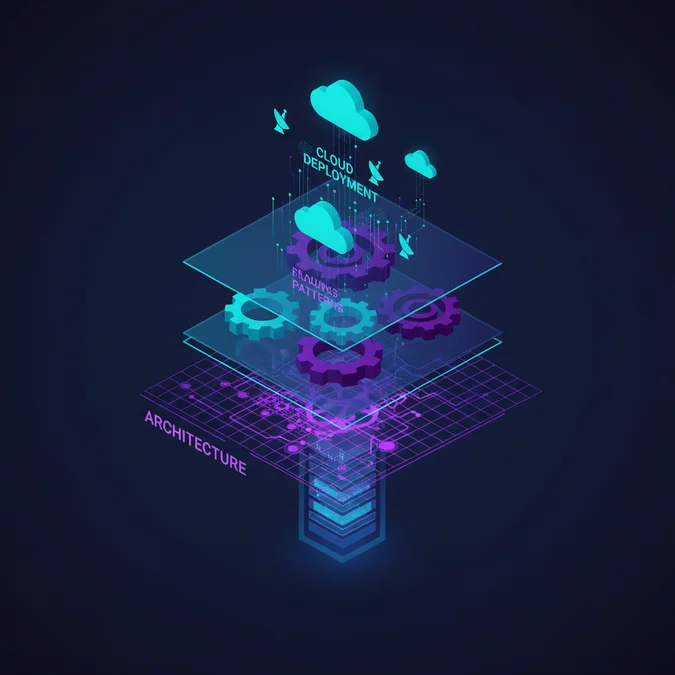

Layered software development is an architectural methodology that organizes an application into discrete, hierarchical tiers (typically presentation, business logic, persistence, and database layers) where each layer possesses dedicated responsibilities and communicates strictly with adjacent boundaries. This separation isolates domain rules from underlying infrastructure, simplifying testing, code maintenance, and horizontal scaling across cloud systems.
As modern cloud deployments evolve toward distributed microservices, containerization, and edge runtimes, teams are rediscovering the stability of layered design. While pure microservice architectures often introduce severe network latency, distributed state complexities, and deployment overhead, a well-structured layered design allows engineering organizations to retain modular boundaries within maintainable services before prematurely distributing their systems across physical network perimeters.
From an infrastructure perspective, layered systems align cleanly with modern cloud constructs. Application layers map directly to independent scaling groups, managed database read replicas, and isolated subnet topologies, providing clear observability signals and predictable failure domains under heavy production traffic.
Core Architectural Anatomy of Layered Systems
A classical layered architecture organizes software components into horizontal bands of abstraction. The foundational rule of layered systems is the principle of closed layers: a given layer can only communicate with the layer immediately beneath it. This structure guarantees that higher-level abstractions remain completely insulated from low-level implementation details.
The Canonical Four-Layer Hierarchy
- Presentation Layer: Ingests external network payloads, terminates SSL/TLS, deserializes incoming JSON or HTTP form requests, handles protocol-level validations, and maps domain responses to API schemas or server-rendered views.
- Application (Orchestration) Layer: Coordinates transactions, handles cross-cutting workflows, manages distributed locks, and coordinates external third-party SDK calls without housing pure domain logic.
- Domain (Business Logic) Layer: Implements immutable business rules, domain entities, value objects, and domain events. This layer must remain pure PHP or agnostic core code, free from direct references to database ORMs, HTTP request objects, or cloud SDKs.
- Persistence (Infrastructure) Layer: Manages concrete database queries via SQL or ORMs, cache interactions through Redis, message queue dispatchers via Amazon SQS or RabbitMQ, and file storage APIs via Amazon S3.
Understanding these boundaries forms the bedrock of modern engineering operations when producing software with scalable delivery pipelines, ensuring application source code mirrors the reliability expectations of modern cloud platforms.
Layered Architecture in Frameworks: The Laravel Implementation
While frameworks like Laravel ship out of the box with an expressive Model-View-Controller (MVC) structure, production enterprise backends rapidly outgrow basic MVC. Active Record models frequently become bloated God classes that mix SQL queries, authorization checks, serialization, and background job dispatches.
Transitioning to a dedicated multi-layered pattern inside Laravel separates these responsibilities across custom service providers, command handlers, and discrete data repositories.
Refactoring from Fat Controllers to Structured Layers
Consider an enterprise checkout pipeline. Instead of executing order calculation, payment gateway calls, and database updates inside a standard controller, the controller delegates immediately to an application service. The application service consumes decoupled interfaces implemented within the infrastructure layer.
<php

namespace App\Http\Controllers;

use App\Http\Requests\CheckoutRequest;
use App\Services\CheckoutApplicationService;
use App\DTOs\CheckoutData;
use Illuminate\Http\JsonResponse;

class CheckoutController extends Controller
{
 // Presentation Layer: Validates input protocol and dispatches to Application Layer
 public function __invoke(CheckoutRequest $request, CheckoutApplicationService $service): JsonResponse
 {
 // DTO transforms raw untrusted array into typed memory structure
 $checkoutData = CheckoutData:fromRequest($request);

 $orderResult = $service->processOrder($checkoutData);

 return response()->json([
 'order_id' => $orderResult->id,
 'status' => $orderResult->status,
 ], 201);
 }
}
In this pattern, the controller acts purely as a protocol translator between HTTP requests and the internal domain structure.
Service and Domain Layers: Isolate Business Logic from Infrastructure
The core business layer must never couple directly to database models or web framework libraries. When domain logic is tightly coupled to Eloquent models, upgrading framework versions or refactoring database schemas carries immense risk of regressions.
By introducing explicit domain entities and application services, core calculations and business state transitions remain fully isolated.
<php

namespace App\Services;

use App\DTOs\CheckoutData;
use App\Domain\Entities\Order;
use App\Domain\Repositories\OrderRepositoryInterface;
use App\Domain\Repositories\InventoryGatewayInterface;
use App\Domain\Exceptions\InsufficientInventoryException;

class CheckoutApplicationService
{
 public function __construct(
 private OrderRepositoryInterface $orderRepository,
 private InventoryGatewayInterface $inventoryGateway
 ) {}

 public function processOrder(CheckoutData $data): Order
 {
 // Domain validation step decoupled from database state
 if (!$this->inventoryGateway->reserveUnits($data->sku, $data->quantity)) {
 throw new InsufficientInventoryException("Unable to reserve stock for item: {$data->sku}");
 }

 // Entity encapsulates immutable pricing and state rules
 $order = Order:create(
 sku: $data->sku,
 quantity: $data->quantity,
 unitPrice: $data->unitPrice,
 customerEmail: $data->email
 );

 return $this->orderRepository->save($order);
 }
}
This design allows rigorous automated testing of edge conditions using comprehensive mock suites without touching a live database connection.
Infrastructure and Data Access: Clean Repositories and ORMs
The persistence layer implements the interfaces defined by the domain layer. This architectural inversion (the Dependency Inversion Principle) ensures that high-level modules do not depend on low-level modules; both depend on abstractions.
Concrete Repository Implementation
Below is a production-grade infrastructure repository that wraps an ORM, translating database records into domain models and handling transient database failures gracefully.
<php

namespace App\Infrastructure\Persistence;

use App\Domain\Entities\Order as OrderDomainEntity;
use App\Domain\Repositories\OrderRepositoryInterface;
use App\Models\Order as EloquentOrderModel;
use Illuminate\Support\Facades\DB;

class EloquentOrderRepository implements OrderRepositoryInterface
{
 public function save(OrderDomainEntity $entity): OrderDomainEntity
 {
 // Encapsulate raw transaction lifecycle in persistence boundary
 return DB:transaction(function () use ($entity) {
 $model = EloquentOrderModel:updateOrCreate(
 ['uuid' => $entity->getId()],
 [
 'sku' => $entity->getSku(),
 'quantity' => $entity->getQuantity(),
 'total_cents' => $entity->getTotalCents(),
 'status' => $entity->getStatus(),
 ]
 );

 // Reconstruct and return domain entity from saved state
 return $model->toDomainEntity();
 });
 }
}
This structural isolation protects teams when testing schemas or populating environments, which can be handled cleanly via dedicated database factory and seeder workflows.
Architectural Patterns Compared: Layered vs Hexagonal vs Clean vs Microservices
Selecting an architectural paradigm requires balancing operational overhead against application complexity. The table below evaluates the primary structural patterns across critical infrastructure and development metrics.
| Metric / Characteristic | Traditional Layered (N-Tier) | Hexagonal (Ports & Adapters) | Clean Architecture | Microservices |
|---|---|---|---|---|
| Infrastructure Overhead | Low (Single runtime deployment) | Low (Single runtime deployment) | Low to Moderate | High (Multiple containers, service mesh) |
| Coupling Direction | Top-down dependency flow | Inverted (Inside-out via ports) | Inverted (Strict concentric rings) | Network-isolated endpoints |
| Refactoring Cost | Low within layers | Moderate (Interface management) | Moderate to High | Extremely High across boundaries |
| Deployment Complexity | Low (Standard CI/CD pipeline) | Low (Single artifact) | Low to Moderate | Complex (Distributed coordination) |
| Testing Isolation | Moderate (Mocks at boundary) | High (Pure port mockability) | High (Strict domain purity) | High per service (Complex E2E) |
A layered model excels during initial build and steady-state scaling, providing structured velocity without the network failure modes introduced by prematurely adopting distributed microservices.
Horizontal Scaling and Infrastructure Topology for Layered Applications
From an infrastructure perspective, layered software maps cleanly onto decoupled cloud tiers. Rather than running database queries, memory caches, worker queues, and HTTP processes within a single compute instance, cloud architects divide compute resources by layer function.
Layered Cloud Infrastructure Blueprint
- Edge Routing and WAF Layer: AWS CloudFront or Cloudflare routes traffic, mitigates volumetric DDoS attacks, handles TLS termination, and caches static presentation assets at point-of-presence (PoP) edge nodes.
- Presentation & Application Compute Tier: Stateless container tasks running on AWS ECS (Fargate) or Google Cloud Run behind an Application Load Balancer (ALB). Tasks scale horizontally based on active HTTP connections and CPU target utilization metrics.
- Asynchronous Processing Tier: Worker tasks decoupled via message queues (Amazon SQS) consuming compute-heavy domain operations (PDF generation, webhooks, analytics sync) without blocking HTTP runtimes.
- Persistence and Caching Tier: AWS Aurora PostgreSQL running Multi-AZ with dedicated read replicas, backed by an in-memory Redis cluster (Amazon ElastiCache) handling session state, distributed locks, and query result caching.
Decoupling stateless compute from stateful persistence allows zero-downtime rolling updates. Web containers can be replaced dynamically without tearing down persistent database connections or losing background queue jobs.
Managing Layer Boundaries: Dependency Injection and Container Binding
A critical challenge in layered architecture is preventing leakages between layers. If a presentation controller instantiates an infrastructure database client directly using new MySQLDatabase(), the boundary breaks. Dependency injection containers resolve this issue at runtime.
By binding domain interfaces to infrastructure implementations within application service providers, runtime dependencies remain configurable across local development, integration testing, and production environments.
<php

namespace App\Providers;

use Illuminate\Support\ServiceProvider;
use App\Domain\Repositories\OrderRepositoryInterface;
use App\Infrastructure\Persistence\EloquentOrderRepository;
use App\Infrastructure\Persistence\InMemoryOrderRepository;

class RepositoryServiceProvider extends ServiceProvider
{
 public function register(): void
 {
 // Dynamically bind concrete implementation based on environment configuration
 if ($this->app->environment('testing')) {
 $this->app->bind(OrderRepositoryInterface:class, InMemoryOrderRepository:class);
 return;
 }

 $this->app->bind(OrderRepositoryInterface:class, EloquentOrderRepository:class);
 }
}
This loose coupling allows developers to swap external systems (such as transitioning from local storage to S3, or swapping mail drivers) without modifying a single line of business logic.
Common Anti-Patterns and Layer Violations in Production
Despite clear boundaries on architectural diagrams, production codebases frequently succumb to subtle anti-patterns that erode the advantages of layered software.
Common Degradation Traps
- The Sinkhole Anti-Pattern: Requests pass through multiple layers without any processing or business logic execution. A controller calls an application service, which calls a domain service, which calls a repository, which simply runs an
all()query. If a request requires no domain logic, forcing it through four layers creates unnecessary boilerplate. Selective bypassing via lightweight read models (CQRS) solves this. - Leaky Abstractions: Database exceptions (such as
QueryExceptionor foreign key errors) bubbling directly to the presentation controller. The persistence layer must catch database-specific exceptions and rethrow standardized domain exceptions. - Circular Dependencies: Infrastructure classes calling domain services that directly instantiate persistence models. Enforce strict static analysis rules in CI pipelines using tools like PHPStan or Deptrac to flag illegal boundary imports before code merges to production branches.
Adhering to strict coding standards throughout the complete lifecycle is highlighted across standard software engineering process models, protecting production systems from architectural decay over time.
Observability, Telemetry, and Failure Modes Across Layers
When a production incident occurs, layered software provides structured telemetry boundaries. By standardizing OpenTelemetry tracing across layer entry and exit points, distributed traces reveal the exact layer responsible for elevated p99 latencies.
Instrumenting Layer Tracing
Assigning explicit metadata tags to spans allows observability platforms like Datadog, Honeycomb, or AWS X-Ray to isolate issues:
- Span Tag
layer:presentation: Measures inbound HTTP request parsing, JSON deserialization, and authentication middleware overhead. Elevated duration points to excessive request payload size or slow identity provider calls. - Span Tag
layer:application: Measures business logic coordination, event dispatching, and distributed transaction waits. - Span Tag
layer:persistence: Tracks query compilation, network roundtrips to database endpoints, connection pool waits, and cache misses.
If overall request latency spikes to 1.8 seconds, telemetry broken down by architectural layer immediately highlights whether the bottleneck stems from an unindexed database query in the persistence layer or a third-party payment gateway timeout in the application layer.
Curated Learning and Framework Exploration
Building resilient, highly available applications requires continuous refinement of architectural boundaries, clean testing paradigms, and structured deployment pipelines.
Explore our complete Laravel, Basics directory for more guides.
Layered software development remains one of the most reliable and pragmatic patterns for engineering teams building scalable cloud backends. By establishing strict horizontal boundaries between presentation protocols, domain rules, and persistence operations, organizations create maintainable systems that scale horizontally without the premature operational debt of microservices.
When aligned with modern cloud infrastructure, layered architectures yield predictable failure domains, clean telemetry traces, and clear operational ownership. Enforce these boundaries through static analysis and dependency injection, and your applications will sustain rapid developer velocity alongside rock-solid infrastructure stability.