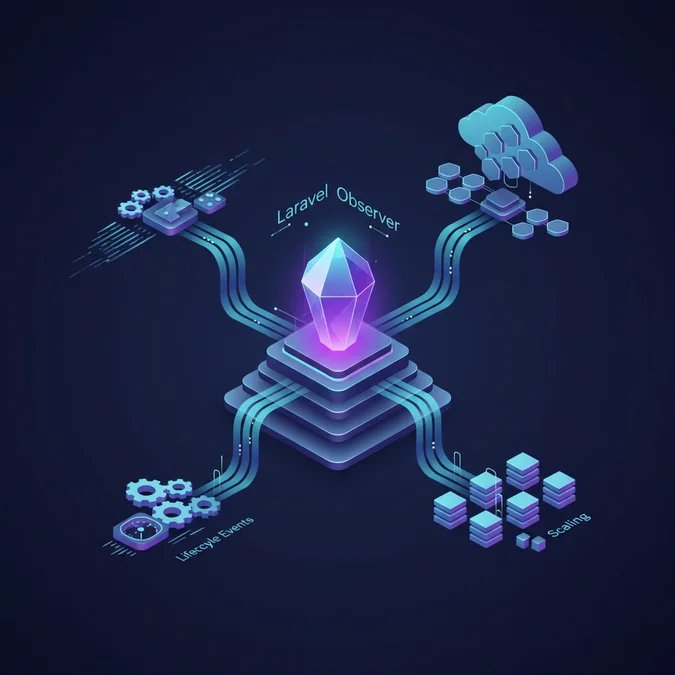

A Laravel Observer aggregates Eloquent lifecycle event listeners into a dedicated class, allowing developers to execute domain logic whenever an Eloquent model triggers actions like creating, updating, or deleting. Instead of scattering event registrations across multiple service providers or model boot methods, observers centralize database hooks into clean, maintainable handler methods.
According to Datadog’s 2024 State of Application Performance report, synchronous side effects inside active database transactions account for over 38 percent of unexpected API tail latency spikes in modern web applications. In distributed cloud environments, unmanaged Eloquent model hooks often introduce severe database connection pool exhaustion, unhandled transaction rollbacks, and tight coupling across service boundaries.
Scaling Laravel horizontally across containerized clusters on AWS ECS, Google Cloud Run, or Kubernetes requires decoupling these lifecycle events from the immediate HTTP request path. This guide analyzes how Eloquent observers operate internally, how to structure them cleanly, and how to safely run observer-triggered side effects across distributed worker pools without degrading system throughput.
Understanding Eloquent Lifecycle Events and the Observer Pattern
Laravel utilizes the classic Gang of Four Observer pattern to decouple model mutations from downstream side effects. Eloquent fires specific internal lifecycle events during database operations: retrieved, creating, created, updating, updated, saving, saved, deleting, deleted, trashed, forceDeleting, forceDeleted, restoring, and restored.
An observer class groups these discrete handlers together. When an operation occurs on a model instance, the underlying event dispatcher scans for registered listeners matching the specific model and lifecycle phase.
Notice the distinction between mutating events and notification events:
- Mutating hooks (pre-persist):
creating,updating, andsavingexecute before Eloquent writes data to the database. Returningfalsefrom any of these handlers immediately halts the operation. - Notification hooks (post-persist):
created,updated, andsavedrun after the query commits to the active database connection. Halting these does not roll back the executed SQL unless wrapped explicitly in a database transaction block.
Understanding this distinction is vital when running applications across horizontally scaled infrastructure. Performing heavy computational workloads or external HTTP requests inside a pre-persist hook blocks the PHP-FPM process and keeps the underlying MySQL or PostgreSQL connection open, rapidly consuming the connection limit of managed database instances like AWS Aurora or GCP Cloud SQL.
Creating and Registering Observers
To generate an observer, use the Artisan CLI. Running the following command generates a template pre-populated with standard lifecycle methods bound to a specific model:
php artisan make:observer OrderObserver --model=OrderThe generated class resides in the app/Observers directory. Modern versions of Laravel allow model observers to be bound either via the AppServiceProvider, through model attributes, or inside a dedicated service provider. In Laravel 11 and recent iterations, you can declare the observer directly on the model via PHP 8 attributes:
<php

namespace App\Models;

use App\Observers\OrderObserver;
use Illuminate\Database\Eloquent\Attributes\ObservedBy;
use Illuminate\Database\Eloquent\Model;

#[ObservedBy([OrderObserver:class])]
class Order extends Model
{
 protected $guarded = [];
}
Alternatively, explicitly register the observer inside the boot method of app/Providers/AppServiceProvider.php:
<php

namespace App\Providers;

use App\Models\Order;
use App\Observers\OrderObserver;
use Illuminate\Support\ServiceProvider;

class AppServiceProvider extends ServiceProvider
{
 public function boot(): void
 {
 Order:observe(OrderObserver:class);
 }
}
Attribute-based binding improves codebase clarity because developers inspecting the model can instantly see that lifecycle hooks exist. For teams maintaining enterprise platforms, integrating clear model patterns simplifies long-term maintenance, especially when evaluating architectures discussed in our analysis of building administrative interfaces and reducing operational overhead.
Complete Implementation: Building a Production-Ready Order Observer
Here is a production-grade implementation of an OrderObserver. This example demonstrates setting default UUID tokens during creation, computing denormalized financial aggregates during updates, and triggering audit logs upon deletion:
<php

namespace App\Observers;

use App\Models\Order;
use Illuminate\Support\Str;
use Psr\Log\LoggerInterface;

class OrderObserver
{
 public function __construct(
 private readonly LoggerInterface $logger
 ) {}

 /**
 * Handle the Order "creating" event.
 * Pre-persist hook: Mutate fields directly before the INSERT query.
 */
 public function creating(Order $order): void
 {
 if (empty($order->tracking_uuid)) {
 $order->tracking_uuid = (string) Str:uuid();
 }
 }

 /**
 * Handle the Order "created" event.
 * Post-persist hook: Model has an auto-increment ID.
 */
 public function created(Order $order): void
 {
 $this->logger->info('Order record created successfully', [
 'order_id' => $order->id,
 'uuid' => $order->tracking_uuid,
 ]);
 }

 /**
 * Handle the Order "saving" event.
 * Executes before both INSERT and UPDATE operations.
 */
 public function saving(Order $order): void
 {
 // Keep total amount synchronized with item subtotal and tax
 if ($order->isDirty(['subtotal_cents', 'tax_cents'])) {
 $order->total_cents = $order->subtotal_cents + $order->tax_cents;
 }
 }

 /**
 * Handle the Order "deleted" event.
 */
 public function deleted(Order $order): void
 {
 $this->logger->warning('Order moved to deleted state', [
 'order_id' => $order->id,
 ]);
 }
}
In this design, state normalization happens synchronously within saving, ensuring database consistency without additional queries. Meanwhile, telemetry logging runs post-persist. Because Laravel’s container resolves observers, you can inject dependencies such as PSR loggers, metric collectors, or configuration repositories directly through the constructor.
Database Transactions and After-Commit Queue Dispatching
A severe architectural flaw in distributed web systems is dispatching asynchronous background jobs from an Eloquent observer while an enclosing database transaction is still open. Consider an API endpoint that executes multiple database updates inside DB:transaction():
DB:transaction(function () use ($payload) {
 $order = Order:create($payload);
 $order->items()->createMany($payload['items']);
});
When Order:create() runs, the created observer method executes immediately. If that observer dispatches an asynchronous job to Redis or AWS SQS, a background worker on another container might pick up and execute that job before MySQL or PostgreSQL commits the parent transaction.
The worker queries the database for the new order ID, encounters an empty result (because the transaction has not committed yet), and throws an EntityNotFoundException.
Implementing afterCommit
Laravel resolves this race condition through transaction-aware event handlers. You can instruct the dispatcher to hold event execution until the outermost database transaction commits:
<php

namespace App\Observers;

use App\Jobs\SendOrderConfirmationEmail;
use App\Models\Order;

class OrderObserver
{
 // Ensures post-save events wait for outer DB transactions to commit
 public bool $afterCommit = true;

 public function created(Order $order): void
 {
 // Dispatched only after database transaction locks release
 SendOrderConfirmationEmail:dispatch($order->id);
 }
}
Setting public bool $afterCommit = true guarantees that if the transaction rolls back due to a failure in subsequent child model updates, the queued notification job will never be dispatched. This pattern prevents phantom executions across distributed job queues like Amazon SQS, RabbitMQ, and Google Cloud Pub/Sub.
Observers vs Custom Domain Events: Architectural Trade-Offs
While observers provide quick ergonomics for hooking into model changes, they can cause architectural rot if used indiscriminately. Observers tie application behavior directly to database table row mutations. In complex business domains, table updates do not always equal business intent.
For example, if an OrderObserver sends an email whenever $order->status changes to paid, that email will also trigger during mass data backfills, migrations, or automated test setups unless explicitly muted. Separating database lifecycle hooks from higher-level domain events preserves operational sanity.
| Criteria | Eloquent Observers | Custom Domain Events |
|---|---|---|
| Coupling Level | Tightly coupled to table CRUD actions | Decoupled; bound to business intent |
| Transaction Scope | Runs directly inside model query lifecycle | Dispatched manually at domain boundaries |
| Execution Control | Fires on every save across CLI, API, seeders | Explicitly dispatched only where intended |
| Payload Flexibility | Restricted to the model instance | Can encapsulate metadata, actors, and state |
| Cloud Suitability | Audit logs, UUID generation, slug creation | Distributed event streams, Kafka, event sourcing |
When engineering event-driven architectures that broadcast state across frontend clients or external microservices, rely on dedicated event classes instead of observers. For an in-depth breakdown of event broadcasting architectures, review our guide on configuring real-time message brokers and WebSockets.
Silent Operations: withoutEvents and Mass Update Traps
System administrators and backend engineers often need to run batch migrations, backfills, or bulk sanitization scripts without triggering notifications or audit cascades. Laravel provides methods to mute observers dynamically.
Executing Code Blocks Silently
The withoutEvents static method accepts a closure. Any model operations performed within that closure bypass observer execution entirely:
use App\Models\Order;

$order = Order:withoutEvents(function () {
 $record = Order:find(102);
 $record->status = 'archived';
 $record->save();

 return $record;
});
The Mass Update Pitfall
A common operational surprise occurs when developers execute Eloquent update queries directly via the query builder:
// WARNING: This DOES NOT fire the OrderObserver!
Order:where('status', 'pending')
 ->where('created_at', '<', now()->subDays(30))
 ->update(['status' => 'expired']);
Eloquent does not instantiate individual models during bulk SQL updates or bulk deletes executed through query builder chains. The query translates directly into an SQL statement executed by the database engine:
UPDATE orders SET status = 'expired' WHERE status = 'pending' AND created_at < '2025-01-01 00:00:00';Because no individual PHP model instances are loaded into memory, no lifecycle events fire, and your observer logic is completely ignored. If your observer manages critical cache invalidation or audit logging, those records will fall out of sync.
To guarantee observer execution during mass updates, iterate over the dataset using chunking:
Order:where('status', 'pending')
 ->where('created_at', '<', now()->subDays(30))
 ->chunkById(100, function ($orders) {
 foreach ($orders as $order) {
 $order->update(['status' => 'expired']);
 }
 });
This pattern incurs a cost in query volume and execution time, but guarantees observer invocation across the entire collection.
Preventing Infinite Loops in Updating and Saved Hooks
A frequent bug in observer implementations is the infinite recursion loop. This occurs when an engineer calls save() or update() on the same model instance within an updated or saved observer method.
<php

namespace App\Observers;

use App\Models\Order;

class OrderObserver
{
 public function updated(Order $order): void
 {
 // DANGER: Calling save() triggers updated() again!
 $order->last_audited_at = now();
 $order->save(); // Causes infinite recursion
 }
}
This loop quickly exhausts the PHP memory limit or triggers a maximum call stack size error. You can eliminate this issue using two engineering approaches:
Approach 1: Migrate to Pre-Persist Hooks
If the field being modified belongs to the same model, shift the logic to the saving or updating hook before the database write occurs:
public function saving(Order $order): void
{
 // Changes are bundled directly into the pending SQL query
 $order->last_audited_at = now();
}
Approach 2: Use saveQuietly
If the update must occur after persistence, call saveQuietly(). This method executes the database update while suppressing all Eloquent event dispatchers for that specific call:
public function updated(Order $order): void
{
 if ($order->wasChanged('status')) {
 $order->last_audited_at = now();
 $order->saveQuietly(); // Updates database without re-firing events
 }
}
Applying saveQuietly() breaks the recursion cycle and protects PHP execution threads from stack overflows.
Cloud Infrastructure and Horizontal Scaling Bottlenecks
Deploying Laravel across container platforms such as Amazon ECS Fargate, Google Kubernetes Engine (GKE), or auto-scaling EC2 instances introduces infrastructure dynamics that directly impact how observers perform.
When HTTP traffic spikes, web containers autoscale out horizontally. If observers perform synchronous tasks like rendering PDF invoices, querying external partner APIs, or writing directly to disk, the consequences multiply across the cluster:
- Connection Pool Depletion: Synchronous observer tasks extend request lifecycle times. A PHP worker thread running for 4 seconds holds its database connection open for the entire duration, exhausting the max connections limit on cloud database instances.
- Ephemeral Storage Loss: Writing files to local storage in an observer fails in multi-container setups. If container A writes an asset to local disk upon model creation, container B serving the next request cannot access it. All file mutations triggered by observers must interface with object storage like AWS S3 or Cloudflare R2 via background workers.
- Distributed Race Conditions: Rapid consecutive updates dispatched from different instances can cause observers to execute out of order. If container A handles an order completion while container B handles an administrative note update simultaneously, observers running unversioned updates can overwrite data.
To preserve horizontal scalability, enforce a strict rule across your engineering teams: observers running in the synchronous web request thread may only validate data, set derived column values, or dispatch jobs to asynchronous message queues. Never initiate external network requests inside an observer.
Refactoring Monolithic Observers in Legacy Codebases
Over years of development, enterprise applications often accumulate bloated observers containing hundreds of lines of mixed business logic, database queries, and notification calls. This hidden complexity slows down test suites and causes unpredictable regressions.
Refactoring these legacy observers requires decomposing monolithic classes into focused domain action classes. For teams managing technical debt, following structured modernization techniques like those outlined in our overview of modernizing legacy software architectures ensures continuous reliability during upgrades.
Instead of placing 200 lines of logistics processing directly into OrderObserver:created(), extract the operational steps into discrete actions dispatched asynchronously:
<php

namespace App\Observers;

use App\Jobs\AllocateInventoryJob;
use App\Jobs\NotifyWarehouseJob;
use App\Models\Order;

class OrderObserver
{
 public bool $afterCommit = true;

 public function created(Order $order): void
 {
 // Clean, minimal orchestration layer
 AllocateInventoryJob:dispatch($order->id);
 NotifyWarehouseJob:dispatch($order->id);
 }
}
Refactoring observers into simple dispatchers keeps model lifecycle events thin, predictable, and easy to unit test.
Testing Observers: Isolation and Integration Strategies
Testing code backed by observers requires validating both that the observer executes when expected and that the observer itself performs correct transformations.
Unit Testing the Observer Class in Isolation
Because observers are standard PHP classes, you can test them directly without touching the database by passing mock or unpersisted model instances:
<php

namespace Tests\Unit\Observers;

use App\Models\Order;
use App\Observers\OrderObserver;
use PHPUnit\Framework\TestCase;
use Psr\Log\LoggerInterface;

class OrderObserverTest extends TestCase
{
 public function test_it_generates_tracking_uuid_on_creating(): void
 {
 $logger = $this->createMock(LoggerInterface:class);
 $observer = new OrderObserver($logger);

 $order = new Order();
 $this->assertNull($order->tracking_uuid);

 $observer->creating($order);

 $this->assertNotNull($order->tracking_uuid);
 $this->assertIsString($order->tracking_uuid);
 }
}
Integration Testing Event Registration and Database Persistence
Integration tests verify that Laravel registers the observer correctly and that it responds to real Eloquent persistence calls:
<php

namespace Tests\Feature;

use App\Models\Order;
use Illuminate\Foundation\Testing\RefreshDatabase;
use Tests\TestCase;

class OrderPersistenceTest extends TestCase
{
 use RefreshDatabase;

 public function test_order_automatically_populates_uuid_in_database(): void
 {
 $order = Order:create([
 'subtotal_cents' => 5000,
 'tax_cents' => 500,
 ]);

 $this->assertDatabaseHas('orders', [
 'id' => $order->id,
 'total_cents' => 5500,
 ]);
 $this->assertNotNull($order->fresh()->tracking_uuid);
 }
}
Balancing unit tests for class logic with integration tests for lifecycle event triggers ensures code reliability across major framework upgrades.
Tracking Development Capitalization and Engineering Effort
When enterprise engineering teams refactor database hooks, optimize query latency, and restructure application event flows, tracking this work accurately helps technical leaders align with organizational governance. For engineering managers documenting these architectural initiatives, reviewing guidelines on software capitalization for engineering teams provides clarity on distinguishing capitalizable platform improvements from everyday operational maintenance.
Building resilient, event-driven architectures that scale smoothly across cloud infrastructure requires ongoing discipline in how models, observers, and background queues interact.
Complete Laravel Basics Directory
Deepening your foundational understanding of Laravel’s core architecture will help you design cleaner, more scalable cloud systems.
Explore our complete Laravel, Basics directory for more guides.
Frequently Asked Questions
What is a Laravel observer?
A Laravel observer is a class that centralizes event listener methods for Eloquent model lifecycle hooks. Instead of writing event listeners across multiple files, an observer groups methods like creating, updated, and deleted into a single class.
How do you register an observer in Laravel?
You can register an observer either by using the #[ObservedBy([UserObserver:class])] attribute directly on the Eloquent model class, or by calling Model:observe(UserObserver:class) within the boot method of AppServiceProvider.
Do Laravel observers fire during mass updates?
No. When you perform bulk updates or deletions using the Eloquent query builder directly, such as User:where(‘active’, false)->update(..), queries execute directly in the database without instantiating models, bypassing all observers.
How do you prevent infinite loops in Laravel observers?
Avoid calling save() inside the saved or updated observer hooks. If you must save changes on the model within a post-persist hook, use the saveQuietly() method to persist data without re-triggering model lifecycle events.
What does afterCommit do in a Laravel observer?
Setting public bool $afterCommit = true on an observer instructs Laravel to delay executing lifecycle hooks until all active database transactions commit. This prevents queued jobs from running before database changes are finalized.
Laravel Observers provide a clean mechanism to consolidate database model lifecycle hooks, but their convenience must be balanced against systemic architectural constraints. For simple model sanitization, automatic UUID generation, and denormalized data sync, pre-persist observer hooks like saving and creating deliver immediate value. However, side effects involving external services, file storage, or email notifications should never run synchronously inside model observers.
At production scale across distributed cloud clusters, always decouple business side effects using asynchronous background queues paired with public bool $afterCommit = true. This guarantees database transactions release locks immediately, prevents ghost worker executions, and ensures your Laravel application scales smoothly under heavy traffic.