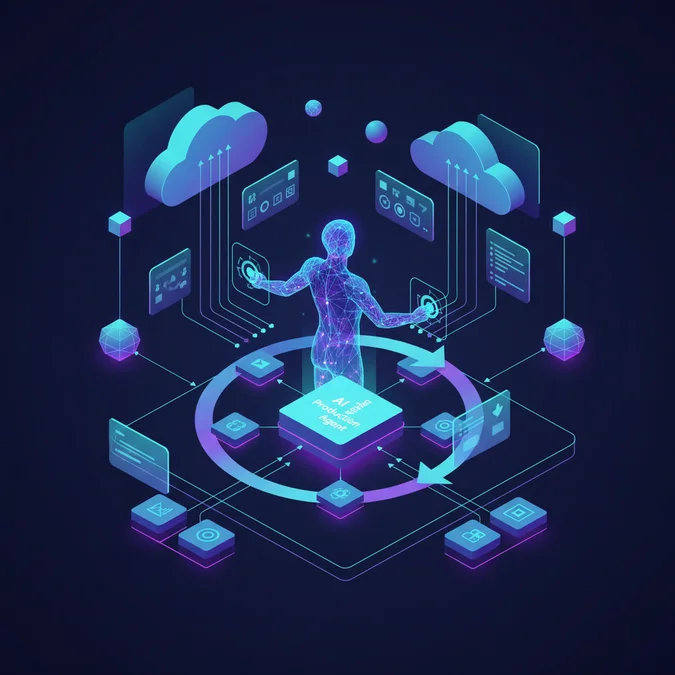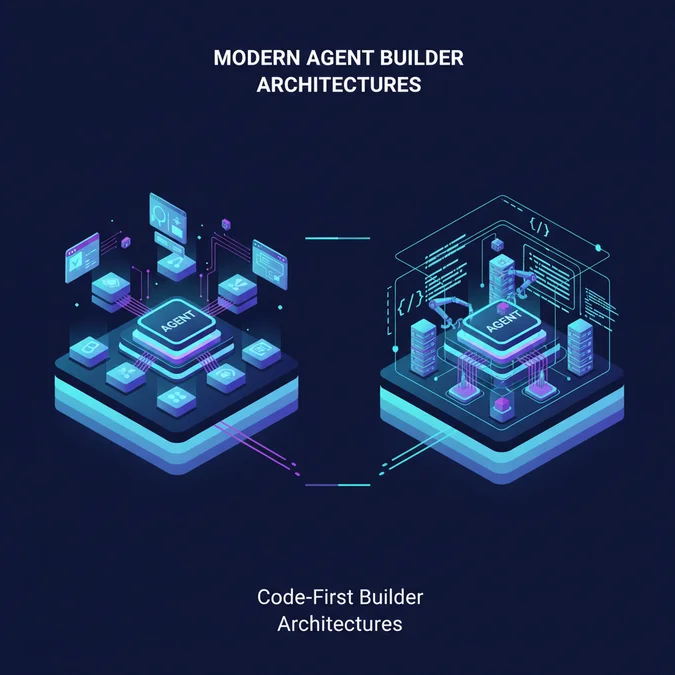

An agent builder is a runtime infrastructure and orchestration layer designed to bind foundation models to external APIs, deterministic state machines, and long-term memory stores. Rather than treating an LLM as an isolated conversational endpoint, an agent builder provisions an execution harness where autonomous planners decompose goals, invoke typed tools, and validate intermediate outputs against formal schemas.
In high-throughput enterprise deployments, teams frequently hit an architectural wall when relying on opaque, managed visual canvases. While managed builders accelerate zero-to-one prototyping, enterprise production systems require sub-second p95 latency, granular session persistence, dynamic tool gating, and absolute protection against cascading hallucination loops. When state is trapped inside a vendor’s proprietary UI, debugging silent tool failures or managing schema transitions becomes nearly impossible.
This architectural guide analyzes the mechanics underpinning modern agent builder systems in 2026. We evaluate the trade-offs between managed platforms like Google Cloud Vertex AI Agent Builder or Microsoft Copilot Studio and code-first orchestration graph engines like LangGraph and CrewAI, backed by production-ready reference implementations, observability blueprints, and failure mode mitigation patterns.
Core Topology: Anatomy of an Enterprise AI Agent Builder
At its foundational layer, an enterprise agent builder is not merely a prompt chaining utility; it is a distributed state machine designed around strict execution boundaries. When an agent receives an unstructured objective, the runtime coordinates model generation, tool routing, memory hydration, and schema enforcement within an isolated sandboxed environment.
+-----------------------------------------------------------------------+
| ENTERPRISE AGENT BUILDER RUNTIME |
| |
| +---------------------+ JSON Schema +-------------------+ |
| | Ingress Gateway | --------------------> | Guardrail Engine | |
| | (Auth, Rate Limits) | | (Sanitize/Mask) |
| +---------------------+ +-------------------+ |
| | | |
| v v |
| +-----------------------------------------------------------------+ |
| | Orchestration Engine Core | |
| | +--------------------+ Plan +-----------------------------+ | |
| | | Reasoning Model | <====> | Cyclic Execution Graph | | |
| | | (Planner / Router) | | (State Checkpoints & Edges) | | |
| | +--------------------+ +-----------------------------+ | |
| +-----------------------------------------------------------------+ |
| | | | |
| v v v |
| +---------------+ +------------------+ +------------------------+ |
| | Tool Gateway | | Memory Subsystem | | Sandboxed Environment | |
| | (OpenAPI 3.1) | | (Vector / Redis) | | (gVisor / Firecracker) | |
| +---------------+ +------------------+ +------------------------+ |
+-----------------------------------------------------------------------+
Architectural Rule: Decouple the reasoning engine from the tool execution sandbox. Foundation models must never execute code, run database queries, or dispatch webhooks within the application’s primary process namespace.
The system decomposes into five decoupled architectural subsystems:
- Deterministic Graph Orchestrator: Manages cyclic and acyclic transitions between reasoning steps. Unlike naive sequential pipelines, an enterprise orchestrator uses conditional branching, backoff loops, and deterministic human-in-the-loop checkpoints.
- Dual-Layer Memory Fabric: Split between short-term working context (hydrated via Redis clusters maintaining sliding-window conversational state) and long-term semantic memory (backed by vector databases with hybrid dense-sparse retrieval).
- Contract-Driven Tool Gateway: Transforms natural language parameters into strictly typed payloads via OpenAPI 3.1 and JSON Schema validation before emitting outbound HTTP or RPC calls.
- Sandboxed Code Execution Engine: Runs dynamic scripts or SQL queries within isolated microVMs (such as Firecracker or gVisor) to prevent arbitrary code execution vulnerabilities.
- Deterministic Output Parser: Intercepts model responses, validating structural integrity before passing state tokens downstream.
| Subsystem Component | Implementation Standard | Primary Latency Impact | Failure Mode Handled |
|---|---|---|---|
| State Orchestration | Deterministic Graph / Redis checkpointer | 5ms to 15ms per transition | Cyclic loops, unhandled edge states |
| Tool Gateway | OpenAPI 3.1 / Pydantic v2 schemas | 20ms to 45ms per tool invoke | Type mismatch, hallucinated arguments |
| Working Memory | Redis Enterprise / PostgreSQL | 2ms to 8ms read/write | Session drift, context desynchronization |
| Semantic Memory | Milvus / Qdrant hybrid vector store | 40ms to 120ms vector search | Stale embeddings, semantic mismatch |
| Execution Sandbox | Firecracker microVM / WebAssembly | 15ms to 50ms boot overhead | Remote code execution, memory exhaustion |
Platform Shift Analysis: Navigating Critical Agent Builder Updates
The landscape of enterprise agent tooling has undergone aggressive consolidation. Historically, cloud providers offered fragmented solutions, such as simple chatbot interfaces, vector search endpoints, and disjointed workflow orchestrators. Today, continuous platform shifts require teams to evaluate how vendor updates impact long-term enterprise architecture.
A critical trend across ecosystem transformations is the migration away from rigid, proprietary visual canvases toward hybrid engines that expose foundational code layers while retaining managed compliance controls. Rapid agent builder updates from major vendors indicate a unified push toward structured output enforcement, multimodal tool ingestion, and native graph-based routing.
Migration Notice: OpenAI deprecated its standalone visual agent prototype mechanisms in favor of the structured Assistants API and Responses framework. Simultaneously, Google rebranded and consolidated Vertex AI Search and Conversation into its integrated Agent Platform ecosystem, deprecating legacy Dialogflow CX wrappers for generative workflows.
| Vendor Platform | Legacy Architecture | Modern Architecture Paradigm | Vendor Lock-in Risk | Extensibility Score |
|---|---|---|---|---|
| Google Cloud Vertex AI | Dialogflow CX / Vertex Conversation | Vertex AI Agent Builder (Gemini grounded reasoning) | High (Vertex ecosystem tie-ins) | Moderate (REST API, extensions) |
| Microsoft Azure | Bot Framework / Power Virtual Agents | Copilot Studio / Azure AI Agent Service | Extreme (M365, Dataverse, Azure RBAC) | Moderate (Power Platform connectors) |
| OpenAI Enterprise | Custom GPTs visual builder | Assistants API v2 / Responses Framework | High (Proprietary tool execution) | High (Custom client orchestrators) |
| Code-First (LangGraph/CrewAI) | Linear LLMChains | StateGraph / Multi-agent Actor Models | Zero (Open source, fully portable) | Maximum (Raw Python/TypeScript) |
Relying exclusively on proprietary platform tooling exposes systems to architectural churn. When a cloud vendor changes its underlying routing algorithms, deprecates proprietary API parameters, or enforces rate-limiting updates, production agents built on proprietary visual tools can fail silently without code-level visibility.
To navigate these updates, modern teams build an abstraction layer between their business domains and the underlying agent builder. By normalizing tool definitions into standard JSON Schema formats and storing conversational graph state in enterprise-owned datastores like PostgreSQL or Redis, organizations can switch model providers or orchestration runtimes without rewriting business logic.
Managed Canvas Platforms vs Code-First Orchestration
When selecting the backbone for an enterprise agentic system, architects face a foundational trade-off: deploy a managed low-code canvas platform (such as Microsoft Copilot Studio or Google Cloud Agent Builder) or construct a code-first graph using open frameworks like LangGraph, AutoGen, or LlamaIndex Workflows.
Managed canvas builders excel at rapid delivery for internal organizational knowledge retrieval. They provide native integration with enterprise identity providers (Entra ID, Google Workspace IAM), document governance controls, and out-of-the-box connectors for enterprise SaaS platforms. However, their deterministic control remains shallow. Most managed platforms abstract away the prompt execution chain, preventing developers from manually altering token budgets, injecting dynamic few-shot examples mid-inference, or optimizing latency-critical paths.
Conversely, code-first frameworks treat agent orchestration as software engineering rather than administrative configuration. State transitions are declared via explicit code graphs where edges represent deterministic condition gates and nodes represent isolated business logic.
| Evaluation Metric | Managed Visual Canvas (e.g. Copilot Studio) | Code-First Framework (e.g. LangGraph / CrewAI) |
|---|---|---|
| p95 Latency Performance | 1,400ms to 3,200ms (Opaque provider middleware) | 450ms to 1,100ms (Direct streaming execution) |
| State Determinism | Probabilistic model routing; limited edge control | Strict programmatic state machines with rollback |
| Multi-Turn Token Cost | High (Automatic bloated context injection) | Optimized (Granular sliding window, manual pruning) |
| Testing and CI/CD | Proprietary testing sandboxes, poor git integration | Unit testable, pytest mocking, deterministic evaluation suites |
| Tool Argument Strictness | Variable; basic type validation via UI | Absolute; strict Pydantic v2 runtime validation |
| Vendor Portability | Low; tightly bound to vendor subscription tiers | High; deployable on any container runtime or cloud |
For operations involving complex state mutations, financial transactions, database schema updates, or customer-facing operations under strict regulatory compliance, code-first orchestration provides the testability, determinism, and performance guarantees that visual canvases cannot deliver.
Step-by-Step Implementation: Building a Resilient Stateful Agent
To demonstrate a resilient architectural approach, we will construct a production-ready, stateful agent engine using a code-first cyclic state pattern in Python. This implementation establishes explicit state transitions, strict schema validation via Pydantic, deterministic tool routing, and exponential-backoff retry handling.
- Define the Typed State Contract: Create a persistent state schema that holds conversational history, execution flags, and structured output values.
- Declare Strict Tool Interfaces: Use Pydantic schemas to validate parameters before tools execute.
- Implement Deterministic Routing: Program conditional branching logic that inspects agent decisions and routes execution to either a tool node or the final response node.
- Execute the Orchestration Graph: Compile the state machine with dynamic checkpoint persistence and defensive error catching.
import json
import time
from typing import Annotated, Any, Dict, List, Literal, TypedDict
from pydantic import BaseModel, Field, ValidationError

# 1. State Contract Definition
class AgentState(TypedDict):
 messages: List[Dict[str, str]]
 current_tool: str | None
 tool_args: Dict[str, Any] | None
 tool_result: Dict[str, Any] | None
 retry_count: int
 is_terminal: bool

# 2. Strict Tool Argument Validation Schemas
class DatabaseQueryArgs(BaseModel):
 customer_id: str = Field(.. pattern=r"^CUST-[0-9]{4,8}$")
 query_scope: Literal["billing", "entitlements", "usage"]

# 3. Production Tool with Defensive Fallback
def execute_database_query(arguments: Dict[str, Any]) -> Dict[str, Any]:
 try:
 validated = DatabaseQueryArgs(**arguments)
 except ValidationError as err:
 return {"status": "error", "code": "VALIDATION_FAILED", "detail": err.errors()}

 # Simulate robust external integration with timeout and error handling
 for attempt in range(1, 4):
 try:
 # Simulated query response
 return {
 "status": "success",
 "customer_id": validated.customer_id,
 "scope": validated.query_scope,
 "data": {"balance_cents": 12450, "currency": "USD", "tier": "enterprise"}
 }
 except Exception as e:
 time.sleep(0.1 * (2 ** attempt))
 if attempt == 3:
 return {"status": "error", "code": "GATEWAY_TIMEOUT", "detail": str(e)}
 return {"status": "error", "code": "MAX_RETRIES_EXCEEDED"}

# 4. Deterministic State Transition Nodes
def reasoning_node(state: AgentState) -> AgentState:
 new_state = state.copy()
 last_message = new_state["messages"][-1]["content"]

 # Simulated LLM planning step returning structured action
 if "CUST-" in last_message and new_state["retry_count"] < 3:
 new_state["current_tool"] = "execute_database_query"
 new_state["tool_args"] = {"customer_id": "CUST-8831", "query_scope": "billing"}
 else:
 new_state["current_tool"] = None
 new_state["is_terminal"] = True
 new_state["messages"].append({
 "role": "assistant",
 "content": "Request resolved or no actionable entities found."
 })
 return new_state

def tool_execution_node(state: AgentState) -> AgentState:
 new_state = state.copy()
 tool_name = new_state.get("current_tool")

 if tool_name == "execute_database_query":
 result = execute_database_query(new_state.get("tool_args", {}))
 new_state["tool_result"] = result

 if result.get("status") == "error":
 new_state["retry_count"] += 1
 else:
 new_state["messages"].append({
 "role": "system",
 "content": f"Tool Execution Output: {json.dumps(result)}"
 })
 new_state["is_terminal"] = True
 return new_state

# 5. Core Orchestration Loop (Graph Simulator)
def run_agent(input_prompt: str) -> AgentState:
 state: AgentState = {
 "messages": [{"role": "user", "content": input_prompt}],
 "current_tool": None,
 "tool_args": None,
 "tool_result": None,
 "retry_count": 0,
 "is_terminal": False
 }

 max_steps = 5
 current_step = 0

 while not state["is_terminal"] and current_step < max_steps:
 state = reasoning_node(state)
 if state.get("current_tool"):
 state = tool_execution_node(state)
 current_step += 1

 return state

# Execution
final_state = run_agent("Please inspect the enterprise billing limits for CUST-8831.")
print(f"Execution Terminal State: {final_state['is_terminal']}")
print(f"Final Response Payload: {final_state['messages'][-1]['content']}")
This pattern ensures that every model decision is bound to a validated Pydantic schema, state is held in an immutable dictionary pattern, and retry backoffs prevent transient database blips from causing unhandled system panics.
Enterprise Guardrails, Security Boundaries, and Observability
Exposing foundation models to enterprise tools introduces security risks that traditional web firewalls cannot remediate. Prompt injection attacks, indirect data poisonings, and inadvertent data exfiltration require multi-layered, active runtime controls.
A production agent pipeline enforces boundary checks at three distinct boundaries:
- Ingress Boundary: Sanitizes raw input against jailbreaks and extracts embedded commands before payloads reach the reasoning model.
- Model Boundary: Employs policy guardrails (such as NeMo Guardrails or Llama Guard) to evaluate intent and enforce role-based output permissions.
- Egress / Tool Execution Boundary: Masks sensitive entities (PII, PCI, API credentials) and verifies that tool arguments conform precisely to pre-compiled allowlists.
import re
from typing import Dict, Any
from opentelemetry import trace

tracer = trace.get_tracer("enterprise.agent.guardrails")

class GuardrailViolationException(Exception):
 pass

class DefensiveSecurityGateway:
 @staticmethod
 def mask_sensitive_tokens(raw_content: str) -> str:
 # Mask credit cards and SSNs before forwarding to model context
 masked = re.sub(r"\b(?\d[ -]*?){13,16}\b", "[REDACTED_PAYMENT_DATA]", raw_content)
 masked = re.sub(r"\b\d{3}-\d{2}-\d{4}\b", "[REDACTED_SSN]", masked)
 return masked

 @classmethod
 def enforce_tool_execution_policy(cls, tool_name: str, arguments: Dict[str, Any]) -> None:
 with tracer.start_as_current_span("guardrail.tool_policy_check") as span:
 span.set_attribute("agent.tool_name", tool_name)

 # Prevent privilege escalation and command injection
 disallowed_patterns = ["DROP TABLE", "sudo", "chmod", "/bin/sh", "<script>"]
 serialized = str(arguments)

 for pattern in disallowed_patterns:
 if pattern.lower() in serialized.lower():
 span.record_exception(Exception("Illegal payload injection detected"))
 span.set_attribute("guardrail.violation", True)
 raise GuardrailViolationException(f"Security policy triggered by pattern: {pattern}")

 span.set_attribute("guardrail.passed", True)
Implementing end-to-end observability requires emitting OpenTelemetry spans for every step of an agent’s reasoning loop. Unlike traditional microservices where an HTTP trace is linear, agent traces branch dynamically based on model outputs.
- Checklist for Production Agent Security and Observability:
- Propagate OpenTelemetry trace contexts across all model prompts, vector lookups, and downstream RPC calls.
- Maintain immutable audit logs of generated tool arguments alongside the original user prompts to support post-incident forensic reviews.
- Enforce strict timeouts (typically 3,000ms to 5,000ms) on all downstream tool actions to prevent slow API responses from blocking worker threads.
- Rotate runtime API tokens dynamically using short-lived OAuth credentials rather than static environment keys.
- Deploy automated semantic evaluation pipelines to continuously monitor drift in retrieval precision and model reasoning fidelity.
Mitigating Runtime Failure Modes and Token Latency Bottlenecks
Production agent systems frequently degrade due to compounding runtime failure modes. While a single prompt-completion call might demonstrate a 99% success rate, a multi-turn agent that executes five sequential tool interactions has an aggregate reliability of 0.99^5 = 95.1%. Without defensive engineering, overall platform availability drops sharply.
Latency Truth: Every intermediate tool call triggers a round-trip model generation step. An agent making three sequential tool calls will typically accumulate between 2,500ms and 6,000ms of end-to-end latency, making asynchronous execution streaming and aggressive context pruning critical for production readiness.
| Failure Mode | Underlying Root Cause | Production Mitigation Architecture |
|---|---|---|
| Infinite Execution Loop | Model continually selects tools without triggering completion criteria | Set strict max-hop thresholds; force routing to synthesis node upon hop exhaustion |
| Tool Argument Hallucination | Model passes non-existent fields or invalid types to APIs | Pydantic validation schemas with auto-repair loops reflecting errors back to the model |
| Context Window Bloat | Accumulating full tool JSON payloads across multi-turn sessions | Aggressive token truncation; summarize JSON outputs into lightweight natural language summaries |
| Rate-Limit Cascade | Spiky agent retry storms flooding downstream microservices | Token-bucket rate limiters integrated with jittered exponential backoffs |
| Semantic Drift | Long conversation histories gradually diluting the initial system instructions | Recency-weighted memory buffers and system-instruction pinning via attention masks |
To mitigate token bloat, production runtimes should avoid appending raw tool outputs directly into the context window. When a database returns a 50KB JSON response containing 200 records, injecting that payload consumes substantial token budgets and increases the probability of attention dilution. Instead, implement a payload reduction layer that extracts only the specific fields required to satisfy the immediate reasoning step.
Frequently Asked Questions
What is an enterprise agent builder?
An enterprise agent builder is an integrated platform or development framework that enables developers to assemble, test, and deploy autonomous LLM-driven agents. It combines prompt engineering, tool routing, long-term memory, and enterprise security guardrails into a unified runtime environment.
How do recent agent builder updates impact existing production deployments?
Recent agent builder updates emphasize multimodal grounding, deterministic graph orchestration, and automated schema generation. These shifts require engineering teams to decouple business logic from proprietary APIs, ensuring agent state and tool contracts survive underlying vendor platform deprecations.
When should an engineering team choose code-first over a visual agent builder?
Teams should choose code-first frameworks when workflows require granular state machine control, strict deterministic execution, sub-second latency, CI/CD automated testing, or custom on-premise model serving that proprietary cloud-managed visual builders cannot support natively.
How do you avoid vendor lock-in when building autonomous AI agents?
Avoid lock-in by using standardized tool definitions via JSON Schema, externalizing memory into vendor-agnostic vector stores or relational databases, and implementing orchestration layers using portable open-source engines rather than proprietary cloud platform visual canvases.
Building production-grade AI agent systems requires balancing delivery velocity against long-term operational autonomy. Managed visual platforms provide immediate enterprise utility for low-risk, internal document retrieval workflows. However, for mission-critical applications that demand deterministic execution, sub-second p95 latency, and zero vendor lock-in, code-first state graph architectures are essential.
By treating agent orchestration as a software engineering discipline, enforcing strict schema contracts, externalizing memory systems, and building robust guardrails, engineering organizations can deploy resilient agentic platforms that scale smoothly through changing model landscapes.
Benchmarking Architecture Trade-offs?
Discuss real-world performance characteristics and production considerations for your specific workload.