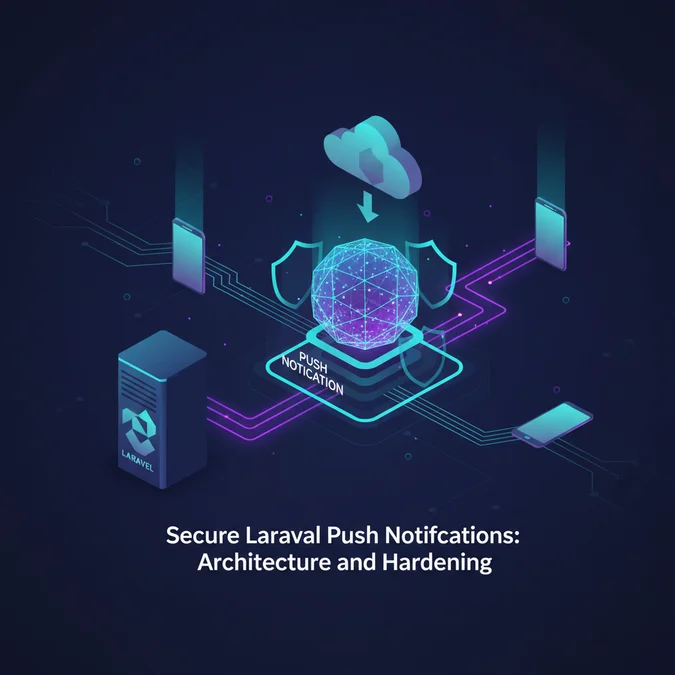

A Laravel push notification is a message dispatched via Laravel’s native notification system to deliver real-time system alerts, updates, or cryptographic challenges directly to user devices using WebPush, Apple Push Notification service (APNs), or Firebase Cloud Messaging (FCM). It connects backend events to notification channels while managing device tokens, encryption handshakes, and transport pipelines.
Push notifications have recently experienced a fundamental shift in the developer community. The deprecation of legacy Firebase Cloud Messaging server keys in favor of short-lived OAuth 2.0 tokens, coupled with stricter Safari and iOS PWA push restrictions, has disrupted standard notification setups. Organizations can no longer rely on unauthenticated endpoints or third-party wrappers without evaluating the security risks of leaking device identifiers and notification contents.
As notification systems handle increasingly sensitive data such as two-factor authentication challenges, transaction confirmations, and account security alerts, treating push delivery as an unverified broadcast channel introduces serious risk. Securing this transport requires a defensive, hardened implementation across credential lifecycles, database token hygiene, payload confidentiality, and queue security.
Threat Modeling and the Laravel Push Notification Attack Surface
Push notification pipelines introduce multiple untrusted external boundaries into an otherwise isolated Laravel application. A secure implementation must evaluate how attackers can exploit notification lifecycles to intercept data, hijack credentials, or compromise backend workers.
The attack surface spans four distinct zones: the browser or native client handling registration, the ingress Laravel API storing subscription credentials, the queue workers processing background jobs, and the external push gateways (Google FCM, Apple APNs, or native WebPush endpoints). Compromising any of these surfaces introduces severe operational vulnerabilities:
- Insecure Direct Object Reference (IDOR) on Subscription Endpoints: If an API endpoint accepts push subscription updates without strictly verifying the authenticated user, an attacker can overwrite another user’s device token with their own. Future notifications containing sensitive alerts, one-time passwords, or account status changes are then dispatched directly to the adversary.
- Queue Worker Poisoning and Code Injection: Unsanitized push payloads stored in serialization queues like Redis or database-backed queue drivers can be modified by internal network attackers to trigger remote code execution through PHP object deserialization vulnerabilities.
- Token Leakage via Gateway Errors: Detailed exception messages logged to external logging services or unencrypted application logs during push failures often contain device tokens, client authorization keys, and private notification payloads in plaintext.
- Denial of Wallet and Gateway Throttling: Unauthenticated or unthrottled push triggers allow malicious actors to saturate upstream push gateways, resulting in quota exhaustion, IP blocking, or vendor rate-limiting that halts mission-critical alerts.
Anatomy of the WebPush Standard and VAPID Cryptography
WebPush relies on Voluntary Application Server Identification (VAPID) defined under RFC 8292 to authenticate the application server to the browser’s push service. Without VAPID, push providers cannot reliably attribute notifications to a specific sender, creating opportunities for man-in-the-middle spoofing and unauthorized tracking.
VAPID uses an asymmetric elliptic curve key pair over the prime256v1 (NIST P-256) curve. The private key resides strictly within the Laravel environment, while the public key is exposed to the browser to generate the push subscription. When dispatching a notification, Laravel signs a short-lived JSON Web Token (JWT) using the private key and passes it inside the Authorization: vapid HTTP header.
# Generate cryptographically secure VAPID keys via openssl
openssl ecparam -name prime256v1 -genkey -noout -out vapid_private.pem
openssl ec -in vapid_private.pem -pubout -outform DER | tail -c 65 | base64 | tr -d '=' | tr '/+' '_-' > vapid_public.txt
openssl ec -in vapid_private.pem -outform DER | tail -c 32 | base64 | tr -d '=' | tr '/+' '_-' > vapid_private.txt
These keys must be stored within your .env file or an encrypted secrets engine like AWS Secrets Manager or HashiCorp Vault. Never commit these raw keys to version control:
VAPID_PUBLIC_KEY=BD2hI8v3.._secure_base64_public_key
VAPID_PRIVATE_KEY=3k4b.._secure_base64_private_key
VAPID_SUBJECT=mailto:security-team@example.com
The VAPID_SUBJECT must contain a valid mailto: URI or a secure URL containing administrative contact details. Push services like Mozilla autopush and Google FCM inspect this header to notify administrators in the event of abusive or malformed notification patterns before applying hard transport bans.
Database Schema Design for Secure Subscription Storage
A push subscription consists of a client endpoint URL, a public encryption key (p256dh), and a shared authentication secret (auth). Treating these fields as plain text leaves user devices exposed if a database breach occurs. While an attacker with database read access cannot sign new notifications without the VAPID private key, having access to endpoints and p256dh keys allows for correlation attacks and user device fingerprinting across third-party networks.
When maintaining legacy applications, team leads often use the strangler fig pattern for modernizing old PHP systems to transition raw database tables to encrypted architectures. We should encrypt the client keys at rest using Laravel’s native encryption primitives:
<php

declare(strict_types=1);

use Illuminate\Database\Migrations\Migration;
use Illuminate\Database\Schema\Blueprint;
use Illuminate\Support\Facades\Schema;

return new class extends Migration
{
 public function up(): void
 {
 Schema:create('push_subscriptions', function (Blueprint $table): void {
 $table->id();
 $table->foreignId('user_id')->constrained()->cascadeOnDelete();
 // SHA-256 hash of the endpoint allows fast lookups without exposing raw endpoints
 $table->string('endpoint_hash', 64)->index();
 $table->text('endpoint');
 $table->text('public_key'); // p256dh key encrypted at rest
 $table->text('auth_token'); // auth secret encrypted at rest
 $table->string('content_encoding', 16)->default('aes128gcm');
 $table->timestamp('last_active_at')->nullable();
 $table->timestamps();
 });
 }

 public function down(): void
 {
 Schema:dropIfExists('push_subscriptions');
 }
};
By adding an endpoint_hash column using a deterministic SHA-256 digest, the application can look up existing subscriptions during subscription updates without performing costly table-wide decryption operations. In multi-tenant platforms, proper isolation of these records prevents cross-tenant data leakage, a risk discussed in tenancy patterns for database isolation.
Ingress Validation and Subscription Controller Implementation
The ingress controller that accepts subscription registrations must be protected against tampering, injection, and unauthorized parameter assignment. Blindly deserializing and storing incoming browser JSON payloads without validation introduces severe risks to application integrity.
We create a dedicated Form Request that validates every cryptographic parameter before saving it to the database:
<php

declare(strict_types=1);

namespace App\Http\Requests;

use Illuminate\Foundation\Http\FormRequest;

class StorePushSubscriptionRequest extends FormRequest
{
 public function authorize(): bool
 {
 // Ensure the actor is authenticated
 return $this->user()!== null;
 }

 public function rules(): array
 {
 return [
 'endpoint' => ['required', 'string', 'url:https', 'max:1024'],
 'keys.p256dh' => ['required', 'string', 'max:255', 'regex:/^[a-zA-Z0-9_-]+$/'],
 'keys.auth' => ['required', 'string', 'max:255', 'regex:/^[a-zA-Z0-9_-]+$/'],
 'content_encoding' => ['nullable', 'string', 'in:aes128gcm,aesgcm'],
 ];
 }
}
The controller must enforce user boundaries, verify endpoints are using valid HTTPS protocols, and update or create subscriptions using explicit object relationships rather than mass-assignment shortcuts:
<php

declare(strict_types=1);

namespace App\Http\Controllers;

use App\Http\Requests\StorePushSubscriptionRequest;
use App\Models\PushSubscription;
use Illuminate\Http\JsonResponse;
use Symfony\Component\HttpFoundation\Response;

class PushSubscriptionController extends Controller
{
 public function store(StorePushSubscriptionRequest $request): JsonResponse
 {
 $validated = $request->validated();
 $endpointHash = hash('sha256', $validated['endpoint']);

 // Bind subscription strictly to the authenticated user context
 $request->user()->pushSubscriptions()->updateOrCreate(
 ['endpoint_hash' => $endpointHash],
 [
 'endpoint' => $validated['endpoint'],
 'public_key' => $validated['keys']['p256dh'],
 'auth_token' => $validated['keys']['auth'],
 'content_encoding' => $validated['content_encoding']? 'aes128gcm',
 'last_active_at' => now(),
 ]
 );

 return response()->json([
 'status' => 'registered',
 'message' => 'Subscription securely persisted.',
 ], Response:HTTP_CREATED);
 }
}
Enforcing strict validation on incoming payload keys protects the application from malicious input and protocol abuse while keeping subscription records clean.
Data Minimization and Zero-Trust Payload Construction
A critical operational failure in push architectures is broadcasting sensitive internal state directly within the push notification payload. Push payloads pass through external intermediate hops, including cloud gateway infrastructure operated by Apple, Google, or other platform providers. These intermediaries can inspect payload contents if messages are delivered unencrypted, as is standard with FCM data messages.
Engineers must follow the principle of zero trust by strictly minimizing the data transmitted across external push brokers:
High-Risk vs. Hardened Payload Payloads
| Security Metric | Insecure Payload Architecture | Hardened Zero-Trust Architecture |
|---|---|---|
| Data Contained | Sensitive context, PII, full banking transactions, plain auth codes | Opaque operational event tokens, UUIDs, generic notification titles |
| Client Behavior | Displays notification body directly from gateway payload | Wakes up service worker; fetches body via authenticated API |
| Interception Risk | Complete exposure of user activity and data to push brokers | Zero visibility into confidential state; tokens are cryptographically opaque |
| Revocation | Impossible once dispatched to gateway network | Application can revoke unread alerts immediately on the server API |
To implement this model, construct push notifications containing only opaque resource references. When the client’s service worker receives the push event, it executes an authenticated background fetch() request to your Laravel API to retrieve the notification body:
// Service Worker: sw.js
self.addEventListener('push', function(event) {
 if (!event.data) {
 return;
 }

 const payload = event.data.json();
 const eventId = payload.event_id;

 // Retrieve decrypted notification context using authenticated user session
 event.waitUntil(
 fetch(`/api/notifications/render/${eventId}`, {
 headers: {
 'Accept': 'application/json',
 'X-Requested-With': 'XMLHttpRequest'
 },
 credentials: 'same-origin'
 }).then(response => response.json()).then(data => {
 return self.registration.showNotification(data.title, {
 body: data.body,
 icon: '/images/shield.png',
 tag: data.tag
 });
 })
 );
});
This zero-trust rendering pipeline protects sensitive user details from third-party notification delivery channels.
Migrating to Firebase Cloud Messaging (FCM) HTTP v1 with OAuth 2.0
Google deprecated FCM legacy server keys due to critical security shortcomings. Legacy server keys were long-lived, high-privilege credentials. If leaked via version control, debug dumps, or server-side request forgery (SSRF), an attacker gained permanent authority to send arbitrary push messages to every registered device on the platform.
The FCM HTTP v1 API replaces legacy keys with short-lived OAuth 2.0 access tokens derived from a dedicated Google Cloud Service Account. These tokens expire after 60 minutes, limiting the window of risk if a token is exposed.
Hardening Google Service Account Permissions
When provisioning your Google Cloud Service Account for FCM HTTP v1, adhere strictly to the principle of least privilege. Grant only the role Firebase Cloud Messaging API Admin (roles/firebasemessaging.admin). Never assign administrative or project-wide roles like Owner, Editor, or general Firebase Admin to this service account.
Store the downloaded Service Account JSON securely on the host server or ingest it through environment variables. Reference it safely within your Laravel service layer:
<php

declare(strict_types=1);

namespace App\Services;

use Google\Client as GoogleClient;
use Illuminate\Support\Facades\Cache;

class FcmAuthService
{
 private string $credentialsPath;

 public function __construct(string $credentialsPath)
 {
 $this->credentialsPath = $credentialsPath;
 }

 public function getAccessToken(): string
 {
 // Cache the short-lived token to prevent unnecessary authorization handshakes
 return Cache:remember('fcm_bearer_token', 3300, function (): string {
 $client = new GoogleClient();
 $client->setAuthConfig($this->credentialsPath);
 $client->addScope('https://www.googleapis.com/auth/firebase.messaging');

 $token = $client->fetchAccessTokenWithAssertion();

 if (isset($token['error'])) {
 throw new \RuntimeException('Failed to authenticate with FCM: '. $token['error_description']);
 }

 return $token['access_token'];
 });
 }
}
This token management pattern ensures predictable and secure credential rotation while avoiding upstream rate limits during high notification volumes.
End-to-End Encryption Over WebPush (RFC 8291)
WebPush mandates end-to-end payload encryption between the application server and the client browser using the Content-Encoding: aes128gcm standard specified in RFC 8291. Even if an intermediary push service intercepts the network packets, it cannot decrypt the notification payload without the client-side private key.
The encryption pipeline relies on an Elliptic Curve Diffie-Hellman (ECDH) exchange:
- The browser generates a local P-256 keypair and a random 16-byte authentication secret during subscription.
- The browser sends its public key (
p256dh) and auth token to the Laravel application. - When dispatching a notification, Laravel generates an ephemeral P-256 EC key pair.
- Laravel computes a shared secret using its ephemeral private key and the browser’s public key.
- Laravel derives the content encryption key (CEK) and a non-repeating nonce via HMAC-based Extract-and-Expand Key Derivation (HKDF).
- The message body is encrypted using AES-128-GCM and forwarded to the push service alongside the ephemeral public key and salt.
Handling these low-level cryptographic handshakes manually in native PHP risks cryptographic flaws such as nonce reuse, timing leaks, or improper padding. Production deployments should use vetted libraries such as web-token/jwt-framework or minishlink/web-push:
<php

declare(strict_types=1);

namespace App\Notifications\Channels;

use App\Models\PushSubscription;
use Minishlink\WebPush\Subscription;
use Minishlink\WebPush\WebPush;

class SecureWebPushChannel
{
 private WebPush $webPushEngine;

 public function __construct(WebPush $webPushEngine)
 {
 $this->webPushEngine = $webPushEngine;
 }

 public function send(object $notifiable, object $notification): void
 {
 $payload = json_encode($notification->toWebPush($notifiable));
 $subscriptions = $notifiable->pushSubscriptions;

 foreach ($subscriptions as $sub) {
 $webPushSubscription = Subscription:create([
 'endpoint' => $sub->endpoint,
 'publicKey' => $sub->public_key,
 'authToken' => $sub->auth_token,
 'contentEncoding' => $sub->content_encoding,
 ]);

 // Automatically encrypts payload using RFC 8291 aes128gcm
 $this->webPushEngine->queueNotification($webPushSubscription, $payload);
 }

 $reports = $this->webPushEngine->flush();
 }
}
Using a standardized, peer-reviewed library prevents cryptographic bugs that can compromise payload confidentiality during transmission.
Queue Isolation, Serialization Defense, and Worker Hardening
Push notifications must be processed via asynchronous queues using Laravel’s ShouldQueue interface. Push network requests are subject to network latency, connection resets, and upstream rate limiting. If executed in the web request cycle, upstream delays will quickly tie up PHP-FPM worker pools, resulting in request backlogs and downtime.
However, running notifications through background workers introduces distinct attack vectors, including queue serialization exploits and shared queue poisoning. If an administrative queue handles database backups and system maintenance jobs, low-privilege push notifications should never share that pipeline.
Establishing Dedicated Queue Channels
Configure dedicated workers to isolate notification handling. This prevents a high volume of push notifications from blocking time-sensitive transactional operations or queue management routines:
<php

declare(strict_types=1);

namespace App\Notifications;

use Illuminate\Bus\Queueable;
use Illuminate\Contracts\Queue\ShouldQueue;
use Illuminate\Notifications\Notification;

class AccountSecurityAlertNotification extends Notification implements ShouldQueue
{
 use Queueable;

 // Prevent serialization of entire Eloquent models to minimize exposure in Redis
 public string $alertReferenceId;

 public function __construct(string $alertReferenceId)
 {
 $this->alertReferenceId = $alertReferenceId;
 // Route strictly to dedicated notifications queue
 $this->onQueue('notifications-low-privilege');
 $this->afterCommit();
 }
}
Run these queue workers with bounded resources and dedicated Linux system permissions:
# Isolate workers to process exclusively the notifications queue
php artisan queue:work redis --queue=notifications-low-privilege --tries=3 --timeout=15 --memory=128
Isolating queue workers ensures that push notification bottlenecks never degrade core transactional processes across your application.
Handling Stale Tokens, Revocations, and 410 Gone Responses
Push endpoints are not permanent. When users clear browser profiles, uninstall applications, or reset device identifiers, upstream gateways invalidate the associated tokens. Continuing to send notifications to dead endpoints leads to gateway rate limiting, IP reputation penalties, and unnecessary database bloat.
Push gateways signal token invalidation through specific HTTP status codes:
- HTTP 404 (Not Found): The subscription endpoint does not exist or has been removed.
- HTTP 410 (Gone): The subscription is permanently deactivated by the client or browser service.
- HTTP 400 / 401 (Bad Request / Unauthorized): The VAPID or bearer authentication credentials supplied are invalid or expired.
Your notification pipeline must clean up stale subscriptions in response to these errors to maintain token hygiene:
<php

declare(strict_types=1);

namespace App\Listeners;

use App\Models\PushSubscription;
use Illuminate\Notifications\Events\NotificationFailed;
use Illuminate\Support\Facades\Log;

class PruneInvalidPushEndpoints
{
 public function handle(NotificationFailed $event): void
 {
 $channel = $event->channel;

 if ($channel!== 'webpush' && $channel!== 'fcm') {
 return;
 }

 $responseContext = $event->data['response']? null;
 $statusCode = $responseContext?->getStatusCode();

 if (in_array($statusCode, [404, 410], true)) {
 $endpoint = $event->data['endpoint']? null;

 if ($endpoint) {
 // Hash endpoint to securely find and purge the revoked device record
 $hash = hash('sha256', $endpoint);
 PushSubscription:where('endpoint_hash', $hash)->delete();

 Log:info('Stale push endpoint purged from database.', [
 'endpoint_hash' => $hash,
 'status_code' => $statusCode,
 ]);
 }
 }
 }
}
Automating token pruning maintains database hygiene and reduces overhead on backend queue workers.
Rate Limiting, Abuse Prevention, and DoS Mitigation
Allowing unthrottled push triggers exposes your application to Denial of Service (DoS) and message bombing attacks. An attacker who compromises a user session or discovers an unthrottled notification endpoint could trigger thousands of notifications per minute. This degrades client devices, exhausts upstream gateway quotas, and incurs high service costs.
Rate limiting push triggers must be enforced at two levels: within the API routing layer and directly around internal notification execution paths:
Configuring Application-Level Rate Limiters
Define a strict rate-limiting policy in your AppServiceProvider or RouteServiceProvider using Laravel’s RateLimiter facade:
<php

declare(strict_types=1);

namespace App\Providers;

use Illuminate\Cache\RateLimiting\Limit;
use Illuminate\Http\Request;
use Illuminate\Support\Facades\RateLimiter;
use Illuminate\Support\ServiceProvider;

class AppServiceProvider extends ServiceProvider
{
 public function boot(): void
 {
 // Restrict device registration updates
 RateLimiter:for('push-register', function (Request $request) {
 return Limit:perMinute(5)->by($request->user()?->id? $request->ip());
 });

 // Restrict transactional alert dispatch triggers
 RateLimiter:for('push-dispatch', function (Request $request) {
 return Limit:perMinute(10)->by($request->user()?->id? $request->ip());
 });
 }
}
In enterprise applications, developers often evaluate how hosting and architecture affect operational limits. Even a personal project like a free portfolio website requires clear resource limits to prevent bot abuse. Similarly, your push notification pipeline needs strict throttling to protect upstream services from being saturated.
Regulatory Compliance and Sanitization of Audit Logs
Push notification architectures are subject to data protection regulations, including the European Union General Data Protection Regulation (GDPR), the California Consumer Privacy Act (CCPA), and HIPAA for healthcare data. Under these regulations, a device push token constitutes Personally Identifiable Information (PII), as it reliably identifies a specific physical device and its associated user.
To maintain regulatory compliance, follow these core operational practices:
- Token Deletion Upon Account De-registration: When a user deletes their account or requests data erasure under GDPR Article 17, all associated push tokens and endpoint hashes must be purged synchronously from database tables and caching layers.
- Exclusion of Plaintext Payload Logs: Default Laravel configurations that log incoming and outgoing HTTP context must be explicitly configured to sanitize push authorization headers, VAPID tokens, and message payloads.
- Encrypted Payload Guarantees: Push notifications containing health records, financial transactions, or unmasked security codes violate regulatory transport mandates unless end-to-end encrypted or reduced to opaque identifiers via zero-trust patterns.
Configure Laravel’s logging channels in config/logging.php to strip authorization and encryption headers using an automated processor:
<php

declare(strict_types=1);

use Monolog\Processor\ProcessorInterface;
use Monolog\LogRecord;

class RedactPushDataProcessor implements ProcessorInterface
{
 public function __invoke(LogRecord $record): LogRecord
 {
 if (isset($record->context['headers']['Authorization'])) {
 $record->context['headers']['Authorization'] = 'REDACTED';
 }

 if (isset($record->context['headers']['Crypto-Key'])) {
 $record->context['headers']['Crypto-Key'] = 'REDACTED';
 }

 return $record;
 }
}
Filtering these headers from system logs ensures that sensitive credential tokens are never exposed in log aggregators or analytics platforms.
Monitoring, Auditing, and Intrusion Detection for Push Gateways
A secure notification system requires continuous operational visibility. Without active monitoring, compromised tokens or silent transport failures can persist undetected for weeks. Push channels require dedicated metric instrumentation covering dispatch patterns, failure states, and gateway error distributions.
Key metrics that require continuous observability include:
- Spike in 401/403 Upstream Errors: Indicates invalid or expired credentials, which could point to an unscheduled key rollover, misconfigured secrets, or revoked FCM service accounts.
- Token Churn Velocity: An unusually high volume of new endpoint registrations from a single IP or user account can signal an endpoint flooding attack.
- Dispatch Latency Percentiles (p95 / p99): Latency spikes on worker queues indicate that external push networks are throttling requests or that workers are backlogged.
<php

declare(strict_types=1);

namespace App\Listeners;

use Illuminate\Notifications\Events\NotificationSent;
use Illuminate\Support\Facades\Log;

class AuditNotificationDispatch
{
 public function handle(NotificationSent $event): void
 {
 // Track successful dispatches using non-PII operational identifiers
 Log:info('Push notification successfully delivered to transport.', [
 'notifiable_id' => $event->notifiable->getKey(),
 'channel' => $event->channel,
 'notification' => get_class($event->notification),
 'dispatched_at' => microtime(true),
 ]);
 }
}
Capturing structural delivery metrics without logging PII gives teams the visibility needed to debug delivery issues while maintaining privacy compliance.
[Explore our complete Laravel, Basics directory for more guides.](/topics/topics-laravel-basics/)
Building a secure push notification pipeline in Laravel requires moving beyond default tutorials that store unencrypted tokens in plaintext and send sensitive user data directly through external push gateways. Securing these pipelines requires protecting every stage of delivery, from input validation on subscription endpoints to background queue isolation and safe token pruning.
By using RFC 8292 VAPID cryptography, migrating to OAuth 2.0-authenticated FCM HTTP v1 APIs, encrypting subscription tokens at rest, and stripping private context from push payloads, teams can build a secure, resilient notification architecture. Treating device endpoints as sensitive personal data and securing background workers against queue poisoning keeps your delivery pipelines performant and protected against compromise.