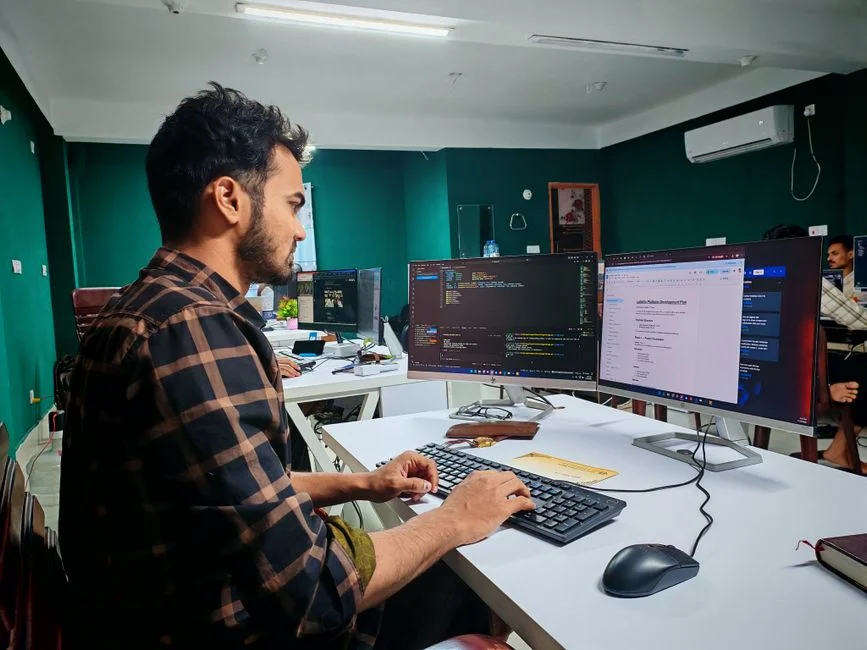

A Laravel developer is a software engineer specializing in building web applications using the Laravel PHP framework. They are proficient in its MVC architecture, Eloquent ORM, Blade templating, and various ecosystem components to deliver scalable, maintainable, and secure server-side logic and APIs for diverse business needs.
Recent industry reports, such as the 2023 Stack Overflow Developer Survey, consistently highlight PHP, and by extension Laravel, as a foundational technology for a significant portion of web applications globally. This enduring relevance underscores the critical role Laravel developers play in constructing and maintaining modern digital infrastructure, particularly for businesses requiring bespoke, high-performance web systems.
For organizations considering Laravel for their next project, understanding the multifaceted role of a skilled Laravel developer extends beyond mere coding proficiency. It encompasses architectural foresight, strategic integration capabilities, and a deep appreciation for long-term system health. This article explores the core competencies, responsibilities, and strategic value that a proficient Laravel developer brings to complex software initiatives.
Defining the Laravel Developer Role: Beyond Basic Coding
The role of a Laravel developer, especially at a senior level, transcends the simple act of writing PHP code. It involves a comprehensive understanding of the entire application lifecycle, from conceptualization and design to deployment, maintenance, and optimization. These professionals are not just implementers; they are problem-solvers who leverage Laravel’s extensive ecosystem to address complex business requirements with elegant, efficient solutions.
A core aspect of this expanded role is the ability to interpret business needs and translate them into technical specifications. This requires strong analytical skills and a capacity for strategic thinking about how software can best serve organizational goals. For instance, when tasked with developing a new CRM module, a Laravel developer must consider data models, user workflows, security implications, and potential integration points with existing systems, rather than merely coding the forms and database interactions. They often act as a bridge between stakeholders and the technical team, ensuring that the developed solution aligns perfectly with the intended business value.
Furthermore, a Laravel developer is expected to be proficient in modern development practices. This includes adherence to PSR standards, understanding of object-oriented programming (OOP) principles, and experience with various design patterns such as Repository, Service, and Observer. They must also be adept at using version control systems like Git, participating in code reviews, and contributing to a collaborative development environment. The emphasis is on producing clean, well-documented, and testable code that contributes to the long-term maintainability and extensibility of the application. This foundational expertise is crucial for any system development software definition to hold true in practice.
Beyond the immediate codebase, a solutions-oriented Laravel developer also considers the operational aspects of an application. This means thinking about deployment strategies, server configurations, database performance tuning, and monitoring. They understand that a well-written application is only effective if it runs reliably and efficiently in production. This holistic perspective ensures that the development effort results in a robust, performant, and scalable system, not just a collection of features. Their input is vital in selecting appropriate hosting environments, configuring caching mechanisms, and planning for disaster recovery scenarios.
Core Competencies of a Senior Laravel Developer
A senior Laravel developer possesses a distinct set of competencies that differentiate them from intermediate or junior counterparts. These competencies span deep technical expertise, architectural insight, and soft skills essential for leadership and collaboration. At the technical core, mastery of Laravel’s foundational components is paramount. This includes an advanced understanding of the Eloquent ORM, the Blade templating engine, the routing system, middleware, and service containers. They can expertly leverage these tools to build complex features, optimize database queries, and manage application state efficiently.
Beyond the framework itself, a senior developer must have a strong command of PHP, including its latest versions, performance characteristics, and common pitfalls. They should be proficient in writing efficient SQL queries and understanding database design principles, including normalization, indexing, and transaction management. Experience with different database systems, such as MySQL, PostgreSQL, or even NoSQL alternatives, is also highly valuable, allowing them to make informed decisions about data storage strategies. Their expertise allows them to design and implement robust database schemas that support complex application logic and high data volumes.
Architectural design is another critical competency. Senior Laravel developers are capable of designing scalable and maintainable application architectures, whether it’s a monolithic application, microservices, or a hybrid approach. They understand design patterns like MVC, Repository, Service, and Command Bus, and know when and how to apply them effectively. This includes making decisions about module separation, API design, and how different parts of the system interact. Their ability to envision the long-term structure of a system helps prevent technical debt and ensures future extensibility.
Furthermore, proficiency in front-end technologies is often expected, as many Laravel applications require integration with JavaScript frameworks like React or Vue.js. While not necessarily a dedicated front-end specialist, a senior Laravel developer should be able to work effectively with front-end teams, understand API contracts, and contribute to the overall user experience. This full stack development services perspective ensures seamless integration between the back-end logic and the user interface. They are adept at using tools like Webpack or Vite for asset compilation and can troubleshoot issues that arise from the interaction between client-side and server-side code.
Finally, soft skills like communication, mentorship, and problem-solving are indispensable. A senior developer often leads teams, mentors junior developers, and communicates complex technical concepts to non-technical stakeholders. Their ability to debug challenging issues, propose practical solutions, and adapt to evolving project requirements makes them invaluable assets to any development team. They foster a culture of technical excellence and continuous improvement.
Architectural Responsibilities and Design Patterns
The architectural responsibilities of a Laravel developer extend to defining the structure and behavior of an application, ensuring it meets functional and non-functional requirements such as scalability, performance, security, and maintainability. This begins with selecting appropriate design patterns that align with the project’s complexity and anticipated growth. While Laravel intrinsically follows the Model-View-Controller (MVC) pattern, a senior developer often applies additional patterns to manage specific concerns within the application.
For instance, the **Repository Pattern** is frequently employed to abstract data access logic, separating the application’s business logic from the persistence layer. This makes the codebase more testable and allows for easier swapping of data storage mechanisms without affecting core business rules. Similarly, the **Service Pattern** is used to encapsulate complex business logic that spans multiple models or requires external integrations, ensuring that controllers remain thin and focused solely on handling HTTP requests and responses. Implementing these patterns requires a deep understanding of dependency injection and service containers, which Laravel provides robust support for.
Consider an application that processes financial transactions. A Laravel developer would architect this using a combination of patterns. The transaction logic might reside in a dedicated service class, invoked by a controller. The service, in turn, would interact with a TransactionRepository to persist data, and perhaps an external PaymentGatewayService for processing. This modular approach ensures that each component has a single responsibility, making the system easier to understand, test, and maintain. The use of interfaces for repositories and services further promotes loose coupling, allowing for flexible implementations.
Another key responsibility involves designing robust API endpoints. Laravel developers are adept at building RESTful APIs, defining clear resource structures, handling authentication (e.g., using Laravel Passport or Sanctum), and implementing rate limiting. They understand the nuances of HTTP methods, status codes, and request/response payloads to create intuitive and efficient interfaces for front-end applications or other microservices. This includes thoughtful consideration of data serialization, often using Laravel’s API Resources to transform models into tailored JSON responses.
Furthermore, architectural decisions often involve choosing between monolithic and microservices architectures. While Laravel is excellent for monoliths, experienced developers can also leverage it to build individual microservices that communicate via message queues or HTTP. This involves understanding inter-service communication patterns, data consistency challenges, and deployment strategies for distributed systems. The ability to make these high-level architectural choices, weighing their trade-offs in terms of complexity, scalability, and operational overhead, is a hallmark of an advanced Laravel developer.
Enterprise Integration Strategies with Laravel
Integrating Laravel applications with existing enterprise systems is a common and critical task for developers working in larger organizations. This often involves connecting to legacy databases, third-party APIs, message queues, or custom internal services. A skilled Laravel developer employs various strategies to ensure these integrations are robust, secure, and maintainable, minimizing disruption to ongoing operations while extending system capabilities.
One primary strategy involves the use of **APIs (Application Programming Interfaces)**. Laravel provides excellent tools for consuming and exposing APIs. Developers frequently use Guzzle HTTP client to interact with external RESTful services, handling authentication, error retries, and data transformation. For exposing APIs, Laravel Passport and Sanctum offer robust authentication mechanisms for OAuth2 and token-based authentication respectively, ensuring secure communication channels for other systems to interact with the Laravel application. This is crucial when integrating with ERP systems, CRM platforms, or even mobile applications.
Consider an enterprise scenario where a new Laravel application needs to pull customer data from an existing SAP system. The developer would implement a service layer in Laravel that uses an HTTP client to call the SAP API, mapping the incoming data to Laravel models. This service would also handle error conditions, logging, and potentially data caching to improve performance and resilience. Similarly, if the Laravel application needs to push order data to a legacy fulfillment system, a dedicated job could be dispatched to handle the asynchronous communication, ensuring that the main application flow remains responsive.
Another vital integration strategy involves **Message Queues**. For asynchronous communication and decoupling services, Laravel integrates seamlessly with queue drivers like Redis, Beanstalkd, and AWS SQS. This is particularly useful for tasks that are time-consuming or prone to failure, such as sending emails, processing large data imports, or triggering external webhooks. By offloading these tasks to a queue, the main application thread remains free, improving user experience and system reliability. A mechanize software engineer often champions such asynchronous patterns.
For complex data synchronization or event-driven architectures, Laravel developers also leverage **Event Broadcasting**. This allows real-time communication between different parts of the application or with external services. For example, using Laravel Echo with Pusher or WebSockets, an event in the Laravel application (e.g., a new order placed) can trigger updates in a separate dashboard application or notify other microservices. Mastering Laravel Broadcasting with Pusher is a testament to the framework’s capabilities in real-time integration.
Finally, for direct database integrations with legacy systems, Laravel’s database abstraction layer and Eloquent’s flexibility can be used, though this approach requires careful management of data schemas and potential conflicts. Developers might configure multiple database connections within Laravel to interact with different data sources, ensuring data integrity and consistency across disparate systems. Understanding the implications of distributed transactions and eventual consistency is key in these complex scenarios.
Performance Optimization and Scalability Concerns
Optimizing performance and ensuring scalability are paramount for any enterprise-grade Laravel application. A skilled Laravel developer continuously considers these aspects throughout the development lifecycle, implementing strategies that ensure the application remains responsive and robust under varying load conditions. This proactive approach prevents bottlenecks and enhances the user experience, directly impacting business operations.
One fundamental area of optimization is **database performance**. Developers achieve this by writing efficient Eloquent queries, utilizing eager loading to prevent N+1 query problems, and implementing proper indexing on frequently accessed columns. They also analyze query execution plans and use tools like Laravel Debugbar or Telescope to identify slow queries. For high-traffic applications, decisions around database sharding, replication, and the use of read replicas become critical architectural considerations. Caching query results with Redis or Memcached further reduces database load, significantly speeding up response times for repetitive data requests.
Next, **caching strategies** extend beyond just database queries. Laravel offers comprehensive caching mechanisms for routes, configurations, views, and entire HTTP responses. Developers leverage these to minimize redundant computations and file I/O operations. For example, caching frequently accessed pages or API responses can dramatically reduce server processing time. Proper cache invalidation strategies are equally important to ensure users always receive up-to-date information, balancing performance gains with data freshness.
For **application code optimization**, profiling tools help identify CPU-intensive sections of code. Developers refactor inefficient algorithms, reduce unnecessary loops, and optimize resource-intensive operations. The effective use of Laravel’s queue system is also crucial for offloading long-running tasks, such as image processing, report generation, or complex calculations, allowing the web server to handle immediate requests quickly. This asynchronous processing model is a cornerstone of scalable web applications.
When it comes to **scalability**, a Laravel developer designs applications with horizontal scaling in mind. This involves making the application stateless, so any instance can handle any request, and separating concerns into distinct services or modules. Utilizing cloud services like AWS Elastic Beanstalk, Google App Engine, or Kubernetes allows for easy auto-scaling based on demand. The developer must ensure that sessions are stored externally (e.g., Redis), and file uploads are handled by shared storage solutions like S3, rather than local disk, to facilitate seamless scaling across multiple servers.
Finally, **asset optimization** plays a role in perceived performance. This includes minifying CSS and JavaScript files, compressing images, and leveraging Content Delivery Networks (CDNs) to serve static assets closer to the user. Laravel Mix (or Vite in newer versions) provides powerful tools for managing and optimizing front-end assets, ensuring that the client-side experience is as fast and smooth as the back-end. A holistic approach to performance and scalability ensures the Laravel application can grow with the business without compromising user experience or operational efficiency.
Security Best Practices in Laravel Development
Security is not an afterthought but a foundational pillar in the development of any Laravel application, particularly in enterprise environments where data breaches can have severe consequences. A proficient Laravel developer adheres to a rigorous set of security best practices, leveraging the framework’s built-in protections and implementing additional measures to safeguard data and prevent vulnerabilities.
Laravel provides robust out-of-the-box protections against many common web vulnerabilities. For instance, its **Eloquent ORM** and database query builder inherently prevent SQL injection attacks by using PDO parameter binding. The **Blade templating engine** automatically escapes output, mitigating Cross-Site Scripting (XSS) attacks. Additionally, Laravel includes mechanisms for **Cross-Site Request Forgery (CSRF) protection** through tokens generated for each user session, ensuring that only legitimate requests from your application can modify data. Developers must ensure these built-in features are correctly utilized and not inadvertently bypassed.
Beyond the framework’s defaults, developers implement strong **authentication and authorization** mechanisms. Laravel’s authentication scaffolding provides a secure starting point, often extended with multi-factor authentication (MFA) for enhanced security. For authorization, Laravel’s Gates and Policies are used to define fine-grained access control, ensuring that users can only perform actions and access data they are explicitly permitted to. This requires careful mapping of user roles and permissions to application functionalities, often involving a Role-Based Access Control (RBAC) system.
Data security is paramount. This involves **encrypting sensitive data** both in transit (using HTTPS/SSL certificates) and at rest (encrypting database fields or using encrypted file storage). Laravel’s encryption facade provides a convenient way to encrypt and decrypt data securely. Proper handling of user passwords, always hashing them with strong, modern algorithms like Bcrypt or Argon2, is non-negotiable. Storing API keys, database credentials, and other sensitive configuration information in environment variables (.env file) and never committing them to version control is a standard practice.
Protection against other common attacks, such as **mass assignment vulnerabilities**, is handled by defining $fillable or $guarded properties on Eloquent models. Developers also implement **rate limiting** for API endpoints and login attempts to prevent brute-force attacks and denial-of-service (DoS) attempts. Input validation, using Laravel’s powerful validation rules, is critical to ensure that only expected and safe data enters the application, preventing various injection attacks and data corruption.
Finally, continuous security monitoring, regular security audits, and keeping Laravel and its dependencies updated are essential. Developers must stay informed about the latest security vulnerabilities and apply patches promptly. Implementing security headers (e.g., Content Security Policy, X-XSS-Protection) and configuring web servers (Nginx/Apache) securely further hardens the application’s perimeter. A proactive and layered approach to security is what distinguishes a responsible Laravel developer.
DevOps and CI/CD for Laravel Projects
In modern software development, a Laravel developer’s responsibilities often extend into the realm of DevOps, particularly concerning Continuous Integration (CI) and Continuous Delivery/Deployment (CD). Integrating CI/CD pipelines is critical for automating the build, test, and deployment processes, ensuring rapid, reliable, and consistent delivery of software updates. This automation drastically reduces human error and speeds up the feedback loop, allowing for quicker iterations and higher quality releases.
For **Continuous Integration**, a Laravel developer integrates automated testing into the workflow. This typically involves unit tests, feature tests, and potentially browser tests written with PHPUnit and Laravel Dusk. Each code push to a version control system (like Git) triggers the CI pipeline, which automatically runs these tests. If any test fails, the developer is immediately notified, preventing faulty code from merging into the main branch. This continuous validation ensures that new features or bug fixes do not introduce regressions. Tools like GitHub Actions, GitLab CI/CD, Jenkins, or Buddy are commonly used to orchestrate these CI processes.
A typical CI pipeline for a Laravel project might involve several steps: first, installing PHP dependencies via Composer; second, running static analysis tools (e.g., PHPStan, Larastan) to check for code quality and potential errors; third, executing all automated tests; and finally, building front-end assets using Laravel Mix or Vite. The developer configures these steps, ensuring that the environment mirrors production as closely as possible to catch issues early.
**Continuous Delivery (CD)** extends CI by automatically preparing releases for deployment after successful integration. This means that once the tests pass, the application artifact (e.g., a compiled application bundle) is ready to be deployed to a staging or production environment. A Laravel developer sets up the CD pipeline to automate tasks like database migrations, clearing caches, and optimizing configuration files for the target environment. This ensures that a deployable version of the application is always available.
For **Continuous Deployment**, the process is fully automated, and every successful build is automatically deployed to production. While this offers the fastest release cycle, it requires a high degree of confidence in the automated tests and monitoring systems. Laravel developers configure deployment scripts that can gracefully handle zero-downtime deployments, often using tools like Envoyer, Deployer, or custom shell scripts. This includes strategies for database migrations without downtime, such as running migrations in separate steps or using a blue/green deployment approach.
The role also involves managing server configurations and environment variables securely within the CI/CD pipeline. This includes setting up SSH keys, managing API tokens, and ensuring that sensitive data is not exposed. Developers work closely with operations teams to define infrastructure-as-code (IaC) using tools like Terraform or Ansible, ensuring that server environments are consistently provisioned and configured. This collaborative approach between development and operations is fundamental to successful DevOps practices in Laravel projects.
The Role of a Laravel Developer in Modern Microservices
While Laravel is often associated with monolithic applications, a skilled Laravel developer also plays a significant role in modern microservices architectures. In such a setup, Laravel can serve as a robust framework for building individual, self-contained services that communicate with each other, offering flexibility, scalability, and independent deployability. Understanding how to leverage Laravel effectively within a distributed system is a key differentiator for senior developers.
In a microservices context, a Laravel application might function as a single service responsible for a specific business domain, such as user authentication, order processing, or product catalog management. The developer’s task is to design this service to be highly cohesive and loosely coupled from other services. This involves defining clear API contracts for inter-service communication, often using RESTful APIs or asynchronous messaging patterns with message brokers like RabbitMQ or Apache Kafka.
For example, a Laravel microservice responsible for user management might expose endpoints for user registration, login, and profile updates. Other services, such as an e-commerce service, would interact with this user service via its API to authenticate users or retrieve profile information. The Laravel developer ensures this service is secure, performs efficiently, and can scale independently of the other microservices. This often means carefully designing the database schema for the service, ensuring it only stores data relevant to its domain and does not share a database with other services.
Implementing event-driven architectures is another common pattern in microservices where Laravel developers excel. A Laravel service can publish events (e.g., ‘UserRegistered’, ‘OrderPlaced’) to a message broker, which other interested services can then consume. Laravel’s event system, combined with its queue capabilities, makes this pattern highly effective. For instance, an ‘OrderPlaced’ event published by an Order Service could be consumed by an Inventory Service to decrement stock, a Shipping Service to initiate delivery, and a Notification Service to send an email confirmation. This asynchronous communication decouples services, making the system more resilient and scalable.
Challenges in microservices, such as distributed transactions, data consistency, and service discovery, require careful consideration. A Laravel developer contributes to solving these by implementing patterns like the Saga pattern for managing distributed transactions or using service registries (e.g., Consul, Eureka) for service discovery. They also focus on robust error handling, circuit breakers, and retry mechanisms to build fault-tolerant services. Monitoring and logging become even more critical in a distributed environment, and Laravel developers integrate their services with centralized logging and monitoring solutions.
Ultimately, utilizing Laravel in a microservices environment requires a strategic mindset. It’s about breaking down complex problems into smaller, manageable services, each leveraging Laravel’s strengths while adhering to the principles of distributed systems design. This approach allows for greater agility, enabling different teams to work on services independently and deploy them more frequently, leading to faster innovation and improved system resilience.
Evaluating Laravel Talent: Technical Assessment Frameworks
When hiring or assigning a Laravel developer to a critical project, a robust technical assessment framework is essential to accurately gauge their capabilities beyond resume claims. Effective evaluation goes beyond basic syntax questions and delves into problem-solving, architectural thinking, and practical application of Laravel’s features in real-world scenarios. A solutions consultant often designs these frameworks to ensure alignment with specific project needs and long-term organizational goals.
A comprehensive assessment typically begins with a review of the candidate’s **portfolio and past projects**. This provides insight into their practical experience, coding style, and the complexity of applications they have built. Looking for contributions to open-source projects or well-maintained personal projects can reveal a developer’s passion and commitment to quality. Discussion during this phase should focus on their decision-making processes, challenges faced, and how they overcame them.
The next stage often involves a **coding challenge or take-home assignment**. This should mimic a simplified version of a real-world problem relevant to the position. For a Laravel developer, this might involve building a small API, implementing a CRUD (Create, Read, Update, Delete) module with specific business logic, or optimizing a given piece of code. The evaluation criteria should include code quality (readability, maintainability, adherence to PSR standards), test coverage, proper use of Laravel features (Eloquent, queues, events), error handling, and performance considerations. The goal is to see how they structure a Laravel application and solve problems pragmatically.
An **in-depth technical interview** follows, covering both theoretical knowledge and practical application. Questions should probe their understanding of:
- Laravel Internals: Service Container, Service Providers, Middleware, Facades.
- Database & Eloquent: Query optimization, relationships, migrations, seeding, database transactions.
- Architecture & Design Patterns: MVC, Repository, Service, Event Sourcing, API design.
- Testing: Unit, Feature, Browser testing with PHPUnit and Dusk.
- Performance: Caching, queueing, database indexing, N+1 problem.
- Security: Common vulnerabilities (XSS, CSRF, SQLi), authentication (Passport, Sanctum), authorization (Gates, Policies).
- DevOps: CI/CD pipelines, deployment strategies, containerization (Docker).
The interviewer should present hypothetical scenarios or ask them to debug a snippet of code, observing their thought process and problem-solving approach.
Finally, a **system design or architectural discussion** is crucial for senior roles. This involves presenting a larger problem and asking the candidate to design a high-level solution using Laravel, considering scalability, reliability, and integration points. This reveals their ability to think abstractly, make trade-offs, and justify their architectural decisions. For instance, asking them to design a multi-tenant SaaS application or a real-time notification system using Laravel and tools like Pusher can be highly insightful. This holistic assessment ensures that the selected Laravel developer not only codes effectively but also contributes strategically to the project’s success.
Migration Strategies: Modernizing Legacy Systems with Laravel
Modernizing legacy systems is a common challenge for many organizations, and Laravel often serves as an excellent framework for this transition. A skilled Laravel developer is instrumental in devising and executing effective migration strategies, transforming outdated, unmaintainable applications into modern, scalable, and secure platforms. This process is complex, requiring careful planning, risk assessment, and a phased approach to minimize business disruption.
The initial phase involves a thorough **assessment of the legacy system**. This includes understanding its architecture, identifying critical functionalities, analyzing the database schema, and documenting existing business logic. The Laravel developer works to identify pain points, security vulnerabilities, and performance bottlenecks in the old system. This discovery phase is crucial for defining the scope of the migration and identifying which parts of the legacy system can be salvaged, re-engineered, or entirely replaced.
One common strategy is the **strangler fig pattern**. This involves incrementally building new functionalities or modules in Laravel, routing new traffic to these modern components, and gradually ‘strangling’ the old system. For example, a new user authentication service could be built in Laravel and integrated, while other parts of the legacy application still run. As new features are developed in Laravel, they replace equivalent functionality in the legacy system until the old application is completely decommissioned. This approach minimizes risk by allowing for continuous delivery and testing of new components.
Another approach is a **big-bang rewrite**, though this is generally riskier and reserved for smaller, less critical applications. In this scenario, the entire application is rebuilt from scratch in Laravel, and then the old system is replaced in one go. The Laravel developer would focus on rapid development, ensuring all critical features are re-implemented and thoroughly tested before the cutover. This demands extensive upfront planning and robust testing protocols to mitigate the inherent risks of a complete overhaul.
Data migration is a critical component of any modernization effort. Laravel provides powerful tools for this, including database migrations and seeders. Developers write scripts to extract data from the legacy database, transform it to fit the new Laravel application’s schema, and then import it. This often involves handling data inconsistencies, cleaning data, and ensuring referential integrity. Depending on the complexity and volume of data, this can be a one-time process or require continuous synchronization during a phased migration.
During the migration, **maintaining business continuity** is paramount. This might involve running both the legacy and the new Laravel application in parallel for a period, using feature flags to gradually roll out new functionalities, or implementing robust fallback mechanisms. A Laravel developer collaborates closely with stakeholders to ensure a smooth transition, often providing temporary integration layers to bridge the old and new systems. Post-migration, ongoing monitoring, performance tuning, and continuous improvement of the new Laravel application are essential for long-term success, ensuring the investment in modernization yields significant returns.
Build vs. Buy Decisions: When Laravel is the Right Fit
Organizations frequently face the critical decision of whether to invest in building custom software or purchasing an off-the-shelf solution. For many complex business needs, Laravel offers a compelling case for the ‘build’ option, particularly when existing commercial products fall short on specific requirements, integration capabilities, or scalability demands. A solutions consultant, often informed by experienced Laravel developers, guides businesses through this strategic choice.
Laravel becomes the right fit for custom development when:
- Unique Business Logic: The organization has highly specific or proprietary business processes that generic SaaS solutions cannot adequately support. Attempting to force these processes into a rigid commercial product often leads to inefficient workarounds, increased operational costs, and user frustration. A custom Laravel application can be tailored precisely to these unique workflows, providing a competitive advantage.
- Complex Integrations: The new application needs to integrate deeply with multiple existing internal systems (ERPs, CRMs, legacy databases) or external services. While some off-the-shelf solutions offer limited API access, a custom Laravel application can be designed from the ground up with robust, flexible integration points, using Laravel’s powerful HTTP client, queue system, and event broadcasting capabilities to ensure seamless data flow.
- Scalability and Performance Requirements: The application is expected to handle significant user loads, high transaction volumes, or complex data processing. Laravel, combined with proper architectural design, caching, and database optimization, is highly scalable. Unlike some commercial solutions that might impose limits or incur prohibitive costs for scaling, a custom Laravel application offers greater control over performance tuning and infrastructure choices.
- Total Cost of Ownership (TCO) Over Time: While the initial investment for custom development might seem higher, proprietary solutions often come with recurring subscription fees, per-user costs, and additional charges for features or integrations. Over the long term, a custom Laravel solution can offer a lower TCO, providing full ownership and avoiding vendor lock-in. Maintenance costs are predictable, and updates can be controlled internally.
- Security and Compliance: For industries with stringent security and compliance requirements (e.g., healthcare, finance), a custom Laravel application allows for complete control over security implementations, data residency, and auditing. This ensures adherence to regulations like HIPAA, GDPR, or specific industry standards, which might be challenging or impossible to achieve with a generic product.
- Flexibility and Future Extensibility: Business requirements evolve. A custom Laravel application provides the flexibility to adapt to future changes, add new features, or pivot quickly without being constrained by a vendor’s roadmap. The modular nature of Laravel development makes it easier to extend and maintain, ensuring the software remains relevant and valuable for years to come.
Ultimately, the decision hinges on a thorough analysis of current and future business needs, the cost of customization for commercial products versus custom build, and the strategic value of owning a bespoke solution. A skilled Laravel developer plays a pivotal role in articulating the technical feasibility and long-term benefits of a custom-built solution.
Team Structure and Collaboration with Laravel Developers
Effective team structure and seamless collaboration are vital for successful Laravel project delivery, especially in complex enterprise settings. A well-organized team, leveraging modern collaboration tools and methodologies, ensures that Laravel developers can work efficiently, share knowledge, and contribute effectively to the project’s goals. As a solutions consultant, defining these structures and processes is key to optimizing development workflows.
A typical Laravel development team might comprise several roles:
- Lead Laravel Developer: Responsible for architectural decisions, technical leadership, mentoring junior developers, and ensuring code quality. They often act as the primary technical point of contact.
- Senior Laravel Developer: Designs and implements complex features, reviews code, and contributes significantly to architectural discussions.
- Mid-Level Laravel Developer: Implements features, writes tests, and participates in code reviews, often with guidance from senior team members.
- Junior Laravel Developer: Focuses on smaller tasks, learns best practices, and contributes under close supervision.
- DevOps Engineer: Manages CI/CD pipelines, infrastructure, deployments, and monitoring (often shared across multiple development teams).
- QA Engineer: Designs and executes test plans, identifies bugs, and ensures the application meets quality standards.
- Project Manager/Scrum Master: Oversees project timelines, manages backlog, facilitates communication, and ensures agile methodologies are followed.
Collaboration within these teams is facilitated by several practices and tools. **Version control systems**, primarily Git, are non-negotiable. Developers use feature branches, pull requests, and code reviews to ensure code quality and knowledge sharing. Regular code reviews are a critical practice, not just for catching bugs but also for maintaining coding standards, sharing best practices, and fostering a collaborative learning environment.
**Agile methodologies**, such as Scrum or Kanban, are widely adopted. Daily stand-ups, sprint planning, and retrospectives ensure transparency, adaptability, and continuous improvement. Task management tools like Jira, Trello, or Asana are used to track progress, assign tasks, and manage the product backlog, providing a clear overview of the project status to all team members and stakeholders.
Effective communication is paramount. Teams utilize communication platforms like Slack or Microsoft Teams for real-time discussions, and video conferencing for remote collaboration. Documentation, including API specifications, architectural diagrams, and feature descriptions, is maintained in shared repositories (e.g., Confluence, Markdown files in Git) to ensure that knowledge is accessible and consistent. This is particularly important for onboarding new team members and for long-term project maintainability.
For complex projects, Laravel developers often work in cross-functional teams, collaborating closely with front-end developers, UI/UX designers, and business analysts. This integrated approach ensures that the back-end implementation aligns with the user interface and business requirements, leading to a cohesive and effective final product. The ability of Laravel developers to integrate seamlessly into these diverse teams is a testament to their adaptability and crucial for the successful delivery of sophisticated web applications.
Continuous Learning and Ecosystem Evolution
The landscape of web development, and specifically the Laravel ecosystem, is in a state of continuous evolution. For a Laravel developer, especially one operating at a senior level or in a consultative capacity, continuous learning is not merely beneficial but absolutely essential. Staying abreast of the latest framework updates, best practices, and emerging tools ensures that the solutions delivered remain cutting-edge, secure, and performant, providing sustained value to the business.
Laravel itself undergoes significant updates annually, with new major versions introducing substantial features, performance improvements, and sometimes breaking changes. A dedicated Laravel developer actively follows these releases, understanding the implications of new features like Livewire for reactive interfaces, or Filament for administrative panels. They evaluate how these new tools can be strategically incorporated into projects to improve development efficiency, enhance user experience, or reduce technical debt. For instance, understanding the shift from Laravel Mix to Vite for asset bundling requires adapting build processes and tooling.
Beyond the core framework, the broader PHP ecosystem also evolves. New PHP versions bring performance gains and language features that a Laravel developer must master. Keeping up with PHP RFCs (Requests for Comments) and understanding changes in language constructs, such as new array functions or JIT compilation, allows them to write more efficient and modern code. Similarly, adjacent technologies like database systems (MySQL, PostgreSQL), caching solutions (Redis), and message queues (RabbitMQ, Kafka) also see continuous advancements that impact Laravel application design and performance.
The developer community plays a crucial role in this continuous learning. Active participation in forums, attending conferences (like Laracon), following influential developers on social media, and contributing to open-source projects provides invaluable insights and fosters skill development. This engagement helps developers discover new libraries, understand alternative approaches to common problems, and stay informed about emerging trends and challenges within the Laravel space. For example, learning about new patterns for handling complex domain logic or advanced testing strategies often comes from community discussions and shared experiences.
Furthermore, continuous learning extends to understanding new development paradigms and architectural patterns. While Laravel is often used for traditional web applications, developers are increasingly exploring its use in serverless architectures, event-driven systems, or for building command-line tools with Laravel Zero. This broader perspective allows them to recommend and implement solutions that are not only technically sound but also strategically aligned with the business’s long-term technology roadmap.
Ultimately, a Laravel developer who embraces continuous learning becomes a strategic asset. They bring fresh perspectives, leverage the latest innovations, and ensure that the applications they build are resilient, adaptable, and future-proof. This commitment to ongoing education translates directly into higher quality software and greater business agility.
Quality Assurance and Testing Methodologies in Laravel
Quality Assurance (QA) and robust testing methodologies are indispensable components of professional Laravel development, ensuring the reliability, correctness, and security of applications before they reach production. A proficient Laravel developer integrates testing throughout the development lifecycle, viewing it not as a separate phase, but as an intrinsic part of delivering high-quality software. This commitment to quality minimizes bugs, reduces technical debt, and builds confidence in the application’s stability.
Laravel provides excellent native support for various testing paradigms through PHPUnit, its integrated testing framework. Developers primarily focus on three types of automated tests:
- Unit Tests: These tests focus on individual components or methods in isolation, ensuring they perform as expected. For example, testing a specific function within a service class or a method on an Eloquent model. Unit tests are fast to execute and provide immediate feedback on the correctness of small code segments.
- Feature Tests: Also known as integration tests, these verify how different parts of the application interact. In Laravel, feature tests often simulate HTTP requests to application routes, asserting that the correct responses are returned, data is stored correctly in the database, and middleware functions as intended. These tests ensure that the application’s features work as a cohesive unit.
- Browser Tests: Using Laravel Dusk, developers can automate browser interactions to simulate a real user’s journey through the application. This includes clicking buttons, filling forms, and asserting that certain elements are present on the page. Browser tests are crucial for verifying the end-to-end user experience and catching front-end integration issues.
Beyond these automated tests, a Laravel developer also implements other QA practices. **Static analysis tools**, such as PHPStan or Larastan, are integrated into the development workflow and CI/CD pipelines. These tools analyze code without executing it, identifying potential bugs, code smells, and adherence to coding standards. This proactive approach catches issues early, improving code quality before tests are even run.
For complex business logic, **Test-Driven Development (TDD)** is often employed. In TDD, tests are written before the actual code, guiding the development process and ensuring that every piece of functionality has corresponding test coverage. This methodology leads to more robust, well-designed, and maintainable code. Developers also focus on achieving high **code coverage**, aiming for a significant percentage of the codebase to be covered by automated tests, typically above 80% for critical applications.
Manual testing, though less automated, still plays a role, especially for exploratory testing, usability testing, and verifying complex edge cases that are difficult to automate. QA engineers collaborate closely with Laravel developers to define test plans, write acceptance criteria, and perform regression testing. The integration of continuous testing into CI/CD pipelines ensures that every code change is validated automatically, providing immediate feedback and preventing regressions from reaching production. This comprehensive approach to QA and testing is a hallmark of professional Laravel development, leading to reliable and high-performing applications.
Advanced Database Management and Optimization
Advanced database management and optimization are critical skills for any Laravel developer building high-performance, scalable applications. While Eloquent ORM simplifies database interactions, a deep understanding of underlying database principles and optimization techniques is essential to prevent bottlenecks and ensure efficient data handling, particularly as data volumes and user traffic grow. This expertise extends beyond basic query writing to encompass schema design, indexing strategies, and advanced caching mechanisms.
The foundation of database optimization lies in **efficient schema design**. A skilled Laravel developer designs normalized database schemas to reduce data redundancy and improve data integrity. They understand when to strategically denormalize for performance gains in specific read-heavy scenarios, always weighing the trade-offs. Choosing appropriate data types, defining primary and foreign keys correctly, and enforcing referential integrity are fundamental steps that prevent many performance issues down the line.
**Indexing** is another cornerstone of database performance. Developers identify frequently queried columns and apply appropriate indexes (B-tree, hash, full-text) to speed up data retrieval. They also understand the nuances of composite indexes and how to use tools to analyze query execution plans (e.g., EXPLAIN in MySQL) to verify index effectiveness. Over-indexing can also degrade write performance, so a balanced approach based on application access patterns is crucial.
Beyond schema and indexing, **Eloquent query optimization** is paramount. While Eloquent is convenient, inefficient use can lead to performance issues. Developers master techniques like:
- Eager Loading (
with()): To prevent the N+1 query problem, where a loop iterates over a collection of models and executes a separate query for each related model. - Lazy Eager Loading (
load()): For relationships that are not always needed. - Constraining Eager Loads: To add conditions to eager-loaded relationships.
- Selecting Specific Columns (
select()): To retrieve only the necessary data, reducing memory footprint and network transfer. - Chunking Results (
chunk()): For processing large datasets efficiently without loading everything into memory. - Using Raw SQL or DB Facade: When Eloquent’s abstraction becomes a performance bottleneck for highly complex or optimized queries.
For high-traffic applications, **database caching** is indispensable. Laravel developers integrate solutions like Redis or Memcached to cache frequently accessed query results or entire eloquent models. This significantly reduces the load on the database server. Implementing effective cache invalidation strategies is critical to ensure data freshness. Additionally, using Laravel’s queue system for database-intensive operations (e.g., bulk inserts, complex report generation) offloads work from the main request thread, improving responsiveness.
Finally, for extreme scalability, understanding **database sharding and replication** becomes relevant. While often managed by a dedicated DBA or DevOps team, a Laravel developer should understand the architectural implications of horizontally scaling databases, including how to configure Laravel to interact with read replicas or different shards. This advanced knowledge ensures the database layer can support the application’s growth and maintain its performance under peak loads.
Security Audits and Vulnerability Management
For any production-grade Laravel application, especially those handling sensitive data or critical business operations, routine security audits and comprehensive vulnerability management are non-negotiable. A responsible Laravel developer actively participates in these processes, ensuring that the application remains resilient against evolving threats. This proactive approach is fundamental to maintaining trust, achieving compliance, and preventing costly data breaches.
Security audits typically involve a systematic review of the application’s codebase, infrastructure, and configurations to identify potential weaknesses. For a Laravel application, this includes:
- Code Review: Manual or automated inspection of the source code for common vulnerabilities (e.g., injection flaws, broken authentication, insecure deserialization) and adherence to secure coding guidelines. Tools like PHPStan with security extensions or specific Laravel security scanners can automate parts of this process.
- Dependency Auditing: Regularly checking all third-party libraries and packages (managed via Composer) for known vulnerabilities. Tools like
composer auditor external services like Snyk can automate this, alerting developers to outdated or compromised dependencies. Keeping Laravel and its packages updated is a primary defense. - Configuration Review: Ensuring that Laravel’s security features are correctly configured (e.g., CSRF tokens enabled, appropriate session drivers, strong encryption keys). Reviewing web server (Nginx/Apache) and database configurations for security hardening is also part of this.
- Penetration Testing (Pen Testing): Engaging ethical hackers to simulate real-world attacks against the application. This provides an external, adversarial perspective on the application’s defenses and can uncover subtle vulnerabilities that automated tools might miss.
- Vulnerability Scanning: Using automated tools to scan the application and its underlying infrastructure for known vulnerabilities, misconfigurations, and weak points.
Once vulnerabilities are identified, the Laravel developer’s role shifts to **vulnerability management**. This involves:
- Prioritization: Assessing the severity and exploitability of each vulnerability, prioritizing fixes based on risk to the business.
- Remediation: Implementing patches, refactoring insecure code, updating dependencies, or reconfiguring systems to eliminate the vulnerability. This often requires careful planning to avoid introducing new bugs.
- Verification: Rerunning tests, conducting follow-up scans, or re-engaging pen testers to confirm that the vulnerability has been successfully addressed and no new ones have been introduced.
- Documentation: Maintaining a record of identified vulnerabilities, their remediation, and the lessons learned to prevent similar issues in the future. This contributes to an ongoing security knowledge base.
Beyond periodic audits, a Laravel developer fosters a culture of **continuous security awareness**. This means integrating security checks into the CI/CD pipeline, conducting regular security training, and staying informed about the latest attack vectors and defense mechanisms. For example, using pre-commit hooks to run basic security checks or integrating security linters into the development environment. By embedding security into every stage of the development and operational process, Laravel applications can achieve a higher posture of resilience against an ever-evolving threat landscape, protecting both the business and its users.
The Evolution of Laravel Development Methodologies
The methodologies employed in Laravel development have continually evolved, reflecting broader trends in software engineering towards greater agility, efficiency, and reliability. Modern Laravel developers do not just write code; they adopt and adapt these methodologies to optimize project delivery, enhance collaboration, and ensure the long-term success of their applications. Understanding this evolution is key for any organization looking to leverage Laravel effectively.
Initially, many Laravel projects might have followed more traditional waterfall models, especially for smaller, less complex applications. However, the inherent flexibility and rapid development capabilities of Laravel naturally lend themselves to **Agile methodologies**, particularly Scrum and Kanban. These iterative approaches allow teams to respond quickly to changing requirements, deliver value incrementally, and gather continuous feedback from stakeholders. Laravel developers are accustomed to working in sprints, participating in daily stand-ups, and delivering demonstrable features at regular intervals.
The rise of **DevOps** has significantly impacted Laravel development workflows. This philosophy emphasizes collaboration and integration between development and operations teams. For Laravel developers, this means taking more ownership of the deployment process, infrastructure configuration, and monitoring. They work with CI/CD pipelines, containerization (Docker), and infrastructure-as-code (Terraform, Ansible) to automate repetitive tasks and ensure consistent environments from development to production. This integration helps bridge the gap between writing code and delivering it reliably to users.
Another significant shift is the adoption of **Test-Driven Development (TDD)** and a strong emphasis on automated testing. While not universally applied, many senior Laravel developers embrace TDD to guide their design decisions and ensure comprehensive test coverage. This methodology, combined with Laravel’s robust testing utilities (PHPUnit, Dusk), leads to more stable, maintainable, and refactorable codebases. The focus has moved from merely functional code to code that is also proven correct through automated means.
Furthermore, the growth of the Laravel ecosystem has encouraged the adoption of **Domain-Driven Design (DDD)** principles in more complex applications. While Laravel does not enforce DDD, its architecture (service containers, events, jobs) provides excellent primitives for implementing bounded contexts, aggregates, and domain events. Developers use these concepts to model complex business domains more effectively, leading to cleaner architectures and a better alignment between software and business logic, especially in large-scale enterprise systems.
Finally, the increasing popularity of **API-first development** and **microservices architectures** has also shaped Laravel development methodologies. Developers are now frequently building Laravel applications that serve primarily as backend APIs for JavaScript front-ends (like React or Vue.js) or mobile applications. This requires a strong focus on API design principles, authentication mechanisms (Laravel Passport/Sanctum), and efficient data serialization. The ability to build decoupled systems, where Laravel services communicate asynchronously via message queues, represents a significant evolution in how Laravel applications are conceived and constructed.
Long-Term Maintainability and Technical Debt Management
Long-term maintainability and the proactive management of technical debt are critical concerns for any software project, particularly for enterprise applications built with Laravel that are expected to have an extended lifespan. A skilled Laravel developer understands that writing code is only part of the equation; ensuring that the application remains adaptable, understandable, and cost-effective to evolve over time is equally important. This perspective is a hallmark of a solutions-oriented approach.
One of the primary strategies for ensuring maintainability is **adherence to coding standards and best practices**. This includes following PSR standards (PSR-1, PSR-2, PSR-12) for code style, using clear and consistent naming conventions, and writing self-documenting code. Laravel’s own conventions often guide developers, but strict enforcement through static analysis tools (like PHPStan or Laravel Pint) and regular code reviews ensures consistency across the team. Well-structured code is easier for new developers to understand and for existing developers to modify without introducing regressions.
**Comprehensive documentation** is another cornerstone of maintainability. This includes inline code comments for non-obvious logic, API documentation (e.g., using OpenAPI/Swagger specifications), architectural decision records (ADRs), and clear README files for projects. Good documentation reduces the cognitive load for developers working on the codebase, speeding up onboarding and troubleshooting. For Laravel, this often extends to documenting complex Eloquent relationships, service container bindings, and custom facades.
**Modular design and separation of concerns** are crucial for managing complexity. A Laravel developer structures the application into logical modules, using services, repositories, and events to decouple different parts of the system. This ensures that changes in one area have minimal impact on others, making the application easier to modify and test. Avoiding ‘God objects’ (classes that do too much) and adhering to the Single Responsibility Principle (SRP) are key architectural considerations.
Proactive **technical debt management** involves identifying, assessing, and systematically addressing areas of the codebase that are difficult to maintain, extend, or understand. This isn’t about blaming past decisions but about making strategic investments in refactoring. Regular code audits, peer reviews, and using metrics (e.g., cyclomatic complexity, code duplication) help identify these areas. Allocating dedicated time in sprints for refactoring, rather than solely focusing on new features, is a common strategy to keep technical debt in check.
Finally, **automated testing** plays a vital role in enabling safe refactoring. A robust suite of unit, feature, and browser tests provides a safety net, allowing developers to make changes to the codebase with confidence, knowing that if they inadvertently introduce a bug, the tests will catch it. This enables continuous improvement and prevents the accumulation of unmanageable technical debt, ensuring the Laravel application remains a valuable asset for the business over its entire lifecycle.
The Strategic Value of Laravel Developers for Digital Transformation
In the era of rapid digital transformation, organizations are constantly seeking ways to modernize their operations, enhance customer experiences, and gain competitive advantages through technology. A skilled Laravel developer is not merely a coder but a strategic asset in this transformation journey, bringing a unique blend of efficiency, flexibility, and architectural foresight that significantly impacts business outcomes. Their value extends beyond project delivery to shaping the long-term technological trajectory of a company.
One of the core strategic values lies in Laravel’s **rapid development capabilities**. The framework’s elegant syntax, rich ecosystem, and comprehensive set of tools allow developers to build complex applications significantly faster than with many other technologies. This speed-to-market is crucial for businesses needing to launch new products, services, or internal tools quickly, enabling them to respond to market demands or internal needs with agility. For instance, developing a custom CRM or ERP module that would take months with older technologies can be accomplished in weeks with Laravel, accelerating the pace of digital change.
Laravel developers also contribute to **cost efficiency** in the long run. By building maintainable, well-structured applications, they reduce the ongoing costs associated with bug fixes, future enhancements, and developer onboarding. The large, active Laravel community and abundant resources mean that finding skilled talent for maintenance and future development is generally easier and more cost-effective compared to niche technologies. This mitigates the risks of vendor lock-in and ensures long-term sustainability of the software investment.
Furthermore, the **scalability and robustness** that a proficient Laravel developer can engineer into an application provide a solid foundation for growth. As businesses expand, their digital platforms must scale seamlessly to accommodate increased user loads, data volumes, and new functionalities. Laravel’s architectural flexibility, coupled with cloud-native deployment strategies, ensures that applications can grow without requiring complete re-architectures, thereby protecting the initial investment and supporting future expansion.
From a **strategic integration perspective**, Laravel developers excel at weaving new applications into an existing, often complex, enterprise technology landscape. Their ability to build robust APIs, leverage message queues, and implement event-driven architectures facilitates seamless data exchange and process automation across disparate systems. This capability is vital for breaking down data silos, improving operational efficiency, and creating a unified digital ecosystem, which is a cornerstone of true digital transformation.
Finally, Laravel developers bring a mindset of **innovation and continuous improvement**. They are often early adopters of new technologies, patterns, and best practices within the PHP and web development space. This ensures that the applications they build are not just functional but also leverage modern approaches to security, performance, and user experience. By having such expertise in-house or through a trusted partner, businesses can continually evolve their digital offerings, staying ahead of the curve and driving sustained competitive advantage.
The role of a Laravel developer is far more expansive and strategic than often perceived. From architecting robust, scalable solutions to ensuring stringent security, managing complex integrations, and fostering a culture of continuous improvement, these professionals are pivotal to the success of modern web applications. Their expertise in navigating the multifaceted landscape of software development, coupled with Laravel’s powerful capabilities, empowers businesses to build bespoke digital products that drive innovation and competitive advantage.
For organizations seeking to build, optimize, or modernize their web presence, understanding the full breadth of a Laravel developer’s contribution is essential. It’s about securing a partner who can translate complex business requirements into elegant, efficient, and future-proof technical realities.
NR Studio builds custom web apps, mobile apps, SaaS platforms, and internal tools for growing businesses. If you’re working through a technical decision, feel free to reach out — no commitment required.