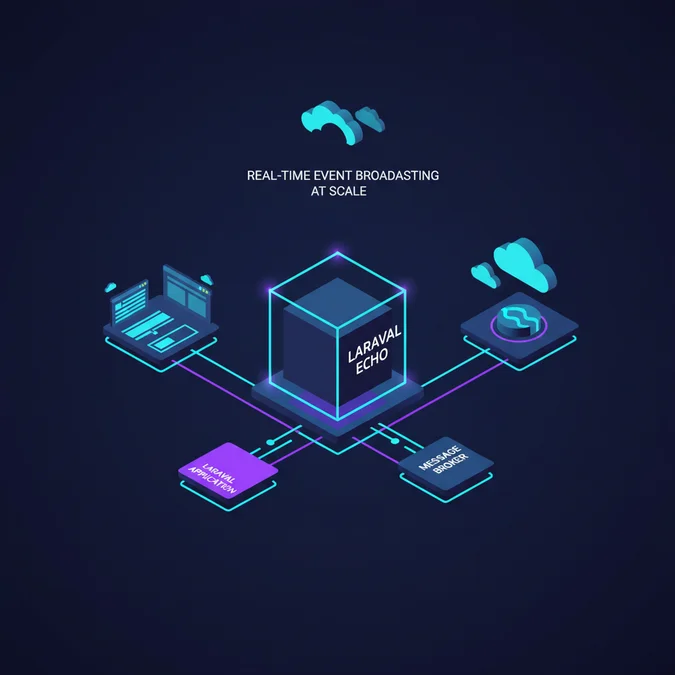

Laravel Echo is a client-side JavaScript library that abstracts WebSocket subscriptions, presence state, and event multiplexing across distributed channels. It unifies transport drivers such as Reverb, Pusher, and Soketi behind a declarative, unified API, allowing browser applications to react to server-side events without polling overhead.
For technology leaders and platform architects, engineering real-time data flows involves balancing throughput, connection state overhead, and developer velocity. Naive polling saturates relational databases and edge proxies, whereas raw WebSocket integrations frequently introduce fragile client-side state machines, duplicated authentication logic, and high maintenance costs.
Laravel Echo solves this architectural friction by establishing an opinionated contract between Laravel’s backend event broadcasting pipeline and frontend client runtimes. This guide examines how Echo operates beneath the abstractions, detailing transport mechanisms, channel security boundaries, clustering topologies, and strategies for production reliability at scale.
Understanding the Laravel Broadcasting Pipeline
At its core, event broadcasting in Laravel is an asynchronous pipeline designed to decouple core application workloads from socket delivery. When a domain event fires inside your application code, the process does not write directly to active client sockets. Doing so within the synchronous HTTP request-response cycle would degrade response latencies, tie up application worker processes, and create hard dependencies on socket broker availability.
Instead, Laravel routes the event payload through a configured queue broker such as Redis, Amazon SQS, or RabbitMQ. A dedicated background worker consumes this broadcast job, serializes the targeted model data, and dispatches an authenticated HTTP POST payload to the WebSocket server cluster. The WebSocket server then multiplexes the payload out to thousands of connected clients matching the channel identifier.
<php

namespace App\Events;

use App\Models\Order;
use Illuminate\Broadcasting\Channel;
use Illuminate\Broadcasting\InteractsWithSockets;
use Illuminate\Broadcasting\PrivateChannel;
use Illuminate\Contracts\Broadcasting\ShouldBroadcast;
use Illuminate\Foundation\Events\Dispatchable;
use Illuminate\Queue\SerializesModels;

final class OrderStatusUpdated implements ShouldBroadcast
{
 use Dispatchable, InteractsWithSockets, SerializesModels;

 /**
 * Create a new event instance.
 */
 public function __construct(public Order $order)
 {
 // Explicitly set the queue to avoid blocking high-priority jobs
 $this->broadcastQueue = 'broadcasts';
 }

 /**
 * Channel authorization routing.
 */
 public function broadcastOn(): array
 {
 return [
 new PrivateChannel('orders.'. $this->order->id),
 ];
 }

 /**
 * Restrict broadcast payload to necessary fields to minimize bandwidth.
 */
 public function broadcastWith(): array
 {
 return [
 'id' => $this->order->id,
 'status' => $this->order->status,
 'updated_at' => $this->order->updated_at->toIso8601String(),
 ];
 }
}
By enforcing this separation, the Laravel application retains deterministic response times. The client-side library, Laravel Echo, completes this circuit by opening a persistent transport connection to the WebSocket broker, authenticating against the application core via standard HTTP cookies or bearer tokens, and binding callback handlers to specific event names.
Transport Layer Options: Reverb, Pusher, and Self-Hosted Daemons
Selecting an underlying transport infrastructure dictates infrastructure complexity, ongoing operating costs, and overall latency characteristics. Laravel Echo remains strictly driver-agnostic, supporting managed third-party brokers alongside self-hosted open-source daemons without altering client-side code.
First-Party Option: Laravel Reverb
Laravel Reverb is a high-speed, native PHP WebSocket server introduced directly into the framework ecosystem. Operating on an asynchronous, event-driven loop powered by ReactPHP and Amp, Reverb handles tens of thousands of concurrent connections on single-node deployments. Because it runs natively within PHP environments, team tooling, deployment configurations, and monitoring practices remain unified across application and socket tiers.
Third-Party Managed: Pusher Channels
Pusher provides an enterprise-managed Software-as-a-Service approach. It eliminates the operational overhead of managing connection pools, horizontal socket autoscaling, and global edge routing. However, high-throughput applications with persistent presence channels face predictable pricing escalation as connection counts and daily message volumes increase.
Open-Source Alternatives: Soketi and Laravel Websockets
Soketi is a Node.js-based, C++ accelerated socket server that adheres strictly to the Pusher Protocol v7. It offers maximum raw performance per CPU core with minimal memory footprints, making it suitable for Kubernetes deployments requiring predictable pod scaling policies.
| Driver | Operational Complexity | Concurrency Ceiling | Primary Architectural Trade-off |
|---|---|---|---|
| Laravel Reverb | Low (Native PHP runtime) | High (~50k+ per node) | Requires supervisord or systemd management inside PHP clusters |
| Pusher Channels | Zero (Fully managed SaaS) | Unlimited (Tier dependent) | Higher ongoing operational expenditures at enterprise volumes |
| Soketi | Medium (Docker/Node runtime) | Very High (~70k+ per node) | Additional runtime technology stack to monitor and maintain |
Engineering teams optimizing development environments can leverage standardized cloud templates; for instance, maintaining modern setups via consistent developer environments for Laravel teams ensures that socket daemons and local queue workers launch identically for every engineer.
Client Architecture and Instantiation Patterns
On the browser runtime, Laravel Echo wraps raw socket protocols into a resilient event-emitter pattern. Under the hood, Echo relies on a low-level connector implementation (such as pusher-js) to handle socket lifecycles, ping-pong heartbeat intervals, and exponential backoff during reconnections.
In modern Single Page Application (SPA) or hybrid server-rendered architectures, client-side configuration must handle dynamic authentication state changes cleanly. Below is a production-hardened initialization pattern using modern TypeScript and Vite:
import Echo from 'laravel-echo';
import Pusher from 'pusher-js';

declare global {
 interface Window {
 Pusher: typeof Pusher;
 Echo: Echo;
 }
}

window.Pusher = Pusher;

export const initializeEcho = (authToken? string): Echo => {
 return new Echo({
 broadcaster: 'reverb',
 key: import.meta.env.VITE_REVERB_APP_KEY,
 wsHost: import.meta.env.VITE_REVERB_HOST,
 wsPort: import.meta.env.VITE_REVERB_PORT? 80,
 wssPort: import.meta.env.VITE_REVERB_PORT? 443,
 forceTLS: (import.meta.env.VITE_REVERB_SCHEME? 'https') === 'https',
 enabledTransports: ['ws', 'wss'],
 authEndpoint: '/broadcasting/auth',
 auth: {
 headers: {
 Accept: 'application/json'..(authToken? { Authorization: `Bearer ${authToken}` }: {}),
 },
 },
 });
};
Instantiating Echo as an exported singleton prevents connection thrashing. Creating multiple new Echo() instances across different UI components causes redundant TCP and TLS handshakes, exhausting client memory and rapidly inflating connection counts on the backend cluster.
Channel Types: Public, Private, and Presence Mechanics
Laravel Echo establishes subscriptions across three distinct channel tiers, each addressing specific authorization boundaries and metadata requirements:
- Public Channels: Open endpoints requiring zero authentication. Any client possessing the channel name can bind to incoming events. Used primarily for system-wide alerts, real-time ticker feeds, and public content updates.
- Private Channels: Secure endpoints requiring server-side authorization. When Echo attempts to subscribe to a private channel, it automatically triggers a parallel HTTP POST request to the application authentication endpoint.
- Presence Channels: Specialized private channels that maintain an in-memory registry of active subscribers. Presence channels broadcast join and leave events automatically, exposing member state and custom user metadata to all participants.
Understanding presence state mechanics is vital for collaborative applications such as live document editors or agent dispatch dashboards. Echo exposes explicit methods to tap into these lifecycle hooks:
import { initializeEcho } from './echo';

const echo = initializeEcho();
const documentId = 482;

echo.join(`documents.${documentId}`).here((users) => {
 // Returns array of all active participants currently subscribed
 console.log('Current editors:', users);
 }).joining((user) => {
 // Fires when a single peer completes handshake
 console.log('User joined:', user.name);
 }).leaving((user) => {
 // Fires immediately upon disconnect or heartbeat expiration
 console.log('User disconnected:', user.name);
 }).listen('.ContentUpdated', (event) => {
 // Handle incoming collaborative updates
 applyDelta(event.delta);
 });
Presence channels introduce notable memory overhead on the WebSocket daemon because the server must maintain distributed key-value sets of user metadata. Teams building reactive interfaces using Livewire or full-stack Laravel solutions can read our architectural breakdown comparing Blade templating and Livewire performance to decide where client-side socket state belongs.
Channel Authorization and Security Boundaries
Security in real-time pipelines depends on strict authorization boundaries. When a client calls echo.private('orders.100'), Echo intercepts this call and dispatches an authorization request to /broadcasting/auth containing the client socket ID and the channel string.
Laravel resolves these incoming requests through the definitions declared in routes/channels.php. Authorization callbacks accept the authenticated user instance as their first argument alongside dynamic channel wildcard variables:
<php

use App\Models\User;
use App\Models\Order;
use Illuminate\Support\Facades\Broadcast;

/*
 * Authorize private order access.
 * Return true, false, or a model instance.
 */
Broadcast:channel('orders.{orderId}', function (User $user, int $orderId): bool {
 $order = Order:query()->select(['id', 'user_id', 'team_id'])->find($orderId);

 if (!$order) {
 return false;
 }

 return (int) $user->id === (int) $order->user_id
 || $user->hasRole('system_admin');
});

/*
 * Authorize presence channels.
 * For presence channels, returning truthy data exposes that array to peers.
 */
Broadcast:channel('documents.{docId}', function (User $user, int $docId):array {
 if (!$user->can('view-document', $docId)) {
 return null; // Denies subscription
 }

 return [
 'id' => $user->id,
 'name' => $user->name,
 'avatar' => $user->avatar_url,
 ];
});
A critical architectural consideration is ensuring that channel authorization endpoints execute efficient, indexed database queries. Because clients reconnect simultaneously during network drops, hundreds of auth requests can hit your application tier in seconds. Ensure foreign key lookups are cached or indexed to prevent database saturation during reconnect storms.
Handling Network Faults and Reconnection Strategies
In production web and mobile environments, network connections are inherently unstable. Cell phone towers switch, laptops sleep, and local Wi-Fi networks encounter packet drops. A production real-time system must handle disconnection gracefully without leaving the user interface in a corrupt or desynchronized state.
Laravel Echo and its underlying drivers maintain an internal reconnection cycle powered by exponential backoff algorithms with jitter. However, application engineers must handle state resynchronization. If an application misses events during a fifteen-second network interruption, relying purely on incoming socket events leads to silent data divergence.
let lastSyncedSequence = 0;

function subscribeToFeed(workspaceId: number) {
 const channel = window.Echo.private(`workspaces.${workspaceId}`);

 channel.listen('.FeedItemCreated', (e: { sequence: number; payload: any }) => {
 // Detect dropped message frames
 if (e.sequence!== lastSyncedSequence + 1) {
 triggerFullResync(workspaceId);
 } else {
 lastSyncedSequence = e.sequence;
 renderFeedItem(e.payload);
 }
 });

 // Hook into low-level transport reconnection
 window.Echo.connector.pusher.connection.bind('state_change', (states: { current: string }) => {
 if (states.current === 'connected') {
 // Refresh full state via HTTP endpoint on recovery
 triggerFullResync(workspaceId);
 }
 });
}

async function triggerFullResync(workspaceId: number) {
 const response = await fetch(`/api/workspaces/${workspaceId}/feed`);
 const data = await response.json();
 lastSyncedSequence = data.latest_sequence;
 renderEntireFeed(data.items);
}
Implementing an architectural pattern combining socket updates with HTTP catch-up requests guarantees strong eventual consistency regardless of edge connection health.
Scaling WebSocket Architecture to Tens of Thousands of Connections
A single server running a socket daemon encounters operating system limits well before CPU saturation. Sockets require persistent file descriptors. Managing 50,000 idle client connections requires kernel tuning, network interface configuration, and horizontal scaling across multiple daemon nodes.
Operating System Kernel Optimization
By default, standard Linux distributions enforce restrictive limits on open file descriptors. Production socket servers must elevate these parameters inside /etc/security/limits.conf and /etc/sysctl.conf:
# /etc/security/limits.conf
* soft nofile 262144
* hard nofile 262144

# /etc/sysctl.conf
fs.file-max = 2097152
net.core.somaxconn = 65535
net.ipv4.tcp_max_syn_backlog = 65535
net.ipv4.ip_local_port_range = 1024 65535
Horizontal Multi-Node Clustering with Redis Pub/Sub
When running multiple WebSocket worker nodes behind an Application Load Balancer (ALB), client connections are distributed across separate physical servers. If Client A is connected to Node 1, and the backend queue worker emits an event to Node 2, Node 2 must propagate the message to Node 1.
Both Laravel Reverb and Soketi solve this by utilizing a high-throughput Redis Pub/Sub backplane. The worker dispatches to Redis, and all connected socket nodes subscribe to the channel, fanning out the payload to local client connections instantly.
Security Governance: Cross-Origin Policies and Token Expiry
Real-time endpoints introduce distinct security attack vectors that standard HTTP security configurations do not address. Because WebSockets do not strictly enforce the same Same-Origin Policy (SOP) that browsers enforce on Fetch or XMLHttpRequest calls, cross-site WebSocket hijacking is a real hazard.
- Origin Validation: Configure your WebSocket server to explicitly reject handshake requests where the
Originheader does not match approved application domains. - Credential Rotation: When users authenticate via short-lived JSON Web Tokens (JWTs) or OAuth bearer tokens, the long-lived nature of a WebSocket connection can bypass revocation. If an administrator revokes a compromised user session, the persistent socket connection might stay open indefinitely unless deliberately closed.
- Channel Name Enumeration: Prevent public exposure of predictable internal identifiers. Prefer cryptographically random UUIDs or hashed channel identifiers (such as
team.a7f1-4b2e.chat) over sequential auto-incrementing database primary keys.
Adhering to strict identity and authorization workflows across the entire development cycle is a core requirement for compliant systems; engineering organizations can review our broader guide on software development practices for cloud architecture for comprehensive security governance frameworks.
Testing and CI/CD Verification of Real-Time Pipelines
Testing real-time event distribution is notoriously difficult if tests depend on live socket connections. Doing so leads to non-deterministic, flaky automated test runs in CI/CD pipelines due to port conflicts, timing discrepancies, and async wait states.
The correct strategy isolates the backend broadcasting contract using Laravel’s native testing doubles, while testing client-side subscriptions using mocked Echo connectors.
Backend Contract Verification
Laravel provides the Event:fake() and Broadcast:fake() facades to assert that events are dispatched onto the correct channels with validated payloads without launching a running daemon:
<php

namespace Tests\Feature;

use App\Events\OrderStatusUpdated;
use App\Models\Order;
use App\Models\User;
use Illuminate\Foundation\Testing\RefreshDatabase;
use Illuminate\Support\Facades\Event;
use Tests\TestCase;

final class OrderBroadcastingTest extends TestCase
{
 use RefreshDatabase;

 public function test_order_status_broadcasts_to_private_channel(): void
 {
 Event:fake([OrderStatusUpdated:class]);

 $user = User:factory()->create();
 $order = Order:factory()->create(['user_id' => $user->id]);

 $response = $this->actingAs($user)
 ->patchJson("/api/orders/{$order->id}", [
 'status' => 'processing',
 ]);

 $response->assertOk();

 Event:assertDispatched(OrderStatusUpdated:class, function ($event) use ($order) {
 return $event->order->id === $order->id
 && $event->broadcastOn()[0]->name === 'private-orders.'. $order->id;
 });
 }
}
On the frontend, unit test frameworks such as Vitest or Jest can mock the Echo.private().listen() chain, ensuring UI rendering logic triggers accurately upon receiving mock event payloads.
Observability, Telemetry, and Production Debugging
Running real-time infrastructure at scale without telemetry invites operational blindness. Traditional application performance monitoring (APM) tools monitor HTTP request-response durations well, but persistent TCP connections require distinct metrics.
Key performance indicators that platform engineers must instrument include:
- Active Connection Count: Tracks active concurrent connections across daemon nodes. Sudden drops indicate upstream network provider drops or proxy timeout misconfigurations.
- Queue Lag on Broadcast Workers: Measures the delta between event dispatch and socket server receipt. Rising queue lag points to starved worker pools or slow model serialization.
- Authentication Latency: Pinpoints the execution time of
/broadcasting/authrequests. If authorization takes more than 200 milliseconds, client reconnection storms will cascade into database connection pool exhaustion. - Message Drop Rates: Tracks instances where WebSocket internal buffers overflow under heavy load, forcing the server to terminate connections.
When orchestrating back-office admin tooling alongside real-time feeds, building on enterprise architectures such as those detailed in our guide on secure administration panels with Laravel, Livewire, and Filament enables operations teams to inspect active connection telemetry without disrupting ongoing end-user sessions.
Exploring the Master Directory
Building resilient, event-driven web applications requires mastering the foundational layers of the Laravel ecosystem. From routing mechanics and service container wiring to queuing architectures and real-time client integrations, understanding the interplay between backend services and client libraries is essential for scalable systems.
Explore our complete Laravel, Basics directory for more guides.
Laravel Echo elevates real-time web application development by replacing proprietary, low-level socket integrations with a clean, decoupled abstraction layer. By separating event dispatching into asynchronous queue workers and routing messages through modern WebSocket backbones like Reverb, applications gain high horizontal scalability without sacrificing developer ergonomics.
Achieving operational success with Laravel Echo requires disciplined architectural boundaries: validating channel security, tuning server kernel parameters for high connection volumes, and decoupling state updates from continuous socket health. When implemented with these practices, teams deliver responsive, collaborative interfaces that scale reliably under demanding production workloads.