
According to the Consortium for Information & Software Quality (CISQ), poor software quality cost organizations in the United States over $2.41 trillion in operational disruptions, technical debt remediation, and canceled projects in 2022. For engineering leadership, addressing quality at enterprise scale requires moving beyond subjective coding style debates and establishing verifiable operational rigor.
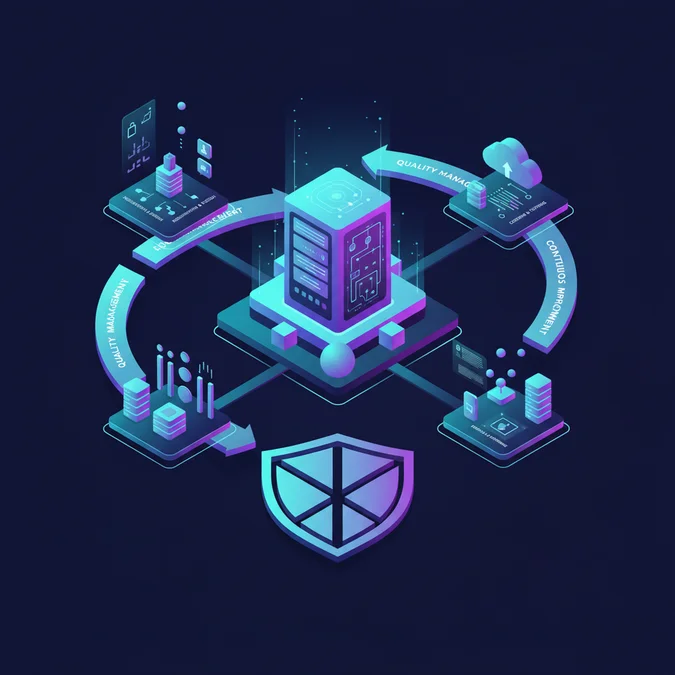
ISO 9001 for software development is an international standard that establishes a process-oriented Quality Management System (QMS), requiring engineering teams to systematically define, track, test, and continuously improve their development lifecycle through reproducible governance, customer requirement validation, and risk mitigation.
Achieving this certification does not require abandoning modern agile workflows or drowning software engineers in analog paper binders. Implemented correctly by technical executives, ISO 9001 translates directly into GitOps automation, auditable continuous integration pipelines, systematic architecture decision records (ADRs), and measurable defect reduction that lowers total cost of ownership across complex codebases.
Direct Answer: What ISO 9001 Means for Software Engineering Teams
ISO 9001 for software development is a structured framework that standardizes how software engineering teams manage requirements, design architecture, verify code, deploy releases, and remediate production defects through an auditable, process-driven Quality Management System (QMS). It establishes verifiable, repeatable baselines for customer satisfaction, risk management, and continuous process improvement across the engineering lifecycle.
In practical software environments, this standard bridges executive compliance mandates with modern engineering workflows. Rather than dictating which language, database, or cloud provider to select, ISO 9001 mandates that every stage of product definition, implementation, and deployment operates under documented, measurable, and repeatable controls.
- Requirements traceability: Every code pull request maps to a documented user need or technical requirement ticket.
- Verification and validation: Unit tests, static code analysis, and integration verification run objectively before production merge.
- Controlled deployment pipelines: Production releases follow cryptographically signed, automated paths rather than ad-hoc console commands.
- Systematic retrospective loops: Incidents produce post-mortems that directly alter automated policies or architectural guidelines to prevent recurrence.
For organizations maintaining web platforms with frameworks like Laravel or enterprise distributed systems, aligning your workflow with ISO 9001 creates an automated paper trail that satisfies external auditors without degrading deployment velocity.
The Core Principles of ISO 9001 Mapped to Agile and DevOps Workflows
Software architects frequently worry that ISO 9001 imposes an obsolete, rigid Waterfall methodology onto fast-moving agile environments. This belief stems from historic manufacturing implementations. Modern ISO 9001:2015 revisions explicitly advocate for context-driven process architecture, allowing engineering leaders to map each ISO requirement directly to GitOps and continuous delivery practices.
The table below highlights how ISO 9001 quality clauses translate into modern engineering primitives:
| ISO 9001:2015 Clause | Manufacturing Interpretation | Modern Software & GitOps Translation |
|---|---|---|
| Clause 7.1.5 (Monitoring & Measuring Resources) | Calibrating physical measurement tools and gauges | Calibrating automated test suites, code coverage benchmarks, and static analyzers (PHPStan, SonarQube) |
| Clause 7.5 (Documented Information) | Physical binder-based Standard Operating Procedures | Docs-as-code, Architecture Decision Records (ADRs) in Git, automated OpenAPI generation |
| Clause 8.2 (Requirements for Products and Services) | Customer specification sheets and signed contracts | Refined Jira/Linear tickets with explicit Given-When-Then acceptance criteria |
| Clause 8.5.1 (Control of Production) | Assembly line operational constraints | Protected main branches, signed commits, immutable container images, semantic version tags |
| Clause 8.7 (Control of Nonconforming Outputs) | Quarantining defective parts off the factory floor | Failed CI test gates, feature flag rollbacks, canary deployment abortions |
| Clause 9.2 (Internal Audit) | Scheduled management floor walk-throughs | Quarterly dependency audits, automated vulnerability scanning, PR review compliance checks |
By defining your internal tools and Git workflows as the formal QMS infrastructure, engineering teams avoid parallel paperwork. The source repository, CI run history, and issue tracking board become the single source of truth for ISO compliance.
Clause 8.3: Managing the Software Design and Development Lifecycle
Clause 8.3 is the technical core of ISO 9001 for software engineers, outlining the lifecycle controls required when building software applications. To satisfy auditors, you must demonstrate controls across five primary phases: planning, inputs, controls, outputs, and design changes.
Design and Development Planning (Clause 8.3.2)
Your team must demonstrate that projects do not begin haphazardly. In an agile environment, this equates to sprint planning documentation, architecture blueprints, and resource allocations. Planning records must capture who is responsible for design stages, the timeline constraints, and how technical debt is factored into delivery schedules.
Design Inputs and Review (Clause 8.3.3)
Inputs represent your product requirements. These must be unambiguous, complete, and free from internal contradictions. Teams typically maintain these inputs in tools like GitHub Issues or Linear, ensuring every ticket defines:
- Functional requirements describing expected behavior under normal parameters.
- Non-functional requirements detailing latency, concurrency limits, and data retention windows.
- Security and compliance constraints such as role-based access control and encryption standards.
Design Verification and Validation (Clause 8.3.4)
Verification asks: Did we build the system right according to our design? This is validated through automated test pipelines running unit, integration, and contract tests. Validation asks: Did we build the right system for the user? This is answered through staging user acceptance testing (UAT), automated smoke suites, and client sign-offs prior to public rollout.
Managing Design Changes (Clause 8.3.6)
Uncontrolled scope creep and unreviewed hotfixes violate ISO 9001. All modifications must follow formal pull request review processes, documenting the change rationale, author identity, peer reviewer approval, and green build status prior to merging.
Docs-as-Code: Transforming Compliance Paperwork into Git Repositories
The traditional pitfall of quality compliance is the disconnected Word document stored on a forgotten corporate intranet. When processes change in code, these documents rot instantly, exposing the organization to audit non-conformances. The modern solution is embracing Docs-as-Code.
Within this paradigm, your Quality Manual, standard operating procedures, coding style rules, and disaster recovery workflows live directly in Git alongside the application code. Changes to operational processes require pull requests, code reviews, and version tags, ensuring the operational documentation evolves in lockstep with the code.
# Architecture Decision Record (ADR) 0014: Asynchronous Queue Worker Isolation

## Status
Accepted

## Context (ISO 9001: Clause 8.3.3 Input)
High-volume webhook ingestion degrades web node latency during traffic spikes.
Processing transactions inline risks worker thread exhaustion and dropped payloads.

## Decision (ISO 9001: Clause 8.3.4 Control)
We isolate asynchronous ingestion using dedicated Redis-backed queue workers.
Web nodes immediately return HTTP 202 Accepted with a correlation UUID.

## Consequences (ISO 9001: Clause 6.1 Risk Assessment)
- Positive: API latency variance drops below 45ms at the 99th percentile.
- Negative: Requires additional monitoring for queue depth lag and dead-letter queues.
- Verification: Monitored via Prometheus alert rule `queue_depth_exceeded_10k`.
Using Markdown-based ADRs satisfies ISO auditors because every entry includes an author, review history, timestamp, rationale, and verification metric. When external auditors request proof of architectural governance, an engineer can share the Git commit history containing the complete design rationale.
CI/CD as Quality Enforcement: Automating the Audit Trail in Laravel and Enterprise Stacks
To minimize manual audit preparation, software organizations must convert their quality gates into executable CI/CD code. Modern pipelines can enforce automated testing, security scanning, static analysis, and cryptographic deployment verification without human intervention.
For instance, an engineering team running web platforms can configure GitHub Actions to run rigid quality audits on every pull request targeting the production branch. This turns compliance checks into continuous gates that block non-conforming builds automatically.
name: ISO-9001 Quality Gate Pipeline

on:
 pull_request:
 branches: [ main ]

jobs:
 compliance-verification:
 runs-on: ubuntu-latest
 steps:
 - name: Checkout Source Code
 uses: actions/checkout@v4

 - name: Setup PHP Environment
 uses: shivammathur/setup-php@v2
 with:
 php-version: '8.3'
 extensions: mbstring, pdo, pdo_mysql
 coverage: pcov

 - name: Install Dependencies
 run: composer install --no-progress --prefer-dist --optimize-autoloader

 - name: Static Analysis (Clause 7.1.5 Verification)
 run:/vendor/bin/phpstan analyse --level=8 --error-format=github

 - name: Automated Test Suite & Coverage Gate (Clause 8.3.4)
 run:/vendor/bin/pest --coverage --min=85

 - name: Security Vulnerability Audit (Clause 6.1 Risk Control)
 run: composer audit

 - name: Record Build Provenance (Clause 8.5.2 Traceability)
 run: |
 echo "Commit: ${{ github.sha }}" > build-metadata.json
 echo "Committer: ${{ github.actor }}" >> build-metadata.json
 echo "Timestamp: $(date -u +'%Y-%m-%dT%H:%M:%SZ')" >> build-metadata.json
This workflow guarantees that no code reaches production without passing static analysis at strict configuration levels and maintaining at least 85% test coverage. Properly instrumenting code quality and system performance also intersects directly with financial reporting, particularly when categorizing engineering expenses via CapEx in software development to track capital asset enhancements against operational maintenance.
Risk-Based Thinking: Engineering Resilient Systems and Preventing Downtime
Clause 6.1 of ISO 9001:2015 demands that organizations practice risk-based thinking throughout their operations. In an engineering context, this shifts compliance from passive document reviews to proactive fault tolerance, chaos engineering, and architectural redundancy.
Defining a Technical Risk Matrix
Engineering leadership should maintain a technical risk register that evaluates the likelihood and severity of engineering failures. Unlike generic business risk registers, this document evaluates low-level failure domains:
- Database connection saturation: What occurs during sudden read/write traffic spikes?
- Third-party API deprecation: How does the core checkout flow handle a payment gateway timeout?
- Data corruption at rest: Are database backups verified through automated weekly restoration tests?
- Secret exposure: Are API tokens scanned via automated pre-commit hooks to block credential leaks?
Mitigating architectural risks requires deep technical monitoring and proactive tuning. For teams handling complex application logic and high database throughput, leveraging concrete Laravel performance optimization techniques helps maintain low latency and predictable query behavior, directly addressing performance risk before it impacts client SLAs.
Change Control, Traceability, and Immutable Releases
Traceability under ISO 9001 (Clause 8.5.2) requires organizations to identify the state of deliverables throughout the production pipeline. In software, this means being able to trace any running line of production code back to the specific pull request, the authorizing reviewer, and the originating business requirement.
To establish bulletproof software traceability, engineering teams should implement an immutable release workflow:
- Cryptographically signed commits: Require all software engineers to sign Git commits using individual GPG or SSH keys. This eliminates author spoofing.
- Branch protection rules: Prohibit direct pushes to
mainorproductionbranches. Merging requires at least one independent, authenticated peer review. - Immutable container artifacts: Package application code into container images tagged with unique semantic versions or Git commit SHAs, never mutable tags like
latest. - Automated release logs: Generate release notes automatically from conventional commit messages (e.g.
feat:,fix:,refactor:), linking each item directly to issue tickets.
When an auditor asks, Who authorized the database schema migration executed on the production cluster last Tuesday?, your response should be a single URL to the merged pull request containing the approval timestamp, passing test suite logs, and release manifest.
Monitoring, Internal Audits, and Corrective Action Loops (CAPA)
ISO 9001 requires closed-loop remediation through Corrective and Preventive Actions (CAPA, Clause 10.2). If a system outage occurs, simply deploying a patch is insufficient to satisfy the standard. Engineering teams must document why the defect bypassed testing, what root cause enabled it, and what systemic mechanism now prevents its return.
The Blameless Post-Mortem as CAPA
Rather than adopting redundant corporate audit software, engineering leaders can map CAPA directly to blameless post-mortems. When an incident occurs, the team produces an engineering post-mortem covering four specific pillars:
- Timeline: An exact sequence of events from deployment to detection, escalation, and resolution.
- Root Cause Analysis: Utilizing the Five Whys methodology to uncover structural weaknesses rather than blaming individual human error.
- Preventive Guardrails: Engineering changes specifically designed to catch the defect automatically in CI (such as a new static analysis rule, end-to-end test, or automated circuit breaker).
- Action Item Tracking: Converting corrective items into urgent engineering backlog tickets with assigned owners and verified completion dates.
During an ISO audit, showing a folder of resolved post-mortems paired with corresponding closed Git pull requests provides definitive evidence of an active, functioning continuous improvement system.
Total Cost of Ownership: Pricing, Audit Fees, and Implementation Economics
Achieving and sustaining ISO 9001 certification involves both direct third-party registrar expenditures and indirect internal engineering investments. Executive leadership must model Total Cost of Ownership (TCO) across a standard three-year certification cycle to balance compliance spend against operational velocity.
Implementation costs vary significantly based on whether the organization engages external QMS consultants, builds internal automated tooling, or expands QA headcount. The tables below break down realistic financial commitments for a mid-market software engineering organization (30 to 100 engineers).
Direct Certification and Surveillance Costs
| Cost Category | Year 1 (Initial Audit) | Year 2 (Surveillance) | Year 3 (Surveillance) | 3-Year Total |
|---|---|---|---|---|
| Registrar Stage 1 (Document Review) | $3,500 – $6,000 | $0 | $0 | $3,500 – $6,000 |
| Registrar Stage 2 (On-Site / Remote Audit) | $8,500 – $15,000 | $0 | $0 | $8,500 – $15,000 |
| Surveillance Audits | $0 | $5,000 – $8,500 | $5,000 – $8,500 | $10,000 – $17,000 |
| ISO Standard Documentation & Filing Fees | $500 – $1,500 | $250 | $250 | $1,000 – $2,000 |
| Total Direct Auditor Outlay | $12,500 – $22,500 | $5,250 – $8,750 | $5,250 – $8,750 | $23,000 – $40,000 |
Implementation and Consulting Engagement Models
| Engagement Model | Typical Cost Range | Internal Engineering Hours | Best Fit Scenario |
|---|---|---|---|
| Specialized ISO 9001 Software Consultant | $25,000 – $55,000 fixed fee | 120 – 200 hours | Fast-track timeline (3-6 months), unburdened internal leads |
| Fractional Quality Manager Retainer | $3,500 – $7,000 / month | 80 – 140 hours / year | Long-term process governance without hiring full-time staff |
| Pure In-House DIY Implementation | $0 consulting fees | 450 – 750 engineering hours | Mature DevSecOps culture with strong internal process leads |
While the initial financial commitment ranges between $45,000 and $95,000 when factoring in consulting and direct fees, the primary cost remains internal engineering capacity. To avoid costly operational drag, leadership must resist manual governance workflows that pull senior engineers away from product delivery.
Common Anti-Patterns and Operational Pitfalls to Avoid
Engineering teams frequently stumble when preparing for their first ISO audit by over-complicating compliance. Recognizing these operational anti-patterns early saves significant capital and protects team velocity.
Anti-Pattern 1: The Parallel Bureaucracy
The most common failure occurs when organizations hire consultants who introduce heavy document templates disconnected from developer workflows. If developers track work in Jira or Linear while a compliance manager manually types status updates into Word documents for the auditor, your QMS is synthetic. Auditors will inspect actual developer activity, discover discrepancies between the documentation and real code commits, and issue major non-conformances.
Anti-Pattern 2: Over-Specifying Development Procedures
Drafting rules like All pull requests must be merged within 48 hours and contain at least three manual approvals creates self-inflicted compliance traps. If an urgent bug fix is approved by two leads instead of three, you have technically violated your own published QMS. Keep procedures broad enough to adapt to operational realities: write what you do, and do what you write.
Anti-Pattern 3: Ignoring Automated Testing Metrics
Claiming high code quality without continuous verification data will raise red flags during technical review. Auditors look for consistency: test coverage thresholds, static analysis rules, and branch restrictions must be enforced through programmatically immutable settings in your CI system, rather than reliance on verbal agreements.
Real-World Architecture Example: From Audit Non-Conformance to Automated Pipeline
Consider a practical scenario involving a mid-sized B2B SaaS platform that failed its preliminary ISO 9001 Stage 1 audit. The registrar identified two major non-conformances:
- Lack of documented requirement validation prior to production release (Clause 8.2.3).
- Absence of formal verification metrics showing that application performance regressions were caught before customer deployment (Clause 8.4).
The Engineering Remediation Strategy
Rather than introducing sign-off sheets, the engineering leadership addressed the audit findings by integrating automated verification contracts directly into their repository workflow.
<php

declare(strict_types=1);

namespace Tests\Architecture;

use Pest\Arch\Expectation;

/**
 * Architectural Governance Test (ISO 9001 Clause 8.3.4 Verification)
 * Ensures all Domain-Driven boundaries and business transactions
 * remain strictly isolated and auditable.
 */
test('Domain models cannot directly depend on infrastructure controllers')
 ->expect('App\Domain')
 ->not->toUse('App\Http\Controllers');

test('All external API client calls must implement timeout handling')
 ->expect('App\Services\External')
 ->toOnlyUse([
 'Illuminate\Support\Facades\Http',
 'App\Exceptions\IntegrationException',
 'Psr\Log\LoggerInterface',
 ]);

test('Strict typing is enforced across all domain entities')
 ->expect('App\Domain')
 ->toUseStrictTypes();
By implementing architectural governance tests via testing tools like Pest PHP or ArchUnit, the team transformed architectural compliance into an automated, verifiable test suite. When rerun during the Stage 2 reassessment, the auditor verified that every merge into the release branch objectively proved architectural compliance, resolving the non-conformance immediately.
Explore our complete Laravel, Basics directory for more guides on modern software architecture and quality engineering.
Factors That Affect Development Cost
- Registrar audit day rates and facility complexity
- Internal engineering hours diverted to QMS documentation
- External compliance consultant and fractional QMS retainer fees
- Automated testing and static analysis pipeline tooling costs
- Annual surveillance audit recurring subscriptions
A typical mid-sized software engineering team spends between $23,000 and $40,000 in direct third-party certification and surveillance audit fees across a three-year cycle.
ISO 9001 for software development is fundamentally an operational framework for risk management, systematic verification, and continuous improvement. When engineering leaders approach the standard through the lens of modern software practices, compliance becomes a natural side effect of well-architected CI/CD pipelines, clear requirements tracing, and disciplined incident post-mortems.
By treating your development infrastructure as the core Quality Management System, you eliminate duplicate compliance overhead, lower the total cost of ownership across your software assets, and build an engineering culture capable of passing rigorous enterprise security and quality audits with complete operational confidence.