When building production-grade AI systems, developers often face the friction of managing complex state, multi-step prompt orchestration, and disparate data sources. LangChain serves as the standard abstraction layer for these challenges, transforming raw LLM capabilities into deterministic software workflows.
Understanding LangChain 是什么 requires looking beyond the marketing hype to its role as an orchestration engine. By providing modular primitives for memory, retrieval, and agentic reasoning, it allows engineering teams to move from simple chat interfaces to sophisticated, autonomous systems capable of executing multi-step logic in 2026.
Defining LangChain: Architectural Foundations and Purpose
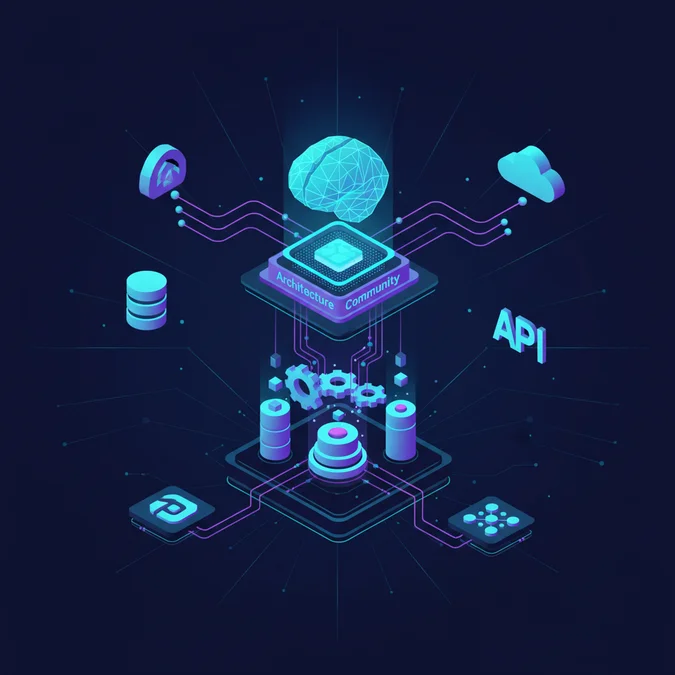
At its core, LangChain is an open-source framework designed to simplify the construction of applications powered by large language models. It exists to solve the ‘plumbing’ problem inherent in generative AI: how to connect an LLM to external data, retain state across interactions, and route logic based on reasoning outputs.
Technical Insight: LangChain provides a standardized interface for LLMs, embedding models, and vector stores, which allows for vendor-agnostic development. This decoupling is critical for teams avoiding lock-in with proprietary model providers.
In the 2026 ecosystem, the framework acts as an integration layer. It does not replace the LLM; instead, it provides the scaffolding required to turn a stateless model into a stateful, tool-using agent capable of completing real-world tasks.
Technical Introduction to the LangChain Ecosystem
A comprehensive LangChain 介绍 requires an understanding of its six core primitives. These components are designed to be swapped or extended depending on the specific requirements of the application.
- Model I/O: Standardized wrappers for different model providers (OpenAI, Anthropic, Ollama).
- Retrieval: Logic for managing document loading, text splitting, and vector database interactions.
- Chains: Sequential execution logic that links different components together.
- Agents: Reasoning engines that decide which tools to invoke based on user input.
- Memory: Persistent state management for conversational history.
- Callbacks: Hooks for observability, logging, and performance monitoring.
By leveraging these modular abstractions, developers can build complex pipelines that are both testable and maintainable.
Core Mechanics: Implementing Agents with LangGraph
Modern agent orchestration has shifted toward graph-based state machines. LangGraph, the latest evolution in the ecosystem, allows for cyclic dependencies and granular control over the agent’s decision-making loop.
- Define the state schema to track variables across the agent lifecycle.
- Create nodes representing tool execution or model reasoning steps.
- Define edges to control the flow between nodes based on conditional logic.
from langgraph.graph import StateGraph, END

# Define the state
class AgentState(TypedDict):
 messages: List[BaseMessage]

# Initialize graph
workflow = StateGraph(AgentState)

# Add nodes and edges
workflow.add_node("agent", my_model_node)
workflow.add_edge("agent", END)

# Compile the agent
app = workflow.compile()
Comparative Analysis: LangChain vs LlamaIndex vs Raw APIs
Selecting the right framework depends on the complexity of your data pipeline and the degree of control required over the inference lifecycle.
| Feature | LangChain | LlamaIndex | Raw API |
|---|---|---|---|
| Orchestration | High (Graph focus) | Moderate | None |
| Data Retrieval | Standard | Optimized | Manual |
| Learning Curve | Steep | Moderate | Low |
| Flexibility | High | High | Maximum |
Production Readiness: Scaling and Observability
Deploying agents to production requires robust observability. LangSmith is the industry standard for tracing execution paths, identifying latency bottlenecks, and debugging hallucination triggers.
- Latency: Use streaming responses to improve perceived performance.
- Cost: Implement caching strategies for repetitive prompts.
- Observability: Utilize LangSmith to visualize multi-step agent reasoning.
Best Practice: Always implement circuit breakers when using LLMs to prevent infinite tool-calling loops that inflate API costs.
Frequently Asked Questions
Langchain 是什么?
LangChain is an open-source framework designed to facilitate the development of applications powered by large language models. It provides modular components and abstractions for chaining complex workflows, managing stateful memory, and connecting external data sources, effectively simplifying the orchestration of sophisticated agentic systems in production.
Where can I find a technical Langchain 介绍?
A technical introduction to LangChain covers its six core modules: Model I/O, Retrieval, Chains, Agents, Memory, and Callbacks. By decoupling these layers, LangChain allows developers to swap components, customize prompt templates, and build complex reasoning loops that interact with vector databases and external APIs seamlessly.
LangChain provides the necessary primitives to build sophisticated agentic systems, but success in production depends on rigorous observability and modular design. By focusing on LangGraph for state management and LangSmith for tracing, engineering teams can navigate the complexities of LLM development with confidence.
As you scale your AI infrastructure, prioritize decoupling your business logic from specific model providers to ensure long-term architectural agility.