
Fine tuning Llama is no longer an experimental pursuit for researchers. In 2026, it is a core engineering operation for organizations seeking to inject proprietary domain knowledge or specific behavioral constraints into foundation models. Achieving production-ready results requires moving beyond generic scripts and addressing the harsh realities of GPU memory constraints, catastrophic forgetting, and infrastructure overhead.
This guide dismantles the complexity of adapting Llama 3.x and beyond. We focus on the pragmatic technical stack, utilizing Parameter-Efficient Fine-Tuning (PEFT) and Low-Rank Adaptation (LoRA) to deliver high-performance models while maintaining hardware sanity. Whether you are scaling to enterprise requirements or optimizing for cost on cloud instances, the following framework provides the architectural foundation for reliable model training.
The Engineering Lifecycle of Fine Tuning Llama
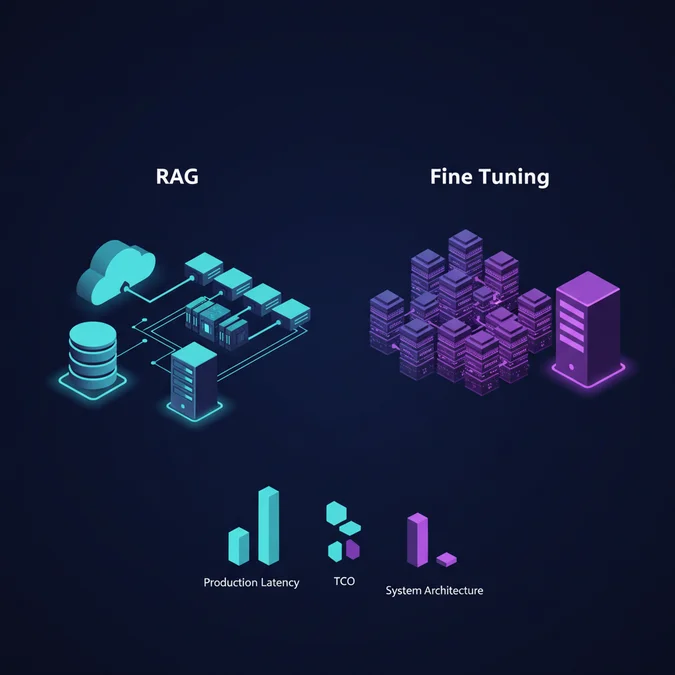
When deciding to pursue fine tuning Llama, the first step is architectural validation. Not every business problem requires weight modification. Many use cases are better served by Retrieval-Augmented Generation (RAG) or advanced prompt engineering. The following decision matrix assists in selecting the appropriate intervention strategy.
| Method | Primary Goal | Resource Cost | Behavioral Change |
|---|---|---|---|
| Prompt Engineering | Task Guidance | Low | Shallow |
| RAG | Knowledge Injection | Medium | Contextual |
| Fine Tuning | Structural Alignment | High | Deep |
Engineering Note: Fine tuning is optimal for changing the model’s tone, format, or internalizing complex logical schemas that RAG cannot effectively retrieve through semantic search.
The lifecycle begins with data preparation. High-quality, instruction-tuned datasets are the single most significant factor in model performance. You must curate datasets that represent the target domain, ensuring a balance between diversity and task-specific patterns.
Optimizing Infrastructure to Finetune Llama Efficiently
To finetune Llama at scale, you must treat your GPU cluster as a constrained resource. VRAM is your primary bottleneck. Using QLoRA (Quantized LoRA) allows you to train 70B parameter models on hardware that would otherwise be insufficient. The following checklist ensures your environment is production-ready:
- Precision: Utilize BF16/FP16 mixed precision to reduce memory overhead without losing convergence stability.
- Gradient Checkpointing: Enable this to trade compute time for significantly lower VRAM usage by recomputing activations during the backward pass.
- Optimizer State: Use 8-bit AdamW to reduce the memory footprint of optimizer states by nearly 75%.
+-----------------+-------------------+-------------------+----------------+ | GPU Model | VRAM | Max Model Size | Strategy | +-----------------+-------------------+-------------------+----------------+ | RTX 4090 | 24GB | 8B - 14B | QLoRA (4-bit) | | A6000 | 48GB | 30B - 35B | QLoRA (4-bit) | | H100 (8x) | 640GB | 70B - 400B | Full/DeepSpeed | +-----------------+-------------------+-------------------+----------------+Implementation Framework: How to Fine Tune Llama with PEFT
Leveraging the trl and peft libraries provides a modular path to model adaptation. The following implementation uses a standard Trainer interface, abstracting away the complex gradient accumulation logic.
from peft import LoraConfig, get_peft_model

from trl import SFTTrainer

from transformers import AutoModelForCausalLM, AutoTokenizer, TrainingArguments
def get_training_config():
return LoraConfig(
r=16,
lora_alpha=32,
target_modules=["q_proj", "v_proj"],
lora_dropout=0.05,
bias="none",
task_type="CAUSAL_LM"
)
# Initialize model with 4-bit loading
model = AutoModelForCausalLM.from_pretrained("meta-llama/Llama-3.1-8B", load_in_4bit=True)
peft_config = get_training_config()
trainer = SFTTrainer(
model=model,
train_dataset=dataset,
peft_config=peft_config,
args=TrainingArguments(output_dir="./output", per_device_train_batch_size=4, learning_rate=2e-4)
)
trainer.train()
Mitigating Catastrophic Forgetting in Domain Adaptation
Catastrophic forgetting occurs when the model overwrites general-purpose reasoning capabilities with domain-specific patterns. To mitigate this, incorporate a ‘Rehearsal Buffer’ strategy where a small percentage of general instruction data is mixed into every training batch.
Strategy: Maintain a 10% mix of general-purpose conversational data (such as OpenOrca or ShareGPT) within your specialized domain dataset. This forces the model to maintain its foundational linguistic abilities while learning the new domain-specific weights.
Production Deployment and Model Merging Pipelines
Once training is complete, your LoRA adapters must be merged with the base weights for inference efficiency. Running adapters separately adds latency and complexity to the serving layer.
- Load the base model in full precision.
- Apply the LoRA weights using
model.merge_and_unload(). - Export the resulting model to GGUF or Safetensors format.
- Deploy using a high-performance inference engine like vLLM or llama.cpp.
# Merging adapter weights

from peft import PeftModel

base_model = AutoModelForCausalLM.from_pretrained("base-model-path")

peft_model = PeftModel.from_pretrained(base_model, "adapter-path")

merged_model = peft_model.merge_and_unload()

merged_model.save_pretrained("./final-model")
Factors That Affect Development Cost
- GPU instance hourly rate
- Dataset size and curation effort
- Training duration (number of epochs)
- Model parameter count
Costs fluctuate based on the duration of GPU lease and the selection of cloud providers versus dedicated on-premise hardware.
Frequently Asked Questions
What is the primary difference between fine tuning llama and prompt engineering?
Fine tuning Llama involves modifying the model weights to internalize specific patterns or knowledge, whereas prompt engineering adjusts the input context at runtime. Fine tuning provides deeper behavioral alignment, while prompt engineering is faster and cheaper, making it ideal for rapid iteration without GPU infrastructure overhead.
Is it possible to finetune llama on consumer hardware?
Yes, you can finetune Llama on consumer hardware using quantization techniques like QLoRA. By reducing precision to 4-bit, you significantly lower the VRAM requirements, allowing models to be trained on single high-end GPUs like the RTX 4090 without sacrificing significant performance or convergence quality.
How long does it take to fine tune llama effectively?
The time required to fine tune Llama depends on your dataset size, the hardware used, and the number of epochs. For small-scale domain adaptation using efficient methods like LoRA, training can take anywhere from one hour to several days depending on GPU throughput and dataset complexity.
Fine tuning Llama is a rigorous exercise in balancing memory constraints against model performance. By utilizing QLoRA, maintaining a balanced dataset, and strictly adhering to validation pipelines, engineering teams can build highly specialized models that outperform generic LLMs in specific domains.
As you move to production, ensure your monitoring stack includes drift detection to identify when model responses begin to degrade. Start with the provided implementation framework and iterate based on your specific hardware budget and domain requirements.