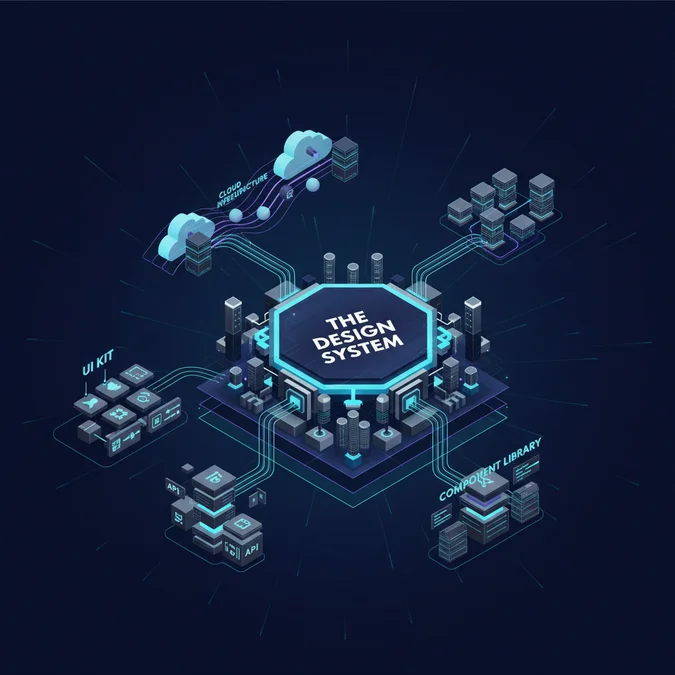

Design systems are often mischaracterized as mere UI kits or component libraries. In reality, they function as the foundational infrastructure of an enterprise frontend. When organizations reach a threshold where cross-platform consistency fractures, they require professional design system services to unify their engineering output and stabilize core product velocity.
This article examines the technical requirements for building scalable design infrastructure. From W3C token compliance to long-term governance, we break down the engineering mechanics that prevent systemic rot and ensure that your design system remains a living asset rather than a legacy burden.
Core Engineering Principles for Design System Services
Professional design system services must be treated as a product-within-a-product. The primary challenge is not the initial implementation of buttons or inputs, but the abstraction of state and style into a system that remains framework-agnostic. Engineers must focus on tokenization as the source of truth, ensuring that design decisions propagate seamlessly across React, Vue, and native mobile environments.
Engineering Callout: A robust design system service is defined by its ability to resolve style conflicts at the compilation layer rather than the runtime layer. If your system relies heavily on runtime CSS injection, you are sacrificing performance for flexibility.
By decoupling the design language from specific implementation frameworks, teams can ensure that updates to core primitives do not trigger breaking changes across the entire product ecosystem.
Strategic Implementation via Design System Consulting
Successful design system consulting is measured by the reduction of technical debt and the velocity increase of product teams. An effective engagement follows a structured path toward maturity, moving from isolated component islands to a cohesive, automated ecosystem.
- Maturity Assessment: auditing current UI fragmentation and token parity.
- Architecture Design: defining the integration points for CI/CD pipelines.
- Standardization: implementing W3C-compliant design tokens.
- Documentation: establishing automated docs that sync with code.
- Governance: defining contribution models for feature teams.
The goal of consulting is to transition internal teams from a reactive state, where they fix UI bugs repeatedly, to a proactive state, where they consume reliable, versioned primitives.
Token Architecture and Component Lifecycle Management
Token architecture serves as the connective tissue between design intent and code implementation. Following W3C Design Token Community Group standards, we implement a tiered structure: Global, Alias, and Component tokens. This layering allows for rapid theme switching and platform-specific overrides.
{ "color-brand-primary": { "value": "#0055ff", "type": "color" }, "alias-button-bg": { "value": "{color-brand-primary}", "type": "color" } }Component lifecycles must be managed through strict semantic versioning. When a component enters a deprecation phase, we utilize automated codemods to refactor legacy implementations, ensuring that engineering teams are not blocked by manual migration tasks.
Build vs Buy Trade off Analysis
Choosing between internal development and external services involves balancing immediate velocity against long-term maintenance overhead. The following table illustrates the technical and operational trade-offs.
| Metric | Build Internally | External Partnership |
|---|---|---|
| Infrastructure Cost | High (Dev Time) | Fixed/Predictable |
| Time to Market | Slow (Learning Curve) | Fast (Proven Patterns) |
| Technical Debt | High (Internal Bias) | Low (Industry Standards) |
| Governance Maturity | Reactive | Proactive |
For high-throughput organizations, the cost of building internally often exceeds the investment in professional services due to the hidden costs of maintenance, documentation, and tooling upkeep.
Day 2 Operations and Governance Patterns
The ‘Day 2’ challenge is where most design systems fail. Without a rigid governance model, the system becomes stagnant. We recommend the following operational flow for maintaining system health.
- Automated Regression Testing: Run visual snapshot tests on every PR to ensure component parity.
- Token Synchronization: Automate the distribution of tokens via npm packages or CDN to ensure all apps use the latest values.
- Contribution Lifecycle: Implement a clear ‘Request for Change’ (RFC) process for adding new components.
- Deprecation Policy: sunset legacy components with a mandatory 3-month transition window and automated linting warnings.
By treating these operations as a background service, you ensure that the design system remains a scalable asset that evolves with the product.
Factors That Affect Development Cost
- System complexity
- Platform diversity (Web, iOS, Android)
- Integration requirements
- Team size and training needs
Costs are highly variable depending on existing architectural maturity and the scope of the required design system transformation.
Frequently Asked Questions
What value do design system services provide to engineering teams?
Design system services accelerate delivery by providing unified component libraries, standardized design tokens, and automated documentation. These services reduce technical debt, ensure cross-platform consistency, and allow engineering teams to focus on core product logic rather than rebuilding UI primitives for every new feature request.
When should an enterprise invest in design system consulting?
You should engage design system consulting when your organization faces severe UI fragmentation, high maintenance costs for existing components, or significant delays in onboarding new developers. Consulting provides the necessary architectural expertise to establish scalable governance models and robust technical foundations that internal teams may lack.
Architecting design system services is a long-term engineering commitment. By prioritizing token-based architecture and clear governance, you move beyond simple UI consistency and build a high-performance foundation for future product growth.
Focus on reducing the friction of contribution and the cost of maintenance. With the right strategy, your design system will become the most valuable piece of infrastructure in your organization.