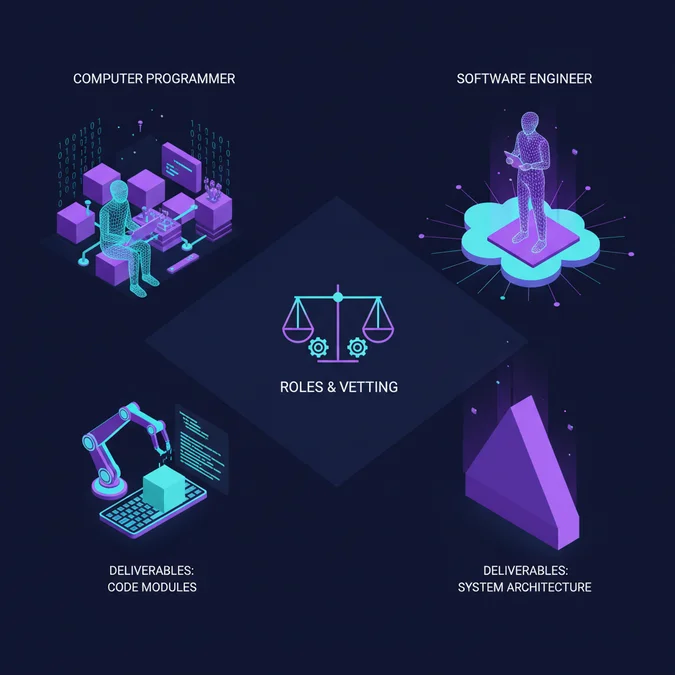

A computer programmer primarily writes, tests, and maintains code based on specifications. A software engineer, however, applies engineering principles to design, develop, and manage entire software systems, often overseeing the full development lifecycle and architectural decisions. Understanding the distinct contributions of these roles is critical for businesses aiming to build robust software solutions and optimize their development workforce.
This article dissects the fundamental differences between computer programmers and software engineers, outlining their core responsibilities, skill sets, and impact on project outcomes. We will provide practical insights for identifying the right talent, structuring effective teams, and maximizing the commercial value derived from your software development investments.
Understanding the Core Roles: Programmer vs. Engineer
The foundational distinction between a computer programmer and a software engineer lies in their scope of responsibility and application of principles. While both write code, their approach to problem-solving and system conceptualization differs significantly, influencing project trajectory and long-term maintainability.
A computer programmer focuses on translating logical designs into executable code, often working within well-defined parameters. Their expertise is in implementation, debugging, and ensuring code adheres to specified requirements. Conversely, a software engineer approaches software creation as an engineering discipline, encompassing design, architecture, testing, deployment, and ongoing maintenance. This role prioritizes system scalability, security, and performance.
The term programmer programmer, though not a formal industry title, colloquially emphasizes a deep specialization in coding, often implying a focus purely on implementation tasks with minimal architectural input. This contrasts with a broader interpretation of a programmer and software developer, where the latter often suggests a wider involvement in the software development lifecycle.
Role-Specific Responsibilities
| Aspect | Computer Programmer | Software Engineer |
|---|---|---|
| Primary Focus | Code implementation, debugging, testing specific modules | System design, architecture, full lifecycle management, problem-solving at scale |
| Key Activities | Writing algorithms, optimizing existing code, fixing bugs, unit testing | Requirements analysis, system architecture, designing APIs, performance tuning, security audits, team leadership |
| Tools & Technologies | IDEs, debuggers, version control systems (Git), specific programming languages (Python, Java, C++) | Design patterns, architectural frameworks, CI/CD pipelines, cloud platforms (AWS, Azure, GCP), project management tools |
| Problem Scope | Tactical, module-level issues, code efficiency | Strategic, system-level challenges, architectural integrity, long-term viability |
Key Differences: Scope, Skills, and Project Impact
The debate of software engineer vs programmer is not about superiority, but about distinct specializations crucial for successful software delivery. A computer programmer vs software engineer comparison reveals differences in their depth of technical understanding, problem-solving methodologies, and strategic influence on a project.
Comparative Analysis of Roles
| Criterion | Computer Programmer | Software Engineer |
|---|---|---|
| **Scope of Work** | Implements specific features or fixes bugs within existing systems. Focuses on writing clean, efficient code for defined tasks. | Designs, builds, and maintains entire software systems or complex components. Considers scalability, security, performance, and maintainability across the system. |
| **Skill Set** | Proficiency in one or more programming languages, strong algorithmic thinking, debugging skills, understanding of data structures. | Comprehensive understanding of software engineering principles, design patterns, system architecture, database design, networking, operating systems, and often project management. |
| **Problem-Solving** | Solves well-defined coding problems, optimizes code for specific performance metrics, identifies and rectifies bugs. | Addresses ambiguous, large-scale problems. Designs solutions, evaluates trade-offs, anticipates future challenges, and ensures system resilience. |
| **Project Impact** | Directly contributes to code base quality and feature completion. Essential for execution phase. | Shapes the entire product’s technical direction and foundation. Ensures long-term viability, scalability, and strategic alignment with business goals. |
| **Education/Background** | Often self-taught, bootcamp graduates, or associate degrees. Focus on practical coding skills. | Typically holds a Bachelor’s or Master’s degree in Computer Science or a related engineering field. Emphasizes theoretical foundations and system design. |
While a programmer might excel at optimizing a single function, an engineer ensures that function integrates seamlessly into a fault-tolerant, secure, and performant distributed system. This distinction is paramount for businesses when allocating resources and defining project roles.
The “Coding Engineer” Explained: A Specialized Role?
The term coding engineer has emerged to describe a professional who combines the rigorous system-level thinking of a software engineer with an exceptional proficiency and passion for writing high-quality, efficient code. It’s often used to emphasize a role that is deeply involved in implementation, but with a strong understanding of underlying engineering principles and system architecture.
A ‘coding engineer’ bridges the gap between pure theoretical design and practical implementation, often taking ownership of complex components from design through to deployment. This role is distinguished by its hands-on coding intensity combined with an engineering mindset, ensuring that code is not just functional, but also robust, scalable, and maintainable within a larger system context. They are typically expected to contribute to architectural discussions while also writing significant amounts of production-grade code.
This specialization is particularly valuable in environments where rapid prototyping needs to be combined with architectural soundness, or in roles focused on performance-critical systems, embedded software, or low-level systems programming. While closely aligned with a traditional software engineer, the ‘coding engineer’ often denotes a heavier emphasis on the actual coding output and less on broader project management or team leadership, though these can still be part of the role.
Programmer vs. Developer: Nuances for Project Staffing
The terms ‘programmer’ and ‘developer’ are frequently used interchangeably, yet there are subtle but important differences that can impact project staffing and role definition. Understanding the distinction between programmer vs developer helps stakeholders accurately staff projects and define job roles with greater clarity and precision.
Defining Programmer and Developer Roles
| Aspect | Programmer | Developer |
|---|---|---|
| **Primary Focus** | Writing, testing, and debugging code for specific features or tasks. | Involved in the entire software development lifecycle: design, development, testing, deployment, and maintenance. |
| **Scope of Work** | More granular, focused on coding individual components or functions. | Broader, encompassing solution design, system integration, user experience considerations, and project management tasks. |
| **Skill Set** | Strong in specific programming languages, algorithms, and data structures. | Possesses programming skills, plus knowledge of databases, APIs, frameworks, cloud services, UI/UX principles, and sometimes project management methodologies. |
| **Output** | Functional code modules, bug fixes, scripts. | Complete software applications, integrated systems, new features, system enhancements. |
| **Strategic Input** | Limited, primarily focused on execution of given specifications. | Significant, often contributing to technical strategy, feature planning, and architectural decisions. |
While every developer is inherently a programmer, not every programmer operates with the full breadth of responsibilities typically associated with a developer. A developer often owns a larger piece of the software puzzle, from conceptualization to deployment, making them crucial for end-to-end project delivery. For project staffing, considering these nuances ensures that the right expertise is matched to the right level of responsibility.
Real-World Deliverables: Code Examples & Project Contributions
To truly grasp the distinction, examining the tangible deliverables and typical project contributions of each role provides invaluable clarity. While both produce code, the nature and context of that code differ significantly.
Programmer’s Contribution: Data Processing Script
A programmer might be tasked with writing a script to process a specific dataset according to predefined rules. This involves strong algorithmic thinking and efficient code execution.
# Programmer's task: Process log files to extract error counts

def count_errors_in_log(log_filepath):
    error_counts = {}
    try:
        with open(log_filepath, 'r') as f:
            for line in f:
                if 'ERROR' in line:
                    # Assuming error format 'ERROR: [ErrorCode] - Message'
                    parts = line.split('ERROR: ')[1].split(' - ')[0]
                    error_code = parts.strip()
                    error_counts[error_code] = error_counts.get(error_code, 0) + 1
    except FileNotFoundError:
        print(f"Error: Log file not found at {log_filepath}")
        return {}
    return error_counts

if __name__ == "__main__":
    log_file = "application.log"
    daily_errors = count_errors_in_log(log_file)
    for code, count in daily_errors.items():
        print(f"Error Code '{code}': {count} occurrences")
This example demonstrates a programmer’s focus on a specific, well-defined task, ensuring the script is functional, efficient, and correctly handles expected inputs and outputs.
Software Engineer’s Contribution: Designing a Microservice API
A software engineer, conversely, would be involved in designing and implementing an entire microservice, considering its API contract, data models, scalability, security, and integration within a larger system. This involves high-level design and architectural decisions.
// Software Engineer's task: Design a User Authentication Microservice API

// 1. Define API Endpoint Structure (e.g., RESTful)
//    POST /api/v1/auth/register
//    POST /api/v1/auth/login
//    GET  /api/v1/auth/users/{userId}

// 2. Define Request/Response Payloads (Data Transfer Objects)
public class RegisterRequest {
    private String username;
    private String email;
    private String password;
    // Getters and Setters
}

public class AuthResponse {
    private String token;
    private long expiresIn;
    // Getters and Setters
}

// 3. Outline Core Service Logic (High-level components)
public interface UserService {
    User registerUser(RegisterRequest request) throws UserAlreadyExistsException;
    AuthResponse loginUser(LoginRequest request) throws InvalidCredentialsException;
    User getUserById(String userId) throws UserNotFoundException;
}

// 4. Consider Non-Functional Requirements
//    - Security: JWT implementation, password hashing (BCrypt), rate limiting
//    - Scalability: Stateless design, containerization (Docker, Kubernetes)
//    - Reliability: Error handling, logging, monitoring (Prometheus, Grafana)
//    - Data Storage: Database choice (e.g., PostgreSQL), schema design
This example illustrates an engineer’s broader perspective, focusing on system architecture, service contracts, and non-functional requirements vital for a robust application. Their work often involves:
- **Requirements Elicitation:** Translating business needs into technical specifications.
- **Architectural Design:** Selecting appropriate technologies, design patterns, and system components.
- **API Definition:** Creating clear contracts for how services interact.
- **Implementation Strategy:** Overseeing the development process, potentially delegating specific coding tasks.
- **Deployment & Operations Planning:** Considering CI/CD, monitoring, and maintenance.
Strategic Hiring: Vetting, Pricing, and Collaboration Models
For businesses, strategically hiring the right talent is paramount. Understanding the nuances between these roles allows for more effective vetting, accurate pricing, and optimized collaboration models. This directly impacts project success and budget adherence.
Vetting Talent: Key Considerations
When vetting candidates, shift focus from generic ‘coding skills’ to the specific problem-solving approach and scope of work required.
- **For Programmers:**
- **Code Challenges:** Assess ability to write clean, efficient, bug-free code for specific algorithms or data manipulation tasks.
- **Debugging Skills:** Provide broken code and ask candidates to identify and fix issues under time pressure.
- **Language Proficiency:** Deep knowledge of chosen programming language syntax, libraries, and idioms.
- **Version Control:** Basic understanding of Git for code collaboration.
- **For Software Engineers:**
- **System Design Interviews:** Present open-ended problems requiring architectural solutions (e.g., design a URL shortener, design a social media feed).
- **Technical Deep Dives:** Discuss past projects, focusing on design decisions, trade-offs, and scaling challenges.
- **Architectural Knowledge:** Assess understanding of design patterns, distributed systems, microservices, cloud architecture, and security best practices.
- **Communication & Leadership:** Evaluate ability to articulate complex technical concepts and potentially lead technical discussions.
Pricing & Deliverables Matrix
Compensation structures reflect the difference in scope and strategic impact. While specific rates vary by location, experience, and technology stack, the underlying value proposition differs.
| Role | Typical Deliverables | Value Proposition for Business | Pricing Factors |
|---|---|---|---|
| **Computer Programmer** | Functional code modules, bug fixes, scripts, unit tests, code documentation for specific features. | Efficient execution of defined coding tasks, rapid development of specific features, maintenance of existing codebase. | Project complexity, programming language expertise, speed of delivery, volume of code produced. |
| **Software Engineer** | System architecture, API designs, scalable and secure systems, technical specifications, CI/CD pipelines, complex feature implementation, technical leadership. | Strategic technical direction, long-term system stability, scalability, security, innovation, reduced technical debt, architectural integrity. | System complexity, architectural impact, strategic importance of the project, leadership responsibilities, experience with advanced technologies. |
Collaboration Models
Effective collaboration leverages the strengths of both roles. Programmers can focus on implementing well-defined tasks, freeing engineers to concentrate on architectural oversight, complex problem-solving, and future-proofing the system. Establishing clear communication channels and well-documented specifications is vital for seamless integration of their work.
Maximizing Team Synergy: When and How These Roles Collaborate
Effective software development teams recognize that the synergy between computer programmers and software engineers drives optimal outcomes. Instead of viewing them as distinct, isolated functions, successful organizations integrate these roles strategically to leverage their complementary strengths throughout the software development lifecycle.
In a high-performing team, a software engineer lays the architectural groundwork, defining the system’s structure, interfaces, and core components, while a computer programmer then meticulously implements those designs. This collaboration allows engineers to focus on macro-level challenges like scalability and security, confident that the underlying code execution is handled by proficient programmers. Programmers benefit from clear specifications and robust frameworks, enabling them to produce high-quality code efficiently.
Here are key areas where their collaboration is critical:
- **Design Handoff:** Engineers provide detailed design specifications, API contracts, and data models. Programmers then take these blueprints and translate them into functional code, raising questions for clarification or suggesting minor implementation optimizations.
- **Code Reviews:** Both roles participate in code reviews. Engineers review for architectural adherence, security implications, and design pattern consistency, while programmers focus on code quality, efficiency, adherence to coding standards, and test coverage.
- **Debugging and Troubleshooting:** Complex system-wide issues often require an engineer’s understanding of the overall architecture to pinpoint the root cause, while a programmer’s debugging prowess is essential for fixing the specific code defect.
- **Feature Development:** Engineers might design a new feature’s integration points and data flow, then delegate the implementation of specific sub-features or UI components to programmers.
- **Performance Optimization:** Engineers identify performance bottlenecks at a system level, while programmers implement the specific code optimizations recommended to resolve them.
This symbiotic relationship ensures that software is not only delivered efficiently but is also architecturally sound, scalable, and maintainable in the long term, directly contributing to business objectives.
Factors That Affect Development Cost
- Project complexity and scope
- Required expertise and seniority level
- Technology stack and specialized skills
- Geographic location of talent
- Engagement model (freelance, contract, full-time)
- Duration of project
The cost for these roles varies significantly based on market demand, experience, and the specific responsibilities assigned within a project.
Frequently Asked Questions
What is the primary distinction between a computer programmer and a software engineer?
A computer programmer primarily writes, tests, and maintains code based on specifications. A software engineer, however, applies engineering principles to design, develop, and manage entire software systems, often overseeing the full development lifecycle and architectural decisions.
Is a “coding engineer” a specific role, or just another term for a software engineer?
The term “coding engineer” often emphasizes a strong hands-on coding ability within an engineering context. While closely related to a software engineer, it can imply a role with a heavier focus on implementation and less on high-level system design or project management.
How does a “programmer” differ from a “developer” in modern tech teams?
While often used interchangeably, a programmer typically focuses on writing code for specific tasks. A developer usually has a broader scope, encompassing design, development, testing, and deployment of software applications, often involving more project ownership.
What does the term “programmer programmer” imply in the industry?
The phrase “programmer programmer” is not a standard industry term. It might be a colloquial way to emphasize a core coding role, focusing purely on implementation and debugging, without the broader responsibilities often associated with a software engineer or developer.
Are “programmer” and “software developer” interchangeable terms?
They are often used interchangeably, but “software developer” generally implies a more comprehensive role. A developer typically participates in the entire software development lifecycle, from conception and design to deployment and maintenance, whereas a programmer might focus more narrowly on coding.
Distinguishing between a computer programmer and a software engineer is not merely a semantic exercise; it is a strategic imperative for any business involved in software development. Understanding these roles, their unique contributions, and how they collaborate is fundamental to building high-performing teams and delivering successful projects.
By applying these insights to your hiring, project planning, and team management, you can ensure that you are leveraging the right talent for the right challenges, ultimately driving innovation, efficiency, and sustained growth in your software initiatives. Effective talent alignment is the bedrock of robust software delivery.
NR Studio builds custom web apps, mobile apps, SaaS platforms, and internal tools for growing businesses. If you’re working through a technical decision, feel free to reach out — no commitment required.