
Automation testing services are specialized external or embedded engineering solutions that design, implement, and maintain automated test suites across API, UI, performance, and unit layers to accelerate deployment cycles, eliminate manual regression bottlenecks, and secure enterprise software reliability. Organizations engage these services to transform quality assurance from a slow, error-prone manual gate into a continuous, programmatic pipeline integrated directly into modern continuous integration workflows.
Data from the 2024 DORA State of DevOps Report highlights that engineering organizations with high test automation maturity achieve 3.9 times higher deployment frequency and an 80 percent lower change failure rate than their low-automation peers. Manual testing pipelines inevitably create delivery bottlenecks as systems grow, degrading engineering throughput and driving up long-term operational expenditures.
For technology leadership, navigating the selection of an automation partner requires looking beyond generic speed guarantees. This guide examines technical selection criteria, test architecture design, real-world cost models, and the trade-offs between outsourced, hybrid, and internal test infrastructure.
Core Value Drivers: Why CTOs Procure Automation Testing Services
Procuring specialized automation testing services is an architectural and capital allocation decision rather than an operational luxury. Engineering leaders often face a sharp divergence between code output and quality confidence: feature delivery speeds up, but regression testing cycles balloon from hours into weeks.
The primary driver for contracting dedicated automation specialists is the immediate reduction of cycle time. When manual testers verify enterprise workflows, release cadences decay. Automated testing shifts validation to commit time, allowing deployment frequency to scale linearly with headcount rather than inversely.
A critical consideration is shifting defect discovery to earlier development stages, commonly known as shifting left. Remediation costs climb sharply as software moves through staging toward production:
- Commit and Build Stage: Defects caught by static analysis or automated unit tests require minimal engineering triage, resolving within minutes.
- Continuous Integration Stage: Failures caught by automated integration and API contract suites prevent bad builds from merging, saving significant developer context switching.
- Staging Regression: Systemic failures detected here require release rollbacks, test data resets, and cross-team debugging sessions.
- Production Outages: Production defects incur emergency rollbacks, potential data corruption fixes, customer support spikes, and contractual SLA breach penalties.
Engaging dedicated automation engineers provides teams with prebuilt testing patterns, test harness designs, and deep proficiency in orchestrating distributed runners. This access allows technology leaders to avoid the common pitfall of having product developers write fragile, unmaintained end-to-end tests that quickly end up disabled in CI pipelines.
Taxonomy of Modern Automation Testing Services
Automation testing services cover diverse technical disciplines. Engaging a provider requires mapping the system’s architectural vulnerabilities to the appropriate testing category.
API and Contract Testing
Modern microservices and distributed backend systems depend heavily on stable communications. API testing validates payload integrity, HTTP response codes, latency boundaries, and schema enforcement using tools like REST Assured, Supertest, or Postman collections orchestrated through command-line runners. Contract testing tools like Pact ensure that distributed services agree on message formats and boundary conditions without spinning up full end-to-end environments, directly complementing sound computer software development practices.
End-to-End (E2E) and UI Automation
UI automation validates complete user journeys across browsers and operating systems. Modern vendors favor engines like Playwright and Cypress over legacy Selenium setups due to their automatic waiting mechanisms, execution tracing, and direct control over browser processes via the Chrome DevTools Protocol (CDP). UI testing yields high business confidence but requires strict maintenance to avoid test flakiness caused by dynamic DOM rendering, CSS animations, and volatile network responses.
Performance, Stress, and Concurrency Testing
Performance automation tests system resilience under expected and peak traffic loads. Tools such as k6, Gatling, and Locust write tests as code, executing high-concurrency protocols to identify database connection exhaustion, memory leaks, and CPU throttling before major release events. Specialized service providers design realistic load curves and data distributions that replicate real production behavior.
Mobile Application Automation
Mobile test automation spans thousands of unique physical device and operating system configurations. Frameworks like Appium, Maestro, and Detox run tests on cloud device farms such as AWS Device Farm or Sauce Labs. Service providers in this area construct robust test harnesses that handle device rotation, push notifications, unstable network connections, and biometrics emulation.
Technical Architecture: Structuring Enterprise Test Automation Frameworks
A high-performance automated testing service builds sustainable test infrastructure rather than isolated scripts. In enterprise applications, a fragile framework that fails randomly during nightly runs destroys developer trust and stalls CI pipelines.
The foundational principle is the Test Pyramid, which structures test volume inversely to execution cost and duration. Unit tests sit at the base, followed by integration tests, API contract validations, and a lean suite of mission-critical end-to-end browser tests at the apex.
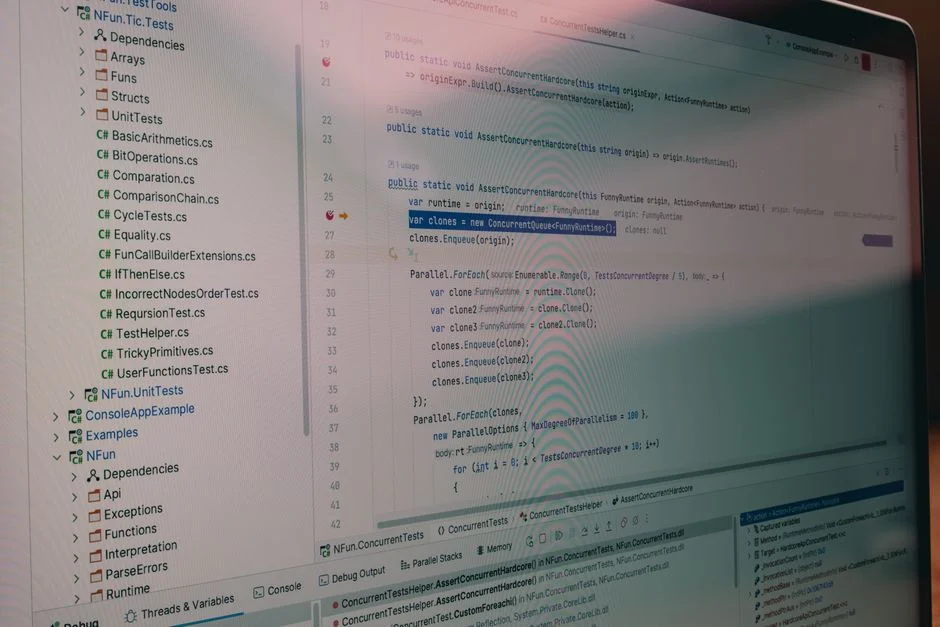
To maintain clean separation between underlying test logic and structural web elements, automation frameworks use the Page Object Model (POM) pattern or the Screenplay pattern. Below is a production Playwright implementation in TypeScript demonstrating Page Object isolation, explicit assertion waiting, and network request interception:
import { Page, Locator, expect } from '@playwright/test';

export class CheckoutPage {
 private readonly page: Page;
 private readonly cartSummary: Locator;
 private readonly submitOrderButton: Locator;
 private readonly confirmationBadge: Locator;

 constructor(page: Page) {
 this.page = page;
 this.cartSummary = page.locator('[data-testid="cart-summary"]');
 this.submitOrderButton = page.locator('[data-testid="btn-submit-order"]');
 this.confirmationBadge = page.locator('[data-testid="order-confirmation"]');
 }

 async loadCheckout(cartId: string): Promise {
 // Intercept checkout API to mock payment gateway latency deterministically
 await this.page.route(`**/api/v1/cart/${cartId}/payment`, async (route) => {
 await route.fulfill({
 status: 200,
 contentType: 'application/json',
 body: JSON.stringify({ status: 'AUTHORIZED', authCode: 'AUTH-99482' }),
 });
 });

 await this.page.goto(`/checkout/${cartId}`);
 await expect(this.cartSummary).toBeVisible();
 }

 async completeTransaction(): Promise {
 await expect(this.submitOrderButton).toBeEnabled();
 await this.submitOrderButton.click();

 // Wait for the confirmation component to resolve via websocket or polling
 await expect(this.confirmationBadge).toBeVisible({ timeout: 10000 });
 const orderId = await this.confirmationBadge.getAttribute('data-order-id');

 if (!orderId) {
 throw new Error('Transaction succeeded but data-order-id attribute was missing');
 }
 return orderId;
 }
}
In backend engineering, particularly when validating internal APIs or asynchronous queues, automated suites must verify database mutations directly without masking system errors. This structural rigor mirrors the discipline required in deep software development analysis during comprehensive architecture audits.
CI/CD Pipeline Integration, Ephemeral Environments, and Test Data
Automated tests deliver minimal business value if they sit disconnected on local developer workstations or run exclusively as disconnected batch jobs. Automation testing partners must weave the execution framework directly into the organization’s Continuous Integration and Continuous Deployment (CI/CD) pipelines.
A resilient pipeline triggers tiered automated suites according to pipeline progression. Linters and fast unit tests run on initial pull request creation. Integration and API contract tests execute upon staging merges. High-concurrency performance tests run in scheduled overnight blocks or trigger automatically on release tag publication.
Managing test data represents one of the most complex challenges in continuous delivery. Static test databases suffer from state corruption, race conditions during parallel runner execution, and drift from production schemas. Mature automation services implement two architectural strategies to solve this:
- Just-in-Time Fixture Factories: Tests generate their own baseline dependencies via direct API calls or isolated database seeds immediately before execution, wiping the data during teardown routines.
- Ephemeral Environments: Using Docker, Kubernetes operators, or platforms like vCluster, CI systems provision clean, isolated replicas of database engines and dependent microservices for individual pull request runs. Tests run against a pristine state and tear down completely upon job completion.
Executing tests in parallel across distributed runner grids significantly shortens build times. Splitting an end-to-end suite across eight parallel matrix containers can turn an hour-long wait into an eight-minute deployment gate, protecting developer momentum.
Evaluating Engagement Models: In-House, Outsourced, and Hybrid Services
Engineering organizations generally select one of three operational models when procuring automation testing services. Each model comes with distinct trade-offs across architectural control, long-term maintenance overhead, and capital expenditure efficiency.
| Engagement Model | Primary Advantages | Systemic Vulnerabilities | Ideal Architectural Context |
|---|---|---|---|
| Fully In-House QA Team | Deep domain retention, aligned company incentives, immediate Slack/PR collaboration. | High recruiting costs, slower ramp-up, ongoing talent retention overhead during lulls. | Core product platforms with highly proprietary business logic and continuous multi-year roadmaps. |
| Dedicated External Agency | Rapid framework bootstrap, pre-built tooling templates, on-demand capacity scaling. | Knowledge fragmentation, risk of framework abandonment, superficial feature context. | Accelerating legacy modernization or bootstrapping automation pipelines from a low-maturity baseline. |
| Hybrid Augmented Team | Internal staff retains architectural governance while external engineers build repetitive coverage. | Requires clear internal technical leadership and strict review gates to prevent code quality decay. | High-growth engineering teams scaling feature delivery alongside aggressive test infrastructure goals. |
A frequent anti-pattern in pure outsourcing is hiring third-party vendors who generate thousands of low-maintenance, brittle UI scripts to hit superficial coverage quotas. When the contract concludes, internal engineers often abandon the entire suite because the tests are too slow, flaky, or brittle to maintain. Successful outsourced and hybrid engagements require the external team to adhere to the organization’s core repository standards, pull request reviews, and coding style guides.
Comprehensive Cost Analysis, Pricing Models, and Real-World TCO
Pricing for automation testing services varies widely based on geographic staffing, engineering seniority, domain complexity, and the chosen pricing structure. Enterprise buyers encounter three predominant pricing models:
- Time and Materials (Hourly): The most common model for technical software engineering. Rates range between $45 and $95 per hour for nearshore teams (Latin America, Eastern Europe) and between $110 and $220 per hour for senior domestic test architects (United States, Western Europe).
- Dedicated Monthly Retainer: A fixed monthly fee for an agreed team composition. A standard unit containing one Lead Test Architect and two Senior Automation Engineers typically costs between $14,000 and $32,000 per month depending on region.
- Fixed-Scope Project: Typically used for initial proof-of-concepts, pipeline bootstrapping, or legacy framework migrations. Engagements usually fall within the $25,000 to $85,000 range based on scope, target browser matrices, and API surface area.
The following table outlines realistic pricing structures and expected cost boundaries for distinct automation engagements:
| Service Engagement Scope | Staffing Profile | Cost Model | Realistic Price Range |
|---|---|---|---|
| CI/CD Test Framework Bootstrap | 1 Senior QA Architect (4-6 weeks) | Fixed Project Fee | $20,000 to $45,000 |
| Continuous Test Suite Development | 2 Automation Engineers (Ongoing) | Monthly Retainer | $12,000 to $24,000 / month |
| Enterprise Performance Benchmark Suite | 1 Performance Engineer + Tooling | Time and Materials | $95 to $185 / hour |
| Comprehensive End-to-End Migration | 1 Lead Architect + 3 Engineers | Milestone-based SOW | $65,000 to $160,000 |
Calculating Total Cost of Ownership (TCO) requires accounting for infrastructure licensing costs alongside agency billable hours. Cloud browser grids such as BrowserStack, Sauce Labs, or Playwright cloud services run from $250 to $2,500 monthly depending on concurrency requirements. Failing to budget for runner compute, data egress, and licensing results in unexpected expenses after deployment.
Flakiness, Maintenance Debt, and Toolchain Modernization
The single greatest operational challenge in automation testing is test flakiness: tests that intermittently pass or fail without any code changes to the underlying application. Left unaddressed, flaky tests undermine pipeline trust, leading developers to bypass CI checks and deploy untested regressions to production.
Flakiness typically stems from architectural root causes:
- Dynamic Asynchronous Rendering: Elements rendered via client-side frameworks shift or update after initial DOM attachment, causing race conditions in click handlers.
- Network and Microservice Jitter: End-to-end tests relying on external third-party APIs (such as payment gateways or authentication providers) fail during minor upstream latency spikes.
- Shared Environment Pollution: Colliding database mutations occur when parallel workers read and modify identical records simultaneously.
Modern service providers combat flakiness using auto-retries, deterministic mocking, and network tracing. Playwright and Cypress isolate browser contexts natively, avoiding the thread-synchronization issues common in legacy Selenium environments.
Technology leadership must also manage maintenance debt. When user interfaces evolve, hardcoded XPath and brittle CSS selectors break. Capable automation teams build resiliency into their locator strategy, prioritizing stable semantic markup, ARIA roles (such as role="button"[name="Submit"]), and dedicated data attributes (such as data-testid="cart-submit") over fragile parent-child DOM chains.
Security Implications and Compliance in Automated Testing
Automating tests across end-to-end systems requires handling production-like environments, user accounts, and data structures. Without deliberate architectural boundaries, automated testing pipelines can inadvertently introduce security vulnerabilities and regulatory liabilities.
A common vulnerability is checking cleartext credentials into test repositories. Service providers must secure API keys, administrative passwords, and client certificates using centralized secret management tools such as HashiCorp Vault, AWS Secrets Manager, or GitHub Actions Secrets. Test frameworks must pull credentials dynamically during CI execution without logging secrets into build console outputs.
Data sanitization and privacy compliance (governed by GDPR, HIPAA, and CCPA) require strict measures when constructing realistic test databases. Populating staging or automated testing databases with raw production backups is an unacceptable compliance failure. Automation testing services must deploy data scrubbing engines or generate synthetic data using tools like Bogus or Faker to avoid exposing sensitive customer records.
Automation suites also enhance security posture when used for automated dependency auditing, container scanning, and Dynamic Application Security Testing (DAST). Embedding tools like OWASP ZAP into regression pipelines ensures that every merge automatically checks for common vulnerabilities like cross-site scripting and insecure direct object references.
Measuring ROI: Key Performance Indicators for Executive Oversight
To justify ongoing investments in automation testing services, technology executives need quantitative metrics that demonstrate cost efficiency and system reliability. Tracking code coverage percentages alone provides misleading signals; engineering teams can easily write tests that achieve 90 percent line coverage without validating edge cases or business assertions.
Executive oversight benefits most from tracking these pragmatic engineering metrics:
- Mean Time to Detect (MTTD): How quickly defects are discovered after a pull request or merge. Automated pipelines reduce this from days to minutes.
- Regression Escapes to Production: The total number of preventable bugs that reach live environments. A falling escape rate directly correlates with test suite effectiveness.
- Pipeline Execution Duration: The wall-clock time required to execute the complete test validation suite. Efficient pipelines maintain runtimes under 15 minutes via concurrency and test sharding.
- Flakiness Ratio: The percentage of test failures caused by framework or infrastructure instability rather than actual code defects. High-performing teams maintain flakiness rates below one percent.
- Manual Testing Hours Saved: Quantifiable labor hours recaptured by shifting repetitive manual regression passes over to automated suites.
By reviewing these metrics monthly, engineering leaders can objectively measure vendor output, maintain framework health, and prevent the accumulation of low-value, high-maintenance tests.
Further Foundations and Cluster Resources
Establishing a dependable testing culture requires a firm grasp of core application patterns, environment configurations, and continuous delivery fundamentals. Exploring broader foundational topics will help your team build a balanced, resilient software delivery lifecycle.
Explore our complete Laravel, Basics directory for more guides.
Factors That Affect Development Cost
- Geographic location and seniority of test engineers
- Scope of coverage (API vs UI vs Mobile vs Concurrency)
- Target browser, device, and operating system matrix breadth
- State of legacy test data and CI/CD pipeline infrastructure
- Third-party device farm and cloud runner grid licensing
Engagements range from focused $20,000 bootstrap initiatives to continuous enterprise retainers running between $12,000 and $32,000 monthly.
Automation testing services are an effective operational lever for organizations looking to accelerate deployment velocity, stabilize infrastructure, and reduce total cost of ownership. Moving from manual verification gates to automated CI/CD pipelines reduces regression bottlenecks and lets engineering teams ship features with high confidence.
Success ultimately hinges on selecting the right service partners, enforcing architectural standards like the Page Object Model, managing test data cleanly, and actively preventing test flakiness. By tracking concrete operational metrics like cycle time and escape rates, technology leaders can build scalable, maintainable test systems that support long-term software delivery.