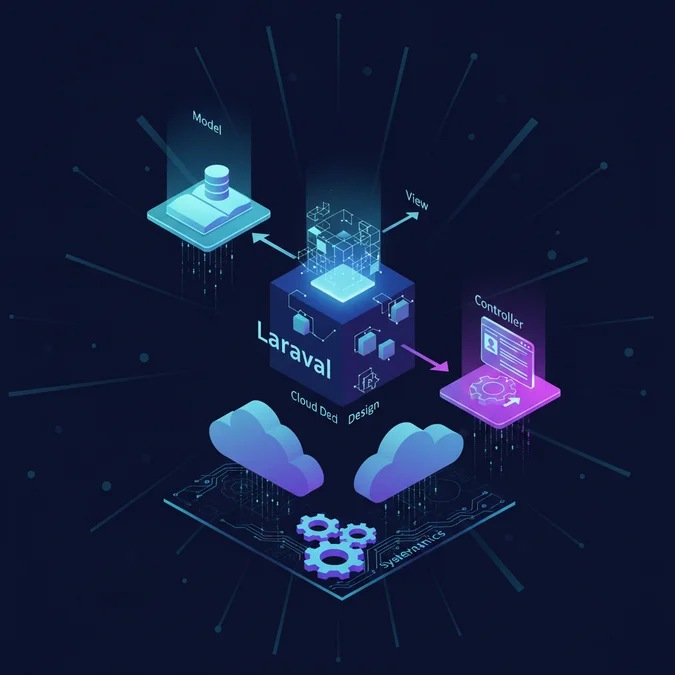

Laravel MVC is an architectural implementation that separates an application into three interconnected components: Models for data persistence and domain logic, Views for presentation rendering, and Controllers for orchestrating incoming HTTP requests and application flow. This decoupling allows web applications running on modern PHP runtimes to isolate business rules from transport protocols and visual interfaces cleanly.
With recent updates in Laravel 11 streamlining application scaffolding, reducing boilerplate service providers, and adopting leaner configuration directories, the framework enforces a decoupled operational model. In enterprise cloud deployments on AWS and GCP, mastering this structural split is the foundation for horizontal scaling, zero-downtime rolling releases, and maintainable distributed infrastructure.
Architectural Foundation: How Laravel Executes the MVC Pattern
Laravel implements the classic Model-View-Controller design pattern through its service container, HTTP kernel, and routing pipeline. When an incoming network packet hits an Nginx or AWS Application Load Balancer reverse proxy, it forwards the FastCGI request to PHP-FPM workers. Laravel initializes by booting the core service container, passing the HTTP request through global and route middleware, and matching the URI pattern to a designated controller method.
Understanding this execution lifecycle reveals how components interact without rigid coupling. Models represent database entities and encapsulate business assertions via Eloquent ORM. Controllers sit as thin traffic directors, delegating database queries to Models or repository services, and returning structured data payloads. Views consume these payloads, using the Blade templating engine to render server-side HTML or emitting structured JSON envelopes for decoupled Single Page Application (SPA) clients.
When planning structural boundaries, teams often consult low-level software design strategies to define clean interfaces between transport controllers, domain entities, and data access layers. Maintaining these strict boundaries prevents controller bloat and ensures individual layers scale independently under sustained cloud traffic.
The Model Layer: Eloquent ORM, Data Integrity, and Sharding
In Laravel, the Model layer extends beyond standard Active Record data mapping. An Eloquent model encapsulates database table definitions, relationship graphs, local scopes, query mutations, and domain-specific state transitions. In modern cloud architecture, database operations often represent the primary latency bottleneck, making query efficiency within Models paramount.
Separating Schema Definitions from State Mutation
Rather than scattering raw SQL across application files, Eloquent centralizes query constraints within explicit Model scopes. This structure prevents repetitive queries and standardizes data hydration throughout the application lifetime.
<php

namespace App\Models;

use Illuminate\Database\Eloquent\Model;
use Illuminate\Database\Eloquent\Builder;
use Illuminate\Database\Eloquent\Relations\HasMany;
use Illuminate\Database\Eloquent\SoftDeletes;

class CustomerAccount extends Model
{
 use SoftDeletes;

 protected $table = 'customer_accounts';

 protected $fillable = [
 'uuid',
 'organization_name',
 'status',
 'region_code',
 'balance_cents',
 ];

 protected $casts = [
 'balance_cents' => 'integer',
 'is_active' => 'boolean',
 'last_login_at' => 'immutable_datetime',
 ];

 // Scope to enforce enterprise multi-region query isolation
 public function scopeForRegion(Builder $query, string $regionCode): Builder
 {
 return $query->where('region_code', $regionCode);
 }

 public function transactions(): HasMany
 {
 return $this->hasMany(AccountTransaction:class, 'account_id');
 }
}
In high-throughput environments, Models must be configured to split read and write operations across AWS Aurora or GCP Cloud SQL read replicas. Defining database connections dynamically within the model or through Laravel database configuration prevents replication lag from corrupting write operations.
The View Layer: Blade Rendering Mechanics and Headless API Envelopes
The View component in Laravel provides presentation formatting while remaining strictly agnostic of database schemas and HTTP routing mechanics. Blade compiles plain PHP templates into cached bytecode in storage/framework/views, yielding direct memory execution speeds for subsequent requests.
Server-Side Blade vs API Data Transformers
Depending on deployment architecture, Laravel Views operate in two distinct modes: server-rendered HTML components via Blade, or structured JSON responses formatted through Eloquent API Resources for decoupled frontend clients.
<php

namespace App\Http\Resources;

use Illuminate\Http\Request;
use Illuminate\Http\Resources\Json\JsonResource;

class CustomerAccountResource extends JsonResource
{
 /**
 * Transform the resource into an array for client consumption.
 */
 public function toArray(Request $request): array
 {
 return [
 'id' => $this->uuid,
 'organization' => $this->organization_name,
 'status' => $this->status,
 'region' => $this->region_code,
 'metrics' => [
 'ledger_balance' => number_format($this->balance_cents / 100, 2),
 ],
 'links' => [
 'self' => route('api.accounts.show', ['account' => $this->uuid]),
 ],
 ];
 }
}
Teams developing enterprise user interfaces often leverage modern full-stack web architectural patterns, combining Laravel backend services with Vue or React single-page frontends. In these environments, API Resources fulfill the View role by defining the exact external interface contract, shielding internal database structures from client exposure.
The Controller Layer: Request Routing, Middleware, and Thin Action Handlers
Controllers function as network arbiters in Laravel MVC. Their mandate is to accept incoming HTTP requests, enforce authorization policies, delegate domain processing to underlying service classes, and hand off response data to the View or JSON formatter. A well-engineered controller contains zero database queries and no heavy procedural business logic.
Single-Action Controllers for Horizontal Workloads
Rather than constructing sprawling controllers with dozens of disparate methods, resilient architectures utilize Single-Action Controllers implementing the PHP magic __invoke method. This approach promotes cohesive codebases and simplifies unit testing.
<php

namespace App\Http\Controllers;

use App\Http\Requests\ProvisionAccountRequest;
use App\Services\AccountProvisioningService;
use App\Http\Resources\CustomerAccountResource;
use Illuminate\Http\JsonResponse;
use Symfony\Component\HttpFoundation\Response;

class ProvisionAccountController extends Controller
{
 public function __invoke(
 ProvisionAccountRequest $request,
 AccountProvisioningService $provisioner
 ): JsonResponse {
 // Request validation has executed automatically prior to controller entry
 $account = $provisioner->provision($request->validated());

 return (new CustomerAccountResource($account))
 ->response()
 ->setStatusCode(Response:HTTP_CREATED);
 }
}
By delegating domain tasks to dedicated service classes, controllers maintain a minimal memory footprint per PHP-FPM process, allowing servers to handle higher concurrency without worker exhaustion.
Request Flow and Lifecycle: Network Ingestion to Response Emission
Tracing the path of an execution context through the framework illustrates how Laravel coordinates MVC boundaries under realistic network conditions. The following step sequence tracks an HTTP packet through the runtime:
- Edge Routing: The request terminates at a cloud load balancer and arrives at the web server (Nginx/Apache), which routes traffic through
public/index.php. - Container Initialization: Composer autoloader initializes system classes, and the framework instantiates the application container (
Illuminate\Foundation\Application). - Kernel Bootstrapping: The HTTP Kernel loads service providers, sets error handling, detects environment variables, and configures logging.
- Middleware Pipeline: Global and route-specific middleware execute in an onion-style pipeline, validating CSRF tokens, verifying signatures, and managing session state.
- Route Resolution: The router matches the URI and method to an action, binding Route Model parameters to database entities via implicit resolution.
- Controller Dispatch: The controller invokes service operations, handles domain calculations, and builds an Eloquent payload.
- View Compilation: Blade compiles markup or API Resources serialize the payload into a structured HTTP response object.
- Response Dispatch: The response passes back out through terminating middleware to the web server, which flushes output buffers to the network socket.
Beyond Standard MVC: Service Classes, Repositories, and Domain Boundaries
Basic tutorials often portray MVC as a triad where Models contain direct data handling and Controllers manage everything else. In production systems with significant domain complexity, this naive view leads directly to unmaintainable anti-patterns such as Fat Models or God Controllers. Enterprise architectures introduce auxiliary layers that preserve MVC isolation while accommodating intricate business workflows.
Architectural Boundary Comparison
The table below summarizes responsibilities across the expanded application structure:
| Architectural Layer | Primary Responsibility | Permitted Dependencies | Prohibited Dependencies |
|---|---|---|---|
| Controller | HTTP translation, status codes, dispatching | FormRequests, Service Classes, Resources | Raw SQL, Heavy Domain Logic, View Logic |
| Service Class | Complex business workflows, third-party APIs | Repositories, Models, Event Dispatchers | HTTP Request Objects, HTML Output |
| Repository | Database abstraction, custom queries | Eloquent Builder, Cache Drivers | Controller Classes, Session Handlers |
| Model | Schema mapping, relationships, mutations | Database Driver, ORM Traits | External HTTP Clients, Email Dispatchers |
| API Resource / View | Presentation rendering, payload serialization | Presenter Classes, Primitive DTOs | Direct Database Queries, Mutating Actions |
Introducing Service Classes isolates business rules entirely from the HTTP layer. This design makes business operations invokable from background queue workers, CLI commands, or HTTP controllers without duplicating logic.
Decoupling Heavy Computations with Asynchronous Job Pipelines
A common operational flaw in MVC architectures is executing long-running transactional work directly inside the Controller-Model cycle. Operations like dispatching webhooks, generating complex billing invoices, or processing uploaded assets block the PHP execution thread, causing HTTP request timeouts and degraded API performance.
Controllers must dispatch computational workloads asynchronously to distributed queue backends like AWS SQS or Redis. Setting up dedicated Laravel queue connection infrastructure ensures high-latency tasks run on isolated background worker nodes without exhausting web-tier resources.
<php

namespace App\Jobs;

use App\Models\CustomerAccount;
use App\Services\BillingGenerationService;
use Illuminate\Bus\Queueable;
use Illuminate\Contracts\Queue\ShouldQueue;
use Illuminate\Foundation\Bus\Dispatchable;
use Illuminate\Queue\InteractsWithQueue;
use Illuminate\Queue\SerializesModels;

class ProcessAccountBillingCycle implements ShouldQueue
{
 use Dispatchable, InteractsWithQueue, Queueable, SerializesModels;

 // SerializesModels stores only the primary key in the queue payload
 public function __construct(
 public CustomerAccount $account,
 public string $billingPeriod
 ) {}

 public function handle(BillingGenerationService $billingService): void
 {
 // Work executes asynchronously on worker nodes managed by Supervisor or Kubernetes
 $billingService->generateInvoiceForPeriod($this->account, $this->billingPeriod);
 }
}
Using the SerializesModels trait ensures that queue workers re-fetch fresh database records upon job execution, avoiding stale state issues across asynchronous worker pools.
Containerization and Infrastructure Topology for Laravel Workloads
In production cloud environments, deploying Laravel MVC applications requires containerized architectures that separate state from stateless application containers. Running Laravel within Docker on AWS ECS, EKS, or Google Cloud Run requires distinct worker roles to maintain system resilience under load spikes.
Multi-Role Container Topologies
Production environments typically deploy the same base container image across three distinct operational roles:
- Web Tier: Runs PHP-FPM paired with an Nginx sidecar or high-speed runtime such as Laravel Octane powered by FrankenPHP or Swoole. Web nodes receive external traffic and auto-scale on CPU utilization or request count.
- Queue Worker Tier: Runs headless PHP CLI containers managed by process supervisors. These workers pull jobs from Redis or SQS and scale based on queue depth metrics.
- Scheduler Tier: A single container instance running
php artisan schedule:runevery minute to trigger recurring cron jobs and system maintenance tasks.
Separating these concerns prevents an unexpected surge in queued jobs from degrading HTTP response latencies on user-facing endpoints.
State Management, Session Clustering, and Persistent Storage
Because horizontal scaling relies on spinning up and terminating stateless container instances on demand, storing local state on the container filesystem is an operational anti-pattern. Session files, uploaded media, and cache stores must be externalized to centralized cloud infrastructure.
Centralizing Volatile State
Laravel provides built-in configuration drivers to route volatile data away from local disk storage to shared cloud services:
- Session Management: Stored within an AWS ElastiCache for Redis cluster or DynamoDB, ensuring users maintain authenticated sessions regardless of which container instance handles their request.
- Application Caching: Utilizing Redis or Memcached clusters configured with read replicas to accelerate query result caching and rate-limiting counters.
- Object Storage: Asset uploads pass directly to AWS S3, Google Cloud Storage, or Cloudflare R2 using the Flysystem driver, bypassing local web server storage entirely.
Externalizing all ephemeral state ensures web instances can be safely destroyed or replaced by auto-scaling policies during traffic changes without data loss.
High-Throughput Optimization: Laravel Octane and In-Memory Runtimes
Standard PHP runtimes follow a shared-nothing model: each incoming HTTP request boots the framework from scratch, reads configuration files, instantiates the service container, executes the request, and frees all allocated memory. While reliable, this initialization lifecycle adds measurable overhead to high-throughput endpoints.
Laravel Octane modernizes this process by loading the application once into persistent system memory using modern runtimes like FrankenPHP, Swoole, or RoadRunner. Requests execute against the warm application container, cutting response times to single-digit milliseconds.
Managing State Leaks in Persistent Memory
Running Laravel in an Octane environment alters the standard MVC lifecycle. Because the application instance persists across requests, singleton services and static variables can leak state between separate client interactions if not handled carefully.
<php

namespace App\Providers;

use Illuminate\Support\ServiceProvider;
use App\Services\DynamicTenantResolver;

class AppServiceProvider extends ServiceProvider
{
 public function register(): void
 {
 // Bound as a scoped instance to ensure cleanup between requests under Octane
 $this->app->scoped(DynamicTenantResolver:class, function ($app) {
 return new DynamicTenantResolver();
 });
 }
}
Using scoped instead of singleton ensures that the service container resets tenant-specific or user-specific state between incoming requests, preventing data cross-contamination in persistent application runtimes.
Laravel Architecture Reference Directory
Deepening your understanding of framework mechanics, database scaling, and containerized deployment pipelines requires studying foundational technical guides. Explore our complete Laravel, Basics directory for more guides.
Laravel MVC architecture provides a dependable baseline for building scalable, maintainable web applications. By maintaining clean boundaries between Eloquent models, lightweight controllers, and decoupled view transformers, engineering teams avoid structural bottlenecks as application requirements expand.
When combined with cloud infrastructure strategies such as horizontal container auto-scaling, asynchronous queue isolation, and in-memory runtimes via Octane, Laravel reliably manages high-throughput enterprise workloads while preserving developer velocity and clean code organization.