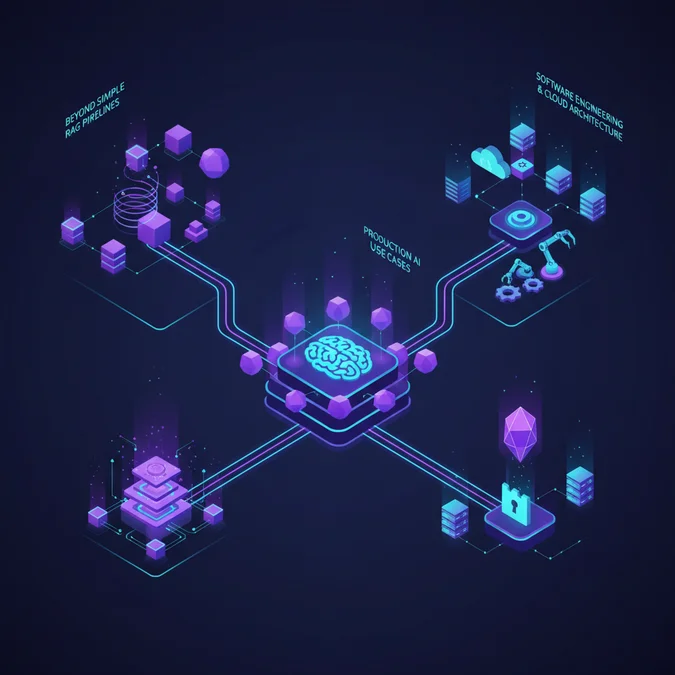

When autonomous agents transition from experimental RAG prototypes to core business infrastructure, the primary point of failure is rarely the underlying LLM. Instead, it is the lack of a robust orchestration layer. AI agent management is the discipline of governing agentic state, telemetry, and security policies across distributed environments to prevent non-deterministic behavior and cascading failures.
As we move into 2026, the complexity of multi-agent systems demands a shift from monolithic scripts to a structured control plane. This guide details the architectural requirements for implementing professional-grade oversight, ensuring that your agentic workflows remain performant, secure, and observable at scale.
The Architecture of AI Agent Management
Effective ai agent management requires a strict separation between the data plane and the control plane. The data plane handles the actual inference calls and tool execution, while the control plane governs policy enforcement, versioning, and observability. Without this separation, agents become black boxes that are impossible to debug when they deviate from intended business logic.
Engineering Note: Treat your agentic control plane as a distributed system state machine. Every state transition, tool call, and memory retrieval must be indexed against a global correlation ID.
+-------------------------------------------------------------+ ------------------ | CONTROL PLANE | | | +-----------+ +-----------+ +-----------+ | | | Policy | | Lifecycle | | Observability | | | | Engine | | Manager | | Aggregator | | | +-----------+ +-----------+ +-----------+ | | +-------------------------------------------------------------+ | | | | +-------------------------------------------------------------+ | | | DATA PLANE | | | +-----------+ +-----------+ +-----------+ | | | LLM Engine| | Tool Exec | | Memory Store| | | +-----------+ +-----------+ +-----------+ | | +-------------------------------------------------------------+Selecting an AI Agent Management Platform
Choosing between a managed ai agent management platform and a custom orchestration layer depends on your engineering team’s capacity for maintaining complex infrastructure. Below is a framework for evaluating your requirements.
| Feature | Custom Layer | Managed Platform |
|---|---|---|
| Latency Overhead | Minimal | Moderate |
| Time to Market | High | Low |
| Security Compliance | Full Control | Vendor Dependent |
| Maintenance Burden | High | Minimal |
Checklist for Evaluation:
- Does the platform support native streaming of agent steps?
- Are there built-in circuit breakers for token budget exhaustion?
- Can you export logs directly into your existing observability stack?
- Does it provide granular RBAC for individual tools?
Core Mechanics of Lifecycle and Observability
Lifecycle management for agents involves treating prompts, tool definitions, and system instructions as versioned code. Observability must capture not just the final output, but the entire chain of thought.
- Instrument the Loop: Wrap every tool invocation in a decorator that captures latency and error codes.
- Token Tracking: Aggregate context window usage per session to predict cost spikes.
- Drift Detection: Periodically run golden datasets against your agents to monitor output consistency.
def monitor_agent_call(func): def wrapper(*args, **kwargs): start = time.time() try: result = func(*args, **kwargs) log_metrics(latency=time.time() - start, success=True) return result except Exception as e: log_metrics(error=str(e), success=False) raise return wrapperSecurity and Compliance Protocols for Agentic Workflows
Security in agentic systems is primarily about limiting the blast radius of unauthorized tool execution and prompt injection. Production-ready agents must implement strict isolation protocols.
- Tool Sandboxing: Execute all code-based tools in a short-lived container or restricted environment.
- Input Sanitization: Validate all user inputs before they reach the LLM context window.
- Human-in-the-Loop (HITL): Require manual approval for high-risk actions, such as database writes or external API calls.
- Audit Trails: Maintain an immutable log of every agent decision for post-mortem analysis.
The 2026 Enterprise Agent Maturity Model
The industry is shifting from reactive debugging to proactive agent governance. Your architectural decisions today determine your ability to scale to thousands of concurrent agents.
| Stage | Focus | Key Metric |
|---|---|---|
| Level 1: Prototype | Functionality | Success Rate |
| Level 2: Integrated | API Stability | Integration Latency |
| Level 3: Governed | Compliance | Policy Violation Rate |
| Level 4: Autonomous | Optimization | Token Efficiency |
Factors That Affect Development Cost
- Integration complexity with existing data stores
- Inference volume and token consumption
- Required latency SLAs
- Compliance and audit logging requirements
Costs vary significantly based on whether you utilize a managed SaaS orchestration layer or build a custom solution requiring internal cloud infrastructure and engineering overhead.
Frequently Asked Questions
What is the primary role of an AI agent management platform?
An AI agent management platform provides the centralized control plane necessary to monitor, deploy, and scale autonomous agents. It handles observability, security, lifecycle versioning, and resource allocation, ensuring agents remain performant and compliant within complex enterprise production environments as of 2026.
Why is AI agent management critical for production scaling?
AI agent management is critical because it mitigates risks like hallucination, excessive latency, and runaway token costs. Without centralized management, maintaining visibility into multi-agent interactions becomes impossible, leading to security vulnerabilities and degraded decision-making consistency across distributed business workflows.
Building a scalable agentic system requires moving beyond simple prompt chains into sophisticated lifecycle management. By decoupling the control plane, implementing strict observability, and enforcing security guardrails, engineering teams can transition from fragile prototypes to resilient enterprise infrastructure.
Review your current orchestration layer against the maturity model above. If your team spends more time debugging agent state than building new features, it is time to formalize your management architecture.