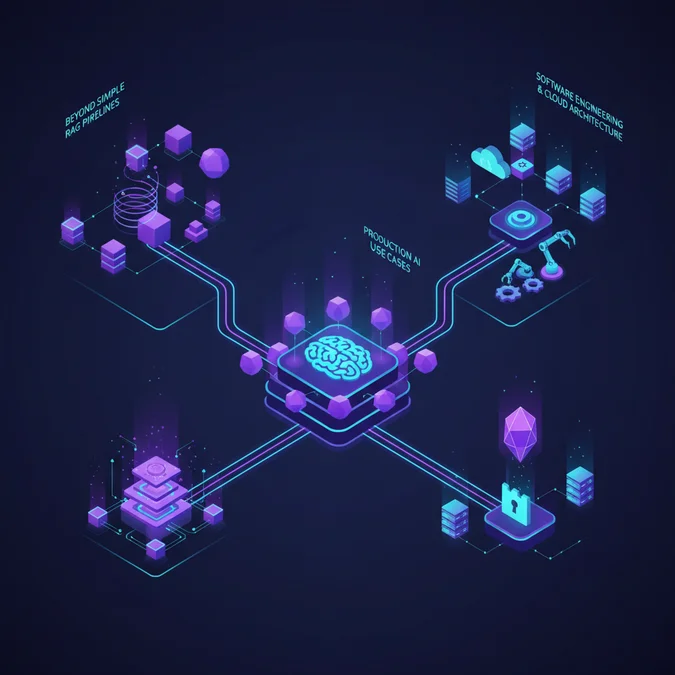

True autonomy in software engineering is no longer limited to simple scripts or static models. Modern agentic systems function as orchestrators, capable of reasoning, tool selection, and iterative error correction. Building these systems requires a shift from linear execution to stateful, loop-based architectures that can navigate complex enterprise constraints.
This guide provides a blueprint for developers moving beyond toy prototypes. We examine the architectural patterns, security requirements, and orchestration frameworks necessary to transition agentic AI project ideas from local development to resilient, production-hardened services.
Taxonomy of Agentic AI Project Ideas
Categorizing agentic ai project ideas requires mapping the required autonomy level against the operational risk. We classify these projects into three tiers based on their interaction with external state and human oversight requirements.
| Tier | Complexity | Primary Mechanism | Risk Profile |
|---|---|---|---|
| Tier 1: Assistant | Low | Tool-calling / Retrieval | Low: Read-only |
| Tier 2: Orchestrator | Medium | Multi-agent planning | Medium: Tool execution |
| Tier 3: Autonomous | High | Recursive task loops | High: Persistent state |
Tier 1 projects focus on augmenting human workflows, such as automated research synthesis. Tier 2 systems involve chaining specialized agents, like a planning agent delegating to a coding agent. Tier 3 systems operate on long-running loops, managing their own memory and error recovery cycles.
Engineering Frameworks for AI Agent Projects
Selecting the right framework for ai agent projects dictates your ability to scale and debug complex state transitions. The following comparison highlights the trade-offs between current industry leaders.
| Framework | State Management | Ease of Deployment | Latency |
|---|---|---|---|
| LangGraph | Explicit Graph | High | Low |
| CrewAI | Role-based | Medium | Medium |
| Agno | Type-safe | High | Low |
Technical Callout: Always prioritize frameworks that support graph-based state persistence. Linear chains fail under complex, non-deterministic tasks where recursion or backtracking is necessary for agent success.
Scaling Agentic AI Business Ideas into Production
When maturing ai agent business ideas, the transition from prototype to service hinges on reliability. A production-ready agent must be evaluated on its ability to handle edge cases without human intervention.
- Observability: Implement distributed tracing for every tool call and model inference step.
- Persistence: Use a database backend for agent memory to ensure state survives process restarts.
- Cost Management: Monitor token usage per task to avoid runaway costs during recursive planning.
- Governance: Enforce strict schemas for every tool argument to prevent hallucinated function calls.
Technical Implementation: Building Resilient Agents
Resilience is achieved through defensive programming. The following example demonstrates a robust tool-calling pattern with validation and error handling.
def execute_tool_with_retry(tool_func, args, max_retries=3): for attempt in range(max_retries): try: # Validate input schema before execution validate_input(args) return tool_func(**args) except ValidationError as e: log_error(f"Invalid arguments: {e}") return None except Exception as e: log_error(f"Attempt {attempt} failed: {e}") if attempt == max_retries - 1: raiseState management must be atomic. By using a graph-based state machine, you ensure that the agent can resume from the last known good state if an external API fails.
Risk Mitigation and Agentic Governance
Securing agentic systems involves protecting against prompt injection and unauthorized tool usage. Human-in-the-loop (HITL) design patterns are mandatory for high-stakes decisions.
- Input Sanitization: Treat all model outputs as untrusted input.
- Tool Sandboxing: Run agents in restricted environments with minimal permissions.
- HITL Gates: Force manual approval for any agent action that modifies external data or triggers payments.
Security Callout: Never grant an agent broad API access. Use scoped tokens and implement a circuit breaker that disables tool execution if the error rate exceeds a defined threshold.
Frequently Asked Questions
What are the most effective agentic ai project ideas for beginners?
Beginners should focus on single-agent workflows that utilize tool-calling for data retrieval. Projects like automated research assistants, personal scheduling agents, or document processing pipelines provide clear boundaries for state management and model interaction while teaching fundamental principles of agentic system design.
How do I evaluate if my ai agent projects are production ready?
Production-ready agentic systems require robust observability, deterministic tool validation, and integrated human-in-the-loop safeguards. You must measure latency, cost per task, and success rate against defined benchmarks. Ensure your architecture includes persistent memory, error recovery mechanisms, and strict security protocols to prevent unauthorized tool execution.
Are there viable ai agent business ideas in the current market?
Yes, viable business ideas focus on automating high-friction enterprise workflows. Opportunities exist in vertical-specific agents for legal document review, automated supply chain orchestration, and autonomous customer support systems that handle complex stateful interactions beyond simple question-answering capabilities.
Building autonomous systems requires a shift toward rigorous engineering practices. By focusing on stateful orchestration, robust error handling, and strict governance, you can move your agentic AI project ideas from the research lab into reliable, production-ready infrastructure.
The future of agentic architecture lies in the ability to compose small, specialized agents into larger, resilient workflows. Start by implementing observability and HITL guardrails to ensure your systems remain predictable under load.