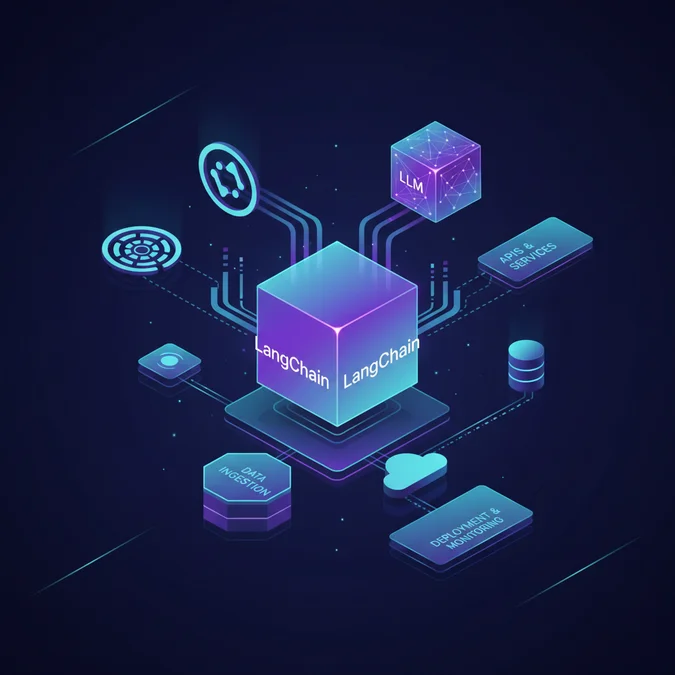

LangChain is an orchestration framework designed to bridge raw large language models with external data sources, computational runtimes, and persistent application state. Rather than treating an LLM as an isolated text-in, text-out API, LangChain structures the multi-component lifecycle required for complex AI systems: prompt composition, context retrieval, tool invocation, and dynamic evaluation.
In standard production environments, integrating LLMs directly via native provider client libraries quickly hits architectural friction. As soon as an engineering team needs to ingest unstructured documents into a vector database, orchestrate parallel tool executions, route inputs between distinct foundation models, and track token usage across multi-turn sessions, native SDK code morphs into brittle, unmaintainable boilerplate.
This technical analysis examines what LangChain is used for across modern enterprise deployments. We review its architectural underpinnings, inspect verified code patterns using LangChain Expression Language (LCEL), compare its footprint against alternatives like LlamaIndex and native SDKs, and outline operational strategies for mitigating token overhead and latency bottlenecks.
LangChain Explained: Foundations of the Open Source AI Framework
To understand the utility of modern AI orchestration, langchain explained from an infrastructure perspective reveals a modular pipeline architecture. At its foundation, LangChain acts as an abstraction layer above raw inference APIs, vector indexes, and deterministic business logic. When evaluating what is lang chain within an enterprise tech stack, it is best understood not as a model provider, but as the connective tissue that coordinates stateful interactions between heterogeneous systems.
The framework operates as an ecosystem split across modular packages to minimize dependency bloat and decouple core runtime interfaces from third-party vendor integrations:
langchain-core: Houses foundational base abstractions, message types, document schemas, and the standard LangChain Expression Language (LCEL) runtime interfaces.langchain-community: Contains community-maintained integrations for hundreds of vector databases, document loaders, and embedding services.langchain(and partner packages like@langchain/openaiorlangchain-anthropic): Provides high-level cognitive architectures, pre-built reasoning chains, and first-party vendor-optimized connectors.langgraph: Delivers cyclical, stateful graph-based orchestration for multi-agent loops and human-in-the-loop validation checkpoints.langsmith: A commercial-grade observability platform for tracing latency, token consumption, intermediate step outputs, and regression evaluations.
As a widely adopted piece of langchain open source software, the project transitioned rapidly from initial prototyping utilities into an enterprise framework. It standardized how developers declare composable, parallelizable execution graphs while maintaining vendor neutrality across foundational model providers.
Architectural Note: In modern enterprise engineering, standardizing on
langchain-coreinterfaces shields downstream business logic from provider-specific breaking changes, allowing teams to swap model backends or vector indexes by altering configuration bindings rather than refactoring domain code.
Production Readiness Checklist: Architecture Setup
- Confirm all microservices pin explicit semantic versions of
langchain-coreand partner packages to prevent interface drift. - Isolate third-party community loaders from critical application paths to safeguard against transitive dependency vulnerabilities.
- Establish strict typing and schema boundaries using Pydantic models for every prompt input and structured output extraction node.
What Does LangChain Do Across Modern Enterprise AI Architectures?
When dissecting what does langchain do in a high-throughput enterprise environment, the framework solves four primary systems challenges: provider lock-in, unstructured context injection, nondeterministic tool execution, and complex state tracking. Raw foundation models lack direct access to private relational databases, internal APIs, and persistent session histories. LangChain organizes these disparate data streams into unified execution pipelines.
Understanding what is langchain ai orchestration in practice requires analyzing how it manages the operational boundary between external infrastructure and probabilistic inference engines:
+-------------------------------------------------------------------------+
| ENTERPRISE APPLICATION RUNTIME |
+-------------------------------------------------------------------------+
 | ^
 | User Request & Session Meta | Typed Response
 v |
+-------------------------------------------------------------------------+
| LANGCHAIN CORE ORCHESTRATION |
| |
| +------------------+ +-------------------+ +--------------------+ |
| | Prompt Template | --> | Retriever / RAG | --> | Dynamic Tool Node | |
| | (Input Binder) | | (Vector / Hybrid) | | (External API/SQL) | |
| +------------------+ +-------------------+ +--------------------+ |
| | |
| v |
| +-------------------+ |
| | Model Binding | |
| | (Fallbacks/Route) | |
| +-------------------+ |
+-------------------------------------------------------------------------+
 | ^
 | Standardized Chat Schema | Model Response
 v |
+-------------------------------------------------------------------------+
| FOUNDATION MODEL PROVIDERS |
| [Anthropic Claude] [OpenAI GPT-4] [Self-Hosted vLLM] |
+-------------------------------------------------------------------------+
The table below breaks down the technical responsibilities handled by LangChain compared to ad-hoc custom code implementations:
| Capability Domain | Ad-Hoc / Custom Provider Script | LangChain Production Implementation |
|---|---|---|
| Model Portability | Manual refactoring of payload formats, API headers, and output parsers. | Uniform BaseChatModel interface; swap models with single-line configuration. |
| Retriever Hybridization | Custom asynchronous routines combining keyword and vector scoring logic. | Pre-built EnsembleRetriever coordinating BM25, vector search, and cross-encoders. |
| Tool Integration | Hardcoded JSON function definitions and manual exception parsing. | Pydantic-based @tool decorators with automatic schema generation and retry handling. |
| Execution Graph | Nested try/except async functions with manual thread pool management. |
Native asynchronous batching, streaming, and parallel execution via LCEL runnables. |
| Observability | Scattered console.log statements or bespoke OpenTelemetry instrumentation. |
Zero-code telemetry injection tracking step-level tokens, latency, and inputs via LangSmith. |
Operational Reality: Without a unified abstraction framework, supporting a multi-model fallback strategy (such as degrading to a self-hosted open-weights model when commercial APIs throttle) requires hundreds of lines of brittle routing code. LangChain handles these fallbacks via declarative chaining primitives.
Production Patterns: What Is LangChain Used for in Real Systems?
Examining what is langchain used for in production reveals several primary architectural patterns. Engineering teams deploy the framework across four dominant archetypes: advanced Retrieval-Augmented Generation (RAG), autonomous multi-tool agents, structured data normalization engines, and persistent conversational interfaces.
1. Enterprise Retrieval-Augmented Generation (RAG)
In standard semantic search, static vector lookups frequently surface irrelevant context due to semantic drift. Enterprise LangChain pipelines deploy advanced retrieval strategies: hybrid search (combining dense vector embeddings with sparse BM25 indices), parent-document chunking, and contextual compression via cross-encoder re-ranking models.
2. Autonomous Multi-Step Agents
Unlike deterministic scripts, agents use an LLM as a dynamic reasoning engine to select external tools, inspect intermediate returns, and iterate until completing an objective. LangChain standardizes the execution loop, parsing function-calling schemas, catching execution exceptions, and feeding normalized errors back into the context window for self-correction.
3. Structured Extraction Pipelines
Unstructured data such as customer support transcripts, scanned receipts, and PDF technical specifications require conversion into strongly typed database records. LangChain links models directly to validation libraries, enforcing schema compliance before saving to downstream transactional databases.
Production Implementation: Tool-Calling Agent with Fallback Handling
The following verified implementation demonstrates a production-grade LCEL pattern. It configures an agent equipped with an external calculation tool, incorporates model fallbacks, and executes asynchronously:
import asyncio
from typing import Any, Dict
from pydantic import BaseModel, Field
from langchain_core.tools import tool
from langchain_core.prompts import ChatPromptTemplate, MessagesPlaceholder
from langchain_core.runnables import RunnableWithFallbacks
from langchain_openai import ChatOpenAI
from langchain_anthropic import ChatAnthropic
from langchain.agents import create_tool_calling_agent, AgentExecutor

# Define explicit schema for structured tool execution
class QueryCalculationInput(BaseModel):
 expression: str = Field(description="Mathematical expression to evaluate")

@tool("calculator_service", args_schema=QueryCalculationInput)
def calculator_service(expression: str) -> str:
 """Calculates simple mathematical evaluations safely."""
 try:
 # Production code should use a sandboxed mathematical parser (e.g. numexpr)
 allowed_chars = set("0123456789+-*/(). ")
 if not set(expression).issubset(allowed_chars):
 return "Error: Invalid characters detected."
 return str(eval(expression, {"__builtins__": None}, {}))
 except Exception as exc:
 return f"Calculation failure: {str(exc)}"

async def initialize_enterprise_agent() -> AgentExecutor:
 tools = [calculator_service]

 # Primary model configuration with deterministic parameters
 primary_llm = ChatOpenAI(
 model="gpt-4o-mini",
 temperature=0.0,
 max_retries=2,
 timeout=10.0
 )

 # Fallback model in case primary provider experiences throttling or downtime
 fallback_llm = ChatAnthropic(
 model="claude-3-haiku-20240307",
 temperature=0.0,
 max_retries=2,
 timeout=10.0
 )

 # Bind tools to runnables
 primary_bound = primary_llm.bind_tools(tools)
 fallback_bound = fallback_llm.bind_tools(tools)
 resilient_llm: RunnableWithFallbacks = primary_bound.with_fallbacks([fallback_bound])

 prompt = ChatPromptTemplate.from_messages([
 ("system", "You are a precise technical support agent. Use tools for calculations."),
 MessagesPlaceholder(variable_name="chat_history", optional=True),
 ("human", "{input}"),
 MessagesPlaceholder(variable_name="agent_scratchpad"),
 ])

 # Modern LCEL agent composition
 agent_runnable = create_tool_calling_agent(resilient_llm, tools, prompt)

 return AgentExecutor(
 agent=agent_runnable,
 tools=tools,
 verbose=False,
 handle_parsing_errors=True,
 max_iterations=5
 )

async def main():
 agent_executor = await initialize_enterprise_agent()
 result: Dict[str, Any] = await agent_executor.ainvoke({
 "input": "Calculate the infrastructure allocation: (1440 * 12) / 4"
 })
 print(f"Execution Output: {result.get('output')}")

if __name__ == "__main__":
 asyncio.run(main())
Production Implementation Checklist
- Always configure explicit
timeoutandmax_retriesthresholds on every LLM instance to prevent hanging event loops. - Enforce
max_iterationsinsideAgentExecutorto guard against non-terminating autonomous reasoning loops. - Implement input validation on all
@toolparameters using strict Pydantic definitions to catch malformed model payloads before runtime execution.
Under the Hood: How Does LangChain Work via LCEL and Runnables?
Engineering teams migrating away from legacy versions often ask: how does langchain work beneath its high-level abstractions? Modern LangChain is powered by the LangChain Expression Language (LCEL). LCEL is a declarative composition framework built around the Runnable interface, establishing a standardized execution protocol across every component in a pipeline.
Every core primitive, including chat models, vector retrievers, prompt templates, and output parsers, implements the Runnable protocol. This protocol mandates standard methods:
invoke/ainvoke: Synchronous and asynchronous execution on a single input.batch/abatch: Optimized batch processing over arrays of inputs, automatically managing underlying concurrency.stream/astream: Incremental token and chunk streaming, enabling rapid Time-to-First-Token (TTFT) metrics for client interfaces.
The Step-by-Step Mechanics of an LCEL Execution Pipeline
- Input Composition: A dictionary of runtime variables enters the pipeline and binds to a
ChatPromptTemplate, formatting internal parameters into typedBaseMessageobjects. - Model Transformation: The formatted prompt pipe forwards directly to the
ChatModelvia the Unix-style pipe operator (|). LCEL handles asynchronous serialization under the hood. - Parser Mapping: The model emits a raw
AIMessage, which streams directly into a parser (e.g.StrOutputParserorJsonOutputParser). - Stream Processing: As tokens generate, the LCEL engine yields them down the chain without waiting for inference completion, keeping consumer sockets saturated.
from langchain_core.prompts import ChatPromptTemplate
from langchain_core.output_parsers import StrOutputParser
from langchain_core.runnables import RunnableParallel, RunnablePassthrough
from langchain_openai import ChatOpenAI

# Configure primitives
model = ChatOpenAI(model="gpt-4o-mini", temperature=0.2)
prompt_analyzer = ChatPromptTemplate.from_template("Summarize the technical issue: {incident}")
prompt_remediation = ChatPromptTemplate.from_template("Suggest remediation steps for: {incident}")
output_parser = StrOutputParser()

# Parallel execution pipeline leveraging LCEL
analysis_chain = prompt_analyzer | model | output_parser
remediation_chain = prompt_remediation | model | output_parser

# Parallel fan-out and downstream composition
incident_pipeline = RunnableParallel(
 analysis=analysis_chain,
 remediation=remediation_chain,
 raw_incident=RunnablePassthrough()
)

# Execution: Runs analysis and remediation concurrently
# output = await incident_pipeline.ainvoke({"incident": "PostgreSQL connection pool exhausted"})
Under the hood, LCEL automatically constructs an asynchronous Directed Acyclic Graph (DAG). When an operation contains parallel branches (as illustrated in RunnableParallel), LangChain distributes computation across thread executors or native async loops, eliminating manual concurrency orchestration.
Comparative Taxonomy: LangChain vs LlamaIndex vs Native Provider SDKs
Choosing the correct framework requires evaluating the trade-offs between low-level control, domain-specific indexing performance, and broad orchestration capabilities. Enterprise teams frequently weigh LangChain against the raw provider SDKs (such as OpenAI or Anthropic clients) and specialized indexing engines like LlamaIndex.
The following architectural matrix compares these approaches across production engineering criteria:
| Evaluation Metric | Raw Native SDKs | LlamaIndex | LangChain & LangGraph |
|---|---|---|---|
| Latency Overhead | Near-Zero (Raw HTTP/REST/gRPC overhead only). | Low to Moderate (Minimal wrapper overhead during retrieval). | Low to Moderate (1 to 5 ms pipeline orchestration latency). |
| Primary Architectural Strength | Microsecond-level performance; absolute control over API payloads. | Deep, specialized data indexing; document ingestion; hierarchical search. | End-to-end orchestration, multi-agent workflows, vendor-neutral routing. |
| Cognitive Load & Complexity | High implementation burden for RAG, memory, and tool handling. | Low to Moderate for search-centric workloads; higher for agent workflows. | Moderate learning curve for LCEL; higher for complex LangGraph state machines. |
| Multi-Agent Capabilities | Requires custom implementation of loops, state, and serialization. | Supported via secondary modules; historically search-optimized. | Industry-standard via LangGraph for cyclic execution, checkpoints, and human loops. |
| Ecosystem Breadth | Limited to individual vendor capabilities. | Extensive for storage engines, chunkers, and embedding providers. | Massive connector catalog across models, databases, and monitoring systems. |
Engineering Rule of Thumb: If an application is purely an index-heavy search engine over structured documents, LlamaIndex offers deeply optimized data loaders. If an application requires simple, high-frequency single prompts, raw SDKs eliminate external dependencies. When building multi-step reasoning systems, complex agents, or multi-provider routing pipelines, LangChain provides the most resilient foundation.
Production Selection Criteria, Latency Trade-offs, and LangSmith Observability
While LangChain accelerates enterprise development, running it in high-throughput environments introduces specific operational trade-offs that must be actively managed: prompt overhead, distributed latency, and runtime debugging opacity.
Managing Latency and Token Overhead
Abstractions can inadvertently introduce token bloat. Generic prompt templates or unoptimized scratchpads can dramatically increase request token counts, directly impacting both provider costs and inference latency. Teams deploying LangChain in production must establish strict token budgets and implement aggressive streaming pipelines to reduce perceived latency.
Observability and Tracing with LangSmith
Debugging a multi-agent system or a nested LCEL chain without tracing instrumentation is notoriously difficult. When an agent enters an infinite tool-calling loop or hallucinated arguments trigger parser failures, inspecting standard application logs provides little insight.
LangSmith integrates natively with the Runnable architecture to capture step-level telemetry without invasive code changes:
[Root Pipeline: Incident Analysis] - 1,240ms
 ├── [RunnablePassthrough] - 1ms
 ├── [Parallel Execution: Analysis + Remediation] - 1,230ms
 │ ├── [ChatPromptTemplate: Analyzer] - 2ms
 │ ├── [ChatOpenAI: gpt-4o-mini] - 620ms (Prompt: 412 tokens | Completion: 88 tokens)
 │ │ └── [StrOutputParser] - 1ms
 │ ├── [ChatPromptTemplate: Remediation] - 2ms
 │ └── [ChatAnthropic: claude-3-haiku] - 605ms (Prompt: 435 tokens | Completion: 112 tokens)
 │ └── [StrOutputParser] - 1ms
 └── [Output Serialization: Final Payload] - 8ms
Enterprise Selection and Adoption Checklist
- Latency Budgets: Determine if your SLA can accommodate framework dispatch overhead (typically 1 to 5 ms per pipeline run, excluding network I/O).
- Component Isolation: Avoid importing unnecessary monolithic subpackages; strictly depend on granular packages such as
langchain-coreto minimize cold-start times in serverless runtimes. - Tracing Compliance: Ensure all environments export tracing telemetry to an observability platform like LangSmith, Arize Phoenix, or custom OpenTelemetry collectors.
- Model Fallback Policies: Implement declarative
with_fallbackspolicies across distinct model providers to maintain uptime during commercial API outages.
Factors That Affect Development Cost
- Foundation model provider API token consumption
- Vector database hosting and indexing compute
- Observability and tracing ingestion volume
- Dedicated compute for custom sandboxed code execution tools
Cost varies widely based on model selection, inference request volume, retrieval chunk density, and self-hosted versus managed observability solutions.
Frequently Asked Questions
What was the initial LangChain release date and how has it evolved?
LangChain was launched by Harrison Chase in late October 2022 as an open source project. It quickly evolved from experimental prompting wrappers into a comprehensive enterprise framework, establishing LCEL runnables, LangGraph stateful orchestration, and LangSmith evaluation platforms by 2026.
Is LangChain free to use in commercial production software?
Yes. The core LangChain library is open source and distributed under the MIT license, allowing royalty-free commercial usage and modification. Commercial costs primarily arise from downstream LLM API tokens, vector database hosting, and optional managed tracing platforms like LangSmith.
What is the difference between LangChain and LangGraph?
LangChain provides linear chaining abstractions and unified connectors for LLMs, prompts, and vector stores via LCEL. LangGraph is an extension built on top of LangChain that enables cyclical, multi-agent, and stateful graph workflows required for complex autonomous loops.
When should teams use raw API calls instead of LangChain?
Teams should use raw provider SDKs when building simple, single-prompt utilities with strict microsecond latency requirements. LangChain adds structural value when applications require dynamic multi-step retrieval, tool calling, swap-ready model providers, or sophisticated conversational memory persistence.
LangChain has matured into an enterprise-grade orchestration layer for sophisticated AI systems. By decoupling application logic from proprietary foundation model interfaces, LangChain Expression Language (LCEL) and LangGraph provide the architectural control necessary to build maintainable, resilient agents and retrieval pipelines. When paired with disciplined observability via LangSmith, engineering teams can safely navigate token costs, manage latency profiles, and prevent vendor lock-in across their modern AI infrastructure.
Need Engineering Guidance for Your Production Stack?
Evaluate architecture trade-offs, scalability limits, and implementation feasibility with experienced systems engineers.