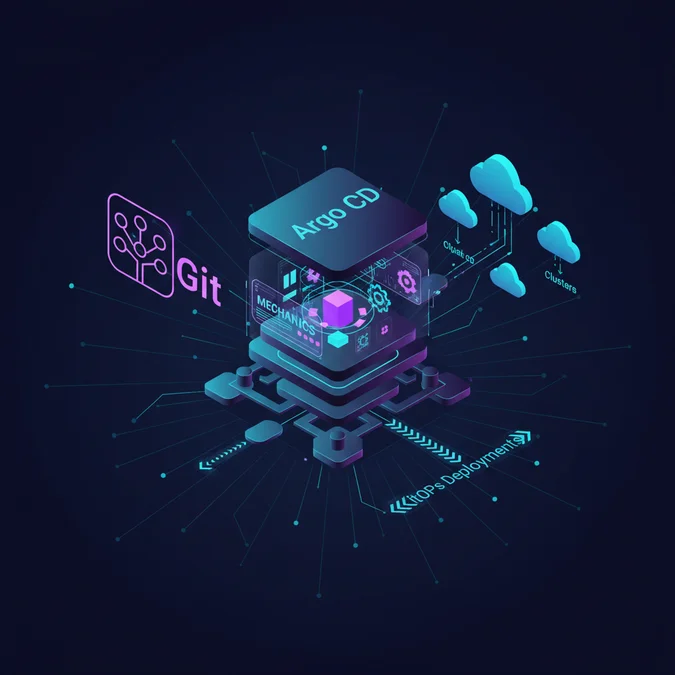

Argo CD is a declarative, Kubernetes-native continuous delivery engine that implements GitOps by continuously reconciling live cluster state against configuration repositories. Unlike legacy continuous deployment mechanisms that execute external kubectl apply commands over network boundaries, Argo CD runs as an in-cluster control loop. It treats Git commits, Helm charts, and Kustomize overlays as the immutable source of truth, pulling configurations inward rather than accepting push-based triggers from external systems.
In standard enterprise delivery pipelines, granting external continuous integration workers direct administrative credentials to target Kubernetes clusters introduces profound attack surfaces and state drift. When engineers modify cluster resources directly using ad-hoc terminal sessions or CI runners crash mid-deployment, cluster state silently deviates from source control. This failure mode turns incident remediation into guesswork and renders audit trails unreliable.
Argo CD resolves this structural vulnerability by decoupling CI artifact generation from CD infrastructure reconciliation. By continuously tracking Kubernetes Custom Resource Definitions, detecting out-of-band drifts, and executing fine-grained sync waves with automated self-healing, it establishes an immutable operational boundary. This architectural guide breaks down how the Argo CD control plane functions under the hood, how its ecosystem tools interact, and how to configure enterprise-grade deployment topologies in 2026.
Declarative GitOps Defined: What Argo CD Is and Why Teams Adopt It
To answer what is argocd from an architectural standpoint: it is a Kubernetes controller that implements declarative GitOps through continuous state verification. In this operational model, version-controlled repositories store the full target definition of your infrastructure and application workloads. When answering what is argocd used for, platform engineering teams deploy it to automate lifecycle deployments, eliminate cluster credential sprawl, guarantee regulatory auditability, and automatically heal out-of-band state drifts.
Traditional deployment engines rely on a push-based workflow. In that legacy architecture, continuous integration servers compile code, run tests, generate container images, and subsequently invoke remote Kubernetes API endpoints using broad administrative service account tokens. If an operator manually edits a deployment replica count or mutates an environment variable via the command line, the CI server remains oblivious. Over time, staging and production clusters drift drastically from the underlying manifest source.
GitOps inverts the delivery model: the infrastructure pulls configurations from within the cluster perimeter. The live Kubernetes cluster becomes a self-correcting entity that continuously references version control, ensuring drift detection and zero leakage of administrative API credentials outside cluster firewalls.
The operational lifecycle of argo cd gitops follows a strictly defined reconciliation cadence:
- Manifest Authoring: Developers commit declarative Kubernetes manifests, Kustomize overlays, or Helm values to a designated Git repository branch.
- State Detection: The cluster-resident Argo CD control plane monitors the Git repository branch and queries the Kubernetes API server to build an internal memory tree of both desired and live states.
- Drift Computation: Argo CD performs a structured deep-diff calculation between the desired target specification and the live running resources.
- Automated or Gated Reconciliation: Based on the configured synchronization policy, the controller initiates sync operations, ordering resource creation or patching based on defined sync waves and phase boundaries.
- Continuous Verification: Post-sync, the engine continuously checks the live health state of running pods, services, and endpoints, flagging degraded workloads immediately in its telemetry streams.
The Argo Project Ecosystem: CD, Workflows, Rollouts, and Events
When engineers first ask what is argo, confusion often arises because the CNCF Argo family includes multiple independent projects designed to address specific cloud-native challenges. The broader argo tool suite comprises four discrete, modular orchestrators that can run together or completely decoupled inside Kubernetes. Repeating the term argo argo across technical documentation usually stems from conflating the root umbrella project with its continuous delivery component.
Understanding the exact functional boundary of each subsystem is crucial for building a cohesive cloud-native platform:
| Subsystem | Primary Function | Kubernetes Custom Resources | Typical Enterprise Use Case |
|---|---|---|---|
| Argo CD | Declarative Continuous Delivery (GitOps) | Application, ApplicationSet |
Reconciling live cluster states with Git repositories, Helm registries, and Kustomize overlays. |
| Argo Rollouts | Advanced Progressive Delivery | Rollout, AnalysisTemplate, AnalysisRun |
Zero-downtime Blue-Green and Canary releases with automated metric verification and rollbacks. |
| Argo Workflows | Container-native Workflow Engine | Workflow, WorkflowTemplate, CronWorkflow |
Running distributed data pipelines, complex CI build execution, machine learning training tasks. |
| Argo Events | Event-driven Workflow Automation Framework | EventSource, Sensor, EventBus |
Triggering K8s workloads and workflows based on webhooks, S3 bucket drops, or Kafka messages. |
A standard enterprise pattern pairs Argo Workflows or GitHub Actions to compile containers and push images, Argo CD to sync updated image tags into Kubernetes manifests, and Argo Rollouts to progressively route production traffic based on Prometheus error-budget metrics.
While Argo CD natively handles the application of deployment manifests, it natively relies on standard Kubernetes rolling update strategies. For complex canary deployments with stepped traffic routing through service meshes like Istio or Envoy, platform architects introduce Argo Rollouts alongside Argo CD, replacing standard Kubernetes Deployment specifications with the Rollout CRD.
Inside the Argo CD Control Plane: API Server, Repo Server, and Controller
The core engine of argo cd kubernetes deployments is distributed across three distinct decoupled control-plane microservices. Each microservice targets specific computational, network, and security concerns to maintain platform scalability across thousands of managed nodes. This modular architecture supports modern argo devops topologies at scale.
+-----------------------------------------------------------------------------------+ Git Commits / Helm OCI Registries | +------------------+----------------------------------------------------------------+ | v +---------------------+ | argo-repo-server | (Manifest Generation: Kustomize / Helm) +----------+----------+ ^ | Manifest Trees v+----------------------+ +----------------------+ +----------------------+ | argo-server | <--> | argo-cd-application- | <--> | Kubernetes API | | (gRPC/REST & Web UI) | | controller | | (Target Clusters) | +----------------------+ +----------------------+ +----------------------+ (Continuous Diff Loop)The internal microservices execute dedicated operational responsibilities:
- argo-server: Exposes the gRPC and REST APIs consumed by the web console, CLI, and incoming webhooks. It handles OpenID Connect (OIDC) identity brokering, role-based access control (RBAC) enforcement, and project-level isolation without accessing cluster manipulation primitives directly.
- argo-repo-server: Clones version-controlled repositories, maintains local cache layers, and executes manifest rendering tools like Kustomize, Helm, or custom config management plugins. It outputs raw, plain-text Kubernetes YAML manifests to avoid running template rendering engines inside the central controller.
- argo-cd-application-controller: The core state reconciliation worker. It queries the target cluster API servers to maintain an in-memory cache of live resources, compares that cache with the manifests returned by the repo-server, identifies differences, and issues API mutations to close the drift.
Production readiness for the Argo CD control plane requires verifying specific operational invariants across these microservices:
- Deploy multiple replicas of
argo-repo-serverwith persistent volume caches or dedicated Redis instances to prevent manifest generation bottlenecks during concurrent Git webhooks. - Configure horizontal pod autoscaling on
argo-serverbased on inbound gRPC and HTTP connection volume. - Enable the application controller dynamic sharding flag to automatically distribute managed Kubernetes clusters across distinct controller replicas as infrastructure scales.
- Implement strict network policies blocking the
argo-repo-serverfrom accessing external internet ranges, restricting outbound egress solely to your Git hosts and container registries.
Configuring the Argo Application CRD for Production Workloads
The foundational declarative building block in any enterprise GitOps pipeline is the argo application Custom Resource Definition. An Application resource establishes the immutable link between a source repository and a target cluster namespace, defining how synchronizations, automated prunings, and error rollbacks are executed within argo cicd workflows.
The manifest below illustrates an enterprise-ready Application resource featuring multi-source declarations, automated drift pruning, sync waves, and target cluster configurations:
apiVersion: argoproj.io/v1alpha1
kind: Application
metadata:
 name: payment-gateway-prod
 namespace: argocd
 finalizers:
 - resources-finalizer.argocd.argoproj.io
 labels:
 environment: production
 tier: backend
spec:
 project: enterprise-core
 source:
 repoURL: 'git@github.com:enterprise/infra-manifests.git'
 targetRevision: v2.4.1
 path: environments/production/payment-gateway
 kustomize:
 images:
 - 'registry.internal.net/apps/payment-gateway:sha-9f3a1bc'
 destination:
 server: 'https://k8s-prod-us-east-1.internal.net:6443'
 namespace: payments
 syncPolicy:
 automated:
 prune: true
 selfHeal: true
 allowEmpty: false
 syncOptions:
 - CreateNamespace=false
 - PruneLast=true
 - ApplyOutOfSyncOnly=true
 - RespectIgnoreDifferences=true
 retry:
 limit: 5
 backoff:
 duration: 5s
 factor: 2
 maxDuration: 3m
 ignoreDifferences:
 - group: apps
 kind: Deployment
 jsonPointers:
 - /spec/replicas
Always attach the
resources-finalizer.argocd.argoproj.iofinalizer to mission-critical Application manifests. Without this finalizer, deleting an Argo CD Application resource removes only the metadata record in Argo CD, leaving orphan unmanaged workloads running blindly inside your target Kubernetes cluster.
Key configuration blocks within this manifest govern reliability under load:
- selfHeal: When set to true, if an engineer directly modifies a live production resource using CLI access, Argo CD detects the drift within its polling window and automatically overwrites the cluster state with the Git definition.
- PruneLast: Guarantees that during manifest updates, new versions of your services and deployments become completely healthy before the controller deletes deprecated resources, preventing traffic blackholes.
- RespectIgnoreDifferences: Ensures that mutations driven by Horizontal Pod Autoscalers (like dynamic replica sizing) or mutating admission controllers are not flagged as unauthorized drift.
Developer Workflows and Enterprise Delivery: Pull Requests to Production
Implementing GitOps fundamentally shifts the daily routine of the argo developer. Engineers no longer configure cluster contexts via the terminal or store deployment secrets on their workstations. Instead, every deployment, rollback, and configuration change translates to a standard Git pull request workflow.
When an engineer inspects deployment health, the Argo CD web dashboard provides an immediate topology graph. The visual status is indicated by the familiar argocd icon states: a green heart icon denotes that the application matches the desired manifest and all deployment health checks pass, while a yellow warning triangle flags an OutOfSync condition requiring administrative or automated sync action.
A production-tested pull request workflow functions according to the following operational steps:
- Code Commit and Containerization: A developer merges feature code into a main branch. The CI runner (e.g. GitHub Actions) executes unit tests, builds an immutable OCI container image, signs it via Sigstore, and pushes it to an enterprise artifact registry.
- Automated Manifest Mutation: The CI runner opens an automated pull request against the deployment manifests repository, updating the target image digest or Kustomize overlay tag.
- Policy Enforcement: Static validation engines (such as Conftest, Kyverno CLI, or kubeconform) execute within the pull request checks to validate manifest schema compliance and security standards before merge.
- Approval and Git Merge: Once peer-reviewed and merged into the production branch, Argo CD detects the Git revision commit hash via an authenticated webhook trigger.
- In-Cluster Execution: The application controller computes the live delta, initiates rolling synchronization steps, and reports deployment status back to monitoring dashboards via OpenTelemetry metrics.
To evaluate how Argo CD positions against other industry deployment models, consider this comparison matrix:
| Evaluation Metric | Argo CD (GitOps Pull) | Flux CD v2 (GitOps Pull) | Jenkins (Push CI/CD) | Spinnaker (Push/Multi-Cloud) |
|---|---|---|---|---|
| Architecture | In-cluster Kubernetes Operator | Modular In-cluster Controllers | External Automation Server | External Clustered Microservices |
| Reconciliation Latency | Sub-second (via Webhooks) / 3m Polling | Configurable interval per Kustomization | Job queue trigger dependent | Polling / CloudEvent driven |
| Target Ecosystem | Kubernetes native | Kubernetes native | Agnostic (VMs, Cloud, Bare Metal) | Multi-cloud (AWS, GCP, K8s) |
| RBAC & Identity | Native OIDC, SSO, built-in RBAC rules | Relies on Kubernetes native RBAC | Jenkins internal or LDAP/SSO | Fiat authorization microservice |
| Secret Management | Integrates with ESO / Sealed Secrets | Built-in SOPS / Age decryption | Plugin credentials store | External Key Management Stores |
Frequently Asked Questions
What is Argo CD and how does it differ from Jenkins?
Argo CD is a declarative GitOps continuous delivery tool native to Kubernetes. Unlike Jenkins, which uses push-based scripts requiring direct cluster credentials, Argo CD runs inside Kubernetes, continually pulling desired state configurations from Git repositories to eliminate credential leakage and drift.
What is the primary purpose of an Argo Application CRD?
An Argo Application is a Kubernetes Custom Resource Definition that binds a Git source repository containing manifests or Helm charts directly to a target Kubernetes cluster and namespace, managing sync waves, automated pruning, and real-time reconciliation.
Can Argo CD handle continuous integration builds and tests?
Argo CD does not run unit tests or compile application source code. It specializes entirely in continuous deployment. Teams combine CI systems like GitHub Actions or Argo Workflows with Argo CD to build artifacts and update deployment manifests declaratively.
What does the Argo CD UI icon status indicate?
In the Argo CD console, icons display health status (Healthy, Progressing, Degraded, or Suspended) and synchronization status (Synced or OutOfSync). A green heart icon indicates healthy running workloads, while yellow warning badges highlight manifest drift requiring sync reconciliation.
Argo CD has established itself as the standard for declarative continuous delivery across Kubernetes platforms. By shifting deployment logic into the cluster and using Git as the single source of truth, it addresses the credential leakage, state drift, and lack of auditability inherent in legacy push-based CI/CD systems.
As you transition your environments toward production GitOps, focus your architectural efforts on designing robust ApplicationSet templates, integrating decentralized secret management like External Secrets Operator, and strictly configuring sync waves. Decoupling CI pipelines from deployment execution creates an immutable, self-healing operational foundation that scales reliably across any number of clusters.