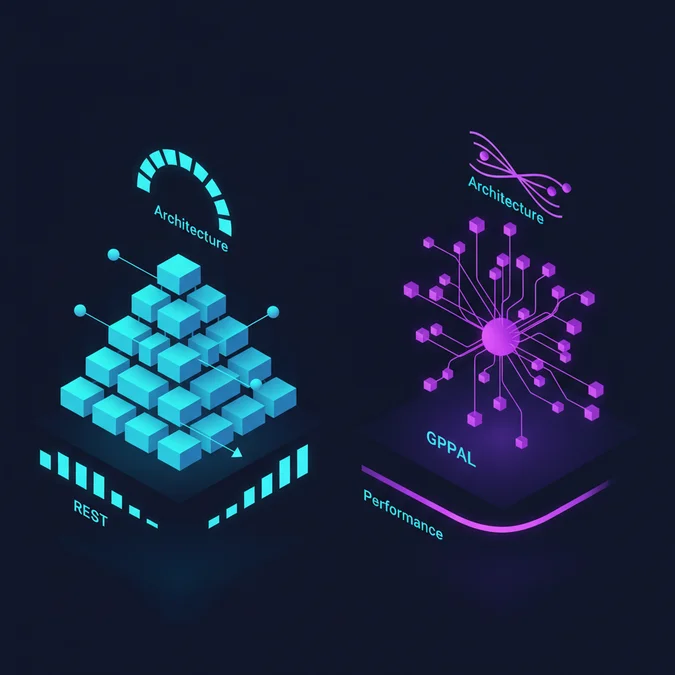

An Application Programming Interface (API) is a set of defined rules and protocols that allows different software applications to communicate and exchange data securely. APIs abstract underlying complexities, enabling developers to integrate functionalities and data from external services into their own applications without needing to understand the internal workings of those services. This standardization fosters interoperability and accelerates development.
This article provides a definitive exploration of APIs, from their fundamental definition and operational mechanics to advanced architectural styles and best practices for development and integration. We will delve into real-world examples, practical code snippets, and critical considerations for selecting an API development partner, equipping you with the knowledge to leverage APIs effectively in your projects.
The Foundation: What is an API and What Does it Mean?
At its core, an API, which stands for Application Programming Interface, serves as a crucial intermediary enabling disparate software systems to interact. When you define API, you are essentially describing a contract for communication: a set of clearly specified methods, protocols, and data formats that applications must adhere to when making requests and receiving responses. This api meaning is fundamental to modern software architecture.
In the realm of computing, the definition of API extends beyond mere communication; it dictates how software components should interact. For instance, a software API allows a mobile application to fetch weather data from a meteorological service without needing to know how that service collects or processes its information. This abstraction is key to understanding what is an API in programming and what does API facilitate in practical terms.
Understanding what does API stand for in technology and what does API stand for in tech reveals its purpose: to provide a standardized, programmatic way to access a service or resource. This simplifies development, promotes reusability, and enables modular software design. The concept of an api meaning computer interaction is about creating a bridge, allowing different programs to speak a common language.
Callout: API Abstraction
APIs provide a layer of abstraction, simplifying complex operations into accessible functions. This allows developers to focus on their application’s unique features rather than reinventing common functionalities or understanding intricate system internals.
The term application programming interface definition highlights its dual nature: it’s for applications (software programs) and for programming (how developers interact with these applications). To have an api explained simply, imagine a restaurant menu: you don’t need to know how the kitchen prepares the food, only what you can order and what to expect. The menu is the API.
This table illustrates common API contexts and their primary functions:
| API Context | Primary Function | Example |
|---|---|---|
| Web API | Enabling communication between web servers and clients (browsers, mobile apps) | Google Maps API for embedding maps |
| Operating System API | Providing access to OS functionalities (file system, network) | Windows API calls for creating files |
| Library/Framework API | Exposing functionalities of a code library or framework | Python’s `requests` library API for HTTP calls |
| Hardware API | Interfacing with hardware components | Graphics card drivers providing an API for rendering |
How APIs Work: The Request-Response Cycle and Core Mechanics
To understand how do APIs work, one must grasp the fundamental request-response cycle that underpins almost all API interactions. An application, acting as a client, sends a request to another application, the server, which hosts the API. The server processes this request, performs the necessary operations, and then sends a response back to the client. This entire process defines how does API work in practice.
The client initiates an API call meaning a specific instruction or query sent to the API endpoint. This call typically includes:
- Endpoint URL: The specific address where the API can be accessed.
- HTTP Method: Defines the action to be performed (e.g., GET for retrieving data, POST for creating data, PUT for updating, DELETE for removing).
- Headers: Metadata about the request, such as authentication tokens, content type, or caching instructions.
- Body: The actual data payload, especially for POST or PUT requests.
Once the server receives the request, it validates it, processes the underlying logic (e.g., querying a database, performing a calculation), and then constructs a response. This response typically includes:
- Status Code: An HTTP status code indicating the outcome (e.g., 200 OK, 404 Not Found, 500 Internal Server Error).
- Headers: Metadata about the response.
- Body: The requested data or a message, usually in a structured format like JSON or XML.
These api connections are stateless in many common API architectures like REST, meaning each request from a client to a server contains all the necessary information to understand the request, and the server does not store any client context between requests.
Callout: Data Serialization
APIs typically exchange data in standardized, language-agnostic formats like JSON (JavaScript Object Notation) or XML (Extensible Markup Language). JSON is now predominant due to its lightweight nature and ease of parsing in web and mobile environments.
Here’s a basic cURL example demonstrating an API call to retrieve user data:
curl -X GET \ 'https://api.example.com/users/123' \ -H 'Accept: application/json' \ -H 'Authorization: Bearer YOUR_AUTH_TOKEN'In this example, the client (cURL) makes a GET request to the specified endpoint, asking for user data for ID 123. It specifies that it prefers JSON as the response format and includes an authorization token for authentication. The server would then respond with the user’s data or an error message.
Types of APIs and Architectural Styles: REST, SOAP, GraphQL, gRPC
While the core concept of an application programming interface example remains consistent, the architectural styles and underlying protocols vary significantly, influencing how developers approach api development. Each style offers distinct advantages and trade-offs, making the choice dependent on specific project requirements.
REST (Representational State Transfer)
REST is an architectural style, not a protocol, that leverages standard HTTP methods. RESTful APIs are stateless, client-server based, and use uniform interfaces. They are the most common type of web API due to their simplicity, scalability, and broad browser support. Data is typically exchanged in JSON or XML format.
Example (Python `requests` library):
import requests

response = requests.get('https://api.example.com/products/456')
if response.status_code == 200:
    print(response.json())
else:
    print(f"Error: {response.status_code}")
SOAP (Simple Object Access Protocol)
SOAP is a protocol that uses XML to define the format of messages. It is highly structured, extensible, and transport-independent (can use HTTP, SMTP, TCP). SOAP APIs often come with built-in error handling, security, and transaction management, making them suitable for enterprise-level applications with strict compliance requirements.
Example (Simplified XML message):
<soapenv:Envelope xmlns:soapenv="http://schemas.xmlsoap.org/soap/envelope/">
   <soapenv:Header/>
   <soapenv:Body>
      <ns:getProductDetails xmlns:ns="http://example.com/productService">
         <ns:productId>789</ns:productId>
      </ns:getProductDetails>
   </soapenv:Body>
</soapenv:Envelope>
GraphQL
GraphQL is a query language for APIs and a runtime for fulfilling those queries with your existing data. Developed by Facebook, it allows clients to request exactly the data they need, reducing over-fetching or under-fetching of data. This flexibility is particularly beneficial for complex systems and mobile applications.
Example (GraphQL query):
query GetProductAndReviews {
  product(id: "101") {
    name
    price
    reviews {
      author
      rating
      comment
    }
  }
}
gRPC (Google Remote Procedure Call)
gRPC is a high-performance, open-source RPC framework developed by Google. It uses Protocol Buffers as its Interface Definition Language (IDL) and HTTP/2 for transport, enabling efficient, bidirectional streaming and low-latency communication. gRPC is ideal for microservices architectures, inter-service communication, and mobile backend services where performance is critical.
Example (Protocol Buffer definition – `.proto` file):
syntax = "proto3";

package ecommerce;

service ProductService {
  rpc GetProduct (GetProductRequest) returns (Product);
}

message GetProductRequest {
  string product_id = 1;
}

message Product {
  string id = 1;
  string name = 2;
  double price = 3;
}
This table summarizes the key characteristics and ideal use cases for each architectural style:
| API Style | Key Characteristics | Pros | Cons | Ideal Use Cases |
|---|---|---|---|---|
| REST | Resource-based, stateless, uses HTTP methods | Simple, scalable, widely adopted, good caching | Can lead to over/under-fetching data | Public APIs, web applications, mobile apps |
| SOAP | Protocol-based, XML messaging, strict contracts | High security, ACID transactions, formal contracts | Complex, verbose, higher overhead | Enterprise services, legacy systems, financial transactions |
| GraphQL | Query language, client-driven data fetching | Efficient data retrieval, reduces multiple requests | Complex caching, requires client-side knowledge | Complex UIs, mobile apps, microservices with diverse clients |
| gRPC | RPC framework, Protocol Buffers, HTTP/2 | High performance, low latency, efficient serialization | Steeper learning curve, limited browser support | Microservices, IoT, real-time communication |
API Development and Integration Best Practices
Effective api development and integration require adherence to best practices that ensure security, reliability, and maintainability. Neglecting these can lead to vulnerabilities, poor performance, and difficult-to-manage systems.
Security First: Protecting Your API
Securing your API is paramount, especially when considering what is API access and the sensitive data it might expose. Key security practices include:
- Authentication: Verify the identity of the client. Common methods include API keys, OAuth 2.0, and JSON Web Tokens (JWT).
- Authorization: Determine what actions an authenticated client is permitted to perform. Implement role-based access control (RBAC) or attribute-based access control (ABAC).
- Encryption: Always use HTTPS/SSL/TLS to encrypt data in transit, protecting against eavesdropping and man-in-the-middle attacks.
- Input Validation: Sanitize and validate all input to prevent injection attacks (SQL, XSS) and malformed requests.
- Rate Limiting: Protect your API from abuse and denial-of-service (DoS) attacks by limiting the number of requests a client can make within a given timeframe.
- API Gateway: Use an API Gateway for centralized security, traffic management, and monitoring.
Versioning and Backward Compatibility
As your API evolves, new features are added, and old ones might be deprecated. Implementing a clear versioning strategy is crucial for maintaining backward compatibility and avoiding breaking changes for existing consumers. Common strategies include URL versioning (e.g., /v1/users, /v2/users) or header versioning.
Always communicate changes clearly and provide ample notice for deprecations. A common practice is to support older versions for a defined period (e.g., 12-18 months) before sunsetting them.
Documentation: The API Contract
Comprehensive, accurate, and up-to-date documentation is the cornerstone of a successful API. It serves as the primary reference for developers, explaining how to use the API, what endpoints are available, expected request/response formats, authentication methods, and error codes. Tools like OpenAPI (Swagger) can automate documentation generation and provide interactive API explorers.
Error Handling and Observability
Robust error handling provides clear, actionable feedback to API consumers when things go wrong. Standardize error response formats, include descriptive error messages, and use appropriate HTTP status codes (e.g., 400 for bad request, 401 for unauthorized, 403 for forbidden, 404 for not found, 500 for internal server error). Implement logging, monitoring, and tracing to gain insights into API performance and quickly identify issues.
Callout: Idempotency
For operations that modify state (e.g., POST, PUT, DELETE), strive for idempotency where possible. An idempotent operation produces the same result whether it’s called once or multiple times with the same parameters, which is vital for reliable distributed systems and retry mechanisms.
API Development Best Practices Checklist:
- Design for Consumers: Prioritize ease of use, consistency, and predictability.
- Statelessness: Design RESTful APIs to be stateless for scalability.
- HATEOAS (for REST): Include hypermedia controls to guide clients through available actions.
- Pagination & Filtering: Implement mechanisms for handling large datasets.
- Caching: Leverage HTTP caching headers to improve performance.
- Testing: Thoroughly test your API with unit, integration, and end-to-end tests.
- Performance: Optimize database queries, reduce network round trips, and use efficient data serialization.
Choosing an API Development Partner: Services, Pricing, and Vetting
For many organizations, engaging an external partner for API development and integration is a strategic decision. This approach leverages specialized expertise, accelerates time-to-market, and allows internal teams to focus on core competencies. When considering what is an API project from a commercial perspective, selecting the right partner is crucial.
Services Offered by API Development Partners
A capable API development partner typically offers a range of services covering the entire API lifecycle:
| Service Category | Description | Key Deliverables |
|---|---|---|
| API Strategy & Consulting | Defining API goals, use cases, and architectural approach. | API roadmap, architectural design document |
| API Design & Development | Building the API backend, endpoints, and business logic. | Functional API, code repository, unit tests |
| API Integration | Connecting the new API with existing systems or third-party services. | Integrated systems, data flow diagrams |
| API Security & Testing | Implementing authentication, authorization, and comprehensive testing. | Security audit report, penetration testing results |
| API Documentation | Creating clear, comprehensive documentation for developers. | OpenAPI specification, interactive documentation portal |
| API Management & Maintenance | Ongoing monitoring, updates, and performance optimization. | SLA, monitoring dashboards, support services |
Pricing Models for API Development
Pricing for API development services can vary significantly based on project complexity, scope, and the chosen partner’s expertise and location. Common models include:
- Fixed-Price: Suitable for well-defined projects with clear requirements. Provides cost predictability but less flexibility for changes.
- Time & Material: Ideal for projects with evolving requirements or uncertain scope. Offers flexibility but requires close monitoring of hours.
- Dedicated Team: A team allocated exclusively to your project, often for long-term engagements or continuous development. Provides high control and integration.
- Retainer Model: Paying a fixed fee for a certain amount of work or support over a period, good for ongoing maintenance or minor enhancements.
Vetting an API Development Partner: A Checklist
Thorough vetting is essential to ensure you choose a partner that aligns with your technical and business needs. Consider the following:
- Technical Expertise: Do they have proven experience with your required API architectural styles (REST, GraphQL, gRPC), programming languages, and cloud platforms?
- Portfolio & Case Studies: Can they showcase similar successful API projects, ideally with references or testimonials?
- Security Practices: What are their security protocols for development, testing, and deployment? Do they follow industry standards (e.g., OWASP Top 10)?
- Communication & Transparency: Do they have clear communication channels, project management methodologies, and reporting structures?
- Scalability & Performance: Do they design APIs with scalability in mind, capable of handling future growth and traffic?
- Documentation Standards: Do they prioritize comprehensive API documentation and adhere to industry best practices (e.g., OpenAPI)?
- Support & Maintenance: What post-launch support and maintenance services do they offer? What are their SLAs?
- Cost-Effectiveness: Is their pricing competitive and transparent, aligning with the value and quality of services provided?
- Cultural Fit: Do their team’s values and working style align with your organization’s culture?
By diligently evaluating these factors, organizations can secure a partner capable of delivering robust, secure, and scalable API solutions that drive business value.
Factors That Affect Development Cost
- Project complexity
- Number of integrations
- API architectural style chosen
- Security requirements
- Documentation depth
- Ongoing maintenance and support
- Team size and experience
- Geographic location of the development partner
The cost for API development and integration services varies widely based on the project’s specific requirements and the chosen partner’s engagement model.
Frequently Asked Questions
What should you consider regarding api stands for?
When assessing api stands for, prioritize measurable technical outcomes, transparent communication, and experienced engineering guidance to ensure maximum ROI.
What should you consider regarding api calls meaning?
When assessing api calls meaning, prioritize measurable technical outcomes, transparent communication, and experienced engineering guidance to ensure maximum ROI.
In summary, an API is a critical communication bridge in the digital ecosystem, enabling diverse software applications to interact and share data efficiently. From understanding what is an API‘s core definition and its operational mechanics through the request-response cycle, to differentiating between architectural styles like REST, SOAP, GraphQL, and gRPC, a solid grasp of APIs is indispensable for modern software engineering.
Adhering to best practices in API development, including stringent security measures, thoughtful versioning, and comprehensive documentation, ensures the creation of robust and maintainable systems. For organizations seeking to leverage APIs without building in-house expertise, selecting the right development partner through careful vetting of their services, technical prowess, and pricing models is a strategic imperative. Mastering APIs empowers innovation, streamlines integration, and unlocks new possibilities for digital transformation.
NR Studio builds custom web apps, mobile apps, SaaS platforms, and internal tools for growing businesses. If you’re working through a technical decision, feel free to reach out — no commitment required.