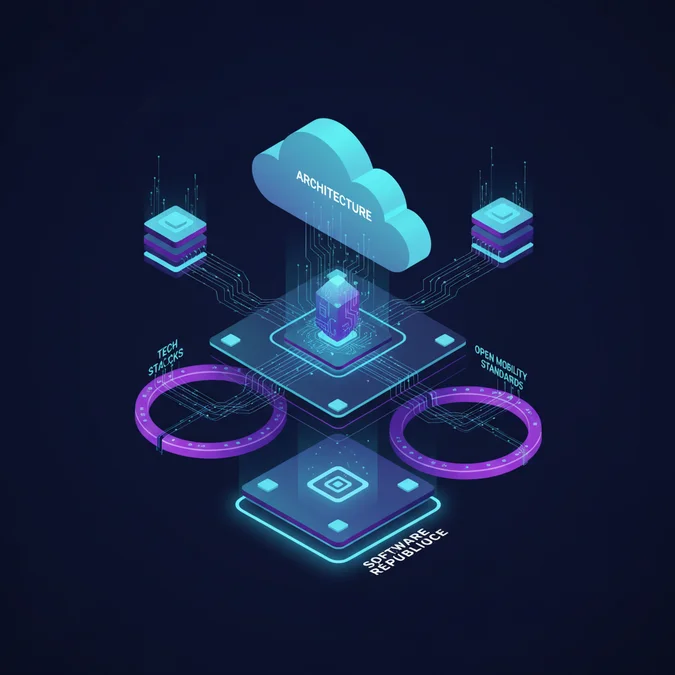

Software République is an open-innovation technology ecosystem founded by major European industrial leaders, including Renault Group, Dassault Systèmes, STMicroelectronics, Atos, and Thales. It creates secure, sovereign software architectures, data exchanges, and intelligent connectivity platforms for intelligent mobility and smart vehicle networks.
Cross-enterprise engineering consortiums have gained significant adoption across global transport, defense, and energy sectors. Modern automotive systems demand deep interoperability between microservices, embedded hardware telemetry, and enterprise cloud applications, moving engineering efforts away from monolithic original equipment manufacturer stacks toward collaborative architectures.
Building applications that interface with high-throughput mobility platforms requires systems architects to balance strict cryptographic security, sub-millisecond data transport, and resilient database performance. This guide breaks down the core architecture, data pipelines, hardware-to-cloud security boundaries, pricing models, and practical application integration patterns governing this distributed ecosystem.
Architectural Foundation of Software République
Software République functions as a multi-tier collaborative engineering architecture. Rather than relying on a single vendor proprietary stack, the framework distributes responsibilities across edge compute runtimes, secure gateway layers, telematics message brokers, and centralized enterprise backends. Industrial partners provide dedicated components: STMicroelectronics powers hardware security modules and silicon processing, Thales provides identity management and cyber defense, Dassault Systèmes delivers digital twin simulation platforms, and Renault Group acts as the automotive deployment environment.
Architecturally, the ecosystem separates core concerns into four concrete layers:
- Silicon and In-Vehicle Edge Layer: Embedded microcontrollers (such as ARM Cortex-M and Cortex-A processors) running real-time operating systems (RTOS) and AUTOSAR runtime environments. These run telemetry filtering directly on the CAN/Ethernet bus.
- Secure Transport Gateway: Hardware-anchored cryptographic gateways managing mutual TLS (mTLS) terminations, tokenization, and payload verification before data leaves physical vehicle perimeters.
- Ingestion and Event Streaming Mesh: Distributed Kafka and MQTT brokers handling millions of concurrent events per second, capable of routing telemetry streams with minimal latency overhead.
- Enterprise and Multi-Tenant Service Mesh: Kubernetes-orchestrated application clusters running polyglot backends (Go, Rust, PHP, and Python) providing API gateways, analytics processing, and predictive maintenance engines.
When connecting external web and enterprise layers to these ecosystems, software engineers must respect domain boundaries. For teams managing transactional web portals or fleet control dashboards, adopting modern design patterns like scalable cloud application development principles ensures that downstream API layers remain resilient against massive telemetry fluctuations without starving database connection pools.
Data Pipeline and Real-Time Telematics Ingestion
Telemetry pipelines inside intelligent transport architectures must handle high-volume ingress while keeping memory consumption bounded. Vehicles emit real-time signals spanning state of charge (SoC), tire pressure, GPS vectors, and battery temperature profiles. Ingesting this data involves passing messages through secure edge gateways down to low-latency pub/sub fabrics.
Below is a comparative breakdown of communication protocols utilized within the Software République transport matrix:
| Protocol | Payload Format | Typical Latency | Transport Layer | Primary Engineering Purpose |
|---|---|---|---|---|
| MQTT (v5.0) | Protobuf / JSON | 15ms to 45ms | TCP / TLS | Vehicle-to-cloud (V2C) real-time state telemetry streaming |
| gRPC / HTTP/2 | Protocol Buffers | 5ms to 20ms | TCP / TLS | Synchronous inter-service RPC between fleet cloud microservices |
| CoAP | CBOR / Binary | 10ms to 30ms | UDP / DTLS | Constrained embedded sensor telemetry under low-bandwidth networks |
| REST / HTTPS | JSON | 60ms to 180ms | TCP / TLS | Public developer APIs and third-party portal integrations |
To prevent ingestion backpressure from degrading operational databases, backend engineers utilize decoupling architectures. Incoming binary frames are parsed, validated, and normalized before being dispatched into partition-keyed event logs. The following Go example demonstrates how an edge ingestion worker processes a binary telematics packet, validates vehicle certificates, and dispatches the payload to an asynchronous pipeline without allocating unnecessary heap structures.
package main

import (
 "context"
 "crypto/x509"
 "encoding/binary"
 "errors"
 "fmt"
 "time"
)

// TelemetryFrame represents an in-vehicle telematics snapshot
type TelemetryFrame struct {
 VehicleID [16]byte
 Timestamp int64
 SpeedKmh float32
 BatterySoC float32
 StatusBits uint32
}

// ParseFrame unpacks a fixed-size binary buffer into memory without reflection overhead
func ParseFrame(buf []byte) (*TelemetryFrame, error) {
 if len(buf) < 36 {
 return nil, errors.New("frame payload too short")
 }

 frame:= &TelemetryFrame{}
 copy(frame.VehicleID[:], buf[0:16])
 frame.Timestamp = int64(binary.BigEndian.Uint64(buf[16:24]))
 frame.SpeedKmh = float32(binary.BigEndian.Uint32(buf[24:28])) / 100.0
 frame.BatterySoC = float32(binary.BigEndian.Uint32(buf[28:32])) / 100.0
 frame.StatusBits = binary.BigEndian.Uint32(buf[32:36])

 return frame, nil
}

func main() {
 // Simulated telemetry packet received from gateway
 rawPacket:= make([]byte, 36)
 binary.BigEndian.PutUint64(rawPacket[16:24], uint64(time.Now().UnixNano()))
 binary.BigEndian.PutUint32(rawPacket[24:28], 8250) // 82.50 km/h
 binary.BigEndian.PutUint32(rawPacket[28:32], 9120) // 91.20% SoC

 frame, err:= ParseFrame(rawPacket)
 if err!= nil {
 fmt.Printf("Ingest error: %v\n", err)
 return
 }

 fmt.Printf("Vehicle Ingest Processed: Speed=%.2f km/h SoC=%.2f%%\n", frame.SpeedKmh, frame.BatterySoC)
}
Security Implications and Public Key Infrastructure
A critical engineering pillar of the Software République collective is zero-trust architecture across distributed hardware nodes. Vehicles cannot be treated as trusted endpoints; physical access invites bus sniffing, memory dumping, and spoofed sensor transmissions. Consequently, edge security adheres to automotive cybersecurity standards, notably ISO/SAE 21434 and UNECE WP.29 regulations.
Hardware Security Modules (HSMs) and Secure Elements (SEs) provide the cryptographic root of trust for each device. Identity verification involves the following technical requirements:
- Unique Per-Device Keypairs: Asymmetric private keys are generated inside the secure silicon enclave during manufacturing and cannot be extracted via software debuggers.
- Short-Lived Ephemeral Certificates: Devices request rotation of x509 leaf certificates signed by an internal intermediate Certificate Authority (CA) managed by consortium defense layers.
- Strict Mutual TLS (mTLS): All edge-to-cloud handshakes require two-way cryptographic verification. Cloud ingestion load balancers reject connections lacking valid client certificates signed by verified authority chains.
- Hardware-Verified Boot Chains: Cryptographic validation sequences verify the digital signature of each bootloader stage and OS kernel prior to execution, mitigating compromised firmware execution risks.
For organizations operating within corporate regulatory guidelines, understanding standardized industry codes is essential when scoping defense, compliance, and custom software contracts. Many enterprise vendors rely on the formal NAICS software development industry definitions to structure legal compliance, procurement criteria, and cybersecurity insurance requirements across transport platforms.
Microservices and Database Optimization for Telemetry Storage
Ingested telematics events create immense write loads that can rapidly exhaust conventional relational databases. Writing 100,000 raw telemetry rows per second directly into standard relational tables without caching or partitioning causes transaction lock contention, massive B-tree indexing latency, and out-of-memory kernel panics.
High-efficiency mobility platforms adopt multi-tier polyglot storage topologies:
- Hot Storage (Time-Series Buffers): Solutions like TimescaleDB, ClickHouse, or Apache Druid store high-frequency metric records using columnar compression. Time-series hypertables automate chunking across disk partitions by physical timestamp.
- Warm Storage (Document / Relational Stores): PostgreSQL databases with JSONB document indexing maintain the latest confirmed snapshot state for each vehicle (e.g. current location, active diagnostic trouble codes, driver profiles).
- Cold Storage (Object Buckets): Amazon S3, Google Cloud Storage, or MinIO clusters store historical raw Protobuf traces in Parquet format, allowing asynchronous distributed queries via Trino or Apache Spark.
Relational databases must be optimized through explicit partition maintenance. For instance, creating monthly declarative range partitions across high-volume PostgreSQL telemetry tables ensures that index updates remain localized within active working sets:
-- Establish the parent partitioned table
CREATE TABLE vehicle_telemetry_events (
 id BIGSERIAL,
 vehicle_uuid UUID NOT NULL,
 recorded_at TIMESTAMPTZ NOT NULL,
 speed_kmh NUMERIC(5, 2),
 battery_soc NUMERIC(4, 2),
 latitude DOUBLE PRECISION,
 longitude DOUBLE PRECISION,
 payload JSONB,
 PRIMARY KEY (id, recorded_at)
) PARTITION BY RANGE (recorded_at);

-- Create optimized range partition for operational throughput
CREATE TABLE vehicle_telemetry_2026_01 PARTITION OF vehicle_telemetry_events
 FOR VALUES FROM ('2026-01-01 00:00:00+00') TO ('2026-02-01 00:00:00+00');

-- Specialized index targeting recent vehicle queries without index bloat
CREATE INDEX idx_telemetry_2026_01_veh_time
ON vehicle_telemetry_2026_01 (vehicle_uuid, recorded_at DESC);
Integrating Enterprise Web Applications and API Gateways
Enterprise applications bridging commercial transport networks often leverage productive application frameworks like Laravel, Node.js, or Spring Boot to manage web portals, scheduling interfaces, and analytics dashboards. In these environments, software architectures must carefully separate public-facing HTTP request-response cycles from asynchronous event listeners.
Consider an enterprise fleet dispatch console. Rather than querying raw time-series clusters synchronously during page generation, developers use Redis-backed caches populated by background workers listening to telemetry topics. This strategy prevents slow external systems from degrading user interface responsiveness.
When handling transaction routing and inventory dispatch, similarities emerge between complex mobility systems and other hardware-integrated software stacks. For example, the transactional isolation and real-time ledger consistency detailed in our guide on building hardware-integrated transactional POS applications parallels how fleet charging platforms manage continuous billing, local offline caches, and hardware-level handshake verifications.
Furthermore, maintaining secure, clean URL routing structures is crucial when managing large registries of vehicle identifiers, battery swap stations, and telemetry endpoints. Clean, parameterized URLs eliminate data leakage and ensure predictable routing behavior, as shown in technical strategies for generating deterministic, secure URL routing slugs across high-traffic enterprise portals.
Common Engineering Mistakes in High-Throughput Connected Platforms
Operating distributed automotive software systems introduces failure modes that rarely occur in basic monolithic CRUD development. Engineering teams frequently fall victim to predictable design traps:
- Synchronous Telemetry Processing: Attempting to write incoming MQTT or CoAP messages directly into a relational database within the ingestion thread. Under traffic spikes or network latency events, worker pools saturate quickly, inducing cascading connection drops.
- Unbounded JSON Serialization: Ingesting verbose, uncompressed JSON schemas directly over cellular connectivity instead of compact binary serializations like Protocol Buffers or FlatBuffers. This dramatically inflates mobile data transmission overhead and increases CPU deserialization cycles.
- Ignoring Clock Drift: Assuming that timestamps generated by in-vehicle embedded clocks are strictly monotonic or accurately synchronized with UTC. Engineers must adopt robust out-of-order sequence ingestion windows and leverage vector clocks or ingest-time timestamps to prevent time-series corruption.
- Naive Reconnection Flooding: Failing to implement randomized exponential backoff on vehicle-side connection clients. When cellular connectivity recovers after traversing a tunnel, tens of thousands of client nodes attempt reconnection simultaneously, taking down edge gateway load balancers in an inadvertent denial-of-service attack.
Total Cost of Ownership and Infrastructure Pricing Models
Budgeting infrastructure and development resources for an enterprise mobility ecosystem involves factoring in cloud streaming, edge network transport, and custom backend development. High-frequency ingestion infrastructures require careful cost modeling to avoid unexpected monthly billing surges.
The table below breaks down the concrete pricing ranges and operational expenses associated with running connected vehicle platforms at production scale:
| Cost Category | Pricing Model | Typical Cost Range (USD) | Operational Scope |
|---|---|---|---|
| Ingestion & Message Brokers | Managed Apache Kafka / AWS MSK | $1,500 – $6,500 / month | Multi-broker clusters handling 20,000 to 100,000 events/sec |
| Time-Series Database Hosting | Managed ClickHouse / TimescaleDB | $2,200 – $9,000 / month | High-availability nodes with tiered storage (hot NVMe + cold S3) |
| Cellular M2M SIM Connectivity | Pooled data per SIM ($0.12 – $0.30/MB) | $1.20 – $4.50 / vehicle / month | Dedicated APN with global roaming and static IP configurations |
| Edge Firmware PKI Management | Certificate-as-a-Service / HSM | $8,000 – $25,000 / year | Hardware cryptographic keys, root CAs, and automated certificate renewals |
| Systems Engineering Team | Retainer / Dedicated Staffing | $160 – $250 / hour | Senior backend architects, embedded engineers, and security specialists |
| Complete Platform Build (MVP) | Fixed Project / Milestone Fee | $120,000 – $350,000 | Initial ingestion gateway, auth microservices, telemetry dashboard |
To keep ongoing operational costs under control, engineering leads must enforce aggressive edge-side data deduplication. Filtering out stationary metric fluctuations at the vehicle’s microcontroller level can reduce outbound data volumes by up to 70%, directly slashing monthly cellular transit and streaming broker expenses.
Exploring the Development Ecosystem
Mastering modern distributed backend systems requires a grounded understanding of asynchronous architectures, reliable caching strategies, and resilient database management. Whether deploying scalable microservices to ingest high-frequency IoT data or building enterprise administrative interfaces, software teams must continuously refine their architectural toolkits.
Explore our complete Laravel, Basics directory for more guides.
Factors That Affect Development Cost
- Cellular M2M data bandwidth and telemetry frequency
- Broker partition scaling and message retention windows
- Time-series database tiering and disk IOPS provisioning
- Hardware Security Module (HSM) licensing and PKI operations
Production mobility platforms typically require ongoing cloud infrastructure investments ranging between $4,000 and $20,000 per month, supplemented by initial engineering development costs.
Software République illustrates the broader transformation occurring across critical industrial sectors: moving away from proprietary, isolated vehicle architectures toward federated, secure, and open mobility platforms. Navigating these environments demands strict adherence to zero-trust device identities, microsecond-level binary data parsing, and multi-tiered database retention architectures.
By decoupling real-time telematics ingestion from transactional presentation layers and establishing hardware-anchored cryptographic trust, engineering teams can build resilient platforms capable of operating across both embedded microcontrollers and elastic cloud infrastructures.