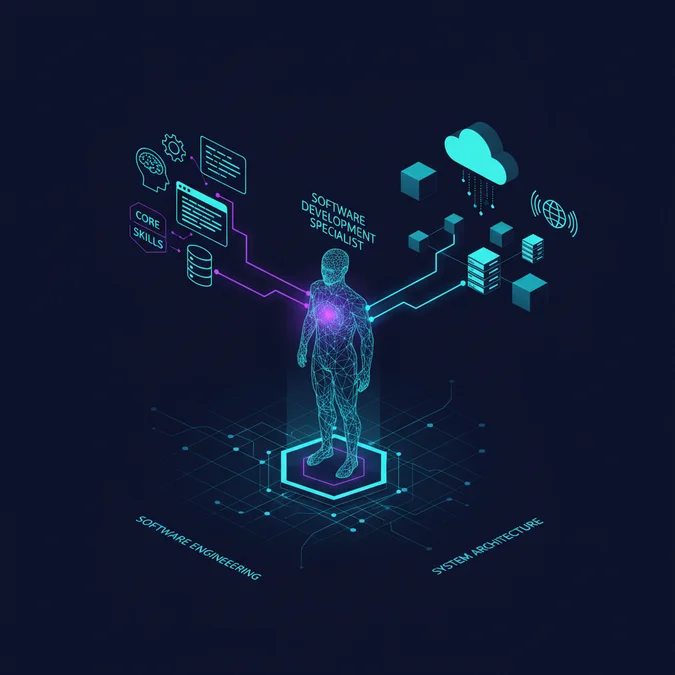

A software development specialist is an advanced engineering professional who combines deep domain expertise in specific runtime ecosystems with cross-functional architectural proficiency. They guide complex technical implementations, resolve systemic production bottlenecks, enforce rigorous testing standards, and align low-level code mechanics with long-term platform scalability.
According to recent empirical data from the 2024 Stack Overflow Developer Survey, over 63% of engineering organizations report substantial velocity declines directly attributable to technical debt, undocumented architectural decisions, and an absence of focused specialists. Generalist software developers write functional code, but specialized engineers establish the guardrails, execution patterns, and runtime performance profiles that allow distributed development teams to ship reliable software repeatedly.
For leadership teams, integrating a software development specialist into an engineering organization changes how teams manage system stability, total cost of ownership, and delivery cadences. Rather than merely closing tickets, these practitioners operate across software architecture, pipeline automation, state synchronization, and low-latency data processing, bridging the gap between business objectives and sustainable codebases.
Defining the Software Development Specialist in Modern Engineering
A software development specialist is an engineering professional who targets deep mastery in a specific domain, runtime environment, or architectural paradigm, rather than maintaining a purely broad overview of the entire stack. Where generalist full-stack developers navigate between front-end interfaces, standard business logic, and operational scripts, a specialist targets the subtle intricacies of application memory footprints, concurrency models, database isolation levels, and framework lifecycles.
Organizations frequently misunderstand this focus as narrow hyper-specialization that limits utility. In practice, modern engineering ecosystems are too intricate for superficial understanding to succeed at scale. A specialist understands how framework abstractions interact with virtual machines, the underlying operating system kernel, and networked I/O.
- Generalist Software Engineer: Delivers feature parity across user interfaces and standard API contracts, prioritizing rapid delivery of business requirements.
- Software Development Specialist: Formulates underlying domain abstractions, monitors resource contention under production loads, optimizes garbage collection or memory recycling, and configures reliable data layer access.
- Systems Architect: Evaluates overarching enterprise boundaries, cross-service protocols, governance, and cloud infrastructure topography.
Specialists sit directly at the convergence point of day-to-day feature implementation and long-term architectural durability. By defining foundational modules, enforcing strict interfaces, and auditing mission-critical code pathways, they prevent team-wide technical regressions.
Core Competencies and Technical Knowledge Areas
The technical profile of a software development specialist demands deep mechanics over surface-level syntax. While programming languages vary, the engineering foundations remain consistent across runtimes such as PHP/Laravel, Go, Node.js, and Java.
Deep Runtime and Framework Mechanics
A specialist does not treat high-level frameworks as black boxes. When working with enterprise PHP and Laravel, for instance, this requires a detailed comprehension of the container lifecycle, reflection performance hits, service provider boot phases, and worker state persistence under modern runtimes like Octane, FrankenPHP, or Swoole.
Data Layer Modeling and Access Optimization
Abstracting database queries behind Object-Relational Mappers (ORMs) creates hidden bottlenecks if unmonitored. Specialists understand when an ORM query generates an N+1 hazard, how composite indexes impact writes, and how to utilize database transaction isolation levels to prevent dirty or phantom reads without introducing system-wide row locks.
Execution Resilience and State Handling
Distributed web systems must manage failure states gracefully. Understanding the trade-offs between asynchronous queues, persistent sockets, idempotency keys, and circuit breakers is essential. You can inspect practical distributed patterns in software trade-offs, security controls, and state persistence to see how real-world architectures prevent cascading failures.
Engineering Velocity, Technical Debt, and Total Cost of Ownership
The economic justification for embedding software development specialists centers on controlling the total cost of ownership (TCO) across an application’s lifecycle. While junior and mid-level generalists can quickly assemble prototypes using third-party packages, premature abstractions and unvetted libraries inevitably introduce performance drag and maintenance overhead.
Engineering velocity does not represent how quickly an engineer writes raw lines of code; it measures the sustained rate at which a team delivers business value without degrading baseline availability or security. Specialists accelerate overall team velocity by developing standard internal toolsets, high-throughput base classes, and unambiguous data access patterns.
| Metric | Generalist-Only Approach | Specialist-Guided Approach |
|---|---|---|
| Mean Time to Recovery (MTTR) | High; involves extensive trial-and-error debugging during production outages. | Low; structured logging, distributed tracing, and clear system isolation localize failures rapidly. |
| Regression Frequency | Frequent; updates to shared models produce unexpected edge cases across modules. | Rare; comprehensive boundary tests, typed contracts, and strict dependency injection isolate behavior. |
| Refactoring Overhead | Exponential; uncoupled state and tight database coupling require massive rewrite projects. | Linear; clean domain boundaries permit surgical module replacements and zero-downtime database migrations. |
| Infrastructure Costs | Inflated; compute and memory instances are scaled vertically to mask slow, unindexed database queries. | Optimized; memory profiles, execution times, and background queues run within controlled physical resource limits. |
When specialists construct the core foundations, the remaining engineering team spends less time fixing race conditions or memory leaks and more time delivering user-facing value.
Framework Internals: The Mechanics Behind Specialized Implementations
To understand the depth a specialist provides, consider an example in the Laravel ecosystem. A standard developer often relies entirely on simple Eloquent relationships and default facades. While clean, high-throughput environments can quickly exhaust PHP memory limits or saturate connection pools if these tools are used without profiling.
A backend specialist designs custom repository primitives, leverages read-replica routing, and processes data using memory-conscious lazy collections and explicit transaction management. The following implementation demonstrates how a specialist structures resilient transactional data ingestion without blowing out system memory:
<php

declare(strict_types=1);

namespace App\Services\Ingestion;

use App\Models\Transaction;
use App\Events\TransactionProcessed;
use Illuminate\Support\Collection;
use Illuminate\Support\Facades\DB;
use Illuminate\Support\Facades\Log;
use Throwable;

final class HighThroughputIngestionService
{
 /**
 * Process large batches using cursor pagination and atomic transactions.
 * Guarantees low memory overhead and predictable database locking.
 */
 public function processBatch(iterable $payloads): int
 {
 $processedCount = 0;

 // Lazy collection prevents loading thousands of objects into RAM at once
 Collection:make($payloads)
 ->lazy()
 ->chunk(500)
 ->each(function (Collection $chunk) use (&$processedCount): void {
 DB:beginTransaction();

 try {
 $records = $chunk->map(fn (array $item): array => [
 'reference_id' => $item['ref'],
 'payload' => json_encode($item['data'], JSON_THROW_ON_ERROR),
 'status' => 'queued',
 'created_at' => now(),
 'updated_at' => now(),
 ])->all();

 // Single batch insert minimizes round-trip network latency
 DB:table('transaction_ledgers')->insert($records);

 DB:commit();
 $processedCount += $chunk->count();
 } catch (Throwable $exception) {
 DB:rollBack();

 Log:error('Batch ingestion aborted due to data violation', [
 'error' => $exception->getMessage(),
 'chunk_sample_ref' => $chunk->first()['ref']? null,
 ]);

 throw $exception;
 }
 });

 return $processedCount;
 }
}
In this block, the specialist addresses multiple non-functional requirements: memory consumption remains static regardless of whether 100 or 100,000 records arrive, database writes are combined into batch operations, and transaction rollbacks prevent partially committed states from corrupting the ledger.
Production Defense: Concurrency, Throughput, and Abuse Prevention
When services scale up, application vulnerability to noisy neighbors, distributed resource contention, and denial-of-service events increases. A generalist often addresses performance drops by provisioning larger server instances. A software development specialist analyzes the bottlenecks across network thresholds, application socket pools, and rate limiting algorithms.
Building defensive layers requires deep comprehension of the token bucket algorithm, sliding window counters, and centralized distributed memory stores like Redis. When an API receives bursts of traffic, specialists structure application gateways that throttle malicious actors while ensuring fair access for mission-critical downstream services.
For enterprise-scale API gateways, understanding rate limiting topologies is critical. You can explore concrete patterns for distributed API rate limiting and traffic shaping to see how specialists mitigate resource starvation under aggressive production conditions.
Beyond rate limits, specialists configure non-blocking operations, asynchronous jobs, and atomic locks. This design prevents cache-stampede scenarios, where hundreds of parallel threads simultaneously attempt to regenerate an expired cache key, overwhelming the database in seconds.
Testing Methodologies and Continuous Quality Verification
A software development specialist approaches testing as an integrated architectural specification rather than an afterthought. Instead of writing superficial unit tests that merely confirm getters and setters return static values, specialists build testing strategies that validate boundary conditions, integration behaviors, and performance limits.
- Contract and Boundary Testing: Validating that outbound network payloads, database schemas, and message-queue payloads adhere to explicit schemas.
- State Mutation Analysis: Ensuring that concurrent processes altering shared state do not trigger race conditions or lock deadlocks.
- Automated Static Analysis: Configuring tools like PHPStan (at Level 8 or 9) or Psalm to eliminate null-pointer exceptions, type mismatches, and dead code execution before continuous integration runners deploy.
- Performance Benchmarks: Tracking query counts, memory allocations, and execution milliseconds in staging environments to catch regressions before they impact end users.
By prioritizing deterministic integration tests over brittle, highly mocked unit tests, specialists ensure the system can be safely refactored as requirements change.
Decision Matrix: When to Hire or Deploy a Specialist
Engineering executives must choose whether a project requires additional generalist developers or a dedicated specialist. Deploying a specialist too early on a throwaway proof-of-concept can introduce unnecessary complexity, while omitting a specialist from a complex platform build risks critical structural failures later on.
| Project Indicator | Deploy Generalist Engineer | Deploy Specialist Engineer |
|---|---|---|
| System Scale | Low concurrent traffic (under 100 requests per minute); simple CRUD cycles. | High throughput (thousands of requests per second); distributed workers and complex queues. |
| Data Integrity Risk | Non-critical information where eventual consistency can tolerate delays. | Zero-tolerance ledgers, payment gateways, and strictly audited compliance systems. |
| Architectural Stage | Initial prototyping, proof-of-concepts, and validating market assumptions. | Platform refactoring, scaling under unexpected growth, and mission-critical core redesigns. |
| Integration Complexity | Standard third-party REST webhooks with basic retry logic. | Bi-directional streaming, custom network protocols, and distributed event sourcing. |
| Codebase Maturity | Greenfield initiatives requiring basic application scaffolding. | Monolith decomposition, domain boundary extraction, and performance tuning. |
Evaluating your organization against these structural parameters prevents over-engineering during early discovery phases and avoids costly system overhauls down the road.
Organizational Leadership and Technical Mentorship
The value of a software development specialist extends far beyond individual commit volume. Within an engineering department, these professionals serve as force multipliers who elevate overall team performance through hands-on mentorship, code reviews, and architectural standard-setting.
When specialists conduct code reviews, they focus on more than simple syntax formatting or variable names. They evaluate:
- Cognitive Load: Ensuring functions do not conceal side effects or create convoluted execution paths that burden future maintainers.
- Defensive Engineering: Checking that every external input is validated, bounded, and sanitized against downstream failures.
- Dependency Hygiene: Limiting the introduction of bloated external packages that increase attack surfaces and runtime vulnerabilities.
- Documentation and RFCs: Formulating Architecture Decision Records (ADRs) that explain not only what was built, but the operational trade-offs considered and rejected.
By establishing rigorous engineering practices across pull requests and documentation, specialists cultivate an organizational culture that defaults to quality and resilience.
Implementation Strategy: Integrating Specialists into Development Squads
Successfully integrating a specialist into an established engineering team requires deliberate organizational design. A common misstep is isolating specialists into an ivory-tower architecture guild disconnected from everyday feature development. This separation breeds resentment and yields abstractions disconnected from real product constraints.
A more effective pattern is the Player-Coach Embedded Specialist approach. In this model, the specialist sits directly within a cross-functional product squad for a defined cycle (typically two to four sprints). During this engagement, they:
- Tackle Core Path Hurdles: Address the squad’s thorniest performance and data-access bottlenecks firsthand.
- Build Foundational Utilities: Abstract common domain operations into modular, well-tested internal libraries that the squad can reuse safely.
- Pair Program: Work alongside mid-level developers on critical modules to transfer architectural intuition, profiling techniques, and debugging workflows.
- Cycle to Adjacent Teams: Once stability targets are met and operational metrics normalize, transition to other squads facing scaling constraints.
This embedded integration model avoids organizational silos, accelerates cross-team upskilling, and keeps architectural standards grounded in actual production realities.
Explore our complete Laravel, Basics directory for more guides.
A software development specialist provides the runtime expertise, systems intuition, and architectural discipline required to scale complex software systems. By managing memory profiles, structuring transactional boundaries, preventing resource contention, and elevating team execution standards, these engineers turn fragile codebases into durable software platforms.
As systems grow in complexity and performance demands mount, the difference between runaway technical debt and sustainable velocity rests on focused technical mastery. Selecting, integrating, and empowering software development specialists ensures your engineering teams can reliably build systems that perform under sustained enterprise demands.