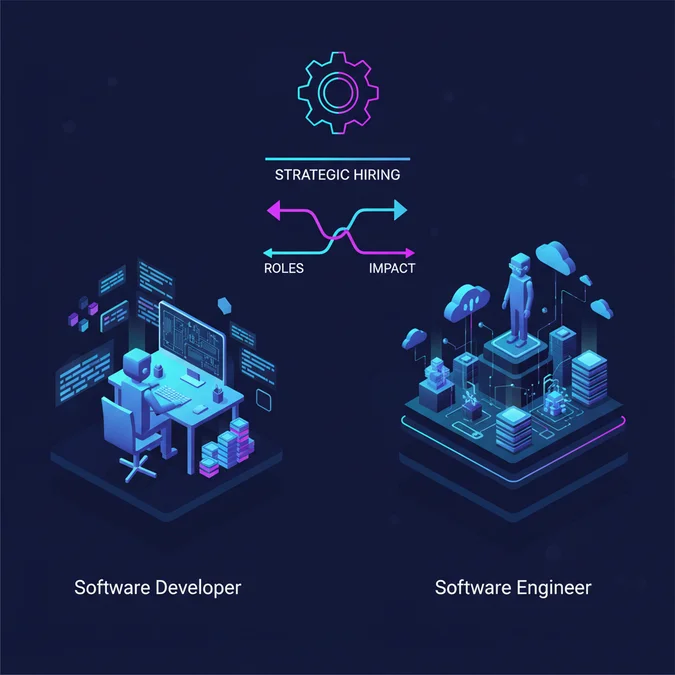

A software developer primarily focuses on writing, debugging, and maintaining code for specific applications, bringing designs to life. In contrast, a software engineer applies engineering principles to design, build, and maintain complex systems, considering scalability, reliability, and security from an architectural perspective.
Understanding the nuanced distinctions between a software developer and a software engineer is critical for both aspiring professionals shaping their careers and organizations making strategic hiring decisions. While often used interchangeably, these roles represent different approaches to software creation, impacting project scope, technical depth, and long-term system health. This article clarifies these differences, providing insights into their respective responsibilities, technical requirements, career trajectories, and compensation expectations.
For businesses, making an informed choice between hiring a developer or an engineer can significantly influence project success, team dynamics, and overall return on investment. We will explore these roles through practical examples, technical comparisons, and a framework to guide your talent acquisition strategy.
Understanding the Software Developer Role: Focus and Responsibilities
The software developer primarily concentrates on the implementation phase of the software development lifecycle. Their core responsibility involves translating design specifications and functional requirements into working code. This role is often hands-on with programming languages, frameworks, and libraries, focusing on building user interfaces, backend logic, APIs, and database interactions.
A typical day for a software developer might include writing new features, debugging existing code, performing unit and integration tests, participating in code reviews, and collaborating with designers and product managers to refine user experience. They are adept at solving specific coding challenges and ensuring that individual components or modules function as intended. Their work directly impacts the application’s functionality and user-facing aspects.
Developers are often specialized, focusing on areas like front-end development (HTML, CSS, JavaScript frameworks), back-end development (Node.js, Python, Java, Ruby on Rails), mobile development (iOS, Android), or full-stack development, which encompasses both front-end and back-end tasks. They thrive on seeing immediate results from their code and are instrumental in bringing product ideas to tangible realities.
A software developer’s primary objective is to implement, test, and maintain specific software functionalities, ensuring the application meets its immediate operational requirements and user stories.
Their involvement in a project typically starts once the architectural design is established, focusing on efficient and clean code production. They are problem-solvers at the micro-level, optimizing specific algorithms, improving code performance, and ensuring robust error handling within their designated modules. The emphasis is on rapid iteration, delivering features, and responding to user feedback through continuous deployment practices.
Understanding the Software Engineer Role: Architecture and Systems
The software engineer, in contrast to a developer, operates at a higher level of abstraction, focusing on the overarching design, architecture, and long-term health of software systems. Their work involves applying systematic, disciplined, and quantifiable approaches to the development, operation, and maintenance of software. This includes considering factors like scalability, reliability, security, performance, and maintainability from the outset.
Software engineers are responsible for designing the blueprints of complex systems, selecting appropriate technologies, defining data structures, and establishing communication protocols between different components. They often conduct in-depth analysis of requirements, anticipate future needs, and mitigate potential risks. Their role is less about writing individual lines of code for specific features and more about ensuring the entire system works cohesively and efficiently under various loads and conditions.
Key responsibilities for a software engineer include system design, architectural review, technology evaluation, performance optimization at a system level, and defining best practices and coding standards for development teams. They might engage in capacity planning, disaster recovery strategies, and ensuring compliance with industry regulations. Engineers are often involved earlier in the project lifecycle, during the planning and design phases, providing technical leadership and strategic direction.
A software engineer applies engineering principles to design, build, and maintain robust, scalable, and secure software systems, focusing on architectural integrity and long-term viability.
Their expertise often extends to distributed systems, cloud computing platforms (AWS, Azure, GCP), network protocols, and complex algorithms. They are critical thinkers who can foresee potential bottlenecks or integration challenges and design solutions to preempt them. While they may write code, it is typically for foundational components, infrastructure, or proof-of-concept implementations rather than routine feature development.
The Fundamental Differences: Software Developer vs. Software Engineer
While both roles are integral to creating software, the fundamental difference between software developer and software engineer lies in their scope, approach, and primary concerns. A software developer builds specific application components, while a software engineer designs and constructs the entire system framework. This distinction is crucial for project planning, resource allocation, and team structuring. Below is a detailed comparison highlighting the key variances:
| Criterion | Software Developer | Software Engineer |
|---|---|---|
| Primary Focus | Implementation, coding, debugging features, application-level tasks. | System design, architecture, scalability, reliability, performance, security, infrastructure. |
| Scope of Work | Specific modules, features, or components of an application. | Entire software systems, platforms, or complex distributed services. |
| Problem Solving | Tactical, focused on coding solutions for immediate functional requirements. | Strategic, focused on systemic issues, long-term implications, and architectural integrity. |
| Tooling & Tech | Programming languages, IDEs, frameworks, libraries, APIs, debugging tools. | Design patterns, architectural diagrams, modeling tools, cloud platforms, infrastructure as code, monitoring systems. |
| Career Path | Specialization (e.g., Senior Front-end Developer, Mobile Developer), Tech Lead. | Architect, Principal Engineer, Staff Engineer, Engineering Manager, CTO. |
| Education Emphasis | Practical coding skills, bootcamps, self-taught, often CS degree. | Computer Science degree, engineering principles, theoretical foundations, algorithms, data structures. |
| Project Involvement | Mid to late-stage, building features, bug fixes, testing. | Early-stage, planning, design, technology selection, system integration. |
The difference between software engineer and developer is not about superiority, but about distinct responsibilities that complement each other within a well-structured development team. A robust software product requires both the meticulous implementation skills of developers and the visionary architectural foresight of engineers.
Technical Skills, Project Scope, and Real-World Examples
The technical skill sets of a software engineer or developer often overlap, but their application and depth vary significantly based on their primary role. A developer might excel in a specific programming language and framework, while an engineer typically possesses a broader understanding of various technologies and how they interact within a larger ecosystem.
Developer’s Technical Prowess: Crafting the User Experience
Consider a scenario where a company needs to build a new e-commerce website. A software developer, particularly a front-end specialist, would focus on implementing the user interface. Their skills would include:
- JavaScript Frameworks: React, Angular, Vue.js for interactive UI components.
- HTML/CSS: Semantic markup, responsive design, styling.
- API Integration: Consuming RESTful or GraphQL APIs to fetch and display product data.
- State Management: Managing application state for a smooth user experience.
- Unit Testing: Ensuring individual UI components function correctly.
Code Example: Front-end Developer (React Component)
// ProductDisplay.js
import React, { useState, useEffect } from 'react';
import axios from 'axios';

function ProductDisplay({ productId }) {
  const [product, setProduct] = useState(null);
  const [loading, setLoading] = useState(true);
  const [error, setError] = useState(null);

  useEffect(() => {
    const fetchProduct = async () => {
      try {
        const response = await axios.get(`/api/products/${productId}`);
        setProduct(response.data);
      } catch (err) {
        setError('Failed to load product data.');
      } finally {
        setLoading(false);
      }
    };
    fetchProduct();
  }, [productId]);

  if (loading) return <div>Loading product...</div>;
  if (error) return <div className="error">{error}</div>;
  if (!product) return <div>Product not found.</div>;

  return (
    <div className="product-card">
      <h2>{product.name}</h2>
      <p>Price: ${product.price.toFixed(2)}</p>
      <button>Add to Cart</button>
    </div>
  );
}

export default ProductDisplay;
Engineer’s Technical Prowess: Designing the System Backbone
For the same e-commerce platform, a software engineer would be concerned with the overall system architecture. Their focus would be on:
- Microservices Design: Decomposing the monolith into services like ‘Product Catalog’, ‘Order Management’, ‘User Authentication’.
- Database Selection: Choosing between SQL (e.g., PostgreSQL) and NoSQL (e.g., MongoDB, Cassandra) based on data models and scalability needs.
- Cloud Infrastructure: Designing deployment strategies on platforms like AWS (ECS, Lambda, RDS), Azure, or GCP.
- Scalability & Load Balancing: Implementing auto-scaling groups, load balancers, and caching mechanisms (e.g., Redis).
- Security Architecture: Defining authentication (OAuth2) and authorization mechanisms, data encryption, and vulnerability management.
- CI/CD Pipelines: Setting up automated build, test, and deployment workflows.
Conceptual Example: System Design for Product Catalog Service
// Pseudo-code for a scalable Product Catalog service architecture

// 1. API Gateway (e.g., AWS API Gateway, Nginx)
//    - Route requests to appropriate microservices
//    - Handle authentication/authorization

// 2. Product Catalog Microservice (e.g., Node.js/Express or Spring Boot)
//    - Responsible for managing product data
//    - Endpoints: /products (GET), /products/{id} (GET), /products (POST), /products/{id} (PUT/DELETE)

// 3. Database (e.g., PostgreSQL for relational product data)
//    - Optimized for read/write consistency
//    - Sharding strategy for horizontal scaling

// 4. Caching Layer (e.g., Redis)
//    - Store frequently accessed product data to reduce database load
//    - Cache invalidation strategy

// 5. Search Engine (e.g., Elasticsearch)
//    - Index product data for fast, full-text search capabilities
//    - Asynchronous data synchronization from database

// 6. Message Queue (e.g., Kafka, RabbitMQ)
//    - Decouple services (e.g., notify 'Inventory Service' on product updates)
//    - Handle asynchronous processing (e.g., image resizing)

// 7. Monitoring & Logging (e.g., Prometheus, Grafana, ELK Stack)
//    - Track service health, performance metrics, and application logs

// 8. CI/CD Pipeline
//    - Automated testing, build, and deployment to container orchestration (e.g., Kubernetes)
Engineers establish the ‘how’ and ‘where’ a system will operate, while developers build the ‘what’ within that established framework. This collaboration is fundamental for successful, resilient software delivery.
The evolving nature of modern tech, including DevOps and SRE practices, often blurs these lines, with engineers sometimes delving into detailed coding and developers gaining more architectural insights. However, the core distinction in primary responsibility and focus remains.
Career Trajectories, Compensation, and Strategic Hiring Decisions
Understanding the career trajectories and compensation expectations for a software developer vs software engineer is vital for both individuals planning their professional growth and companies structuring their talent acquisition and retention strategies. While both paths offer significant growth, the nature of advancement often diverges.
Career Trajectories
Software Developer:
- Junior Developer: Entry-level, focuses on learning codebase, implementing small features, bug fixes.
- Mid-level Developer: Independent feature development, participates in design discussions, mentors juniors.
- Senior Developer: Leads feature development, responsible for significant modules, influences technical decisions, may become a Tech Lead managing a small team’s technical direction.
- Principal/Staff Developer: Deep technical expertise in a specific domain, drives best practices, complex problem-solving within their specialization.
Software Engineer:
- Junior Engineer: Assists in system design, implements infrastructure components, learns architectural patterns.
- Mid-level Engineer: Designs components, contributes to architectural decisions, implements scalable solutions.
- Senior Engineer: Leads system design for major projects, defines technical roadmap, mentors other engineers, resolves complex system-wide issues.
- Staff/Principal Engineer: Drives architectural vision, sets technical strategy across multiple teams or products, influences company-wide engineering standards.
- Architect: Specializes purely in system design, defining high-level structures and technology stacks.
Compensation Insights
Generally, the compensation for a software engineer vs developer tends to favor the engineer, particularly at senior levels, due to the broader scope, higher impact on system stability, and strategic value of architectural decisions. However, highly specialized and experienced developers in niche, in-demand areas can also command premium salaries.
| Role Level | Software Developer (Typical Focus) | Software Engineer (Typical Focus) |
|---|---|---|
| Junior | Entry-level coding, learning frameworks | Basic infrastructure, architectural concepts |
| Mid-Level | Independent feature delivery, problem-solving | Component design, system integration |
| Senior | Lead feature development, domain expert | Lead system design, architectural oversight |
| Staff/Principal | Deep specialization, technical mentorship | Strategic architectural vision, cross-team impact |
Strategic Hiring Decisions
For organizations, the decision to hire a software developer or a software engineer should align with current project needs, team structure, and long-term strategic goals. Here’s a checklist to guide your hiring strategy:
Hiring Decision Checklist:
- Project Stage: Are you initiating a new complex system or building features for an established application? (Engineer for new systems, Developer for features).
- Required Skill Set: Do you need someone to quickly implement user stories and specific features, or someone to design scalable infrastructure and solve systemic challenges?
- Team Composition: Do you already have strong architectural leadership, or is there a gap in system design expertise?
- Budget Allocation: Engineers generally command higher salaries; ensure your budget aligns with the strategic value they bring.
- Long-term Vision: Is the focus on rapid product iteration, or on building a highly robust, scalable, and maintainable platform for future growth?
- Problem Type: Are the challenges primarily feature-level bugs and new functionalities, or are they related to system performance, reliability, and security?
By carefully evaluating these factors, companies can ensure they recruit the right talent to achieve their technical and business objectives effectively.
Frequently Asked Questions
Are the terms ‘software developer’ and ‘software engineer’ truly interchangeable in the tech industry?
While often used interchangeably, especially in job titles, ‘software developer’ typically focuses on coding and implementation, whereas ‘software engineer’ often encompasses broader system design, architecture, and engineering principles. The distinction can vary significantly between companies and specific roles, but a core difference in scope often exists.
Which role, a software developer or a software engineer, generally commands a higher salary?
Generally, software engineers tend to command higher salaries due to their broader responsibilities, which often include system architecture, design, and complex problem-solving. However, highly skilled and experienced software developers, particularly those specializing in niche technologies or leading teams, can also achieve competitive compensation packages.
What educational background is typically preferred for a software engineer versus a software developer?
A software engineer often benefits from a formal computer science or engineering degree, emphasizing theoretical foundations, algorithms, and system design. A software developer may also have a similar background but can also thrive with vocational training, bootcamps, or self-taught skills, focusing more on practical coding and application building.
The distinction between a software developer and a software engineer, while often blurred in common parlance, is fundamental to understanding their unique contributions to software creation. Developers are the hands-on builders, meticulously crafting features and bringing designs to life, ensuring the application functions as intended. Engineers are the architects and strategists, designing robust, scalable, and secure systems that provide the foundational framework for developers’ work.
For individuals, choosing between these paths depends on personal interest: a passion for immediate code implementation and feature delivery points towards development, while an inclination for high-level system design, complex problem-solving, and long-term architectural vision aligns with engineering. For businesses, a clear understanding of these roles is paramount for effective talent acquisition, team structuring, and ultimately, delivering successful and sustainable software solutions. Strategic hiring involves recognizing project needs and matching them with the distinct expertise offered by each role.
NR Studio builds custom web apps, mobile apps, SaaS platforms, and internal tools for growing businesses. If you’re working through a technical decision, feel free to reach out — no commitment required.